Introduction
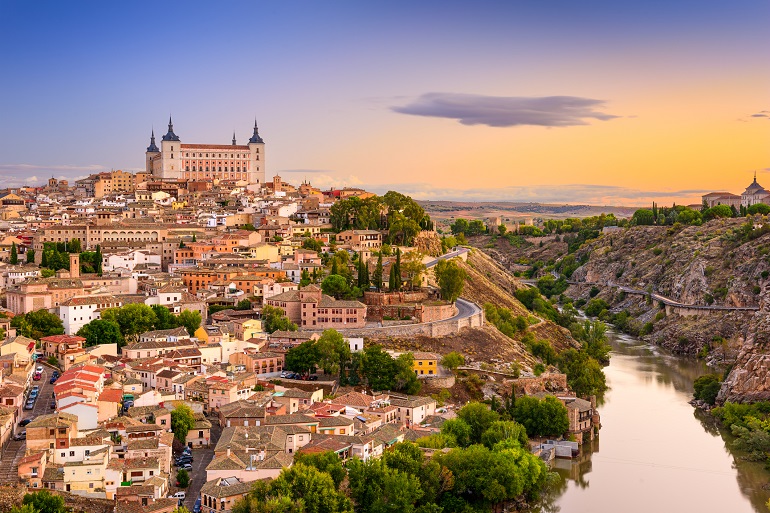
Toledo (pop. 86,000), situated just 70 km south of Madrid in Castilla-La Mancha, is one of Spain's most magnificent cities with over 2,000 years of rich history. Often referred to as the "city of three cultures," Toledo was once home to Christians, Muslims, and Jews who lived together in harmony for centuries, leaving behind a remarkable architectural legacy that earned the city UNESCO World Heritage status. The city is dramatically perched atop a gorge overlooking the Tagus River, offering visitors a captivating blend of Roman, Visigothic, Islamic, Jewish, and Christian influences visible throughout its winding cobbled streets, ancient city walls, and impressive monuments. Key attractions include the Gothic Toledo Cathedral built between 1226 and 1493, the Renaissance-style Alcázar fortress that now houses the Army Museum, the Monastery of San Juan de los Reyes, and numerous synagogues and mosques converted to churches that showcase the city's multicultural heritage.
Interesting Facts about Toledo
- Toledo, a UNESCO World Heritage Site, served as Spain's capital until 1561 and is renowned for its layered history spanning Roman, Visigothic, Islamic, and Christian civilisations.
- Known as the "City of Three Cultures", Toledo preserved synagogues, mosques, and churches side-by-side, reflecting centuries of Christian, Jewish, and Muslim coexistence.
- The Toledo Cathedral houses Spain's largest bell, weighing nearly 20 tonnes, though it remains cracked and un-rung since its 18th-century installation.
- Toledo's labyrinthine medieval streets are considered among Spain's most confusing, with steep gradients and irregular layouts designed for ancient defence.
- Famed for bladesmithing since Roman times, Toledo steel swords became Hollywood's go-to prop weapons for classic films due to their historic craftsmanship.
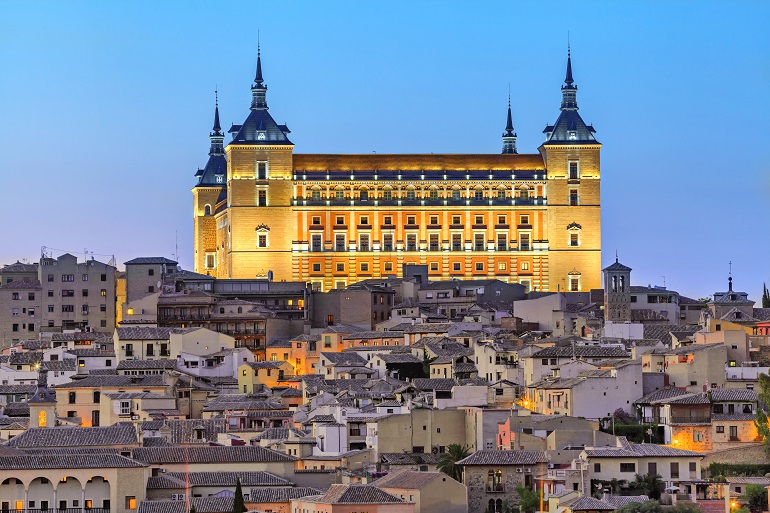
- The Alcázar of Toledo, a hilltop fortress, later housed Spain's Army Museum and endured multiple sieges, including a dramatic 1936 military standoff.
- El Greco's masterpiece The Burial of the Count of Orgaz resides in Santo Tomé Church, painted during his Toledo residency between 1577-1614.
- Toledo's School of Translators pioneered 12th-century knowledge exchange, translating Arabic and Hebrew texts into Latin for European scholars.
- The Puente de San Martín, a 14th-century Gothic bridge spanning the Tagus River, features defensive towers and five arches spanning 40 metres.
- Toledo's Mudejar architecture uniquely blends Islamic decorative motifs with Christian structural designs, seen in landmarks like Santiago del Arrabal church.
History
Toledo, situated on a hill above the Tagus River, boasts a rich history spanning over 2,500 years. Archaeological evidence suggests the area was first inhabited by prehistoric Iberians and later by Celtic tribes, before the Romans conquered it in 193 BCE, naming it Toletum. Following the fall of the Roman Empire, the Visigoths established their capital here in the 5th century CE, making it a crucial centre for Christianity after King Reccared convened the Council of Toledo in 589, rejecting Arianism in favour of Catholicism.
The city entered a golden age after the Moorish conquest in 711, when it became known as Ṭulayṭulah. This period ushered in remarkable cultural advancement and prosperity, with Jews, Christians and Muslims coexisting harmoniously—earning Toledo its nickname "La ciudad de las tres culturas" (the city of three cultures). When Alfonso VI of Castile recaptured the city in 1085, Toledo became the first major city in Al-Andalus to fall to Christian forces, marking a significant moment in the Reconquista. Despite the change in leadership, the peaceful coexistence continued, reaching its zenith under Alfonso X "The Wise", who placed special importance on Toledo's unique translation school that disseminated Greek classics and scientific texts throughout the Western world.
Toledo served intermittently as the capital of Castile and later of the united kingdom of Castilla y León, flourishing throughout the medieval period. The city was renowned for its steel sword production, which remains part of its appeal today. However, Toledo's prominence began to decline when Philip II moved the Spanish court to Madrid in 1561. This political relegation, while diminishing Toledo's economic importance, inadvertently helped preserve its cultural and architectural heritage. Today, Toledo's stunning medieval architecture and multicultural legacy have earned it UNESCO World Heritage status, making it one of Spain's most captivating destinations for travellers seeking to immerse themselves in the country's storied past.
Main Attractions
The Alcázar of Toledo
The imposing Alcázar dominates Toledo's skyline, standing proudly at the highest point of the city. This massive stone fortification has witnessed the ebb and flow of Toledo's complex history since Roman times. Originally built as a Roman palace in the 3rd century, it was later expanded by the Visigoths before being transformed into a fortress during the Moorish period under Abd ar-Rahman III.
After the Christian reconquest, the Alcázar underwent significant renovations, particularly during the reign of Emperor Charles V, who commissioned Alonso de Covarrubias to redesign it as a royal residence. The structure presents a fascinating architectural amalgamation, with each of its four façades displaying a different style: Renaissance, Plateresque, medieval and Churrigueresque. The eastern façade, designed by Juan de Herrera, exemplifies the austere Renaissance style that would later characterise the El Escorial monastery.
The Alcázar's history took a dramatic turn during the Spanish Civil War when it became the site of a significant siege. Colonel José Moscardó and his Nationalist forces held out against Republican troops for 70 days in 1936, an event that transformed the building into a powerful symbol of Spanish nationalism. Today, the restored fortress stands as a testament to Toledo's strategic importance throughout Spanish history.
The Cathedral of Toledo
The Cathedral of Toledo represents one of Spain's finest examples of Gothic architecture and stands as a monument to the city's historical significance. Construction began in 1226 under the reign of Ferdinand III of Castile and continued for over 250 years, resulting in a magnificent blend of architectural styles that reflect the changing tastes of successive generations.
The cathedral's exterior presents an imposing façade with intricate stone carvings and flying buttresses typical of High Gothic style. Its bell tower, rising to 90 metres, offers a commanding presence over the city. Inside, the cathedral unfolds into five naves supported by 88 columns, creating a forest of stone pillars that draws the eye upward to the vaulted ceiling.
What makes this cathedral particularly remarkable is its incorporation of Mudéjar elements—the artistic expression of Muslims living under Christian rule—alongside Gothic, Renaissance, and Baroque influences. This cultural fusion is emblematic of Toledo itself, a city where different traditions coexisted and cross-pollinated for centuries.
Plaza de Zocodover
The bustling Plaza de Zocodover forms the beating heart of Toledo's social life, as it has done for centuries. The name itself reveals its Moorish origins, derived from the Arabic "sūq ad-dawābb," meaning "market of beasts of burden." This etymology points to its historical function as the main marketplace where livestock was traded.
The square underwent significant redesign after a devastating fire in 1589, with part of it planned by Juan de Herrera, the renowned architect of El Escorial. The plaza's irregular shape, typical of medieval urban spaces, creates an intimate atmosphere despite its role as the city's main gathering place.
Surrounding the plaza are buildings with traditional wooden balconies and arcaded ground floors that house cafés and shops. The square has witnessed countless historical events, from medieval tournaments to public executions during the Spanish Inquisition. Today, it serves as the starting point for most explorations of Toledo, with narrow streets radiating outward into the labyrinthine old town.
The Jewish Quarter
Toledo's Jewish Quarter represents one of the best-preserved medieval Jewish neighbourhoods in Europe. Known locally as "La Judería," this district was home to a thriving Jewish community that contributed significantly to Toledo's cultural and intellectual life until their expulsion from Spain in 1492.
The quarter is characterised by narrow, winding streets that seem to fold in upon themselves, creating a maze-like environment that reflects medieval urban planning. These narrow passageways, often barely wide enough for two people to pass, were designed to provide shade during the scorching summer months and protection from cold winds in winter.
Walking through the Jewish Quarter today, visitors can still see the distinctive architecture of Jewish homes, with their small windows and interior courtyards. Many buildings feature decorative elements that blend Jewish symbolism with local architectural traditions, creating a unique aesthetic that speaks to the cultural synthesis that characterised medieval Toledo.
Synagogue of Santa María la Blanca
The Synagogue of Santa María la Blanca stands as one of the most remarkable examples of Mudéjar architecture in Toledo. Built in 1180, it is considered the oldest synagogue building still standing in Europe. What makes this structure particularly fascinating is that it was constructed under Christian rule by Islamic architects for Jewish use—a perfect embodiment of the cultural cooperation that once defined Toledo.
The synagogue's interior presents a breathtaking forest of white horseshoe arches supported by octagonal pillars, creating a sense of rhythmic harmony. The pillars are topped with intricately carved capitals featuring pine cone, plant and geometric motifs. The building's five naves are separated by four rows of columns, with the central nave standing taller than the others allowing natural light to filter in from above.
After the expulsion of the Jews in 1492, the building was converted into a church, hence its current name. Despite this conversion, the structure retains its essential Mudéjar character, with minimal Christian additions. The synagogue's pristine white interior creates a sense of luminous tranquillity that continues to move visitors today.
Synagogue of El Tránsito
The Synagogue of El Tránsito represents the pinnacle of Sephardic art in Spain. Built in 1356 by Samuel ha-Levi Abulafia, treasurer to King Pedro I of Castile, this synagogue stands as a testament to the influence and prosperity of Toledo's Jewish community in the 14th century.
Unlike the austere exterior typical of synagogues of the period (designed to avoid attracting unwanted attention), the interior of El Tránsito is lavishly decorated with intricate stucco work. The walls feature elaborate geometric patterns, floral designs, and Hebrew inscriptions from the Psalms. The eastern wall, where the Torah ark once stood, is particularly ornate, with multifoil arches and delicate filigree work that demonstrates the high level of craftsmanship achieved by Mudéjar artisans.
The women's gallery on the upper level is supported by a series of arches and columns, creating a harmonious spatial division. Large windows allow natural light to illuminate the interior, highlighting the rich textures of the decorative elements. After the expulsion of the Jews, the synagogue was converted into a church and later a military museum, but its essential character as a masterpiece of Sephardic architecture remains intact.
Mosque of Cristo de la Luz
The Mosque of Cristo de la Luz represents a rare surviving example of Islamic architecture from Toledo's Moorish period. Built in 999 CE, as indicated by an Arabic inscription on its façade, it is the only one of Toledo's ten mosques to remain largely intact. The mosque's original name was Mezquita Bab al-Mardum, referring to its location near one of the city gates.
The building's compact dimensions belie its architectural sophistication. Its square floor plan is divided into nine compartments, each covered by a different cupola with unique geometric designs. These vaults represent an early example of ribbed domes that would later influence Gothic architecture throughout Europe. The supporting structure consists of four columns recycled from earlier Visigothic or Roman buildings, demonstrating the common practice of architectural reuse in medieval times.
After the Christian reconquest of Toledo in 1085, the mosque was converted into a chapel with the addition of a Mudéjar-style apse. According to legend, when King Alfonso VI entered Toledo, his horse knelt at this spot where a light shone through the wall, revealing a hidden crucifix that had been walled up during the Islamic period—hence the current name "Christ of the Light."
Puente de San Martín
The Puente de San Martín spans the Tagus River on the western approach to Toledo, forming a magnificent medieval entrance to the city. Constructed in the late 14th century, this bridge replaced an earlier structure that had been destroyed by flooding. It features five arches of varying sizes, with the central arch spanning an impressive 40 metres—a remarkable engineering achievement for its time.
The bridge's design reflects both practical and defensive considerations. Its height above the river protected it from the Tagus's occasional violent floods, while its fortified towers at either end allowed for control of this crucial access point to the city. The larger tower on the city side contains a small chapel dedicated to the bridge's namesake, Saint Martin.
A charming legend surrounds the bridge's construction. It is said that the architect realised, as the scaffolding was about to be removed, that he had made a calculation error that would cause the central arch to collapse. He confided this to his wife, who secretly set fire to the scaffolding one night. The architect was thus able to correct his mistake during reconstruction without losing his reputation or possibly his life.
Puente de Alcántara
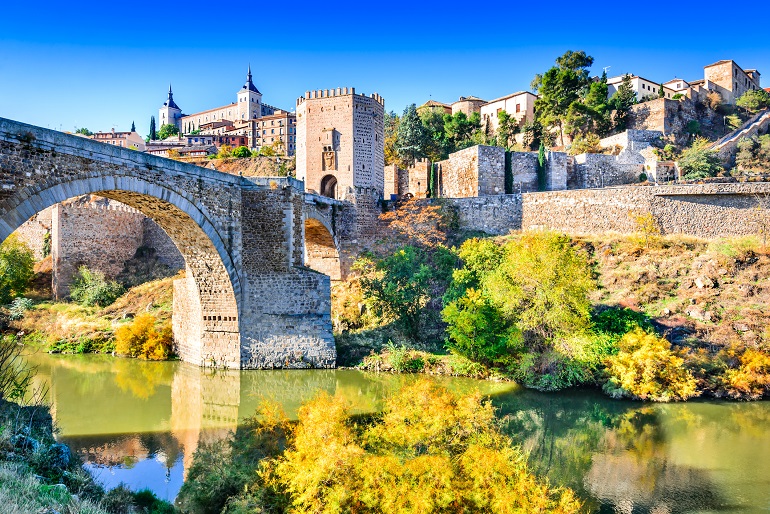
The Puente de Alcántara, whose name derives from the Arabic word for "bridge" (al-qantara), represents one of Toledo's oldest river crossings. Originally built by the Romans, the bridge has been destroyed and rebuilt numerous times throughout its long history. The current structure dates primarily from the Moorish period with significant reconstructions during the 13th and 14th centuries.
The bridge spans the Tagus River at its narrowest point, where the river cuts deeply through the rocky terrain. This strategic location made it a crucial entry point to the city from the east. The bridge features two main arches of unequal size, adapting to the irregular riverbed below. Its dramatic setting, with the Alcázar looming above on the city side and the Castle of San Servando on the opposite bank, creates one of Toledo's most picturesque views.
The bridge's defensive importance is evident in its fortified design. A large gate tower on the city side, rebuilt during the reign of Alfonso X and later embellished under the Catholic Monarchs, controlled access to Toledo. This tower bears inscriptions and heraldic emblems that chronicle the bridge's many reconstructions throughout its tumultuous history.
Mirador del Valle
The Mirador del Valle offers what is undoubtedly the most spectacular panoramic view of Toledo. Located on the opposite bank of the Tagus River, this viewpoint presents the classic postcard image of the city: a compact urban mass perched atop a rocky promontory, nearly encircled by the river's dramatic bend.
From this vantage point, Toledo's major monuments can be identified within the city's skyline: the Alcázar's square bulk, the cathedral's Gothic spire, and numerous church towers rising above the terracotta rooftops. The city walls can be traced along the perimeter, following the natural contours of the terrain. This perspective reveals how Toledo's urban development was shaped by its defensive position, with the river serving as a natural moat on three sides.
The view changes dramatically with the time of day and season. In the early morning, mist often clings to the river, partially obscuring the city's lower sections. As the sun rises, the golden limestone buildings seem to glow against the blue sky. At sunset, the entire city is bathed in warm light, creating a scene that has inspired countless artists throughout the centuries, most famously El Greco, whose "View of Toledo" captures the city's dramatic setting and almost mystical quality.
City Walls and Gates
Toledo's impressive city walls represent over two thousand years of defensive architecture. Originally established by the Romans, the walls were extensively rebuilt by the Visigoths and later strengthened during the Moorish period. After the Christian reconquest, they continued to be maintained and modified until the end of the medieval era.
Today, significant sections of these walls remain intact, particularly along the northern and eastern sides of the city. Walking alongside these ancient fortifications gives visitors a tangible connection to Toledo's strategic importance throughout history. The walls follow the natural topography of the hill upon which Toledo sits, incorporating rocky outcrops into the defensive system where possible.
The city's historic gates punctuate these walls, each telling its own story of Toledo's past. The Puerta de Bisagra Nueva, rebuilt in the 16th century during the reign of Charles V, presents an imposing imperial façade with the Habsburg double-headed eagle prominently displayed. The Puerta del Sol, constructed in the 14th century in Mudéjar style, features horseshoe arches and decorative brickwork that reflect Islamic architectural influences. The Puerta de Alarcones preserves elements from the original Moorish gate, while the Puerta del Cambrón, named after the brambles that once grew nearby, was rebuilt in Renaissance style in the 16th century.
Monastery of San Juan de los Reyes
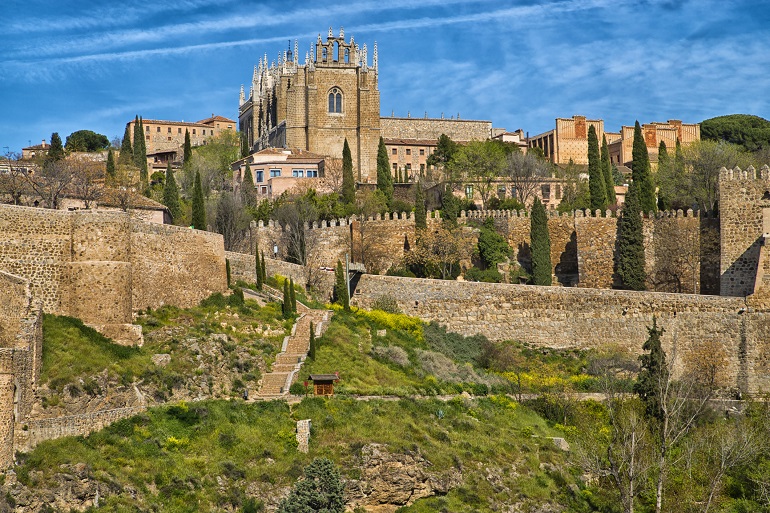
The Monastery of San Juan de los Reyes stands as one of Toledo's most impressive examples of Isabelline Gothic architecture. Commissioned by the Catholic Monarchs, Ferdinand and Isabella, to commemorate their victory at the Battle of Toro in 1476, the monastery was originally intended as their royal mausoleum before they later chose Granada instead.
The monastery's exterior is adorned with an unusual decorative element: chains hanging from the walls. These are said to be the actual chains of Christian prisoners liberated from Muslim territories during the Reconquista, displayed as symbols of the monarchs' triumph. This dramatic visual statement is complemented by heraldic symbols, including the royal coat of arms supported by eagles, which appear throughout the building.
The church interior features a single nave with a stellar vault and elaborate stone carvings. Particularly noteworthy are the royal emblems and the intertwined initials of Ferdinand and Isabella that appear repeatedly, emphasising the monastery's role as a monument to royal power. The two-storey cloister represents a masterpiece of late Gothic design, with delicate tracery, plant motifs, and statues of saints in niches along the walls. The upper level features a wooden ceiling in Mudéjar style, demonstrating once again Toledo's characteristic fusion of cultural influences.
Cigarrales Estates
The Cigarrales are historic country estates that dot the hills south of the Tagus River, offering spectacular views of Toledo. The name "cigarral" is thought to derive from the Spanish word "cigarra" (cicada), referring to the abundance of these insects in the area during summer months. These estates began as recreational properties for Toledo's nobility and wealthy clergy during the 16th century, providing an escape from the densely populated city.
Traditionally, a cigarral consisted of a main house surrounded by gardens and orchards, particularly olive and fruit trees. Many featured decorative elements such as fountains, pavilions, and terraced gardens that took advantage of the sloping terrain. The architecture typically followed the regional vernacular style, with thick walls to provide insulation against Toledo's extreme temperatures.
Today, some cigarrales have been converted into luxury hotels and restaurants, allowing visitors to experience these historic properties. Others remain private residences, their terracotta roofs and whitewashed walls visible among the olive groves. The roads winding through the cigarrales area offer alternative perspectives of Toledo, complementing the more famous view from the Mirador del Valle.
Plaza del Ayuntamiento
The Plaza del Ayuntamiento (Town Hall Square) represents Toledo's civic heart, as it has done since medieval times. This elegant square is framed by three significant buildings that reflect different aspects of power in historical Toledo: the Cathedral representing ecclesiastical authority, the Town Hall representing civic governance, and the Archbishop's Palace symbolising the church's temporal influence.
The Town Hall itself was designed in the Baroque style by the architect Juan Manuel Theotocopuli, son of the famous painter El Greco. Its façade features a rhythmic series of arches on the ground floor, creating a welcoming public space. The upper levels display balanced proportions with decorative elements that are restrained by Baroque standards, reflecting Toledo's dignified character.
The square's open space provides an excellent vantage point to appreciate the Cathedral's western façade and tower. The contrast between the Gothic cathedral and the Baroque town hall creates a visual dialogue between different historical periods that characterises much of Toledo's urban landscape. The square continues to serve as a gathering place for both locals and visitors, hosting various civic events throughout the year.
Paseo del Tránsito
The Paseo del Tránsito offers one of Toledo's most pleasant promenades, running along the southern edge of the Jewish Quarter. This elevated walkway provides spectacular views across the Tagus River to the rolling hills beyond, making it a favourite spot for evening strolls among locals.
The paseo takes its name from the nearby Synagogue of El Tránsito and follows part of the city's historic walls. From this vantage point, visitors can appreciate Toledo's dramatic setting on a rocky promontory nearly encircled by the river. The view encompasses the river valley with its historic bridges, the remains of water mills that once harnessed the Tagus's power, and the cigarrales estates dotting the opposite hillsides.
Along the promenade are several small gardens and sitting areas that invite contemplation of the landscape that has inspired artists for centuries. The walkway is particularly magical at sunset, when the declining light bathes the river valley in golden hues and the city's historic buildings are silhouetted against the changing sky.
The Swords of Toledo
While not a single monument but rather a cultural heritage, Toledo's sword-making tradition deserves special mention. The city has been renowned for its exceptional bladed weapons since Roman times, with "Toledano steel" becoming synonymous with quality throughout the medieval world. The particular combination of local iron ores, the waters of the Tagus River used in the tempering process, and the accumulated expertise of generations of craftsmen created weapons of legendary quality.
Today, visitors can observe traditional sword-making techniques at several workshops in the city. These artisans continue to use methods that have changed little since medieval times, including the complex process of folding and tempering the steel to achieve the perfect balance of hardness and flexibility. Many workshops produce both functional weapons for historical martial arts practitioners and decorative pieces that replicate famous historical designs.
The most famous Toledo blades are the distinctive "espada ropera" (rapier) that became the gentleman's weapon of choice throughout Renaissance Europe, and reproductions of medieval swords like those depicted in El Greco's paintings. These swords represent not just weapons but cultural artefacts that embody Toledo's historical position at the crossroads of different civilisations.
Top Museums
Art and History Museums
Santa Cruz Museum
The Santa Cruz Museum is housed in a stunning 16th-century building that was originally a hospital. This Renaissance masterpiece features an impressive façade and cloister staircase designed by architect Alonso de Covarrubias. The museum's collection is divided into three main sections:
- Archaeology: Featuring artefacts from Roman, Visigoth, Arab, and Mudejar cultures.
- Fine Arts: Showcasing an important display of Toledo painting from the 16th and 17th centuries, including works by El Greco.
- Industrial Arts: Exhibiting examples of popular culture and local artisan traditions, such as ceramics, glass, textiles, forging, and goldsmithing.
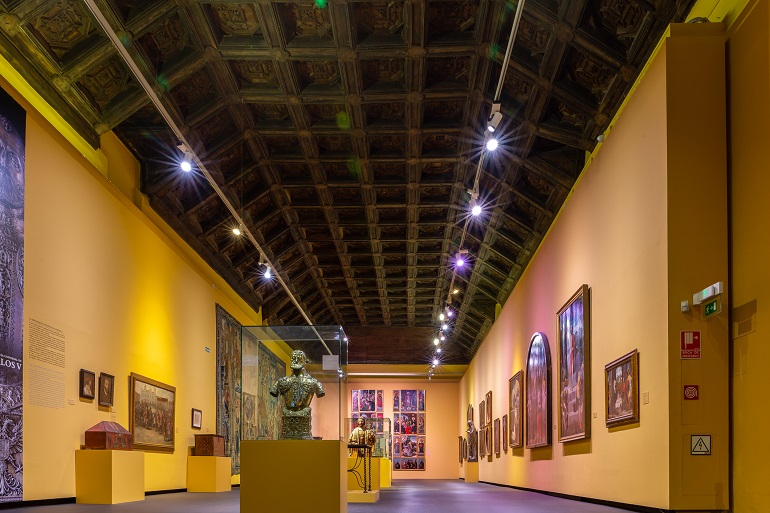
El Greco Museum
Located in Toledo's Jewish Quarter, the El Greco Museum is dedicated to the life and work of the renowned painter Domenikos Theotokopoulos, better known as El Greco. The museum complex consists of two buildings:
- A 16th-century house with a courtyard
- An early 20th-century extension
The museum houses an extensive collection of El Greco's paintings, particularly from his later period, as well as works by other 16th and 17th-century Spanish painters. Visitors can also explore period furniture and pottery from Talavera de la Reina.
Cultural Museums
Sephardic Museum
Situated in the Samuel ha-Leví Synagogue, also known as the El Tránsito Synagogue, the Sephardic Museum is dedicated to preserving and showcasing Hispano-Jewish and Sephardic culture. The museum's collection includes:
- Archaeological pieces from the 6th to 8th centuries
- Paintings and documents
- Precious metalwork
- Funeral offerings from the Carpio de Tajo necropolis
- Replicas of crowns from the Guarrazar treasure
The synagogue itself, built in the 14th century, is considered the most important Hispano-Jewish building in Spain.
Military History Museum
Museum of the Army
Housed in the historic Alcázar of Toledo and a modern extension, the Museum of the Army offers a comprehensive look at the history of the Spanish military. The museum features:
- Chronological displays mirroring the history of Spain and its Army
- Thematic rooms exploring different aspects of military history
- A collection of miniature battle replicas
Archaeological Museums
Museum of Visigothic Councils and Culture
Located in the 13th-century Mudéjar church of San Román, this museum is dedicated to preserving and displaying the historic and artistic remains of the Visigoths. The collection includes:
- Archaeological pieces from the 6th to 8th centuries
- Paintings and documents
- Precious metalwork
- Funeral offerings from the Carpio de Tajo necropolis
The church walls are adorned with 13th-century Romanesque frescoes.
Artist's Museum
Victorio Macho Museum
Situated on a promontory called "Roca Tarpeya" overlooking the Tagus River, the Victorio Macho Museum showcases the life and works of the artist Victorio Macho. The museum, which was originally the artist's home and workshop, houses:
- 91 sculptures
- 48 drawings
- Works spanning the artist's career from 1903 to 1965
Local Cuisine
Toledo's cuisine is a delightful reflection of its rich cultural heritage, offering a tantalising array of traditional dishes that showcase the flavours of Castilian food. The city is renowned for its hearty stews, particularly carcamusas, a tender pork stew with tomato sauce and peas that warms the soul. Game meats feature prominently on local menus, with perdiz en escabeche (partridge in vinegar sauce) being a regional speciality. Vegetable lovers will appreciate pisto manchego, a Spanish ratatouille often served with a fried egg on top. No visit would be complete without sampling migas, fried breadcrumbs typically prepared with garlic, olive oil and meats – a peasant dish that has become a celebrated part of Toledo's gastronomic heritage. The city is also famous for its mazapán (marzipan), said to have been invented by nuns at the Convent of San Clemente. Cheese enthusiasts must try the local Manchego cheese, produced in the region for centuries and perfect paired with regional wines. For a truly authentic experience, venture to a "cigarral" restaurant outside the city, where you can enjoy these delicacies whilst taking in spectacular views of Toledo's skyline.
Shopping
Toledo offers a diverse shopping experience, with its main commercial street hosting familiar brands like Zara, Pull and Bear, and Punto Roma, while Bershka can be found in Zocodover Square. The city is renowned for three traditional crafts: damascene (interlaced gold on steel jewellery), Toledo steel swords, and marzipan, which was invented in Toledo and is still made by local nuns. Visitors can explore the narrow winding streets filled with boutique shops selling traditional Spanish crafts, handmade ceramics, and exquisite jewellery. For food enthusiasts, shops like Santo Tomé offer the famous Toledo marzipan, while others specialise in local wines, olive oil, and Manchego cheese. Beyond the old town, shoppers can take the number 6 bus from Plaza de Zocodover to the "Luz Del Tajo" mall, or visit the Zoco Europa shopping centre in the new part of town. Most shops open Monday to Saturday from 10:00-14:00 and 16:30-20:00, with summer hours slightly adjusted to 17:30-20:30.
Nature in and around Toledo
Toledo and its surrounding areas offer a diverse range of natural attractions for visitors to explore. The city itself features the Ecological Path, a 5-kilometre route along the Tagus River that provides stunning views of Toledo's iconic monuments. Just outside the city, the Cabañeros National Park showcases the best of Mediterranean forests, with oak and cork trees dominating the landscape. The park is home to various wildlife, including deer and golden eagles. Another notable natural site is Las Barrancas de Burujón, a striking sedimentary formation along the Tagus River. For those interested in hiking, the Montes de Toledo region offers numerous trails of varying difficulty levels. The Hoz de los Carboneros route is particularly picturesque, featuring streams and waterfalls. Birdwatchers may enjoy visiting the nature reserves in the province, which provide opportunities to observe various avian species in their natural habitats.
Getting There & Around
Getting to Toledo from Madrid is straightforward with several convenient options. The high-speed AVE train is the fastest method, departing hourly from Madrid's Atocha station with a journey time of approximately 35 minutes and costing around €7-14 per person. Buses offer a more economical alternative at about €6 per ticket, departing every 30 minutes from Madrid's Plaza Elíptica and taking roughly 50-90 minutes to reach Toledo. For those seeking flexibility, driving takes about 50 minutes along the A-42 highway, covering a distance of 73 km. Whilst this isn't practical if you're returning to Madrid, it's ideal if Toledo is a stop on a longer journey. If you're staying overnight, which is recommended to experience the tranquil medieval atmosphere after day-trippers depart, you'll find the historic centre easily navigable on foot.
Best Time to Visit
The best time to visit Toledo, Spain, is during the spring (March to May) or autumn (September to November) when the weather is mild and pleasant, making it ideal for exploring the city's historic streets and attractions. During these seasons, temperatures are comfortable, ranging from 15°C to 25°C, with fewer crowds compared to the peak summer months. Spring offers the added charm of blooming flowers and lush landscapes, whilst autumn boasts beautiful foliage and harvest-time festivities. It's worth noting that summers in Toledo can be scorching, with temperatures often soaring above 35°C, which can make sightseeing quite uncomfortable. Winters, although mild, can be chilly and occasionally wet, but they offer a cosier atmosphere and the chance to experience Toledo's enchanting Christmas markets. Ultimately, spring and autumn provide the perfect balance of agreeable weather and cultural experiences for an unforgettable visit to this captivating Spanish city.


