


| Contents |
|---|

Introduction
Pontevedra (pop. 83,000) is a picturesque Galician city situated on the Lérez River where it meets the Atlantic Ocean. The city boasts the second most important historic centre in Galicia, featuring a well-preserved old town with numerous historic buildings including the Plateresque Church of Santa María la Mayor, Gothic convents and the Rococo La Peregrina Sanctuary. Originally developed around an ancient Roman bridge, Pontevedra has evolved from a significant medieval port town into a modern city internationally recognised for its innovative urban planning and pedestrianisation initiatives, having received multiple European awards for sustainability and urban mobility. The city has a mild, rainy climate year-round and serves as the capital of the tourist region of Rías Baixas, offering visitors a blend of rich historical heritage, cultural attractions and natural beauty with its coastal location providing access to mountains, green hills, rivers and shorelines.
Interesting Facts about Pontevedra
- Pontevedra has the second most important historic centre in Galicia, after Santiago de Compostela.
- The city's name means "old bridge" in Galician, referring to the many historic bridges spanning its rivers.
- Pontevedra was awarded European City of the Year by the Urbanism Institute in 2019 for its sustainable urban development.
- The Baroque church of the Pilgrim Virgin is the city's most emblematic building and the only rounded scallop-shaped church in Spain.
- Pontevedra's old town is mainly car-free and open to pedestrians only, making it easy to explore its granite streets.
- It is believed that Christopher Columbus's ship, the Santa Maria, was built in Pontevedra's shipyards.
- Many of the lively squares and streets in Pontevedra's Old Town take their names after medieval guilds or trades.
- The city lies along the Camino Portugués, one of the most popular pilgrimage routes to Santiago de Compostela.
- Pontevedra celebrates its main festivities, called Peregrina, every August in honour of the Pilgrim Virgin, the patron saint of the city.
- The city is renowned for its delicious seafood cuisine, including fresh octopus, mussels, and clams.
- Pontevedra is home to an abundance of camellias, with the city's Camellia Route offering stunning displays of these colourful flowers.
- The 11-arch Roman bridge that gave the city its name still spans the Lérez River, though with modifications over the centuries.

History
Pontevedra’s origins are shrouded in both myth and Roman practicality. Legend attributes its founding to Teukro, a hero of the Trojan War, though historians favour its Roman roots, evidenced by the name Pons Vetus (“Old Bridge”) and the remnants of a 1st-century bridge over the Lérez River. By the 9th century, settlers clustered around this vital crossing, laying the groundwork for a medieval powerhouse. The city’s fortunes surged in 1169 when King Ferdinand II granted it a charter, cementing its status as Galicia’s premier port and granting exclusive rights to fish-related trade. This privilege fuelled a golden age, with Pontevedra eclipsing rivals like Santiago de Compostela in wealth and influence, its shipyards reportedly crafting Christopher Columbus’s Santa Maria. Yet, its strategic position also invited conflict: in 1719, during the War of the Quadruple Alliance, British forces under Lord Cobham captured Pontevedra, destroying military stores and occupying the city for ten days—a stark reminder of its maritime significance.
The 16th century heralded decline as silt choked the estuary, wars drained resources, and political shifts favoured rivals like Vigo. Despite losing provincial capital status briefly in 1822, Pontevedra rebounded, its medieval core enduring as one of Galicia’s best-preserved historic districts. Wandering its labyrinthine streets, visitors encounter architectural gems like the Gothic Basilica of Santa María la Mayor, adorned with intricate Manueline carvings, and the Convent of San Francisco, where Gothic arches shelter medieval tombs. The 18th-century Capela da Peregrina, with its scallop-shell floor plan, symbolises the city’s Camino de Santiago legacy, while Praza da Ferraría’s lively arcades echo centuries of mercantile hustle. Declared a Historic-Artistic Site in 1951, this open-air museum blends Roman foundations, Baroque grandeur, and pilgrim lore.
Modern Pontevedra has reinvented itself as a beacon of sustainability, its pedestrianised centre a model for urban renewal. Yet its soul remains anchored in history: the Museo de Pontevedra showcases Roman artefacts and Galician traditions, while the Burgo Bridge—rebuilt in medieval times—still spans the Lérez as a testament to enduring ingenuity. From Teukro’s myths to British cannons, each cobblestone whispers tales of resilience, making Pontevedra not just a stop on the Camino, but a destination where past and present converge.
Main Attractions
Praza de Orense
The Praza de Orense, situated between the Plaza de la Peregrina, Casto San Pedro gardens, Plaza de la Herrería, and the Puerta del Camino, serves as the city's social, cultural, and commercial hub. Considered the heart of Pontevedra by locals, it is a lively area with numerous Galician taverns.

Sanctuary of A Peregrina
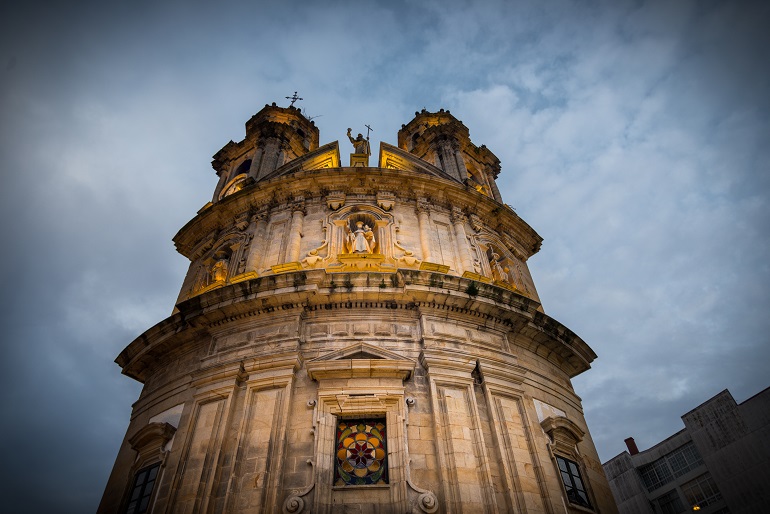
The Sanctuary of A Peregrina is a small but unique church dedicated to Our Lady of the Pilgrim, the patron saint of Pontevedra province. Its most distinctive feature is its floor plan, which is shaped like a scallop shell—a symbol associated with pilgrims on the Camino de Santiago. Built in the 18th century, the sanctuary combines Baroque and Neoclassical elements. Its location along the Portuguese route to Santiago de Compostela makes it a popular stop for pilgrims and tourists alike.
Praza Alonso de Fonseca
The Praza Alonso de Fonseca, formerly known as Plaza de Santa María, is an irregularly shaped triangular square atop a hill in the old town. It is dominated by the southern façade of the Basilica of Saint Mary Major and features a 16th-century calvary in its centre. The square is paved and retains a medieval atmosphere, with the Casa Rectoral de Santa María on its eastern side.
Basilica of Santa María la Mayor
The Basilica of Santa María la Mayor is a prime example of late Gothic architecture with Renaissance influences. Built in the 15th and 16th centuries by the local seafarers’ guild, it is one of Pontevedra’s most iconic landmarks. The basilica’s façade is particularly striking, resembling a large stone altarpiece adorned with intricate carvings, including religious figures and maritime motifs. Inside, visitors can admire ribbed vaulted ceilings and a collection of sculptures that reflect the Portuguese-Manueline style. The basilica is located in the heart of the historic centre, making it a key stop for anyone exploring Pontevedra.

Praza da Leña
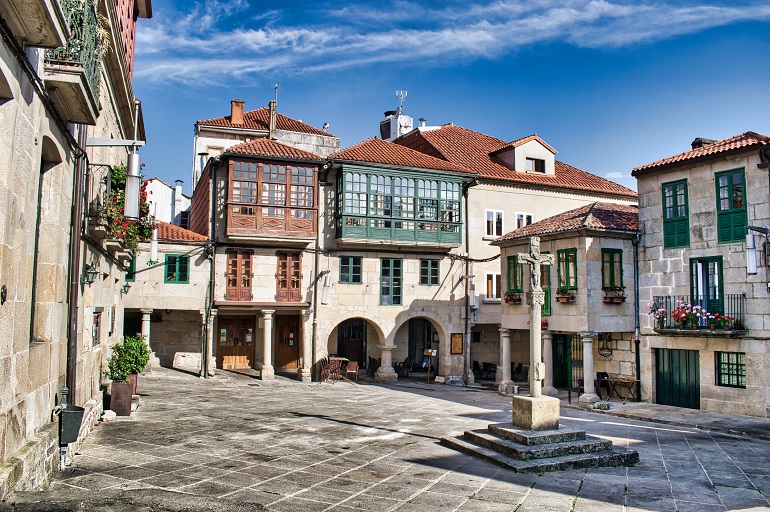
Praza da Leña is one of Pontevedra’s most picturesque squares, located in the heart of the old town. Surrounded by traditional Galician stone houses with wooden balconies, this square exudes charm and history. At its centre stands a stone cross (cruceiro), a common feature in Galician public spaces. The square was historically used for firewood trading, hence its name ("leña" means firewood). Today, it is a peaceful spot where visitors can enjoy the historic atmosphere while sitting at one of its nearby cafes or restaurants.
Praza da Ferrería
Praza da Ferrería (or Plaza de la Herrería in Castillan Spanish) serves as Pontevedra’s main public square and social hub. It is surrounded by arcaded buildings, cafes, and shops that give it a lively yet relaxed atmosphere. The square connects to other important landmarks such as the Church of San Francisco and the Gardens of Casto Sampedro. Historically, this area was used for blacksmithing activities ("ferrería" means blacksmithing), but today it is a popular meeting place for locals and tourists alike.
Church of San Francisco
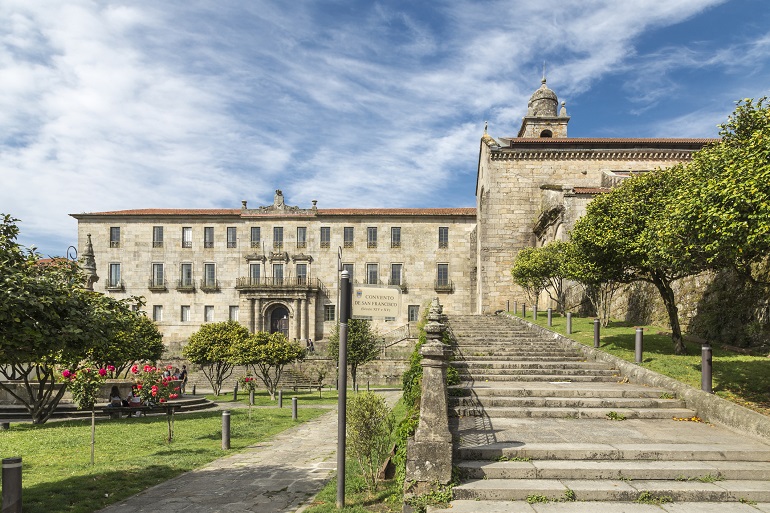
The Church of San Francisco is a 14th-century Gothic structure situated in Praza da Ferrería, one of Pontevedra’s most vibrant squares. It was originally part of a Franciscan convent and retains its austere yet elegant design. Notable features include its chancel from the 15th century and the tomb of Paio Gómez Chariño, a medieval poet and admiral. The church also houses a late 18th-century Nazarene image and colourful murals on the altar of the souls, dating back to the 16th and 17th centuries. Its historical significance and serene atmosphere make it a must-visit site.
Praza da Pedreira
Praza da Pedreira takes its name from its historical use as a stone market ("pedreira" means quarry). Located near several historic mansions, including Pazo de Mugartegui, this square has a quieter atmosphere compared to others in Pontevedra’s old town. Its central location makes it an excellent place to pause while exploring nearby attractions.
Pazo de Mugartegui
Pazo de Mugartegui is an elegant Baroque mansion located near Praza da Pedreira. Built in the 18th century, it features a symmetrical façade with decorative stonework and an impressive coat of arms above its entrance. While it currently serves as administrative offices for local organisations, its architectural beauty makes it worth visiting during a stroll through Pontevedra’s old town.

Church of San Bartolomé
The Church of San Bartolomé stands out as one of Galicia’s few examples of Italian Baroque architecture. Built in the 17th century by Jesuits, it features an imposing façade crowned with Spain’s royal coat of arms. Inside, visitors will find richly decorated altarpieces and sculptures from the Baroque period, including an evocative Penitent Magdalene and a sorrowful Christ figure. The church is located near other historic landmarks, making it an easy addition to any walking tour of Pontevedra.
Praza da Verdura
This charming square was once Pontevedra’s vegetable market ("verdura" means vegetables) and retains much of its traditional character. It is surrounded by historic buildings with arcades that now house cafes and bars, making it an ideal spot for enjoying tapas or drinks outdoors. The square often hosts cultural events and markets, adding to its lively atmosphere.
Monumento a Valle-Inclán
This life-size bronze statue pays tribute to Ramón María del Valle-Inclán, one of Spain’s most renowned writers who spent part of his life in Pontevedra. Located in Alameda Park, near Praza de España, the statue captures Valle-Inclán’s eccentric personality with exaggerated features such as his long beard and walking cane. It is an interesting stop for literature enthusiasts or anyone interested in local cultural figures.
Alameda de Pontevedra
Alameda de Pontevedra is a large park located at the edge of the historic centre near Praza de España. It features tree-lined paths, manicured gardens, fountains, and several monuments dedicated to notable figures from Galicia’s history. The park provides a peaceful retreat from the bustling streets while still being close to major attractions.
Ruins of San Domingos
The Ruins of San Domingos are all that remain of a 14th-century Dominican convent that was once one of Pontevedra’s most important religious institutions. The site includes parts of the church’s apse and cloister as well as several Gothic arches adorned with heraldic shields. Visitors can also see medieval carvings and sepulchres displayed within the ruins. This open-air site offers a fascinating glimpse into Pontevedra’s medieval past.
Top Museums
Provincial Museum of Pontevedra
Considered one of the best provincial museums in Spain, the Museum of Pontevedra boasts an impressive collection spanning from prehistoric times to the 20th century. Founded in 1927 by the Provincial Government of Pontevedra, it continues the work of the Archaeological Society of Pontevedra.
The museum complex comprises six buildings in Pontevedra town:
- Castelao Building (Sexto Edificio): This modern glass and steel structure houses collections of Spanish painting from the 19th-20th centuries and Galician art from the 14th century onwards. It showcases the evolution of Galician art from Gothic to modern styles, as well as Spanish art from the times of Goya to the present day.
- Sarmiento Building: Housed in a former 18th-century college, this building preserves archaeological collections from Prehistory and Antiquity, Galician medieval art up to the 13th century, and the Sargadelos earthenware and Celtic pottery collections.
- Ruins of San Domingos: The remnants of a 14th-century church and Dominican convent, featuring medieval carvings, heraldic shields and sepulchres. The convent has an enchanting atmosphere as nature gradually reclaims the space.
- Castro Monteagudo Building: A large urban manor house from the late 18th century.
- García Flórez Building: Primarily displays paintings from the 19th and 20th centuries.
- Fernández López Building: Opened in 2013, featuring rooms for exhibitions, conferences and workshops.
The museum houses over 16,000 pieces including paintings, sculptures, drawings, engravings, archaeological artefacts, coins, musical instruments, furniture, and jewellery. Notable collections include prehistoric goldsmith works (the largest collection of prehistoric gold in Europe), Celtic pottery, medieval art pieces, and Spanish art by renowned painters such as Sorolla, Dalí, Picasso, and Miró.
Island of Sculptures
This open-air museum is the most important and most visited contemporary art museum in Galicia. Situated on the banks of the river Lérez, it displays 12 large outdoor granite sculptures by different artists, integrated into the natural environment. The area is part of the Natura 2000 Network and has been designated as a Site of Community Importance (SCI).
Archbishop's Towers Interpretation Center (CITA)
This museum showcases the remains of the Archbishop's Towers and their significance in key episodes of Spanish history, such as the 15th-century civil war between supporters of Isabel la Católica and those of her niece Juana la Beltraneja. Visitors can see preserved artefacts like catapult balls.
Massó Museum
Located in Bueu in the Rías Baixas, 21 km from Pontevedra city, this museum occupies the former industrial warehouses of the Massó Hermanos cannery. Dedicated to maritime and industrial heritage, it houses navigational instruments, models of historic ships, old documents, and exhibits on the region's canning and whaling activities.
MASAT Museum (Archaeological Museum of Monte Santa Tegra)
Situated in A Garda, this museum displays artefacts and findings from archaeological work conducted at a pre-Roman settlement, spanning from prehistoric to Roman times.
Pontevedra's museums offer a fascinating glimpse into the region's rich cultural heritage, making them essential destinations for any visitor to this beautiful part of Galicia.
Local Cuisine
Pontevedra's cuisine is a delightful showcase of Galician flavours, with a strong emphasis on fresh seafood from the Rías Baixas. Visitors can savour Arcade oysters, renowned for their exquisite taste, and O Carril's clams, prized for their intense flavour. The Lérez oyster soup is a comforting dish, especially popular in winter. For a unique culinary experience, try the lobster with chocolate picadillo, an unexpected but delicious combination. Fish lovers will enjoy the variety of catches, from sea bass to grouper, whilst meat enthusiasts can indulge in Galician veal. No meal is complete without sampling the local Albariño wine, perfectly complemented by Porriño bread and tetilla cheese. For dessert, the Llanderos cake offers a sweet finale with its crunchy base and almond-chocolate topping. Don't miss the opportunity to try the ubiquitous empanada, a savoury pastry with various fillings, epitomising the region's culinary tradition.
Getting There & Around
The closest airport is Vigo (30 minutes by car), with Santiago de Compostela (55 minutes) and Porto in Portugal (2 hours) offering additional flight connections. From these airports, visitors can take buses or trains to reach Pontevedra, with tickets typically costing €1-3. The city's train and bus stations are conveniently located together about 10-12 minutes from the city centre, with connections to major Spanish cities including Madrid and Barcelona. For getting around, Pontevedra is impressively pedestrian-friendly, making walking the preferred option for exploring the historic centre. The city also boasts excellent cycling infrastructure with bike lanes and a bicycle loan service. Urban buses connect the main areas, whilst taxis are readily available for those preferring door-to-door service. Car hire is not recommended for city centre stays as Pontevedra prioritises pedestrians and parking can be challenging, though the city is well-connected to major motorways if travelling further afield.