


| Contents |
|---|

Introduction
El Escorial, officially known as the Royal Site of San Lorenzo de El Escorial, is a magnificent historical complex located about 45 kilometres northwest of Madrid in central Spain. Built between 1563 and 1584 under the orders of King Philip II to commemorate Spain's victory at the Battle of St Quentin against France, it stands as the largest Renaissance building in the world. This imposing granite structure serves multiple functions as a monastery, basilica, royal palace, pantheon, library, museum, university, school, and hospital. Designed by architects Juan Bautista de Toledo and later Juan de Herrera, who developed the distinctive Herrerian architectural style, El Escorial houses approximately 1,600 paintings and a rare collection of over 4,700 manuscripts and 40,000 printed books in its library. The complex is a UNESCO World Heritage site where visitors can explore its various buildings, courtyards, towers and halls, as well as the royal necropolis containing the remains of many Spanish monarchs from the Habsburg and Bourbon dynasties.
Interesting Facts about El Escorial
- El Escorial was commissioned by King Philip II of Spain in 1563 to commemorate the Spanish victory at the Battle of St. Quentin.
- The complex was designed to serve multiple purposes, including a royal palace, monastery, basilica, library, school, and mausoleum.
- El Escorial's ground plan is said to resemble a grid iron, symbolising the martyrdom of St Lawrence who was burnt to death on a grill.
- The complex contains approximately 4,000 rooms, more than 1,200 doors, and a total of 2,675 windows.
- El Escorial houses one of the world's most important reliquaries, containing thousands of bones and relics.
- The library of El Escorial contains over 40,000 printed books and 4,700 manuscripts, including rare works on dark science and esotericism.
- Before the bodies of monarchs can be interred in the Royal Pantheon, they must spend about 30 years in a special chamber called the 'Pudridero' for decomposition.
- El Escorial was declared a UNESCO World Heritage Site in 1984, coinciding with its 400th anniversary.
- The complex was known as the '8th Wonder of the World' during the late 16th century due to its impressive dimensions and symbolic value.
- Legend has it that Philip II chose the location of El Escorial to seal off a supposed door to Hell beneath the basilica.
History
Commissioned by King Philip II in 1563, the complex was built to commemorate Spain's victory over the French in the Battle of St Quentin, which occurred on the feast day of St Lawrence in 1557. The monastery also fulfilled the wishes of Philip's father, Emperor Charles V, for a grand royal mausoleum.
Construction of El Escorial began in 1563 under the direction of Juan Bautista de Toledo, a Spanish architect who had previously worked in Italy. Following Toledo's death in 1567, his apprentice Juan de Herrera took over the project, bringing it to completion in 1584. The complex is considered one of the largest religious establishments in the world, measuring approximately 206 by 161 metres. It showcases the Herrerian style of architecture, characterised by its austere and imposing granite walls, which became influential in Spanish Renaissance architecture.
El Escorial serves multiple purposes, functioning as a monastery, royal palace, museum, and school. It houses the remains of many Spanish monarchs, including those from the Habsburg and Bourbon dynasties, with the notable exceptions of Philip V, Ferdinand VI, and Alfonso XIII. The complex also boasts a remarkable library founded by Philip II, containing over 4,700 rare manuscripts and 40,000 printed books. Throughout its history, El Escorial has faced several challenges, including fires in 1671, 1731, and 1872. In 1885, the Hieronymite monks who originally occupied the monastery were replaced by Augustinians, who continue to reside there today.
Description
The Magnificent Exterior
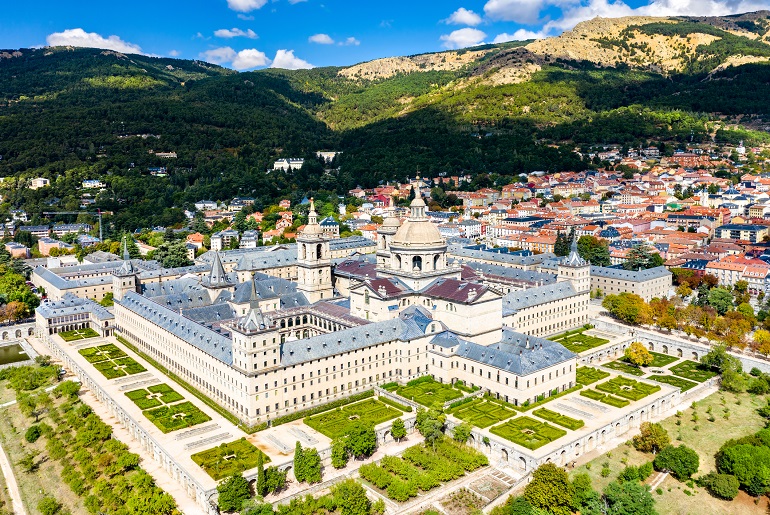
As you approach the Royal Monastery of San Lorenzo de El Escorial, you'll be immediately struck by its imposing presence against the backdrop of the Guadarrama mountains. This colossal granite structure, with its distinctive blue-grey hue, extends over 33,000 square metres. The austere yet harmonious façade exemplifies the Herreriano architectural style, named after its principal architect Juan de Herrera.
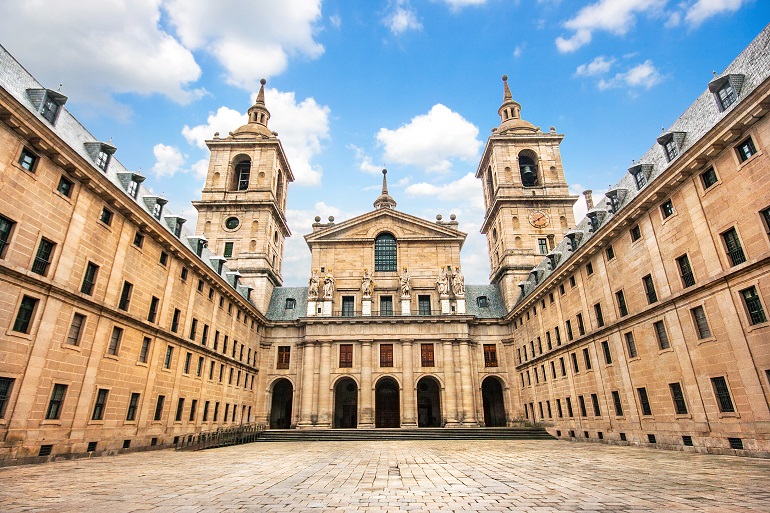
The west-facing main entrance is truly spectacular, flanked by two large side doors leading to the Alfonso XII school and the Augustine friary. The central façade boasts eight massive Doric columns, crowned by a body of Ionic columns that create a sense of classical proportion. Above, you'll spot the family coat of arms of Felipe II and a colossal granite statue of St. Lawrence, the monastery's namesake, holding his emblematic gridiron.
The four corner towers, topped with distinctive slate spires, rise majestically above the complex, giving El Escorial its distinctive silhouette visible from miles around. These towers, along with the central dome of the basilica, create a perfectly balanced skyline that has become iconic in Spanish architecture.
The Breathtaking Interior
The Basilica and Courtyard of the Kings
Upon entering, you'll find yourself in the Courtyard of the Kings (Patio de los Reyes), an impressive rectangular space that serves as the formal entrance to the basilica. The courtyard takes its name from the six massive statues of kings of Judah that adorn the basilica's façade: David, Solomon, Jehoshaphat, Hezekiah, Josiah, and Manasseh, each standing over 5 metres tall.
The basilica itself is a masterpiece of Renaissance design, with a Greek cross floor plan topped by an enormous dome inspired by St. Peter's in Rome. The interior is remarkably luminous despite its solemn character, with light filtering through numerous windows. The main altarpiece, designed by Juan de Herrera and executed by various artists, rises 30 metres high and is divided into several tiers featuring paintings and sculptures depicting scenes from the Bible and the life of St. Lawrence.
The Chapter Houses
Adjacent to the basilica are the Chapter Houses, comprising several rooms adorned with exceptional artworks. The walls display an impressive collection of paintings by Italian and Spanish masters including Titian, El Greco, Velázquez, and Ribera. The vaulted ceilings feature intricate frescoes depicting allegorical and biblical themes, creating a veritable museum of 16th and 17th-century art.
Royal Apartments and Staterooms
The complex houses royal apartments that offer a glimpse into the private lives of Spanish monarchs. Philip II's austere personal quarters contrast sharply with the more opulent chambers of later kings. His bedroom, positioned to allow him to view the high altar of the basilica from his bed when ill, reveals the deeply religious character of the king who commissioned this monumental complex.
The Hall of Battles (Sala de Batallas) is particularly impressive, featuring a 55-metre-long gallery adorned with frescoes depicting Spanish military victories, including the Battle of Higueruela against the Moors and the Battle of San Quintín against the French.
The Magnificent Library
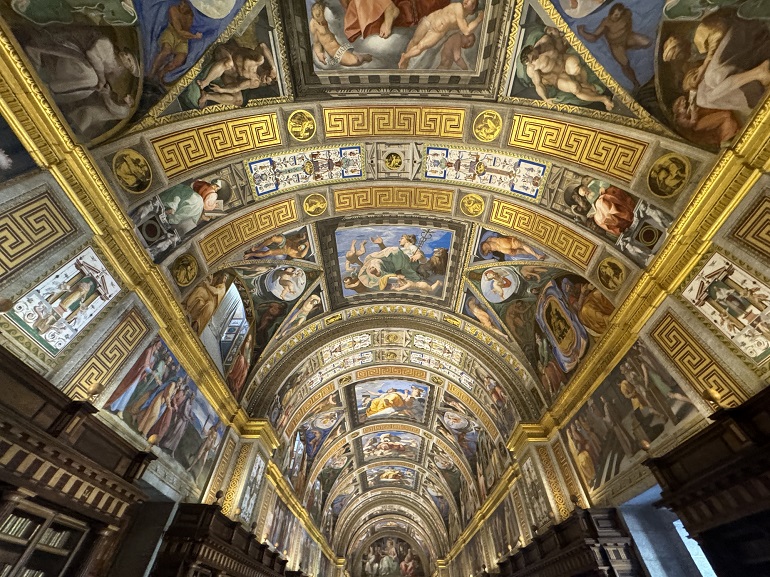
The Royal Library of El Escorial is one of the most remarkable rooms in the entire complex. The vaulted ceiling, painted by Pellegrino Tibaldi, depicts the seven liberal arts in a series of stunning frescoes. The library houses over 40,000 printed works and 4,700 manuscripts, including rare Arabic, Greek, and Latin texts.
The bookshelves, crafted from exotic woods including cedar, ebony, and mahogany, are works of art in themselves. The central corridor features marble flooring and ornate wooden tables displaying ancient manuscripts and scientific instruments that belonged to Philip II, reflecting his interest in astronomy and mathematics.
The Royal Pantheon
Descend into the Royal Pantheon, an octagonal chamber lined with polished marble that serves as the final resting place for most Spanish kings and queens since Charles V. The chamber's walls are lined with 26 black marble sepulchres, each bearing the name of its royal occupant in gold lettering. The sombre grandeur of this space, with its bronze and marble decorations, creates an atmosphere of solemn majesty befitting the final resting place of royalty.
The Pantheon of the Infantes
Adjacent to the Royal Pantheon lies the Pantheon of the Infantes, where princes, princesses, and non-regnant queens are interred. This series of rooms contains elaborately decorated marble tombs, including the striking "Pudridero" where royal bodies were temporarily placed before their final entombment.
The Enchanting Gardens
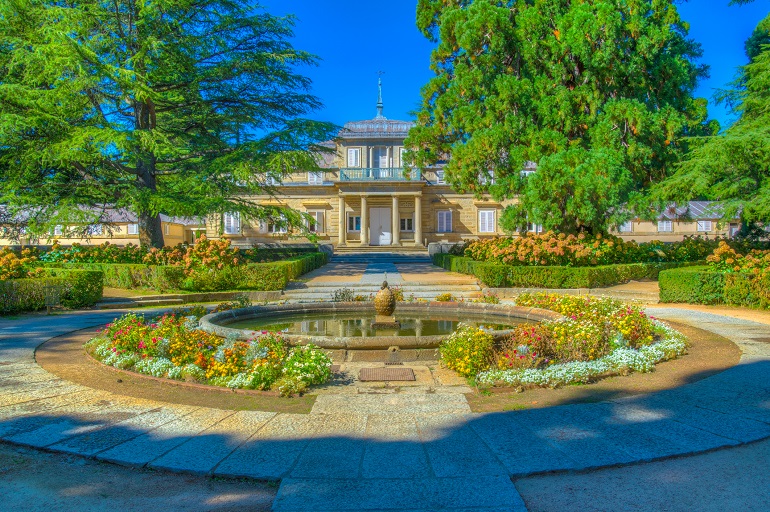
The Friars' Garden (Jardín de los Frailes)
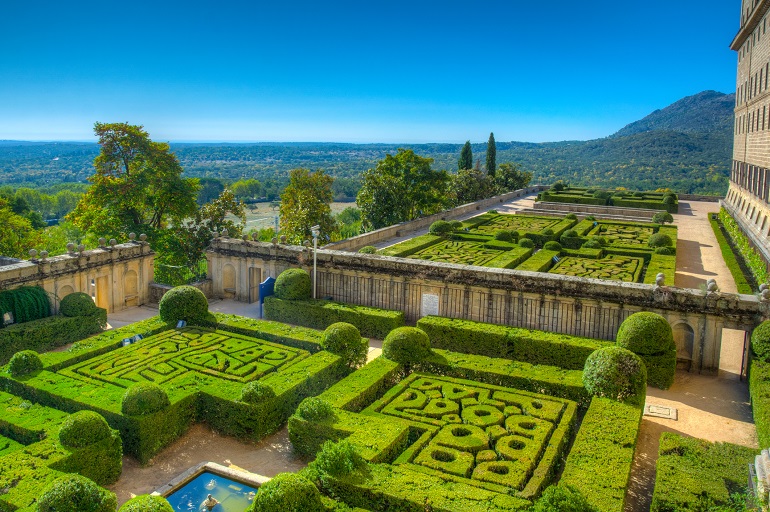
The Friars' Garden stretches along the southern and eastern terraces of the monastery, offering a serene escape from the grandeur of the interior. This formal garden is divided into geometric parterres bordered by meticulously trimmed boxwood hedges. Four large fountains mark the intersections of the garden paths, their gentle splashing providing a soothing soundtrack to your stroll.
From the balustrade that borders the garden, you can enjoy breathtaking panoramic views of the surrounding landscape—the lake, the market gardens of El Bosquecillo and La Herrería, with the dramatic peaks of Las Machotas forming a majestic backdrop. On clear days, the vista extends all the way to Madrid.
The King's and Queen's Gardens
Located on the eastern side of the complex, these intimate gardens feature exquisite boxwood hedging arranged in intricate geometric designs. While the original brightly coloured flowers have been replaced over the centuries, the precise patterns of the hedges still evoke the Renaissance aesthetic favoured by Philip II.
Small fountains and carefully placed stone benches invite visitors to pause and contemplate the perfect harmony between architecture and nature that characterises El Escorial. These gardens were designed as places for quiet reflection, and they retain that tranquil atmosphere to this day.
The Pond Garden (Jardín de la Estanque)
This charming garden features a large rectangular pond surrounded by neatly trimmed hedges and flowering plants. Originally designed as a place for the royal family to enjoy boating and fishing, it now offers visitors a peaceful retreat where they can admire the reflection of the monastery's imposing façade in the still waters.
The Galería de Convalecientes
This covered walkway along the southern edge of the complex was designed for monks to take gentle exercise while recovering from illness. Today, it offers visitors spectacular views across the gardens and surrounding countryside. The gallery's arched openings frame perfect vignettes of the landscape, creating natural "paintings" that change with the seasons and the light.
The Hidden Corners
The Architect's Garden (Jardín del Arquitecto)
This small, secluded garden is named after Juan de Herrera, the principal architect of El Escorial. Less formal than the other gardens, it features a variety of Mediterranean plants and herbs that would have been used in the monastery's pharmacy. A small fountain at its centre provides a focal point for this intimate space.
The Monastery Orchard
Beyond the formal gardens lies the monastery's historic orchard, where monks once grew fruits, vegetables, and medicinal herbs. Today, this area maintains some of its agricultural character, with fruit trees and vegetable plots that continue the centuries-old tradition of self-sufficiency.
The Casita del Príncipe
A short walk from the main complex brings you to the Casita del Príncipe, a small neoclassical palace built for the future Charles IV. Surrounded by its own gardens, this elegant building offers a striking contrast to the monumental severity of the monastery. Its gardens feature winding paths, ornamental trees, and surprising vistas that exemplify the more naturalistic approach to landscape design that became fashionable in the late 18th century.
Getting There
Getting to El Escorial from Madrid is straightforward and affordable. The most convenient option is taking the train from Madrid-Principe Pio station, which departs every two hours and reaches El Escorial in approximately 41 minutes for €5-8. Alternatively, you can opt for a bus from Intercambiador Moncloa, running every 10 minutes and taking about 50 minutes to arrive, costing €3-5. For those preferring more flexibility, a rideshare service is available, taking around 59 minutes and costing just €3. If you're driving, the journey takes about 40 minutes and covers 45.6 km. Upon arrival at El Escorial station, a local bus timed to meet incoming trains can take you to San Lorenzo de El Escorial, where the famous monastery is located, for an additional €1.30 each way.
Best Time to Visit
The best time to visit El Escorial is during autumn, from September to November, when you can enjoy pleasant weather and significantly fewer crowds compared to the busy summer months. Spring is also an excellent choice, offering mild temperatures and smaller visitor numbers than the peak season. The monastery opens from Tuesday to Sunday, with hours varying seasonally—10am to 6pm from October to March and 10am to 7pm from April to September. Note that El Escorial sits at an elevation over 3000 feet above sea level, making winters quite cold, whilst summers can be uncomfortably hot. For the most enjoyable experience, plan to arrive early in the morning when the complex opens at 10am, allowing yourself 3-4 hours to properly explore the magnificent UNESCO World Heritage Site without feeling rushed. Remember that the site is closed on Mondays and several public holidays throughout the year.