Introduction
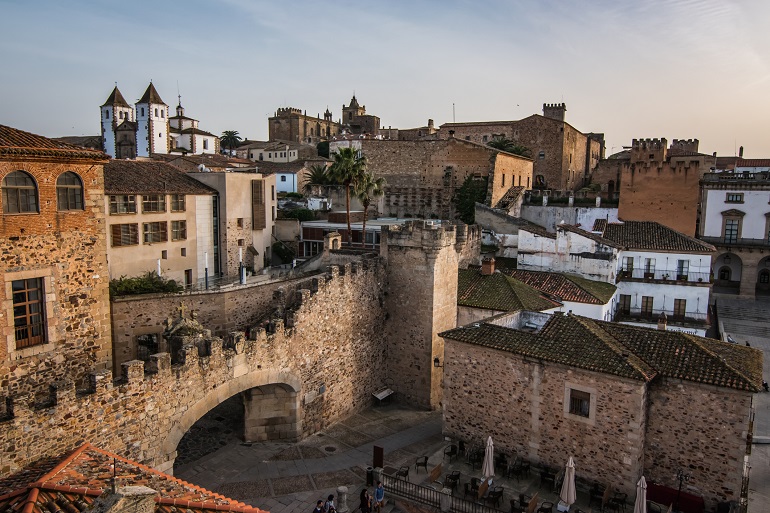
Located in the heart of Extremadura, Cáceres (pop. 96,500) is a medieval walled city, declared a UNESCO World Heritage Site in 1986, showcases a remarkable blend of Roman, Moorish, Northern Gothic and Italian Renaissance architecture. Within its ancient walls, visitors can explore the Old Town (Parte Antigua) with its impressive towers, including the famous Torre del Bujaco, one of thirty towers remaining from the Islamic period. The city's rich past reflects centuries of conflict and cultural exchange, with visible influences from Roman, Arab, Jewish and Christian civilisations. Beyond its historical significance, Cáceres serves as the capital of Cáceres province and houses the headquarters of the Superior Court of Justice of Extremadura. With a population of approximately 95,500 inhabitants, the city is also home to the Universidad de Extremadura and has been used as a filming location for television shows including Game of Thrones due to its perfectly preserved medieval setting.
Interesting Facts about Cáceres
- Cáceres is home to numerous stork nests, which can be spotted atop trees and rooftops throughout the city.
- The city's UNESCO-listed Old Town features a unique blend of Roman, Islamic, Northern Gothic, and Italian Renaissance architecture.
- Founded by the Romans in 25 BCE, it was originally named Norba Caesarina and served as a strategic settlement along the Vía de la Plata trade route.
- It briefly served as the capital of Francisco Franco's government during the Spanish Civil War in the 1930s.
- The medieval walls surrounding the historic centre include Roman foundations and Moorish-era towers like the iconic Torre del Bujaco.
- Cáceres boasts Spain's largest municipal land area, covering 1,750 square kilometres – larger than Greater London.
- Scenes from Game of Thrones were filmed in its well-preserved ancient quarters, including the Arco de la Estrella and Plaza Santa María.
- The city hosts an annual World Music Festival showcasing non-mainstream artists from global traditions.
- It maintains one of Spain's most intact medieval Jewish quarters, despite the 1492 expulsion order by Catholic monarchs.
- Cáceres remains a key hub for Jamón Ibérico production, with local hams being internationally renowned.
History
Cáceres, Spain, boasts a rich history dating back to prehistoric times. Founded by the Romans in 25 BCE as Castra Caecilia, it flourished as a strategic settlement along the Vía de la Plata (Silver Route). Roman influence can still be seen today through remains of the first city walls built in the 3rd and 4th centuries, including the Arco de Cristo gateway. Following the fall of the Western Roman Empire, the Visigoths occupied the city, leading to a period of decline until the 8th century when the Moors arrived.
During the medieval period, Cáceres became a contested frontier between Christian kingdoms to the north and Muslim territories to the south. The city's impressive Almohad walls and towers, including the famous Torre de Bujaco, were constructed during this period of Islamic rule. After numerous sieges, Alfonso IX of León finally conquered Cáceres on 23 April 1229, marking a pivotal moment in the Christian Reconquista. The city then experienced a golden age during the 15th and 16th centuries, particularly following the Discovery of the Americas, when many locals sought their fortunes overseas and returned to build grand palaces and mansions.
Cáceres continued to evolve through the centuries, becoming a provincial capital in the 19th century. A significant moment in its development came in 1790 when Charles IV established the headquarters of the Royal Court of Extremadura in the town, transforming it from a simple settlement into a city of regional importance. Today, Cáceres stands as a UNESCO World Heritage Site, its remarkably preserved old town offering visitors an authentic journey through Spanish history, with its unique blend of Roman, Moorish, Gothic and Renaissance architecture telling the story of its diverse cultural influences.
Main Attractions
The Old Town (Casco Antiguo)
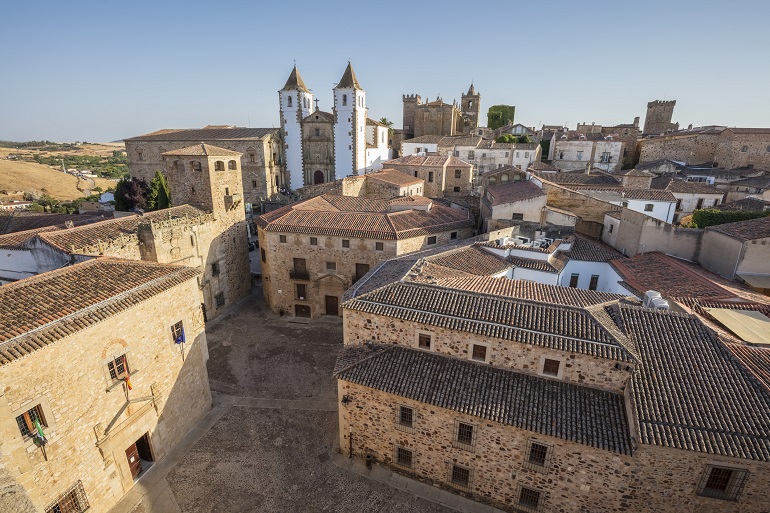
The UNESCO World Heritage-listed Old Town of Cáceres stands as one of Spain's most remarkably preserved medieval quarters. Walking through its narrow, winding streets feels like stepping back in time to the 15th and 16th centuries when the city flourished. The quarter contains over 30 towers from Islamic origins, alongside aristocratic stone mansions and fortified houses built by returning conquistadors who had made their fortunes in the Americas.
The Old Town's architectural integrity remains largely untouched by modern development, creating an authentic medieval atmosphere that few European cities can match. The honey-coloured stone buildings glow magnificently at sunset, whilst the absence of visible modern infrastructure enhances the immersive historical experience. The layout of the streets follows medieval patterns, with unexpected plazas and hidden corners revealing themselves as you explore.
Plaza Mayor
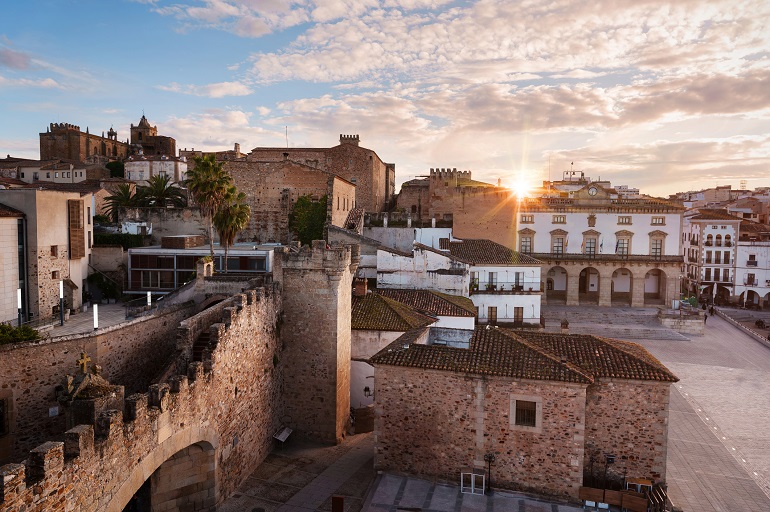
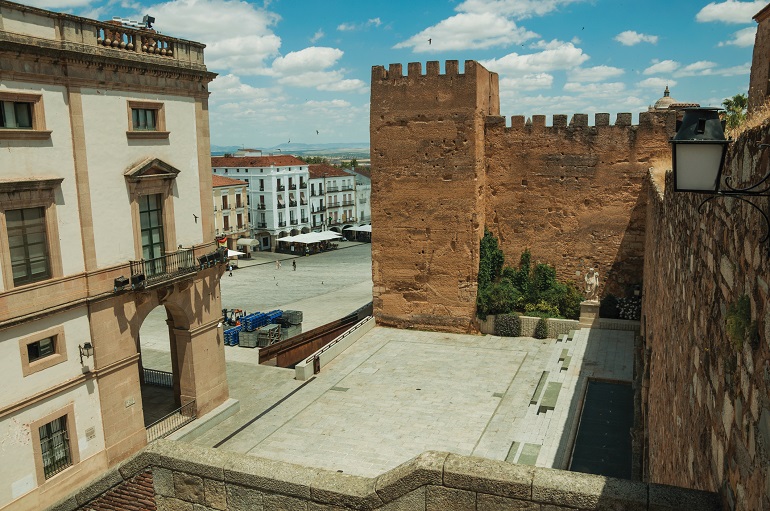
The Plaza Mayor serves as the vibrant heart of Cáceres and the natural gateway to the monumental city. This expansive square has been the centre of commercial and social life for centuries, hosting markets, celebrations, and public gatherings throughout its history. The western side features traditional soportales (arcades) that provide shade during hot summer days and shelter during rainy periods.
The plaza's open design creates a natural amphitheatre for the city's cultural events, including the WOMAD music festival and medieval markets that transform the space into a bustling recreation of its historical character. The square offers the first glimpse of the Old Town's towers and walls, creating a striking contrast between the open plaza and the enclosed medieval quarter. Local residents gather here in the evenings for the traditional Spanish paseo (evening stroll), making it an excellent spot to observe local life.
Torre de Bujaco
The imposing Torre de Bujaco stands as the most emblematic structure in Cáceres, rising 25 metres above the Plaza Mayor. This 12th-century Almohad tower was constructed using Roman stone blocks from earlier structures, demonstrating the layered history of the city. Named after Califa Abú-Ya'qub, who conquered the city in 1173, the tower served as a crucial defensive structure for centuries.
Inside, a spiral staircase leads visitors to the top, where panoramic views unfold across the red-tiled roofs of the Old Town and beyond to the undulating Extremaduran countryside. The tower's thick walls and strategic position at the corner of the city walls highlight its military significance. The structure has been meticulously preserved, allowing visitors to appreciate authentic medieval military architecture without modern alterations.
Arco de la Estrella
The Arco de la Estrella (Star Arch) represents one of the most ingenious elements of Cáceres' defensive system. Originally built in the 15th century and later remodelled in the 18th century by Manuel de Larra Churriguera, this main entrance to the walled city features an unusual curved design. The arch's distinctive shape was specifically engineered to allow horse-drawn carriages to enter the narrow streets of the Old Town without having to reverse or perform difficult manoeuvres.
The arch is crowned by an image of the Virgen de la Estrella (Star Virgin) in a small niche, from which it derives its name. The structure bears the coat of arms of the city and represents a fascinating blend of practical engineering and symbolic importance. When passing through the arch, visitors transition from the open, modern city into the enclosed medieval world, creating a palpable sense of travelling back in time.
City Walls
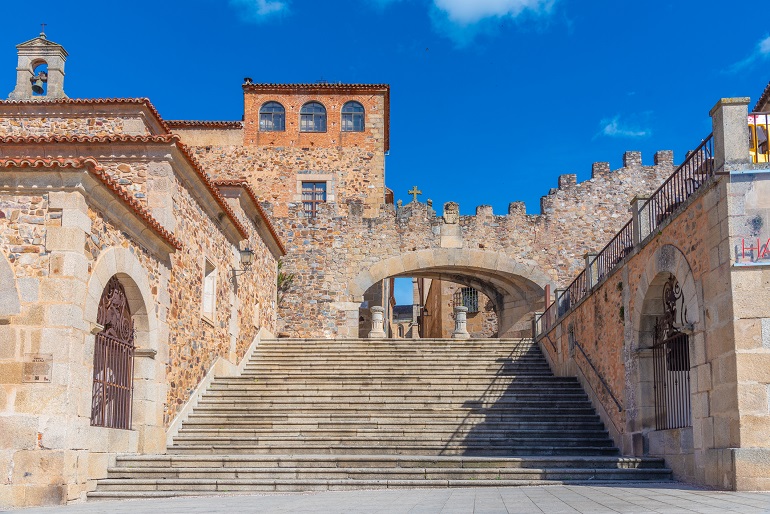
The ancient walls of Cáceres represent one of the most complete medieval defensive systems in Europe. Constructed primarily during the Almohad period in the 12th century, these formidable fortifications incorporate earlier Roman elements and later Christian modifications, creating a physical timeline of the city's history. The walls stretch for approximately 1.2 kilometres, punctuated by towers and gates that controlled access to the city.
Walking along sections of the preserved walls offers unique perspectives of both the historic Old Town and the surrounding landscape. The walls vary in thickness between 2 and 3 metres, demonstrating their serious defensive purpose. The construction techniques visible in their stonework reveal sophisticated engineering knowledge capable of withstanding centuries of weathering and conflict. Their impressive state of preservation allows visitors to appreciate their original scale and impact.
Plaza de Santa María
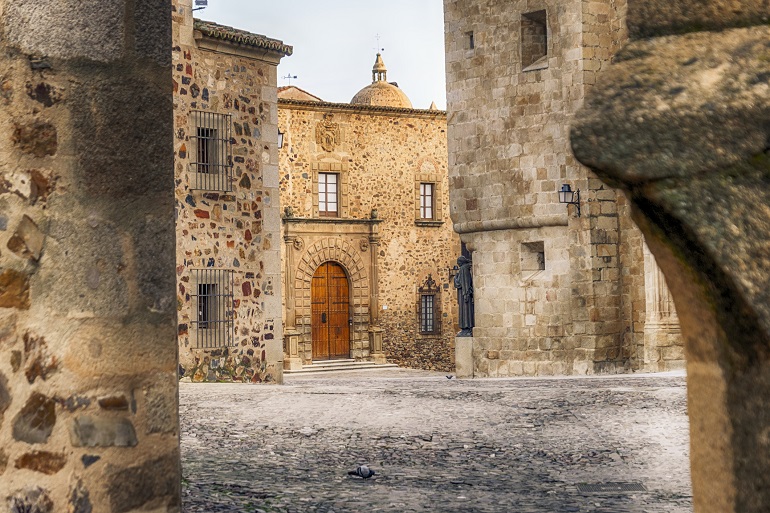
The Plaza de Santa María forms the religious and aristocratic heart of old Cáceres. This elegant square is surrounded by some of the city's most impressive palaces and noble houses, creating an architectural ensemble of extraordinary harmony and beauty. The open space would have served as a gathering place for Cáceres' elite families, who competed to build increasingly impressive residences around its perimeter.
The plaza's cobblestones and weathered façades create an atmosphere of timeless elegance. Its proportions feel perfectly balanced, demonstrating sophisticated urban planning principles from medieval Spain. From this central point, narrow streets radiate outward toward other significant buildings within Cáceres' Old Town.
Palacio de los Golfines de Abajo
The Palacio de los Golfines de Abajo stands as one of Cáceres' most magnificent aristocratic residences. This impressive palace served as temporary lodging for Ferdinand and Isabella during their visits to Cáceres. It exemplifies Gothic fortress-house architecture typical of 15th-century Spanish noble residences but also incorporates elaborate Plateresque decoration added during later periods.
The façade features two asymmetrical towers flanking a rounded arch portal adorned with intricate coats of arms that proclaim its owners' lineage. This palace reflects how noble families transitioned from defensive priorities toward more decorative Renaissance styles as political stability increased across Spain.
Palacio Carvajal
The Palacio Carvajal represents one of the finest examples of aristocratic architecture in Cáceres. Located near the Cathedral, this 16th-century palace incorporates a 12th-century Almohad defensive tower, demonstrating how noble families often built their residences by adapting existing military structures. The palace's most distinctive feature is its exquisite interior courtyard, which unfolds across multiple levels connected by stone staircases.
The courtyard features abundant greenery, with traditional potted plants creating a refreshing microclimate within the stone structure. The walls display exquisite Gothic windows and columns that demonstrate the sophisticated artistic tastes of the Carvajal family. Visitors can climb the ancient Moorish tower for spectacular views across the city's rooftops.
Plaza de San Jorge
The Plaza de San Jorge offers another tranquil space within the monumental city, surrounded by buildings of significant historical and architectural value. The square takes its name from the Church of San Jorge (St. George), though its secular buildings are equally impressive. The Casa Palacio de los Becerra stands as a prime example of the noble residences that dominate this space, featuring the characteristic blend of defensive elements and decorative flourishes typical of Cáceres' aristocratic architecture.
The plaza connects with the nearby Palacio de los Golfines de Abajo, creating a network of elegant public spaces that would have served as the social stage for the city's elite families. The square's proportions create a sense of enclosure and protection from the outside world, whilst still allowing for social interaction and public gatherings.
Palacio de las Veletas
The Palacio de las Veletas (Palace of the Weather Vanes) represents one of the most architecturally distinctive buildings in Cáceres. Named for the decorative weather vanes that once adorned its roof, this 15th-century palace was built on the foundations of a former Almohad fortress. The building's most remarkable feature lies beneath its elegant courtyard—a perfectly preserved 12th-century Almohad cistern, one of the finest examples of Islamic hydraulic engineering in Spain.
The palace's façade features an impressive stone entrance with the coat of arms of the Toledo-Moctezuma family, descendants of a Spanish conquistador and an Aztec princess. The building exemplifies how successive cultures in Cáceres adapted and built upon the structures of previous inhabitants, creating a physical layering of history.
Torre de los Púlpitos
The Torre de los Púlpitos (Tower of the Pulpits) derives its unusual name from the two pulpit-like balconies that project from its façade. This defensive tower dates from the 15th century and represents one of the most distinctive elements of Cáceres' skyline. The tower formed part of the palace of the Sande family, one of the city's most powerful noble lineages.
The tower's solid stone construction and strategic position demonstrate its dual purpose as both a status symbol and a practical defensive structure. The projecting balconies would have allowed residents to observe activities in the surrounding streets whilst remaining protected.
Plaza de San Mateo
The Plaza de San Mateo creates another significant public space within the Old Town, surrounded by impressive noble houses and palaces. This square would have functioned as a secondary centre of aristocratic life, where prominent families constructed their residences to demonstrate their wealth and status. The plaza takes its name from the Church of San Mateo, though the secular buildings surrounding it are equally noteworthy.
The square's intimate scale creates a sense of enclosure and exclusivity that reflects its historical function as a space for the city's elite. The consistent use of local stone and traditional building techniques throughout the surrounding structures creates a harmonious architectural ensemble.
Torre de Sande
The Torre de Sande, dating from the 14th-15th centuries, is one of the most picturesque towers in Cáceres. Belonging to the Mansion of the Sande, it forms part of a harmonious architectural ensemble alongside the House of the Sun and the House of the Eagle. The tower's medieval character has been exceptionally well preserved, offering visitors an authentic glimpse into the defensive architecture of medieval Cáceres.
The tower's strategic position within the urban fabric demonstrates how noble families integrated defensive elements into their residential compounds. Its sturdy construction and commanding presence reflect the turbulent times during which it was built, when displays of military strength were essential for prominent families.
Palacio de las Cigüeñas
The Palacio de las Cigüeñas (Palace of the Storks), also known as the Palacio de los Cáceres Ovando, dates to the 15th century and earned its nickname from the large number of storks that traditionally nested on its tower. At 425 metres high, its tower is the only untruncated tower in the historic site, having been exempted from Queen Isabel I's royal order to lower all towers of houses that had remained loyal to her rival Juana la Beltraneja.
The palace exemplifies the privileges enjoyed by certain noble families who managed to navigate the complex political landscape of medieval Spain. Currently serving as the headquarters of the Military Government, the building continues to play an important role in the city's administrative functions while preserving its historical character.
Top Museums
Cáceres Museum
Housed in two historic buildings, the Casa de las Veletas and Casa de los Caballos, the Cáceres Museum offers a comprehensive journey through the region's history. The museum's collection spans from the Palaeolithic Age to Contemporary Art, featuring:
- Archaeological artefacts, including stone steles from the Bronze Age and Roman mosaics
- An ethnographic collection showcasing traditional ways of life in Extremadura
- A fine arts section with works by renowned artists such as El Greco and Pablo Picasso
A highlight of the museum is the impressive 12th-century Moorish cistern, a marvel of medieval engineering.
Art Museums
Museum of Contemporary Art Helga de Alvear
This modern art museum, established by German-born art collector Helga de Alvear, reopened in 2021 in a striking modernist building. The museum houses over 3,000 pieces of contemporary art, including:
- Paintings, sculptures, and installations
- Video art and photography
- Works by notable artists such as Andreas Gursky, Gerhard Richter, and Joseph Beuys
Museo de Historia de la Computación
Dedicated to the history of computing, this museum aims to document, restore, and exhibit both analogue and digital hardware and software. Visitors can explore:
- A collection of over 450 different computers
- Sections devoted to mainframes, minicomputers, and personal computers
- Displays of mechanical and electronic calculators
- A library of manuals and books related to computer science
Casa Museo Árabe Yusuf al Burch
This 12th-century house offers a glimpse into the Muslim period of Cáceres. Visitors can explore:
- Original vaulted ceilings and an ancient cistern
- A traditional hammam (bathhouse)
- Archaeological remains
- Rooms showcasing daily life in medieval Muslim Cáceres, including a kitchen, tea room, and harem
Museum of History and Culture "Casa Pedrilla" and Guayasamín House-Museum
This dual museum complex offers a unique blend of local and Latin American art:
- The Casa Pedrilla showcases works by renowned local artists and includes sections on Extremadura's history
- The Guayasamín House-Museum houses a collection of pre-Columbian and colonial art, as well as works by Ecuadorian painter Oswaldo Guayasamín
Cáceres Co-Cathedral Museum
Located in the Church of Santa María Co-Cathedral, this museum displays a collection of religious artefacts, including:
- Liturgical pieces and sacred vessels
- Religious paintings and sculptures
- Clerical vestments and other cult objects
Local Cuisine
Cáceres offers a rich gastronomic experience that showcases the best of Extremaduran cuisine. The region is renowned for its Iberian ham, produced from black Iberian pigs that roam freely and feed on acorns from local oak trees. Visitors should not miss trying migas extremeñas, a hearty dish originally made by shepherds using bread crumbs, garlic, bacon and other pork derivatives. Another local delicacy is Torta del Casar, a creamy sheep's milk cheese with a distinctive flavour that is traditionally eaten by removing the top and scooping out the interior with a spoon. The patatera sausage, made with Iberian pork and potatoes seasoned with La Vera paprika, represents the region's ingenious approach to preserving food. For meat lovers, cochifrito (crispy fried piglet) and caldereta de cordero (mutton stew) offer authentic tastes of the region. Complete your culinary journey with sweet treats like perrunillas (crunchy almond biscuits) and sapillos (fried bread dough with lemon and cinnamon). Many restaurants in Cáceres offer excellent tasting menus at reasonable prices, making it a paradise for food enthusiasts seeking authentic Spanish flavours.
Shopping
The historic Plaza Mayor serves as a central hub, with Calle Pintores being a coveted 200-metre shopping street packed with toy stores, furniture shops, jewellery stores, fashion chains, and more. For souvenirs featuring local symbols like storks and acorns, head to Calle San Pedro or Plaza de San Juan, where you'll find handicraft stalls selling ceramics, gold work, lace, embroidery, and basket weaving. The Ruta de la Plata Shopping Centre houses nearly 90 stores along two corridors, offering family-friendly amenities including children's areas and free parking. Don't miss the Wednesday market (Mercado de los Miércoles) for local products, sweets, clothes, and handicrafts at affordable prices, or the Sunday antiques market (Rastro de Cáceres). Speciality shops worth visiting include Sabor a Montánchez for acorn-fed pork products and local pimentón, Centro de Artesanía Casa Palacio de los Moraga for artisanal leather and ceramic goods, and Pastelería Isa for traditional local pastries like the orange-scented mojicón.
Nature in and around Cáceres
The region around Cáceres, Spain, boasts a diverse array of natural attractions. The Sierra de Gata offers lush woodlands, mountains, and meadows, with highlights including the Jevero natural swimming pool and the Cervigona waterfall. To the northeast, the Borbollón Reservoir is ideal for watersports and birdwatching, classified as a Special Protection Area for the Conservation of Wild Birds. Near the city, Los Barruecos Natural Monument features unique granite formations and ponds, providing habitat for various bird species. The Castañar Cave, though access is restricted, is renowned for its geological significance and beauty. Additionally, the municipality of Cáceres encompasses two Protected Natural Spaces: Los Llanos de Cáceres-Sierra de Fuentes and Sierra de San Pedro, offering further opportunities for nature exploration.
Getting There & Around
Cáceres is well-connected to major Spanish cities and offers several transport options for visitors. From Madrid, the fastest way to reach Cáceres is by car, taking approximately 2 hours and 50 minutes to cover the 314 kilometres, with the journey following the A-5/E-90 motorway and then the A-58 road. Train services depart from Madrid's Atocha-Cercanías Station, with journey times between 3 hours 34 minutes and 4 hours 9 minutes, arriving at Cáceres Train Station, which is about a 30-minute walk from the main square. Coach services operated by Avanza run six times daily (five on Saturdays) from Madrid Airport and Estación Sur de Autobuses, with journey times ranging from 3 hours 55 minutes to 4 hours 55 minutes. For those travelling from Barcelona, options include train connections via Madrid (approximately 7 hours total journey time) or bus services with connections, costing between €45 and €130 for trains. Within Cáceres itself, the city centre is walkable, but local buses run frequently, and taxis are readily available at reasonable prices (call +34 927 242 424). If driving, the centrally located Párking Obispo Galarza offers 24/7 parking at €0.0138 per minute up to a maximum of €12.45 per 24 hours.
Best Time to Visit
The best time to visit Cáceres, Spain, is during the spring months of April and May or in autumn from mid-September to mid-October. These periods offer pleasant temperatures, ranging from 15°C to 25°C, ideal for exploring the city's historic sites and outdoor attractions without the scorching summer heat. Spring brings lush greenery and blooming flowers, whilst autumn offers golden hues and harvest festivities. These shoulder seasons also tend to be less crowded and more affordable than the peak summer months. However, if you don't mind the heat, summer can be an option, with temperatures often exceeding 35°C. Winter, particularly January, is the quietest month for tourism, but it can be chilly with temperatures dropping to around 8°C. For those interested in cultural events, Easter in mid-April sees vibrant religious celebrations, whilst the WOMAD festival in mid-May brings a lively atmosphere to the city centre.


