Introduction

Spreading south of the western Pyrenees, Navarre (Navarra in Spanish, Nafarroa in Basque) is the largest portion of the greater Basque Country, which also include the autonomous community of the same name, and the French Basque Country. It was named after the Kingdom of Navarre, which originally comprised all the greater Basque Country. The southern part of the kingdom was conquered by the Crown of Castile in 1512, and thus became part of the unified Kingdom of Spain. The northern part of the kingdom remained independent, and in 1589 King Henry III of Navarre inherited the French throne as Henry IV of France. In 1620, northern Navarre was permanently incorporated to France to this day.
Navarre is the third least populated autonomous community in continental Spain, with merely 640,000 inhabitants, a third of whom living in the capital Pamplona. Its GRP per capita (PPP) is, however, the second highest after the Basque Country, and similar to that of Germany.
The region's green, forested and mountainous north contrasts with the flatter and arid south, famous for the surreal, semi-desert landscapes of the Bardenas Reales Natural Park. The northern part of the community is largely Basque-speaking, while the southern part is entirely Spanish-speaking. The capital, Pamplona, is bilingual.
Famous people from Navarre include (chronologically): the neuroscientist Santiago Ramón y Cajal (Nobel Prize, dubbed the father of modern neuroscience), and the road racing cyclist Miguel Indurain.
Cuisine
Navarran cuisine is similar to that of the Basque Country, apart from the paucity of seafood. Culinary specialties include trout à la Navarra (cooked stuffed with bacon and cheese), piquillo peppers (stuffed with meat), vegetable stews, and in the southern town of Tudela lettuce hearts with anchovies or salmon. The local liquor is the patxaran, which is flavoured with sloe.
Attractions
North & Centre
| Palacio Real de Olite |
|---|

 The Palacio Real de Olite is a remarkable Gothic castle-palace that was once considered one of Europe's most luxurious medieval residences. Built between 1402 and 1424 by King Charles III "The Noble", the palace complex features distinctive French Gothic and Mudéjar architectural styles, with multiple towers including the Torre del Homenaje and Tres Coronas. The palace, which sits atop ancient Roman foundations, formerly boasted exotic features including hanging gardens, a royal menagerie with lions and camels, and hosted grand events such as jousts and bullfights. After suffering devastating fire damage in 1813, the palace underwent careful restoration in the early 20th century and was declared a National Monument in 1925. Today, visitors can explore the New Palace (known as Olite Castle), whilst the Old Palace has been converted into a Parador hotel. A centuries-old white mulberry tree in the palace gardens has also been designated as a National Monument5. The surrounding medieval town of Olite, with its cobbled streets and noble houses, hosts an annual Medieval Festival in August that brings the historic atmosphere to life with period performers and craftsmen. |
| Pamplona (Iruña) |
|---|

Pamplona, the capital of Spain's Navarra region, was founded by Roman general Pompeius in 75 BCE and sits near the foothills of the Pyrenees. The city boasts impressive medieval walls and fortifications, with the Fortín de San Bartolomé offering historical reenactments in summer. Nature enthusiasts can explore the vast Riverside Park, spanning nearly a million square metres with 17 kilometres of pathways along three rivers. The city houses one of the world's largest planetariums, featuring a 20-metre diameter dome in Yamaguchi Park. Gastronomy is central to Pamplona's identity, with local specialities including piquillo peppers, chistorra sausage, and award-winning Navarran wines. The city is a significant stop on the Camino de Santiago pilgrimage route, with pilgrims entering through the French Gate past the medieval Magdalena bridge. For culture seekers, the Museo Universidad de Navarra and Museo de Navarra showcase both contemporary works and Roman artefacts. Bullet holes from the Spanish Civil War can still be seen in the walls of the Navarre Government building, offering a stark reminder of the city's recent history. |
Other attractions

Monastery of Leyre
South
| Bardenas Reales Natural Park |
|---|

 This semi-desert landscape spans 42,000 hectares and features striking rock formations sculpted by millions of years of wind and water erosion, with Castildetierra being the most iconic formation. The area gained UNESCO Biosphere Reserve status in 2000 and has since become a popular filming location, notably appearing in Game of Thrones. Despite its barren appearance, the park harbours diverse wildlife, including 24 species of birds of prey such as eagle owls and griffon vultures, whilst traditional shepherds' cabins dot the landscape where they once cooked migas, a local dish made with stale bread and lamb suet. Visitors can explore 700 kilometres of back roads by car, bicycle, or on guided tours using 4x4 vehicles, buggies, or even Segways. The area is divided into two distinct regions: the white Bardena Blanca, characterised by its gypsum-rich soil and deep gorges, and the greener Bardena Negra, featuring Aleppo pine forests. |
| Tudela |
|---|
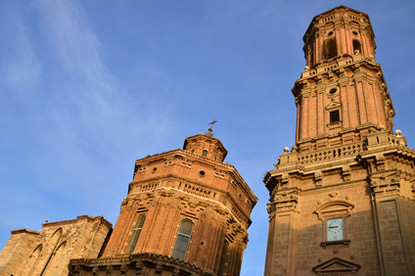
Founded in 802 under Muslim rule, Tudela boasts a rich heritage from its time as a multicultural city where Muslims, Jews and Christians coexisted. The city features remarkable Renaissance palaces, including the Palace of the Marquis of San Adrián, where Goya's portrait of the Marquis once hung. The 360-metre-long medieval Ebro Bridge, with its 17 arches, serves as the city's symbol and offers panoramic views. Tudela has gained international recognition for its contemporary urban art murals, displayed through various festivals. The city is particularly renowned for its exceptional vegetables, grown in the fertile floodplains of the River Ebro, including its famous 'ugly tomatoes' and artichokes with Protected Geographical Indication status. Local specialities include menestra (a seasonal vegetable stew), whilst the annual Fiestas de la Verdura celebrates the region's agricultural bounty. |


 : Local interest
 : Moderately interesting
 : Outstanding place
 : Must-see in the country
 : Top cities in Europe