


 Ireland Guide
 Scotland Guide
 Wales Guide
| Contents |
|---|
Introduction
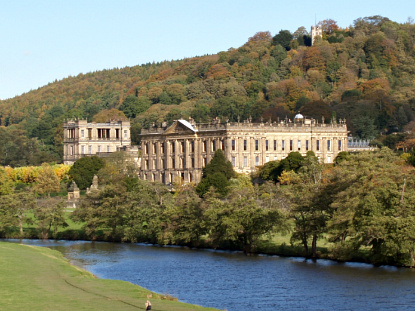
Nestled in the natural grandeur of the Peak District, Chatsworth House is one of the jewels of the Midlands. In fact, few other stately homes in England can compete with Chatsworth in beauty, situation and history. This magnificent country estate has been the ancestral seat of the Cavendish family, the Dukes of Devonshire, for nearly five centuries, passed down through 16 generations. The original Tudor mansion was built in the 1560s by Bess of Hardwick and her husband Sir William Cavendish, though most of what visitors see today dates from the late 17th century when it was rebuilt in the Baroque style. The house boasts over 30 richly decorated rooms showcasing an impressive collection of art spanning 4,000 years, including masterpieces by Rembrandt and Canaletto. Unsurprisingly, Chatsworth is listed as one of the ten Treasure Houses of England.
Beyond the house itself, visitors can explore 105 acres of landscaped gardens featuring spectacular water displays like the Emperor Fountain, a farmyard with animal handling experiences, and an adventure playground, making Chatsworth an ideal destination for all ages.
Interesting Facts about Chatsworth House
- The entire village of Edensor was relocated in the 19th century to enhance the view from Chatsworth House.
- The Cascade, a magnificent water feature built in 1696, is a listed building in its own right.
- Chatsworth House served as the iconic Pemberley Estate in the 2005 film adaptation of Jane Austen's "Pride and Prejudice".
- During World War II, the house became a girls' public school, accommodating 250 pupils from Penrhos College in Wales.
- The estate boasts a yew tree maze with over 1,200 intricately shaped trees.
- Chatsworth's gardens feature a 500-year-old hunting tower, a chapel, a grotto pond, and extravagant water features.
- The house contains a vast collection of family heirlooms, including medieval illuminated manuscripts and rare books from the 15th and 16th centuries.
- Chatsworth's sculpture gallery, inspired by a room in the Vatican, is considered one of the foremost collections in the world.
- The original Tudor mansion, built in the 1560s by Bess of Hardwick, was used as a prison for Mary Queen of Scots between 1569 and 1584.
- The Emperor Fountain, built in 1843 in anticipation of a visit from Tsar Nicholas I of Russia, was once recorded as reaching a height of 296 feet.
- Chatsworth House has been home to seventeen generations of the Devonshire family for nearly five centuries.
- The Conservative Wall, a set of greenhouses, houses prize-winning camellias, including two Camellia reticulata 'Captain Rawes' planted in 1850.
History
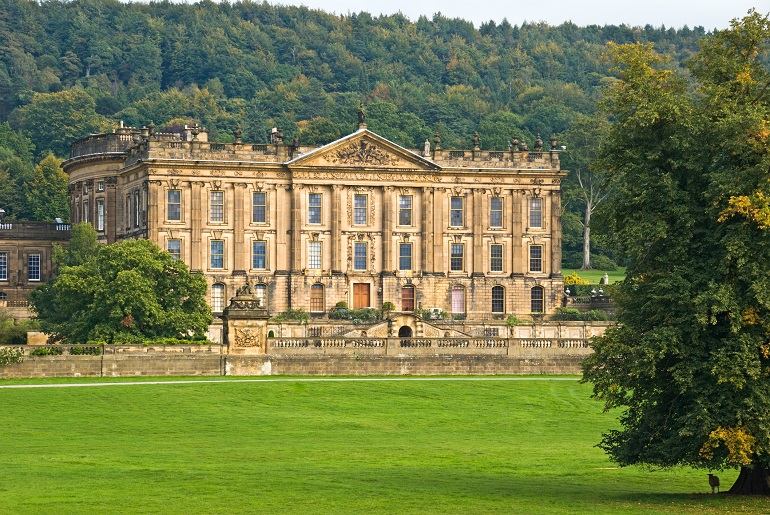
The palace has been home to the Cavendish family since the 16th century, when it was first built by 'Bess of Hardwick' (c. 1527-1608) her second husband Sir William Cavendish (1505-57). Another William Cavendish was created Earl of Devonshire in 1618, and his great-great-grand-son, the 5th of 11 consecutive "William's" was made Duke of Devonshire and Marquess of Hartington by William of Orange in 1694.
Mary, Queen of the Scots was a prisoner at Chatsworth between 1569 and 1584 under the guard of the Earl of Shrewsbury.
The 1st Duke of Devonshire built the State Rooms and redesign the whole house between 1686 and 1707. The house was further altered and embellish with paintings and sculpture by the extravagant 6th Duke in the first half of the 19th century.
The 7th Duke was a scholar best remembered for founding the Cavendish Laboratory of Cambridge University. The 8th Duke stayed over 50 years in Parliament and was asked three time by Queen Victoria to become Prime Minister, but refused each time.
Chatsworth lost a considerable amount of works of art and land at the 10th Duke's death in 1955 to pay for the £7 million inheritance tax (80% of the estate's estimated worth). In May 2004, Peregrine Cavendish succeeded his father as the 12th Duke of Devonshire and proprietor of Chatsworth.
Description
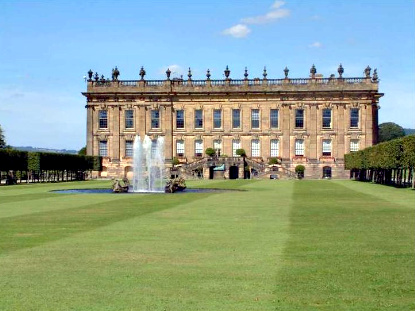
Chatsworth House stands as one of Britain's most magnificent stately homes, a resplendent example of Baroque architecture nestled in the verdant valleys of the Peak District. This palatial residence, often referred to as the "Palace of the Peak," presents an awe-inspiring façade of golden-hued stone that seems to glow in the afternoon sunlight. The exterior features exquisite symmetrical designs with ionic pilasters framing its central bays, creating a sense of grandeur and elegance that has captivated visitors for centuries. The south elevation is particularly remarkable for its time, showcasing a double-storey design without an attic, adorned with heavy entablature and carved urns atop a balustrade. The north entrance, with its imposing pediment and grand staircase, offers a stately welcome to all who visit.
The Magnificent Interior
Upon crossing the threshold, visitors are immediately transported into a world of opulence and artistic splendour. The Painted Hall, the first major room encountered, features dramatic murals by Louis Laguerre depicting scenes from the life of Julius Caesar. The hall's black-and-white marble flooring, gilded mouldings, and Roman-inspired architectural elements create an atmosphere of imperial grandeur. Moving through the house, one encounters the State Apartments, where monarchs once stayed, featuring sumptuous textiles, ornate plasterwork, and priceless furnishings.
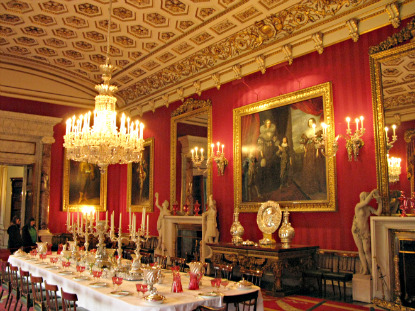
The Great Dining Room impresses with its crimson damask walls and elaborate ceiling, whilst the Library houses over 17,000 volumes collected over generations. The Sculpture Gallery, inspired by the Vatican, is filled with classical works by renowned artists like Antonio Canova, including his masterpiece "Endymion." Perhaps most striking is the State Bedroom, with its magnificent four-poster bed and hand-painted Chinese wallpaper, a testament to the exquisite taste of the Devonshire family.

The Devonshire Collection: A Treasury of Art
Chatsworth is home to one of Europe's most significant private art collections, amassed over 16 generations of the Cavendish family. The collection spans 4,000 years of artistic endeavour, from ancient Roman and Egyptian artefacts to contemporary masterpieces. Visitors can admire works by Old Masters such as Rembrandt, Van Dyck, and Gainsborough alongside pieces by modern artists like Lucian Freud, David Hockney, and Edmund de Waal.
The Drawing Room houses exceptional portraits, including Lucian Freud's controversial painting of the 11th Duchess. The North Sketch Gallery features contemporary installations that contrast beautifully with the historic setting. Throughout the house, one encounters exquisite treasures: Napoleonic-era furniture, Renaissance drawings, neoclassical sculptures, and one of the world's finest collections of porcelain and silver. The chapel within the house features a striking sculpture by Damien Hirst that complements its historic altar and stained glass windows, demonstrating how contemporary art continues to find a place within this historic setting.
The Spectacular Gardens
The 105-acre gardens at Chatsworth represent over 450 years of careful cultivation and artistic vision. Designed over centuries by notable figures such as Capability Brown, Joseph Paxton, and more recently Tom Stuart-Smith, the gardens offer a journey through the evolution of English landscape design. The formal gardens near the house feature immaculate lawns, geometric flower beds, and precisely clipped topiary, gradually giving way to more naturalistic landscapes as one ventures further from the house.
The iconic Emperor Fountain, once the tallest in the world, shoots water up to 90 metres high on still days, creating a spectacular display against the backdrop of the house. The Cascade, designed by Grillet in 1696 and later enhanced by Paxton, comprises a series of twenty-four stone steps, each with a different carved pattern that creates unique water effects as the water tumbles down. The Canal Pond offers perfect reflections of the house on calm days, whilst the Ring Pond serves as a focal point for the South Lawn.
Arcadia: A Contemporary Vision
A recent addition to the gardens is Arcadia, a tranquil 15-acre area designed by Tom Stuart-Smith. This innovative space reimagines the 18th-century concept of the picturesque, consisting of meadow-like glades connected by meandering woodland walks and dotted with contemporary sculptures. Native and exotic plants intermingle in naturalistic plantings, creating a rich tapestry of textures and colours that change with the seasons. Arcadia provides stunning views across the park and links other garden features such as the Maze, Rockery, Trout Stream, and Grotto Pond, offering visitors a contemplative space that feels both wild and designed.
The Rockery and Water Features
The Rockery at Chatsworth is one of the largest and most impressive in Britain, featuring dramatic boulder arrangements that create a wild yet harmonious landscape. Designed by Joseph Paxton in the 1840s, this area showcases alpine and woodland plants nestled among massive gritstone boulders, some weighing several tonnes. Water plays a crucial role here, with streams cascading down rocky outcrops into serene pools below.
The gardens are renowned for their innovative waterworks, including the charming Willow Tree Fountain, which surprises unsuspecting visitors with jets of water, and the gravity-fed Emperor Fountain in the Canal Pond. The Seahorse Fountain adds classical elegance to the South Lawn, whilst the Grotto Pond offers a more naturalistic water feature, its reflective surface complemented by surrounding autumnal foliage and exotic plantings.
Seasonal Highlights and Special Gardens
Each season brings different delights to Chatsworth's gardens. Spring sees the emergence of over 250,000 daffodils and narcissi, followed by bluebells carpeting the woodland floors. Summer brings the Rose Garden into its full glory, with hundreds of varieties filling the air with their perfume. The Kitchen Garden reaches its productive peak, supplying fresh produce to Chatsworth's restaurants. Autumn transforms the landscape with fiery colours in the arboretum and Salisbury Lawns, whilst winter reveals the elegant bones of the garden, with frost highlighting the sculptural forms of topiary and statuary.
Special areas within the gardens include the Sensory Garden, designed to engage all five senses with its diverse plantings; the Cottage Garden, a charming area filled with traditional flowers and herbs; and the Ravine, a dramatic gorge-like feature with a tumbling stream. The Snake Terrace, a unique pathway winding through lush greenery, offers elevated views across the gardens, whilst the Maze provides a delightful challenge for visitors of all ages.
The Wider Estate
Beyond the formal gardens lies the expansive parkland, designed by Capability Brown in the 18th century. This naturalistic landscape features rolling hills, ancient oak trees, and the meandering River Derwent. Herds of red and fallow deer roam freely across the park, adding a touch of wild majesty to the scene. The Stand, a hilltop folly, offers panoramic views across the estate and surrounding countryside, whilst Queen Mary's Bower, a raised stone platform near the house, provides a historical connection to Mary, Queen of Scots, who was once imprisoned at Chatsworth.
The estate is dotted with architectural features that enhance the landscape, including the Three Arch Bridge spanning the River Derwent, the picturesque Hunting Tower perched on the hillside, and the Russian Cottage, a charming building with distinctive onion domes. These structures, along with ha-has, stone walls, and carefully positioned trees, create a landscape that appears natural but is in fact meticulously designed.
A Quintessential English Experience
Whether strolling through the formal gardens, exploring the wilderness areas, or simply relaxing on the grassy hillsides overlooking serene lakes and fountains, Chatsworth offers visitors a quintessentially English experience. The house and gardens work in perfect harmony, each enhancing the other's beauty. From the grandeur of the Painted Hall to the tranquillity of Arcadia, from priceless art treasures to humble wildflowers, Chatsworth represents the finest aspects of British culture and heritage.
Getting There
To reach Chatsworth House, located in the heart of the Peak District in Derbyshire, you have several options. By car, use the postcode DE45 1PP for your sat-nav. From the M1, exit at Junction 29 and follow the brown signs to Chatsworth, which is approximately 16 miles away. Alternatively, from Matlock, take the A6 and then the B6012. If you prefer public transport, buses such as the 218 from Sheffield, the 170 from Chesterfield, and the 160 from Matlock offer convenient routes. On Sundays, buses run regularly from nearby towns like Bakewell and Baslow. The nearest train station is Chesterfield, about 10 miles away, from where you can take a bus or taxi to Chatsworth. Cycling is also a scenic option, with bike-friendly paths through the Peak District.
Best Time to Visit
The best time to visit Chatsworth House is during the early spring or at Christmas. In the spring, the gardens are particularly vibrant with flowers, and the crowds are generally smaller, making for a more peaceful visit. Christmas at Chatsworth is a special event, running from early November to the beginning of January, featuring a festive market and beautifully decorated interiors. Throughout the year, Chatsworth hosts various events, including screenings and themed balls, so it's advisable to check their events calendar to plan your visit accordingly. If you prefer fewer crowds, weekdays are often quieter than weekends, especially during peak summer months.