


 England Guide
 Ireland Guide
 Wales Guide
| Contents |
|---|
Introduction
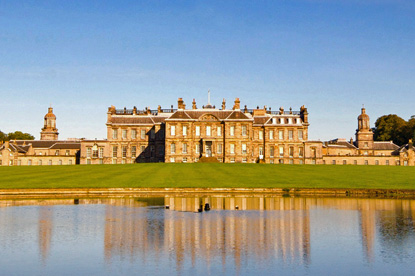
Hopetoun House, often referred to as Scotland's Finest Stately Home, is a magnificent palatial mansion situated on the shores of the Firth of Forth, approximately 2.5 miles west of South Queensferry near Edinburgh. This impressive country house, dating from the late 17th century, was designed by Scottish architects Sir William Bruce and William Adam, and is considered one of the finest examples of 18th-century architecture in Britain. The house features a classical central block of four storeys with sweeping flanking wings, and has been home to the Hope family since the late 1600s, with the present Lord Hopetoun and his family still residing in the south wing. Visitors can explore the magnificent interiors, which have remained virtually unchanged for three centuries, adorned with period furniture, paintings, tapestries and clocks, as well as enjoy the 150 acres of parkland with nature trails, scenic walks and a deer park.
Interesting Facts about Hopetoun House
- Hopetoun House, located near South Queensferry, is considered one of Scotland's finest stately homes and a masterpiece of Georgian architecture.
- The house was originally designed by Sir William Bruce between 1699 and 1707, with significant extensions added by William Adam starting in 1721.
- Hopetoun House uniquely combines two architectural styles: the original Bruce design reflects a country house feel, while Adam's additions showcase European grandeur inspired by palaces like Versailles.
- The estate spans over 100 acres of parkland, featuring woodland walks, a red deer park, and picturesque picnic spots.
- The interior boasts opulent gilding, classical motifs, and rooms such as the Large and Small Libraries, which house books collected since 1650.
- The gardens were meticulously designed to appear symmetrical from within the house, including an elliptical pond that looks circular from the Garden Parlour.
- Hopetoun House has been home to the Hope family for over 300 years and is still partially occupied by the current Earl of Hopetoun.
- The estate is managed by the Hopetoun House Preservation Trust, established in 1974 to ensure its preservation for public benefit.
- It served as a filming location for the popular TV series "Outlander," further enhancing its cultural significance.
- The house features a charming Stables Tearoom offering lunches, snacks, and champagne afternoon teas in a historic setting.

History
Hopetoun House's history dates back to 1699 when Lady Margaret Hope commissioned renowned architect Sir William Bruce to design the house for her son, Charles Hope, marking his marriage. Completed in 1707, the original structure was a masterpiece of early 18th-century Scottish architecture, featuring exquisite carved details and a grand staircase by Alexander Eizat. Charles Hope was later named the 1st Earl of Hopetoun in 1703. Over time, the house underwent significant expansions and transformations under architect William Adam, starting in 1721. Adam’s work, continued by his sons John and Robert Adam after his death in 1748, brought European grandeur to Hopetoun, making it one of the finest examples of architectural evolution in Scotland.
The estate reflects changing tastes and styles over centuries. While Bruce’s original design embodied the elegance of a comfortable country house, Adam’s additions introduced a sophisticated flair inspired by grand European palaces such as Versailles. The house grew upwards with an additional floor, and its wings were replaced by larger pavilions that extended further outwards. The interiors were embellished with intricate decorations, including libraries and dining rooms designed by James Gillespie Graham during later modifications between 1816 and 1823. Hopetoun House also played witness to historical events, such as King George IV's departure from Scotland in 1822 and the passage of Jacobite forces during their march to Derby.
Today, Hopetoun House remains a symbol of aristocratic heritage and architectural splendour. It has been home to the Hope family for over three centuries and is now managed by the Hopetoun House Preservation Trust, established in 1974 to ensure its preservation for public enjoyment. Visitors can explore its richly decorated rooms, including the Large Library and Bruce Bedchamber, as well as its expansive gardens designed by William Adam in 1725. The estate’s landscape park features views towards Inchgarvie and North Berwick Law and includes remnants of Abercorn Castle dating back to the 15th century. Hopetoun House continues to serve as a living monument to Scotland’s history and culture.
Description
The Approach and First Impressions
As you journey along the winding entrance road to Hopetoun House, anticipation builds with each turn. Suddenly, the trees part to reveal one of Scotland's most magnificent stately homes in all its splendour. The grand façade stretches impressively before you, its honey-coloured stone glowing warmly in the Scottish light. The main house, flanked by elegant colonnaded wings that curve outward in a welcoming embrace, creates an immediate sense of grandeur and aristocratic refinement.
The sweeping gravel forecourt, meticulously maintained, leads visitors toward the imposing entrance. From this vantage point, one can fully appreciate the architectural mastery at work—the perfect symmetry, the classical proportions, and the clever use of perspective that makes the already vast house appear even more impressive. The frontal elevation was deliberately designed to create this magnificent optical illusion, setting the tone for the wonders that await within.
The Exterior Architecture
Hopetoun House represents the pinnacle of Georgian architectural achievement in Scotland. Its L-shaped floorplan ingeniously splays outwards at the site's narrowest point, creating a sense of expansiveness that belies the actual footprint. The exterior is a harmonious blend of Baroque and Palladian influences, with the original Bruce House at the core complemented by the Adam family's later additions.
The façade features elegant Corinthian columns, ornate pediments, and perfectly proportioned windows that grow progressively smaller on upper floors—a classical technique that enhances the building's apparent height. Decorative urns and statuary adorn the roofline, silhouetted dramatically against the Scottish sky. The softened outdoor corners provide a subtle transition between the bold architectural statement and the surrounding landscape, offering visitors a sense of welcome despite the building's imposing presence.
The colonnaded wings curve gracefully from the central block, creating a dramatic forecourt that draws the eye and guides visitors toward the entrance. These wings house various service rooms and stables, cleverly disguised behind an exterior of equal grandeur to the main house—a testament to the comprehensive vision behind Hopetoun's design.
The Interior Splendours
The Entrance Hall and Grand Staircase
Upon crossing the threshold, visitors enter a world of aristocratic opulence. The Entrance Hall, with its soaring ceiling and marble floor, sets the tone for what lies beyond. The walls are adorned with ancestral portraits and classical sculptures, while ornate plasterwork frames every architectural feature.
The Grand Staircase rises majestically from the hall in an octagonal formation, its wrought-iron balustrade showcasing exceptional craftsmanship. Each panel is intricately decorated with scrollwork and the family crest, while overhead, the cupola floods the space with natural light. As you ascend, take note of the family portraits lining the walls, chronicling generations of the Hope family.
State Apartments
The State Apartments at Hopetoun represent the pinnacle of Georgian interior design. The enfilade of rooms creates a magnificent processional route through the house, each space more impressive than the last.
The Red Drawing Room is perhaps the most breathtaking of these spaces. Its walls are hung with crimson silk damask, providing a rich backdrop for the gilt-framed paintings and mirrors. The ceiling is a masterpiece of plasterwork, featuring intricate floral motifs, classical figures, and the family coat of arms, all highlighted with gilding that catches the light from the crystal chandeliers.
The Yellow Drawing Room offers a lighter ambience while maintaining the same level of grandeur. Despite its formal design, it retains the atmosphere of a family living space, albeit on an aristocratic scale. The yellow silk wall coverings complement the ornate white and gold plasterwork, creating a warm, inviting environment despite the room's impressive proportions.
The State Dining Room
Created in 1821 for the visit of King George IV, the State Dining Room exemplifies Georgian formal dining at its most magnificent. The long mahogany table, which can seat dozens of guests, gleams beneath crystal chandeliers. The walls feature ornate plasterwork panels and are hung with impressive portraits and landscapes. The room's proportions are perfectly calculated to impress while maintaining acoustic properties suitable for conversation—a critical consideration for aristocratic entertaining.
The silver and porcelain displays showcase the family's collection of fine dining ware, accumulated over centuries. Each piece tells a story of craftsmanship, taste, and the international connections of the Hope family.
The Libraries
Hopetoun House boasts both Large and Small Libraries, housing a remarkable collection of books dating back to 1650. The Large Library features floor-to-ceiling bookcases of polished mahogany, with a gallery running around the upper level accessed by a hidden staircase. The ceiling is adorned with allegorical paintings representing the arts and sciences, while comfortable leather chairs invite visitors to imagine the scholarly pursuits of previous generations.
The Small Library offers a more intimate setting, with rich wood panelling and built-in bookcases. This room reflects the more personal reading habits of the family, with volumes ranging from classical literature to contemporary works of the period.
Private Apartments
The Bruce Bedchamber represents one of the few remaining elements of the original house designed for the 1st Earl of Hopetoun. This room offers a fascinating glimpse into early 18th-century private life, with its ornate four-poster bed, antique furniture, and more intimate scale compared to the later additions.
Other bedchambers throughout the house showcase various periods of decoration, from the bold patterns and rich colours of early Georgian taste to the lighter, more delicate aesthetics of the later 18th century. Each room features period-appropriate furniture, textiles, and decorative arts, creating a comprehensive picture of aristocratic private life across generations.
The Gardens and Grounds
Formal Gardens
The formal gardens of Hopetoun House extend the architectural principles of the house into the landscape. Geometric parterres, clipped hedges, and symmetrical plantings create outdoor "rooms" that complement the interior spaces. These gardens feature seasonal displays of flowers, with spring bulbs giving way to summer roses and autumn dahlias, ensuring year-round interest.
The terraced gardens descend in a series of levels from the house, offering increasingly panoramic views across the estate to the Firth of Forth beyond. Stone balustrades, urns, and statuary punctuate these spaces, providing focal points and reinforcing the classical themes of the house itself.
The Walled Garden
A particular highlight is the Walled Garden, a traditional feature of Scottish estates designed to create a microclimate for growing tender plants and produce. Within these sheltering walls, espaliered fruit trees line the pathways, while geometric beds burst with vegetables, herbs, and cutting flowers. This productive garden would historically have supplied the house with fresh produce year-round, and still maintains many heritage varieties of fruits and vegetables.
Woodland Walks and Parkland
Beyond the formal gardens, Hopetoun's grounds transition into naturalistic parkland designed in the English landscape tradition. Meandering paths lead through ancient woodlands, opening occasionally to reveal carefully composed vistas of the house or glimpses of the Firth of Forth. These walks were designed to provide both exercise and contemplation, with occasional architectural features serving as destinations or resting points.
The Spring Garden is particularly enchanting, carpeted with snowdrops, daffodils, and bluebells in succession. Ancient trees provide dappled shade, while rhododendrons and azaleas add dramatic splashes of colour in late spring.
The Deer Park
Hopetoun maintains a traditional red deer park, where these majestic animals can be observed in a semi-wild setting. The deer have been part of the estate for centuries, originally serving as both ornamental features and a source of venison for the table. Today, they add a touch of wild Scotland to the carefully managed landscape.
Water Features
Water plays an important role in Hopetoun's landscape design. Ornamental ponds reflect the house and sky, while a cascade tumbles down a series of stone steps, creating both visual interest and a soothing soundtrack. These water features serve practical purposes too, forming part of the estate's historical water management system while creating habitats for wildlife.
Architectural Highlights and Details
The Adam Additions
The Adam family's contributions to Hopetoun represent some of their finest work in Scotland. Their additions transformed the original Bruce House into a palace of European significance, introducing neoclassical elements that complemented yet elevated the original design. The Adam interiors are characterised by their perfect proportions, delicate plasterwork, and integrated design approach where architecture, decoration, and furnishings work in harmony.
Decorative Arts
Throughout Hopetoun House, visitors will notice exceptional examples of decorative arts from the 17th to 19th centuries. Particularly noteworthy are:
- The collection of Flemish tapestries depicting classical and biblical scenes
- French and English furniture spanning several important design periods
- The clock collection, featuring examples from master clockmakers across Europe
- Chinese porcelain and lacquerwork reflecting the international trade connections of the period
- Scottish craftsmanship in silver, glass, and textiles
Architectural Details
The true magic of Hopetoun lies in its details. Notice the different treatment of plasterwork in each major room, with themes appropriate to the space's function. Observe how the proportions of doors, windows, and fireplaces relate perfectly to each room's dimensions. Admire the craftsmanship in wooden panelling, parquet floors, and carved mouldings.
Particularly interesting are the banks of horizontal louvres that mediate between indoors and outdoors, an innovative feature for the period. These allowed for control of light and air while maintaining privacy—an early example of environmental control in architecture.
Estate Buildings and Follies
The Hopetoun Mausoleum
This classical structure serves as the final resting place for generations of the Hope family. Its domed roof and columned portico echo classical temples, reflecting the 18th-century fascination with antiquity while providing a dignified memorial.
The Temple of Peace
This exquisite tempietto features a scrolled ironwork dome supported on Corinthian columns. Originally designed as a contemplative retreat, it offers panoramic views across the estate and creates a focal point visible from various vantage points in the landscape.
The Sea Gate
Marking the boundary between the estate and the Firth of Forth, this ornamental gateway once welcomed visitors arriving by water. Its classical design complements the main house while serving as a reminder of the importance of maritime connections to the estate's prosperity.
Farm Buildings and Stables
The working buildings of the estate demonstrate how practical necessities were elevated through architectural treatment. The stable block, with its classical façade and clock tower, is particularly noteworthy, housing horses in conditions that reflected their importance to estate life.
Viewpoints and Vistas
Hopetoun House rewards exploration with a series of carefully planned viewpoints:
- From the upper floors, expansive windows frame breathtaking views across the Firth of Forth to Fife beyond
- The South Lawn offers the classic perspective of the house's main façade, best appreciated in morning light
- The West Drive provides glimpses of the house through ancient trees, creating a sequence of revealing views
- The East Terrace offers panoramic vistas across the formal gardens to the wider landscape
- From the shore, looking back at the house, one can appreciate how the architecture sits harmoniously within its setting
Each of these viewpoints was carefully considered in the original design, creating a dialogue between the built environment and the natural landscape that continues to enchant visitors today.
Hopetoun House stands as one of Britain's finest examples of Georgian architecture and landscape design, offering visitors an immersive experience of aristocratic life at its most refined. From its imposing exterior to its sumptuous interiors and magnificent grounds, every element works in harmony to create a place of extraordinary beauty and historical significance.
Getting There
Hopetoun House, often referred to as Scotland's Finest Stately Home, is easily accessible from both Edinburgh and Glasgow. When driving, follow the brown tourist signs towards South Queensferry. For satellite navigation systems, use postcode EH30 9RW which will direct you to Farquhar Terrace in South Queensferry, from where it's a straight road for approximately 1.5 miles to the house. Alternatively, you can use the coordinates 55.995297, -3.45122 or the What3Words location "destiny.puzzles.albums" to reach the main gate and ticket kiosk. Please note there is no access from the Bo'ness road A904 despite what your sat nav might suggest. If using public transport, buses and trains operate to nearby Newton and South Queensferry (1.8 and 2.2 miles away respectively), with taxi services available from South Queensferry. Cyclists can access Hopetoun via the Forth Cycle Route (NCN76), with bicycle parking available in the main visitor car park. Car parking at Hopetoun is free except during large public events when additional charges may apply.
Best Time to Visit
The best time to visit Hopetoun House is during its open season, which typically runs from mid-April to late September. This period allows visitors to enjoy the house and its stunning grounds in pleasant weather, with the added benefit of longer daylight hours. The house is open five days a week, from Thursday to Monday, between 11 am and 5 pm, with the last entry at 4 pm. Visitors can explore the magnificent Georgian architecture, beautiful interiors, and picturesque surroundings, making it an ideal destination for those interested in history, architecture, and nature. Additionally, the nearby Midhope Castle, also known as Castle Leoch from the "Outlander" series, is another attraction that can be visited during this time, enhancing the overall experience.