


 England Guide
 Ireland Guide
 Scotland Guide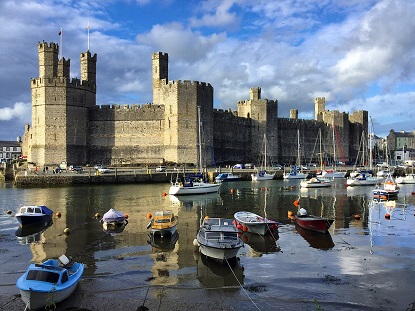
Prehistoric Wales
Earliest Human Habitation
The earliest evidence of human habitation in Wales dates back to approximately 230,000 BCE, during the Lower Palaeolithic period. Archaeological discoveries at Pontnewydd Cave in the Elwy Valley in North Wales have revealed the teeth and bones of Neanderthals, along with stone tools from this era.
The end of the last ice age around 10,000 BCE saw the gradual warming of the climate, allowing Mesolithic hunter-gatherers to establish seasonal camps throughout Wales. Notable Mesolithic sites include Nab Head in Pembrokeshire, where archaeologists have found microliths (small flint tools) and evidence of hazelnut processing.
Neolithic Revolution
The Neolithic period (c. 4400-2300 BCE) brought significant changes to Wales with the introduction of agriculture. Early farming communities cleared forests to create fields for crops and pasture for livestock. This period saw the construction of impressive megalithic monuments, including:
- Pentre Ifan in Pembrokeshire, a dramatic dolmen with a massive capstone balanced on three standing stones
- Bryn Celli Ddu on Anglesey, a passage tomb aligned with the summer solstice
- Tinkinswood burial chamber in the Vale of Glamorgan, containing the remains of approximately 50 individuals
Bronze and Iron Ages
The Bronze Age (c. 2300-800 BCE) brought metalworking technology to Wales. Copper was mined from the Great Orme in North Wales, creating one of Europe's largest prehistoric copper mines with over 5 miles of tunnels. Bronze Age communities constructed numerous stone circles, cairns, and standing stones across the Welsh landscape.
During the Iron Age (c. 800 BCE-43 CE), hillforts became a dominant feature of the Welsh landscape. Impressive examples include:
- Tre'r Ceiri on the Llŷn Peninsula, with over 150 stone roundhouses still visible
- Castell Henllys in Pembrokeshire, which has been reconstructed to show how these settlements appeared
- Pen Dinas overlooking Aberystwyth, with massive stone ramparts
These hillforts served as defensive settlements, centres of political power, and trading hubs for the various tribal groups that inhabited Wales before the Roman conquest.
Roman Wales (43-410 CE)
Conquest and Resistance
The Roman conquest of Wales began in 48 CE but faced fierce resistance from the native Celtic tribes, particularly the Silures in southeast Wales and the Ordovices in the north. The Roman historian Tacitus recorded that the Silures were especially difficult to subdue, writing that they required "either to be exterminated or transplanted."
The conquest was not completed until 78 CE when the Roman governor Gnaeus Julius Agricola defeated the Ordovices and captured the island of Mona (Anglesey), which was a stronghold of Druidic resistance. The Romans never fully controlled all of Wales, maintaining a military presence rather than fully incorporating it into civilian Roman Britain.
Military Infrastructure
The Romans established a network of forts across Wales to maintain control. Major fortresses included:
- Isca Augusta (Caerleon), headquarters of the Second Augustan Legion
- Segontium (Caernarfon), guarding the strategically important Menai Strait
- Moridunum (Carmarthen), which later developed into a significant civilian settlement
The most impressive surviving Roman military site in Wales is the amphitheatre at Caerleon, which could seat approximately 6,000 spectators and was used for military training and entertainment.
Mining and Industry
The Romans exploited Wales's mineral wealth extensively. They established gold mines at Dolaucothi in Carmarthenshire, using sophisticated hydraulic mining techniques including aqueducts and water-powered crushing equipment. Lead and copper were also mined in various locations across Wales.
Legacy and Withdrawal
Roman influence on Welsh culture was limited compared to other parts of Britain. Urbanisation was minimal, with only a few civilian settlements developing, primarily at Moridunum (Carmarthen) and Venta Silurum (Caerwent). The latter is particularly well-preserved, with substantial town walls, the foundations of shops, a basilica, and a temple.
Latin had little impact on the native Brittonic language spoken in Wales, with only a small number of Latin loanwords being adopted. Christianity was introduced during the Roman period, with the first recorded Christian martyr in Britain being St Alban in the early 4th century.
The Roman withdrawal from Britain around 410 CE left Wales vulnerable to raids from Irish pirates and later Anglo-Saxon invaders, leading to the emergence of post-Roman Welsh kingdoms.
Post-Roman Wales and the Age of Saints (410-800 CE)
Emergence of Welsh Kingdoms
Following the Roman withdrawal, Wales fragmented into numerous small kingdoms. By the 6th century, several major kingdoms had emerged:
- Gwynedd in northwest Wales, founded by Cunedda who had originally come from the Manaw Gododdin region (modern southeast Scotland)
- Powys in east and central Wales
- Dyfed in southwest Wales, which had strong Irish influences
- Gwent in southeast Wales
- Brycheiniog (Brecon) in central southern Wales
These kingdoms were ruled by dynasties who claimed descent from Roman-British leaders or from incoming Irish settlers.
The Age of Saints
The 5th and 6th centuries are known as the "Age of Saints" in Welsh history, a period of intense Christian activity. Notable Welsh saints included:
- St David (Dewi Sant), Wales's patron saint who established his monastery at what is now St Davids in Pembrokeshire
- St Illtud, who founded a major centre of learning at Llanilltud Fawr (Llantwit Major)
- St Teilo, associated with Llandaff Cathedral in Cardiff
- St Deiniol, who established the monastery at Bangor
- St Beuno, a missionary active in North Wales
These saints established monastic communities that became centres of learning and culture. The distinctive Celtic Christianity that developed in Wales emphasised asceticism, missionary work, and a decentralised church structure that differed from the Roman model.
Cultural Developments
This period saw the development of a distinctive Welsh identity and culture. The Welsh language (Cymraeg) evolved from the Brittonic language spoken throughout Britain before the Anglo-Saxon invasions. The earliest Welsh poetry dates from this era, preserved in later medieval manuscripts.
The legendary figure of King Arthur may have originated from a Romano-British leader who fought against the Anglo-Saxons. Many Arthurian locations are associated with Wales, including:
- Caerleon, identified with Arthur's court in medieval Welsh literature
- Bardsey Island (Ynys Enlli), sometimes identified with the mythical Avalon
- Llyn Llydaw on Snowdon, where Arthur's sword Excalibur was supposedly thrown
Medieval Wales (800-1282)
Viking Raids and Anglo-Saxon Pressure
From the late 8th century, Wales faced Viking raids along its coastlines. The Vikings established temporary bases on Anglesey and the Llŷn Peninsula but never settled permanently in Wales as they did in parts of England and Ireland. In 853, the Viking leader Rhodri Mawr (Rhodri the Great) of Gwynedd defeated a Viking fleet off Anglesey.
Meanwhile, pressure from the expanding Anglo-Saxon kingdoms to the east intensified. Around 784, King Offa of Mercia constructed Offa's Dyke, a massive earthwork stretching approximately 150 miles from the Dee Estuary in the north to the Severn Estuary in the south. This earthwork marked the boundary between Anglo-Saxon England and the Welsh kingdoms, and portions of it remain visible today.
Hywel Dda and Welsh Law
One of the most significant Welsh rulers of this period was Hywel Dda (Hywel the Good), who ruled much of Wales from 942 to 950. He is best known for codifying Welsh law, creating a comprehensive legal system known as the Laws of Hywel Dda (Cyfraith Hywel).
These laws were remarkably progressive for their time:
- They gave women greater legal rights than in most contemporary European societies, including the right to divorce and claim a fair division of property
- They established a detailed system of compensation for injuries rather than physical punishment
- They protected the rights of the unfree classes and provided paths to freedom
The laws were preserved in medieval manuscripts and continued to be used in Wales until the Acts of Union in the 16th century.
Gruffydd ap Llywelyn and Welsh Unity
In the 11th century, Gruffydd ap Llywelyn (c. 1007-1063) became the only ruler to control all of Wales. Through military campaigns and strategic alliances, he united the Welsh kingdoms under his rule from 1055 until his death in 1063.
Gruffydd was a formidable opponent to the English, defeating an English army at Rhyd-y-Groes near Welshpool in 1039. He allied with Ælfgar, the exiled Earl of Mercia, to attack the English border town of Hereford in 1055, burning the cathedral and causing significant damage.
Gruffydd's reign represented the height of independent Welsh power in the medieval period, but his kingdom fragmented after his death, leaving Wales vulnerable to Norman invasion.
Norman Conquest and Marcher Lords
Following the Norman Conquest of England in 1066, the Normans began to push into Wales. William the Conqueror visited St Davids in 1081, both as a pilgrimage and to demonstrate his authority. He established a series of earldoms along the Welsh border, granting his followers permission to conquer Welsh territory.
These border territories became known as the Marcher Lordships, semi-autonomous regions where the Marcher Lords had exceptional powers, including the right to build castles, establish towns, create forests, and administer their own justice. Major Marcher Lordships included:
- The Earldom of Chester in the northeast
- The Lordship of Glamorgan in the south
- The Earldom of Pembroke in the southwest
- The Lordship of Brecon in central southern Wales
The Marcher Lords built numerous castles to secure their conquests, initially as earth and timber motte-and-bailey structures, later replaced by stone fortifications. Early Norman castles in Wales included Cardiff, Chepstow, and Pembroke.
Welsh Resistance and the Rise of the Princes of Gwynedd
The Welsh princes mounted significant resistance to Norman expansion. In 1094, there was a general Welsh uprising against Norman rule, during which many castles were captured or destroyed.
From the late 12th century, the princes of Gwynedd in northwest Wales emerged as the leaders of Welsh resistance. Owain Gwynedd (ruled 1137-1170) successfully defended Gwynedd against Henry II of England and expanded his territory. His grandson Llywelyn ap Iorwerth, known as Llywelyn Fawr (Llywelyn the Great), ruled from 1195 to 1240 and extended his influence over much of Wales.
Llywelyn Fawr married Joan, the illegitimate daughter of King John of England, and was recognised as Prince of Wales by the English crown in the Treaty of Worcester (1218). He established diplomatic relations with other European powers, including the Papacy and France.
Llywelyn ap Gruffudd and the Conquest of Wales
Llywelyn ap Gruffudd (c. 1223-1282), the grandson of Llywelyn Fawr, became the dominant Welsh ruler in the mid-13th century. In 1267, Henry III of England recognised him as Prince of Wales in the Treaty of Montgomery, acknowledging his control over the native Welsh princes.
However, relations deteriorated after Edward I became King of England in 1272. Disputes over Llywelyn's vassalage and his planned marriage to Eleanor de Montfort, daughter of Simon de Montfort (a rebel against the English crown), led to conflict.
Edward I invaded Wales in 1277 with a large army, forcing Llywelyn to surrender and confining his rule to Gwynedd west of the River Conwy. In 1282, Llywelyn's brother Dafydd launched a revolt against English rule, which Llywelyn joined. On 11 December 1282, Llywelyn was killed in a skirmish at Cilmeri near Builth Wells, effectively ending Welsh independence.
Dafydd ap Gruffudd continued the resistance until June 1283, when he was captured. He was executed in Shrewsbury—the first person in recorded history to be hanged, drawn, and quartered—a punishment specifically created for him as a "traitor" to the king.
Edwardian Conquest and Colonial Rule (1282-1400)
The Edwardian Castle Building Programme
Following his conquest of Wales, Edward I implemented an ambitious castle-building programme to secure his control. Between 1277 and 1295, he constructed or substantially rebuilt a ring of castles around the coast of North Wales:
- Flint and Rhuddlan (begun 1277)
- Conwy, Caernarfon, and Harlech (begun 1283)
- Beaumaris on Anglesey (begun 1295)
These castles represented the pinnacle of medieval military architecture, designed by the Savoyard master mason James of St George. They featured concentric defences, massive gatehouses, and sophisticated defensive features. Caernarfon Castle was deliberately designed to evoke the walls of Constantinople, symbolising Edward's imperial ambitions.
The castles were accompanied by planned English boroughs, walled towns where English settlers were encouraged to live under English law, separate from the native Welsh population. These towns received royal charters and trading privileges.
The Statute of Rhuddlan
In 1284, Edward I issued the Statute of Rhuddlan (also known as the Statute of Wales), which established the constitutional basis for English rule in Wales. The statute:
- Divided the Principality of Wales (the territories formerly ruled by the Welsh princes) into counties modelled on the English system: Anglesey, Caernarfonshire, Merionethshire, Flintshire, Carmarthenshire, and Cardiganshire
- Introduced English criminal law while allowing Welsh civil law to continue in modified form
- Established a system of sheriffs, coroners, and bailiffs to administer justice
- Created the office of Justice of North Wales and Justice of South Wales to oversee the legal system
The Marcher Lordships remained semi-autonomous, outside the scope of the statute, creating a complex patchwork of jurisdictions across Wales.
Welsh Resistance and the Glyndŵr Rising
Despite Edward's efforts to secure Wales, resistance to English rule continued. Major rebellions occurred in 1287, 1294-95, and 1316-18. The 1294 rebellion, led by Madog ap Llywelyn, was particularly serious, temporarily capturing several English castles before being defeated.
The most significant uprising came in 1400 when Owain Glyndŵr (c. 1359-c. 1415), a Welsh landowner with connections to the royal houses of Powys and Deheubarth, proclaimed himself Prince of Wales and launched a national rebellion against English rule.
Glyndŵr's rebellion quickly gained momentum, spreading throughout Wales. By 1403, he controlled most of Wales and had established alliances with the Percy family in northern England and with France. In 1404, he held a parliament (senedd) at Machynlleth, where he outlined his vision for an independent Wales with its own church and universities.
French troops landed at Milford Haven in 1405 to support Glyndŵr, and the combined forces marched through Wales to Worcester before being forced to retreat. However, the rebellion gradually lost momentum after 1406 as English forces under Prince Henry (later Henry V) recaptured key strongholds.
By 1415, the rebellion had been suppressed, though Glyndŵr himself was never captured. His fate remains unknown, but he became a powerful symbol of Welsh nationalism and independence.
Tudor Wales and the Acts of Union (1485-1603)
The Rise of the Tudors
The Tudor dynasty, which would transform the relationship between England and Wales, had Welsh origins. Henry Tudor was born in 1457 at Pembroke Castle, the son of Edmund Tudor, Earl of Richmond, and Margaret Beaufort. Edmund was the son of Owen Tudor, a Welsh squire who had married Catherine of Valois, widow of Henry V.
During the Wars of the Roses, Henry Tudor spent 14 years in exile in Brittany. In 1485, he landed at Milford Haven in Pembrokeshire with a small force and marched through Wales, gathering support before defeating Richard III at the Battle of Bosworth Field. As Henry VII, he was the first Tudor monarch of England.
Henry emphasised his Welsh ancestry, naming his eldest son Arthur (evoking the legendary king) and adopting the red dragon of Cadwaladr as his personal emblem, which later became the Welsh national flag. However, his policies towards Wales were pragmatic rather than sentimental, focused on ensuring stability and loyalty.
The Acts of Union
Henry VIII, who succeeded his father in 1509, implemented the most significant constitutional changes in Welsh history through what became known as the Acts of Union (1535-1542):
- The first Act of Union (1535) extended the English legal system to Wales, abolished the Marcher Lordships, and created five new counties: Denbighshire, Montgomeryshire, Radnorshire, Brecknockshire, and Monmouthshire
- The second Act of Union (1542) established the Court of Great Sessions in Wales and defined the Wales-England border
These acts fully incorporated Wales into the Kingdom of England, creating a unified legal and administrative system. Welsh representatives were elected to the English Parliament, with 24 MPs representing the 12 Welsh counties and 12 boroughs.
While the Acts of Union imposed English administrative and legal systems on Wales, they also gave the Welsh gentry access to English institutions and offices. Many Welsh gentry families prospered under Tudor rule, building impressive manor houses and sending their sons to English universities and the Inns of Court in London.
Religious Changes and Cultural Impact
The Tudor period also saw dramatic religious changes with the Protestant Reformation. The monasteries, which had been important economic and cultural centres in Wales, were dissolved between 1536 and 1540. Major Welsh abbeys such as Tintern, Strata Florida, and Valle Crucis were abandoned and fell into ruin.
The Book of Common Prayer was translated into Welsh in 1567 by Richard Davies and William Salesbury, and the complete Bible was translated by William Morgan in 1588. These translations were crucial for the preservation of the Welsh language, providing standardised written Welsh at a time when the language might otherwise have declined.
The Acts of Union had prohibited the use of Welsh in official contexts, stating that "no Person or Persons that use the Welsh Speech or Language shall have or enjoy any manner Office or Fees within the Realm of England, Wales, or other the King's Dominions." However, the Welsh translations of religious texts, authorised by the Tudor monarchs, helped ensure the language's survival.
Wales in the Stuart Era (1603-1714)
Civil War and Revolution
The English Civil War (1642-1651) divided Wales as it did England. Initially, most of Wales supported the Royalist cause, with important exceptions in Pembrokeshire and parts of Glamorgan and Monmouthshire where Parliamentarian sympathies were stronger.
Key events of the Civil War in Wales included:
- The Battle of Montgomery (1644), where Parliamentarian forces defeated the Royalists
- The sieges of Pembroke Castle and Tenby (1648), where Parliamentarian forces under Oliver Cromwell crushed the last significant Royalist resistance in Wales
- The Battle of St Fagans near Cardiff (1648), where a Parliamentarian army defeated a Royalist uprising
Following the Royalist defeat, many Welsh castles were "slighted" (deliberately damaged) to prevent their future military use. Prominent examples included Aberystwyth, Caernarfon, and Raglan castles.
The Restoration of the monarchy in 1660 was generally welcomed in Wales, but religious tensions continued with the persecution of Nonconformists under the Clarendon Code. Welsh Quakers were particularly affected, with many emigrating to Pennsylvania, where they established Welsh-speaking settlements in what became known as the "Welsh Tract."
Industrial Beginnings
The late 17th century saw the beginnings of industrial development in Wales. Sir Humphrey Mackworth established copper smelting works at Melincryddan near Neath in 1695, using coal from his mines at Neath Abbey. The first blast furnace in Wales was built at Pontygwaith in the Taff Valley in 1658.
Lead mining expanded in Cardiganshire and Flintshire, while the copper mines at Parys Mountain on Anglesey became the largest in Europe by the late 18th century. These developments laid the foundations for the more extensive industrialisation that would transform Wales in the following century.
Cultural and Religious Developments
The 17th century saw important developments in Welsh education and culture. Jesus College, Oxford, was founded in 1571 specifically to educate Welsh students, and it remained strongly associated with Wales.
The Welsh Trust, established in 1674 by Thomas Gouge, aimed to establish schools in Wales to teach children to read the Bible in Welsh and English. By 1681, the Trust had established 87 schools teaching over 1,500 children.
The late 17th century also saw the beginnings of the Welsh Nonconformist tradition that would become so important in later Welsh history. Early pioneers included:
- William Wroth, who established the first Independent (Congregationalist) church in Wales at Llanfaches in Monmouthshire in 1639
- Walter Cradock, who preached throughout Wales during the Civil War period
- Vavasor Powell, a Baptist preacher who was imprisoned multiple times for his religious activities
Industrial Revolution and Population Growth (1750-1850)
The Transformation of South Wales
The Industrial Revolution transformed Wales from a predominantly rural, agricultural society into one of the world's first industrialised nations. The South Wales Coalfield, covering approximately 1,000 square miles across Glamorgan, Monmouthshire, Carmarthenshire, and Pembrokeshire, became the driving force of this transformation.
Iron production expanded dramatically from the late 18th century. Major ironworks were established at:
- Merthyr Tydfil, where the Dowlais, Plymouth, Cyfarthfa, and Penydarren works made it the iron capital of the world by 1830
- Blaenavon, where the ironworks (now a UNESCO World Heritage Site) began production in 1789
- Ebbw Vale, Tredegar, and Rhymney in the valleys of Monmouthshire
By 1830, Wales was producing 277,000 tons of iron annually, representing over 40% of Britain's total output. The iron industry drove technological innovation, including Richard Trevithick's first steam locomotive, which ran on the Penydarren tramroad in 1804.
Coal mining expanded dramatically to fuel the ironworks and later for export. By 1850, South Wales was producing 8.5 million tons of coal annually, rising to 57 million tons by 1913.
North Wales Industries
North Wales experienced different patterns of industrial development. The slate industry dominated in Gwynedd, with major quarries at Penrhyn, Dinorwig, and Blaenau Ffestiniog. By the late 19th century, Welsh slate roofed buildings throughout Britain and was exported worldwide.
Lead and zinc mining were significant in northeast Wales, particularly around Minera near Wrexham and in the Halkyn Mountain area of Flintshire. Copper mining at Parys Mountain on Anglesey was internationally important in the late 18th century, briefly making Britain the world's leading copper producer.
Transport Revolution
The industrial revolution necessitated improved transportation networks. Canals were constructed to move raw materials and finished products:
- The Glamorganshire Canal (completed 1794) linked Merthyr Tydfil to Cardiff
- The Monmouthshire Canal (completed 1799) connected Newport with the ironworks of the eastern valleys
- The Swansea Canal (completed 1798) served the lower Swansea Valley
Railways followed, with the Taff Vale Railway opening in 1841 and the Great Western Railway reaching Wales in 1850. By 1860, most of the South Wales valleys were served by railways, facilitating the export of coal and iron.
The growth of the coal export trade led to the rapid development of Welsh ports. Cardiff grew from a small town of 1,870 in 1801 to a city of 164,000 by 1901, becoming the world's largest coal-exporting port. Swansea, Newport, and Barry also expanded significantly as industrial ports.
Demographic and Social Change
Industrialisation drove dramatic population growth and urbanisation. Wales's population increased from approximately 500,000 in 1800 to over 2 million by 1900. Much of this growth was concentrated in the industrial areas of South Wales.
New industrial towns emerged in the South Wales valleys, often developing haphazardly with poor housing and sanitation. Merthyr Tydfil grew from a small village to become Wales's largest town by 1851, with a population of over 46,000.
This period saw significant internal migration within Wales, primarily from rural areas to the industrial regions, as well as substantial immigration from England, Ireland, and further afield. By 1851, 20% of Merthyr Tydfil's population was Irish-born.
Industrial communities developed distinctive social structures and cultural institutions. Workmen's institutes, with libraries and reading rooms, became centres of adult education. Choral singing became an important cultural tradition, with male voice choirs forming in many industrial communities.
Welsh Language and Culture in the 19th Century
Religious Revival and Nonconformity
The 19th century saw the dominance of Nonconformist Christianity in Wales, with the 1851 Religious Census revealing that 80% of Welsh worshippers attended Nonconformist chapels rather than the established Church of England.
The major Nonconformist denominations in Wales were:
- Calvinistic Methodists (later the Presbyterian Church of Wales), the only denomination to originate in Wales
- Independents (Congregationalists)
- Baptists
- Wesleyan Methodists
These denominations experienced significant growth through religious revivals, particularly the 1859 revival and the 1904-05 Welsh Revival led by Evan Roberts, which saw approximately 100,000 converts and influenced similar movements worldwide.
Nonconformist chapels became the social and cultural centres of many communities. By 1905, there were over 5,000 chapels in Wales, often impressive buildings reflecting the centrality of religion in Welsh life. Chapel activities extended beyond worship to include Sunday schools, literary societies, temperance groups, and choirs.
Nonconformity also had political implications, with chapels becoming centres of Liberal politics and campaigns for Welsh disestablishment (the separation of the Church of England in Wales from the state).
Education and the Welsh Language
The 19th century saw important developments in Welsh education. The "Welsh Not" was used in some schools to discourage children from speaking Welsh, with pupils caught speaking the language forced to wear a wooden placard and often punished at the end of the day.
Despite this, significant efforts were made to promote Welsh-language education:
- The Welsh Sunday School movement, pioneered by Thomas Charles of Bala, taught thousands of adults and children to read Welsh
- Sir Hugh Owen established the first teacher training college in Aberystwyth in 1858
- The University College of Wales was founded in Aberystwyth in 1872, followed by colleges in Cardiff (1883) and Bangor (1884)
The Welsh language faced significant challenges during this period. While it remained the majority language until the 1891 census, industrialisation and migration patterns led to its decline in many areas. However, there was also a literary and cultural revival:
- The National Eisteddfod was revived as an annual event from 1880
- The Honourable Society of Cymmrodorion was re-established in 1873 to promote Welsh literature and culture
- Important Welsh-language periodicals were established, including Y Traethodydd (1845) and Y Geninen (1883)
Political Developments and Welsh Identity
The 19th century saw the emergence of a distinctive Welsh political identity. The Rebecca Riots (1839-1843) in west Wales saw protesters, often men dressed as women, attacking toll gates in protest against road tolls and broader agricultural grievances.
The Chartist movement had significant support in industrial South Wales, culminating in the Newport Rising of 1839, when approximately 5,000 Chartist sympathisers marched on Newport, leading to a confrontation with soldiers in which at least 22 protesters were killed.
The Liberal Party became dominant in Wales from the 1860s, championing causes including land reform, religious equality, and temperance. Welsh Liberalism found its greatest champion in David Lloyd George, who was elected MP for Caernarfon Boroughs in 1890 and later became Prime Minister (1916-1922).
The campaign for Welsh disestablishment (the separation of the Church of England in Wales from the state) became a major political issue, seen as a Welsh national cause. This was finally achieved with the Welsh Church Act of 1914, which came into effect in 1920.
Modern Wales: 20th Century to Present
Economic Challenges and Social Change
The early 20th century brought severe economic challenges to Wales. The First World War initially created a boom in coal and steel production, but the post-war period saw decline as international competition increased and traditional markets were lost.
The Great Depression hit Wales particularly hard:
- Coal production fell from 57 million tons in 1913 to 35 million tons by 1934
- Unemployment in the South Wales coalfield reached 59% in 1932
- Many mining communities experienced severe hardship, with malnutrition and health problems becoming widespread
This economic crisis led to significant outmigration, with an estimated 390,000 people leaving Wales between 1921 and 1940. The Jarrow March of 1936, protesting unemployment and poverty, included many Welsh participants.
The Second World War brought temporary economic revival, with Welsh industry contributing significantly to the war effort. The post-war period saw nationalisation of key industries under the Labour government, with the National Coal Board taking control of the mines in 1947 and steel nationalisation following in 1951.
The second half of the 20th century saw continued economic restructuring:
- Coal mining declined dramatically, with employment falling from 114,000 in 1947 to just a few hundred by the 2000s
- Steel production was rationalised, with major job losses at plants in Ebbw Vale, East Moors (Cardiff), and Shotton
- New industries were attracted to Wales, including automotive manufacturing, electronics, and services
- Tourism became increasingly important, particularly in rural and coastal areas
Political Developments and Devolution
The 20th century saw significant political changes in Wales. The Labour Party replaced the Liberals as the dominant political force from the 1922 election onwards, reflecting the importance of industrial working-class communities.
Welsh nationalism emerged as a political force with the formation of Plaid Cymru (the Party of Wales) in 1925. Initially focused on cultural and linguistic issues, the party gradually developed a broader political programme and won its first parliamentary seat when Gwynfor Evans was elected MP for Carmarthen in 1966.
The question of Welsh devolution gained prominence from the 1960s:
- The appointment of the first Secretary of State for Wales in 1964 created a distinct Welsh Office within the UK government
- A Royal Commission on the Constitution (the Kilbrandon Commission) recommended elected assemblies for Wales and Scotland in 1973
- A referendum on Welsh devolution in 1979 saw the proposal rejected by a margin of 4:1
- A second referendum in 1997 approved devolution by a narrow margin (50.3% to 49.7%)
The National Assembly for Wales (now Senedd Cymru/Welsh Parliament) was established in 1999 with limited powers, initially operating under a complex system of secondary legislative authority. Its powers have been progressively expanded:
- The Government of Wales Act 2006 created a clearer separation between the executive (Welsh Government) and legislature (Assembly) and established a path to primary law-making powers
- A referendum in 2011 approved full primary legislative powers in devolved areas
- The Wales Acts of 2014 and 2017 devolved additional powers, including some taxation powers and control over elections
Cultural Developments and Language Revival
The 20th century saw important developments in Welsh culture and language. The Welsh language experienced serious decline in the first half of the century, with the percentage of Welsh speakers falling from 49.9% in 1901 to 18.9% in 1971.
However, the second half of the century saw determined efforts to reverse this decline:
- The Welsh Language Society (Cymdeithas yr Iaith Gymraeg), founded in 1962, campaigned for official status for Welsh through direct action and protests
- The first Welsh-medium primary school was established in Llanelli in 1947, beginning a movement that now educates over 22% of primary school pupils
- S4C, the Welsh-language television channel, was launched in 1982 after a campaign that included a threatened hunger strike by Gwynfor Evans
- The Welsh Language Act 1993 established the principle that Welsh and English should be treated equally in the public sector in Wales
- The Welsh Language (Wales) Measure 2011 made Welsh an official language in Wales and established the office of Welsh Language Commissioner
These efforts have helped stabilise and slightly increase the number of Welsh speakers, with the 2011 census showing 19% of the population (562,000 people) able to speak Welsh.
Welsh literature flourished in both languages. Notable Welsh writers of the 20th century included:
- Dylan Thomas, whose works include "Under Milk Wood" and "Do not go gentle into that good night"
- R.S. Thomas, a poet and Anglican priest whose work often explored Welsh identity and spirituality
- Kate Roberts, known as "the Queen of Welsh literature," whose Welsh-language short stories and novels depicted life in the slate-quarrying communities
- Saunders Lewis, a dramatist, poet, and nationalist who was a founding member of Plaid Cymru
Welsh music developed in new directions while maintaining traditional forms. Male voice choirs remained important, while new genres emerged. The 1960s saw a Welsh pop music scene develop, and the 1990s "Cool Cymru" movement brought international attention to Welsh bands such as the Manic Street Preachers, Catatonia, and Super Furry Animals.
Contemporary Wales
Modern Wales is a diverse society facing both opportunities and challenges. The traditional industrial base has largely disappeared, replaced by a mixed economy with significant public sector employment, tourism, light manufacturing, and services.
Cardiff has emerged as a modern European capital city following significant redevelopment, including the Cardiff Bay regeneration project and landmarks such as the Millennium Stadium (now Principality Stadium) and Wales Millennium Centre.
Wales has achieved international recognition in various fields:
- Sport, particularly rugby union, where the national team has won the Six Nations Championship 28 times and reached the semi-finals of the Rugby World Cup three times
- The arts, with Welsh actors including Anthony Hopkins, Catherine Zeta-Jones, and Michael Sheen achieving international success
- Music, with singers such as Shirley Bassey, Tom Jones, and Bryn Terfel gaining worldwide recognition
Contemporary challenges include:
- Economic disparities, with West Wales and the Valleys among the poorest regions in Northern Europe, qualifying for the highest level of EU structural funding before Brexit
- Post-industrial social problems, including high levels of economic inactivity and health inequalities
- The impact of Brexit, which Wales voted for by 52.5% to 47.5% despite being a net beneficiary of EU funding
- The future of the United Kingdom, with Scottish and Northern Irish constitutional questions potentially affecting Wales
The COVID-19 pandemic highlighted the reality of devolution, with the Welsh Government taking different approaches to lockdown measures and vaccination programmes from those in England, increasing public awareness of devolved powers.
Conclusion
Wales's history reveals a nation that has repeatedly adapted to profound changes while maintaining a distinctive identity. From its early Celtic origins through Roman occupation, medieval principalities, industrial transformation, and into the devolution era, Wales has evolved while preserving key aspects of its cultural heritage.
The survival and revival of the Welsh language represents perhaps the most remarkable aspect of this continuity, with Welsh now experiencing growth after centuries of decline. This linguistic persistence symbolises the broader resilience of Welsh identity throughout its long and complex history.
Today's Wales combines traditional elements with contemporary innovations, creating a modern European nation that nonetheless maintains strong connections to its past. As Wales continues to evolve within the changing constitutional framework of the United Kingdom, its distinctive history remains fundamental to understanding its present and future development.
History of European Countries
| Concise Histories of European Countries |
|---|


