


 Finland Guide
 Iceland Guide
 Norway Guide
 Sweden Guide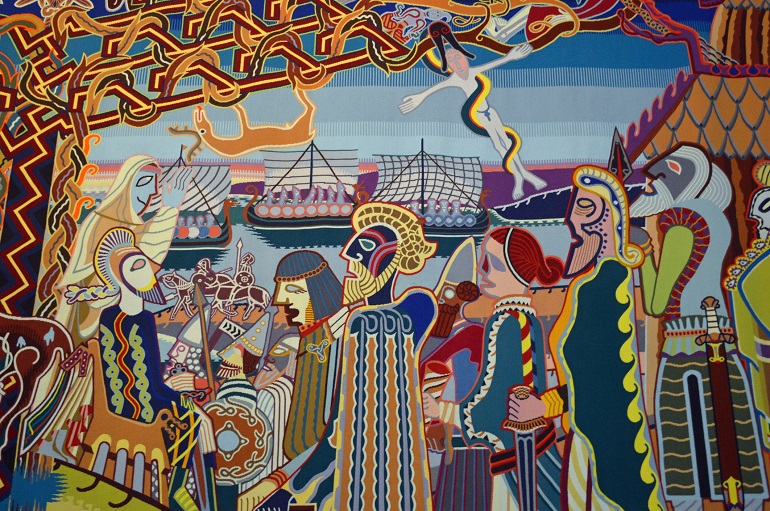
Denmark’s history spans thousands of years, shaped by its strategic location in Northern Europe. From prehistoric settlements to a modern welfare state, Denmark has undergone significant political, cultural, and social transformations. Below is an extensive account of Denmark’s history, presented in chronological order.
Prehistoric Denmark (c. 12,000 BCE–700 CE)
The first humans arrived in Denmark around 12,000 BCE, following the retreat of the Ice Age glaciers. These early inhabitants were hunter-gatherers who lived in seasonal camps near lakes and fjords. During the Mesolithic period (9,000–4,000 BCE), cultures such as the Maglemosian and Kongemose thrived, developing advanced tools and adapting to maritime environments. By 3,900 BCE, the Neolithic Revolution reached Denmark with the Funnel Beaker Culture introducing agriculture and permanent settlements. This period also saw the construction of megalithic tombs such as dolmens and passage graves.
The Nordic Bronze Age (1700–500 BCE) marked a period of cultural and technological advancement. Trade networks extended to Central Europe, evidenced by imported bronze artifacts. The famous Trundholm Sun Chariot, a bronze sculpture depicting the sun pulled by a horse, reflects the religious beliefs of this era. The Iron Age (500 BCE–700 CE) brought further societal changes as iron tools replaced bronze. During this time, Denmark’s inhabitants engaged in trade with the Roman Empire and began forming early tribal kingdoms. The Gundestrup Cauldron and the Hjortspring Boat are notable archaeological finds from this period.
The Viking Age (793–1066 CE)
The Viking Age began in 793 CE with raids on monasteries like Lindisfarne in England. Danish Vikings were among the most active raiders and settlers during this period. They established settlements across England, Ireland, and France while also venturing as far as North America (Vinland). In 866 CE, Danish Vikings captured York (Jórvík), establishing it as a key Viking stronghold in England.
Domestically, Denmark underwent significant changes during this era. Harald Bluetooth (r. 958–986) unified Denmark and introduced Christianity around 965 CE, as recorded on the Jelling Stones—monuments often referred to as Denmark’s "birth certificate." The Trelleborg ring fortresses built during Harald’s reign demonstrate advanced military organisation and engineering skills. By the early 11th century, King Cnut the Great (r. 1016–1035) ruled over a vast North Sea Empire comprising Denmark, England, Norway, and parts of Sweden. However, after Cnut’s death in 1035, his empire disintegrated.
The Viking Age ended in 1066 with Harald Hardrada’s defeat at the Battle of Stamford Bridge in England. Despite their reputation as raiders, the Vikings were also skilled traders and shipbuilders whose influence extended across Europe and beyond.
Medieval Denmark (1066–1536)
Following the Viking Age, Denmark transitioned into a feudal Christian kingdom. In 1086, King Canute IV was assassinated after attempting to strengthen royal authority and enforce church tithes; he was later canonised as Denmark’s first saint. During the 12th century, Denmark expanded its influence under Valdemar I (r. 1157–1182) and Bishop Absalon, who founded Copenhagen in 1167 as a trading post and fortress.
The late medieval period saw Denmark reach its territorial zenith under Valdemar II (r. 1202–1241), who conquered parts of northern Germany and Estonia. According to legend, the Danish flag (Dannebrog) fell from the sky during the Battle of Lindanise in Estonia in 1219. However, Valdemar’s successors faced internal strife and external challenges from German states and Sweden. In 1397, Queen Margaret I united Denmark, Norway, and Sweden under the Kalmar Union—a political alliance that lasted until Sweden’s departure in 1523.
The late Middle Ages were marked by economic decline due to wars and plagues such as the Black Death (1348–1350), which killed roughly one-third of Denmark's population. The Hanseatic League dominated trade in the Baltic Sea region during this time, challenging Danish economic interests.
Reformation and Early Modern Period (1536–1660)
In 1536, King Christian III officially introduced Lutheranism to Denmark during the Protestant Reformation. Catholic monasteries were dissolved, church lands were confiscated by the crown, and Lutheranism became the state religion. This marked a significant cultural shift that aligned Denmark with other Protestant states in Northern Europe.
During this period, Denmark also began its colonial ventures. In 1620, it established its first overseas colony at Tranquebar in India and later expanded into West Africa (the Gold Coast) and the Caribbean (St. Thomas). Domestically, King Christian IV (r. 1588–1648) oversaw a cultural renaissance marked by grand architectural projects such as Rosenborg Castle and Rundetårn Observatory in Copenhagen.
However, Denmark faced military setbacks during this era. It was defeated by Sweden in several wars during the mid-17th century, culminating in the Treaty of Roskilde (1658), where Denmark ceded Scania, Halland, Blekinge, Bornholm (later regained), and parts of Norway to Sweden.
Absolutism and Enlightenment (1660–1814)
In 1660–1661, King Frederik III abolished elective monarchy and established absolutism through a bloodless coup d’état. This centralised power allowed subsequent monarchs to implement reforms more effectively. The Kongeloven (King’s Law) of 1665 formalised absolutist rule.
Denmark also expanded its colonial empire during this period but became increasingly reliant on trade monopolies such as those operated by the Danish West India Company. In 1792, Denmark became one of the first nations to ban participation in the transatlantic slave trade (effective from 1803).
The Napoleonic Wars had devastating consequences for Denmark. After siding with France against Britain during these conflicts, Copenhagen was bombarded twice by British forces (1801 and 1807). In 1814, following defeat in war against Sweden allied with Britain at Kiel Treaty , Denmark lost Norway but retained Greenland , Iceland & Faroe Islands .
Constitutional Monarchy & Industrialisation (1814-1914)
The loss of Norway in 1814 marked the beginning of a new era for Denmark. The country gradually transitioned from an absolute monarchy to a constitutional one. In 1849, King Frederik VII signed Denmark's first democratic constitution, establishing a two-chamber parliament and granting basic rights to citizens. This period also saw the rise of Danish national identity, influenced by thinkers like N.F.S. Grundtvig, who established the folk high school movement to promote popular education.
Industrialisation arrived later in Denmark compared to other European nations but progressed rapidly from the 1870s onwards. The agricultural sector underwent significant modernisation, shifting from grain production to dairy and meat exports. The cooperative movement played a crucial role in this transformation, with the first cooperative dairy established in 1882. In urban areas, industries such as shipbuilding and brewing expanded, while Copenhagen grew as a major port and commercial centre.
Denmark faced another significant territorial loss in 1864 when it was defeated by Prussia and Austria in the Second Schleswig War, resulting in the loss of Schleswig and Holstein. This defeat led to a period of introspection and the adoption of a neutral foreign policy. The motto "What is lost externally shall be gained internally" guided efforts to reclaim heath and marshlands for agriculture, particularly in Jutland.
World Wars and Interwar Period (1914–1945)
Denmark maintained neutrality during World War I (1914-1918) but profited from trade with both sides. In 1915, a new constitution was adopted, granting women the right to vote. In 1920, following a plebiscite, Northern Schleswig was reunited with Denmark, partially reversing the losses of 1864.
The interwar period saw the establishment of Denmark's welfare state foundations. The Social Democratic Party, led by Thorvald Stauning, formed its first government in 1924. The Great Depression hit Denmark hard, but the Kanslergade Agreement of 1933 introduced major social reforms and agricultural subsidies, setting the stage for the modern Danish welfare system.
Despite signing a non-aggression pact with Nazi Germany, Denmark was occupied on April 9, 1940. The Danish government initially pursued a policy of cooperation to protect its citizens, but resistance grew over time. In August 1943, the government resigned rather than accede to German demands. The Danish Resistance, with help from ordinary citizens, managed to evacuate nearly all of Denmark's Jewish population to neutral Sweden in October 1943, saving them from deportation to concentration camps.
Post-War Denmark and Modern Era (1945–Present)
After World War II, Denmark joined NATO in 1949, abandoning its traditional neutrality. The country also became a founding member of the United Nations and later joined the European Economic Community (now the European Union) in 1973. The post-war years saw rapid economic growth and the expansion of the welfare state, with universal healthcare, free education, and comprehensive social security becoming hallmarks of Danish society.
In 1953, a constitutional reform allowed for female succession to the throne, leading to the ascension of Queen Margrethe II in 1972. Denmark's relationship with the EU has been marked by some reservations, with Danes rejecting the Maastricht Treaty in 1992 and the Euro in 2000. However, Denmark remains an active EU member with opt-outs in certain areas.
In recent decades, Denmark has been at the forefront of green energy initiatives, particularly in wind power. The country has also grappled with issues of immigration and integration, sparking national debates. Internationally, Denmark has maintained an active role in peacekeeping missions and development aid.
Today, Denmark is known for its high standard of living, strong social welfare system, and commitment to sustainability. It consistently ranks among the world's happiest and least corrupt countries, serving as a model for progressive policies in areas such as work-life balance, gender equality, and environmental protection.
History of European Countries
| Concise Histories of European Countries |
|---|


