Introduction
Tournai, one of Belgium's oldest cities, is a treasure trove of history and culture nestled in the Wallonia region. Founded by the Romans around 50 CE, it briefly served as the capital of the Frankish Empire under Childeric I and Clovis I. The city boasts an impressive architectural heritage, including the UNESCO World Heritage-listed Cathedral of Our Lady with its distinctive five towers and the oldest belfry in Belgium. Tournai's rich past includes a brief period under English rule during Henry VIII's reign, making it the only Belgian city ever held by the British. Today, visitors can explore seven municipal museums, admire well-preserved medieval architecture, and experience the city's vibrant cultural scene. The annual Great Procession of Tournai, held on the second Sunday of September, offers a glimpse into the city's enduring traditions.
Interesting Facts about Tournai
- Tournai is the oldest town in Belgium, founded by the Romans around 50 CE.
- The city served as the capital of the Frankish Empire under King Childeric I in the 5th century.
- Tournai is known as the "cradle of France" due to its historical significance during the reign of Clovis.
- The Cathedral of Our Lady, a UNESCO World Heritage site, features five iconic towers and a mix of Romanesque and Gothic architecture.
- Tournai's Belfry is the oldest in Belgium and offers stunning panoramic views from its top.
- During Henry VIII's reign, Tournai was the only Belgian city to be ruled by England.
- The city flourished in the Middle Ages as a centre for tapestry, embroidery, and goldsmithing.
- Renowned painter Rogier van der Weyden was born in Tournai, contributing to its artistic legacy.
- The Musée des Beaux-Arts, designed by Victor Horta, houses works by Manet, Monet, Rubens, and Van Gogh.
- Tournai was heavily bombed during World War II but has been carefully restored to preserve its historical charm.
History
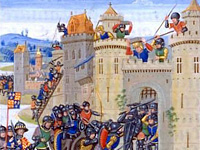
Tournai was founded by the Romans around 50 CE, making it the oldest town in Belgium long with Tongeren. It became a royal city of the Kingdom of France under Merovingian kings Childeric and Clovis, and was still French during the Hundred Years War.
Throughout its tumultuous past, Tournai changed hands numerous times, belonging to various European powers. Notably, it was briefly under English rule during Henry VIII's reign from 1513 to 1519, making it the only Belgian city to have ever been part of England. The city flourished in the late Middle Ages as a centre for tapestry, embroidery, and goldsmith's works.
Despite suffering damage during both World Wars, Tournai's historical significance remains evident in its well-preserved medieval architecture, including the UNESCO World Heritage sites of the Cathedral of Our Lady and the Belfry, which stand as testaments to the city's enduring cultural importance.
Main Attractions
Our Lady's Cathedral
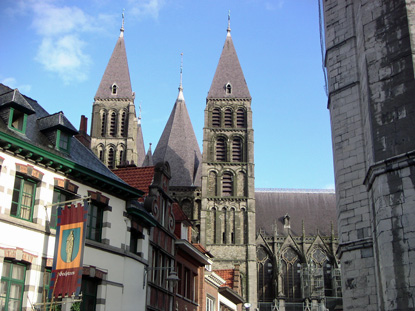
The town's most interesting edifice are the 800 years old Our Ladys' Cathedral (Cathedral Notre-Dame in French) and its its five towers.
The nave and the transept, in Romanesque style, were built in the 12th Century, while the choir, in Gothic style, was built in the 13th century.
Dont' miss "The deliverance of souls from the Purgatory" by Pierre-Paul Rubens in the St Louis Chapel. The Treasury has reliquary chests and shrines from the 13th century.
 Our Lady's Cathedral, Tournai Our Lady's Cathedral, Tournai
The cathedral is open from 9.30am to noon and 2pm to 5.30pm from April to October, and 10am to noon and 2pm to 4pm the rest of the year. Admission is free.
The Treasury is open at the same time, but opens 15min later and closes 15min earlier. Admission is 1 for individuals or 3 for families or school groups.
Belfry
The 72m high belfry of Tournai was erected in 1188 and is the oldest in Belgium and in Northern Europe. You can climb the 256 steps to the top using the spiral stairs. It is open from 10am to 1pm and 2pm to 6.30pm from March to October, and 10 am to noon and 2 pm to 5 pm the rest of the year. It is closed on Mondays, Sunday mornings, on 15 August, 25 December and 31 December to 3 January.
 Grand Place & Belfry, Tournai Grand Place & Belfry, Tournai
Other attractions
Some 12th century Romanesque stone houses have survived rue Barre Saint-Brice and are among the oldest burghers houses remaining in Western Europe.
The Town Hall was built on the 11th-century Benedictine abbey of Saint-Martin in the early 19th century. The 13th c. Romanesque crypt and part of the 14th c. Gothic cloister have survived. The 13th-century bridge flanked by two towers known as 'Pont des Trous' was part of the old city wall and one of the few such building still standing in the world.
The Cloth Hall is a splendid Renaissance building from 1610-1612 that merchants used to sell cloth goods on the market square. It was restored in 1998.
 Statue of Christine de Lalaing on the Grand Place Statue of Christine de Lalaing on the Grand Place
The Tower of Henry VIII Tudor was built during the few years the city joined England in the early 16th century. Although the castle once had 60 towers and 18 gates, only the Marvis Tower, the Great Tower and the Pont des Trous remain. The Great Tower is 27m in external diameter with walls 6.9m thick.
Local Cuisine
Tournai's culinary scene offers a delightful mix of sweet and savoury specialties that reflect the city's rich heritage. Visitors can indulge in Ballons Noirs, hard black candies made from three types of sugar, or savour the Desobry Biscuits, delectable part-chocolate cookies perfect with coffee. For a heartier meal, try the Lapin à la Tournaisienne, a traditional dish of rabbit slowly cooked with onions, raisins, prunes, and sometimes dark beer. The Ficelle Picarde, a savoury pancake stuffed with ham, mushrooms, and cream, is another local favourite. Don't miss the Gâteau Clovis, a frangipane cake filled with apricot and pineapple compote, created in homage to the Merovingian king. To wash it all down, sample the locally brewed Tournay beer, which comes in various styles including ale, dark, and triple. For a truly unique experience, visit during January to partake in the Lundi Perdu tradition, where locals enjoy a feast featuring specialties like Tournai-style rabbit and the Tournai salad, a mix of 13 different ingredients.
Getting There & Around
Tournai is easily accessible by various modes of transport. By train, the city is well-connected, with regular services from major Belgian cities. Direct trains from Brussels run hourly on weekends and more frequently on weekdays, taking approximately one hour. From Lille in France, direct trains take 30-60 minutes, offering a convenient connection to the Eurostar network. For those flying in, the nearest airport is Lille Lesquin (LIL), though Brussels Airport (BRU) and Brussels South Charleroi Airport (CRL) offer more extensive flight options. If driving, Tournai is accessible via the E429 motorway, about 90 km from Brussels and 30 km from Lille. The E19 and E42 also provide routes from Mons, whilst the E403 connects Bruges and Kortrijk to Tournai.
| 


 Luxembourg Guide
 Netherlands Guide


