


 Belgium Guide
 Luxembourg Guide


Introduction
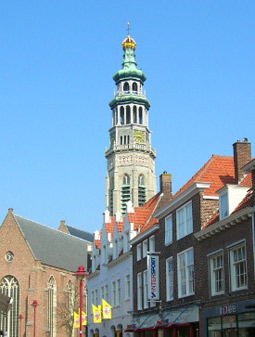
Middelburg, the charming capital of Zeeland province in the south-western Netherlands, is a compact city rich in history and architectural splendour. Founded as a fortified town in the 9th century to guard against Viking raids, it evolved into one of the Netherlands' most important trading cities during the Golden Age, second only to Amsterdam. Today, this vibrant city boasts over 1,200 listed historical buildings, reflecting its prosperous past as a major centre for the Dutch East India Company. Situated on the Walcheren peninsula between the Eastern and Western Scheldt estuaries, Middelburg combines a beautifully preserved medieval centre with stately canal houses, winding alleyways, and impressive monuments including the late Gothic Town Hall and the Abbey complex with its 91-metre tower affectionately called 'Lange Jan'. The city also played a significant role in the Scientific Revolution, with the invention of the microscope and telescope often credited to Middelburg spectacle-makers in the late 16th and early 17th centuries. With its diverse shops, restaurants, cultural museums and regular markets, Middelburg offers visitors a perfect blend of historical exploration and modern amenities, all within a walkable city centre.
History
Middelburg was founded as a "burg" (fortified town) in the 9th century to guard against Viking raids. The first abbey was built in 844, and was replaced by a new one in 1125.
Middelburg was part of the County of Zeeland, which was soon to be disputed by the Counts of Holland and those of Flanders. The city was granted a charter of rights in 1217. In 1299, Holland and Zeeland both passed to the Counts of Hainaut, then to the Wittelsbach of Bavaria in 1345, to the Dukes of Burgundy a century later, and finally to the Habsburgs.
The Eighty Years' War (1568-1648) with Spain resulted the independence of the United Provinces of the Netherlands, of which Zeeland was part.
Middelburg became a major trading city between England and the cities of Flanders (e.g. Ghent and Bruges), then, from 17th century, for the Dutch East India Company. The Gothic townhall reflects the Flemish influence of the late medieval period, while the beautiful townhouses were built on the wealth from the colonial activities.
Much of the city was destroyed by German bombing in May 1940, but most of the historical buildings were reconstructed afterwards.
Attractions
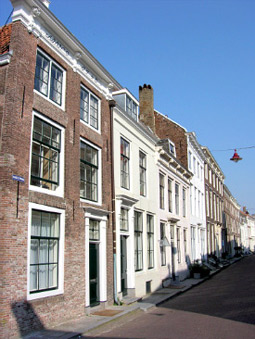
The main interest of the city is its beautiful townhouses and pleasant atmosphere. The historic centre is surrounded by the old moat and a few surving gates. Spaniaardstraat (Spanairds Street) and Singelstraat, between the Abbey and the Oostkerk, have some of the nicest constructions in town.
Dominating on the Markt (town square), the late Gothic Stadhuis (town hall), completed in 1458, is the architectural jewel of the city. It is ornated with statues of the Burgundian rulers of the time. The various halls inside are decorated with Flemish tapestries.
The Abdij (abbey) is a vast enclosed abbatial complex. The southern part is composed of the eye-catching 91m tower, affectionately called 'Lange Jan' (Long John) by the locals, as well as three churches : the 14th-century Koorkerk, the 16th-century Nieuwe kerk and the 17th-century Wandelkerk. The northern section houses the Zeeuws Museum, renovated in 2007 by a well-known Belgian architect. The museum has a fine collections of china, silver and paintings, and tapestries.
North-east of the abbey, the Oostkerk ("East Church") is an octagonal Baroque structure topped by a dome.


How to get there
Getting to Middelburg is straightforward, with the train being the most convenient option. From Amsterdam Schiphol Airport, trains run approximately 37 times daily, taking around 2 hours and 20 minutes to reach Middelburg Station, which is just a 7-minute walk from the city centre. The journey requires one change and can cost as little as €2.30 per hour for parking if you choose to drive. Once in Middelburg, the compact city centre is easily explored on foot, but for those wishing to venture further, local buses connect to surrounding areas like Veere, Vlissingen, and Domburg. The bus station is conveniently located next to the train station. For a sustainable transport option, consider using the mobility hub at Oude Veerseweg, which offers free parking plus shared bikes, e-scooters, and bicycle rental services. The OVpay system allows travellers to check in and out of public transport using debit cards, credit cards or mobile phones, eliminating the need to purchase tickets in advance.