


 Belgium Guide
 Luxembourg Guide
Introduction
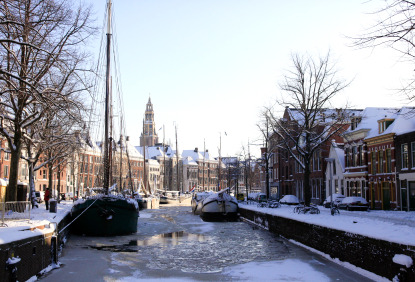
Groningen, the vibrant capital of the eponymous province in the northern Netherlands, is a city that seamlessly blends ancient history with youthful energy. With a population of approximately 230,000, including a significant student community, Groningen boasts a rich cultural heritage dating back over 2,000 years. The city centre, encircled by canals, features medieval architecture, picturesque courtyards, and the iconic Martini Tower, a 97-metre-tall Gothic beacon that has watched over the city for more than five centuries. Known for its thriving arts scene, world-class museums, and innovative architecture, Groningen is also celebrated as one of the most bicycle-friendly cities in the world, with over 60% of all traffic attributed to cycling. The city's commitment to sustainability and quality of life has earned it recognition as one of the healthiest cities in the Netherlands, boasting the cleanest air among Dutch urban areas.
History
Probably inhabited for some 6000 years, the first archeological evidence of a settlement in Groningen itself dates from the 3rd century CE. The town was not mentioned in documents before 1040 though.
In the 13th century, when Groningen was an important trade center, and a member of the Hanseatic league since 1253. The city had a strong influence on the surrounding lands and made its dialect a common tongue.
The most influential period of the city was the end of the 15th century, when the nearby province of Friesland was administered from Groningen.
The city's stadhouder chose to side with the Spanish forces during the Eighty Years' War in 1577. After being captured in 1594, it switched sides, joining the Republic of the Seven United Netherlands.
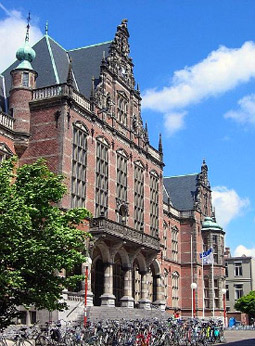
The University of Groningen was founded in 1614, initially only for religious education. In 1672, during the Third Anglo-Dutch War, the city was bombarded by the troops of the Bernhard von Galen, Bishop of Münster. The city walls resisted, and to this day, this event is celebrated on 28 August, when the city bustles with music and fireworks.
Attractions
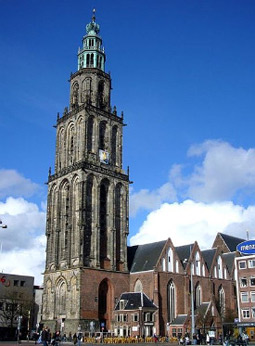
The city did not escape the devastation of World War II, in particular the Grote Markt (town square). The town hall dates from 1810 - quite new by Dutch standards. The Vismarkt (fish marquet) is better preserved than its big sister. Noteworthy buildings in the historic centre include the , the Prinsenhof (Princes' court), Martinikerk (Martini church) and Martinikerkhof, the Korenbeurs (corn exchange) and the Sint-Jozefkathedraal (St Joseph's Cathedral).
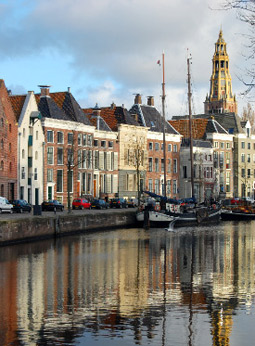
The 97m-high Martini Tower is the city's landmark. It was rebuilt between 1469 and 1482 , after the first 30m-high tower, then the second 45m-tall tower were destroyed by lightning. At the time of its completion, it reached 127 meters in height, making it one of the highest towers in Europe. Its architecture was influenced by the Dom Tower of Utrecht. It has since been damaged by the elements numerous times again. It partial collapsed in 1577, was maintained at 69m, then was repaired to 97m in 1627.
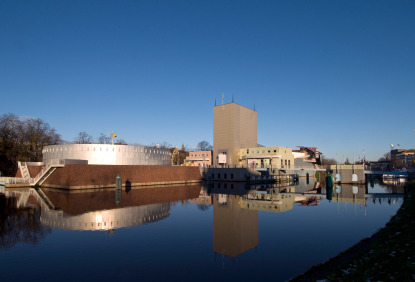
The Groninger Museum is considered to be one of the best museums in The Netherlands. Opened in 1994, the building became a well known highlight in the world of art. It was designed by the architects Philippe Starck, Alessandro Mendini and Coop Himmelblau. It mostly hosts collections of Dutch and international modern and abstract art.
Other museums in town include the Northern Maritime Museum, the Niemeyer Tobacco Museum, the Dutch Comics Museum, the Graphic Museum and the University Museum.
How to get there
Groningen is a compact city that's exceptionally easy to navigate. The city centre is largely car-free, making walking and cycling the preferred methods of transport for locals and visitors alike. Almost any destination within the city can be reached on foot or by bicycle, with Groningen being declared the healthiest city in the Netherlands due to its green spaces and cyclist-friendly infrastructure. If you're arriving from elsewhere, the city is well-connected by train to major Dutch cities and parts of northern Germany, with the impressive Central Station worth admiring upon arrival. For those driving, several highways connect to Groningen, including the A7 (west-east) and A28 (from the south), though parking in the centre can be challenging. Consider using one of the convenient Park & Ride facilities around the city, where you can park for free and take a frequent bus into the centre for just €6 return for up to five people. The local bus network, operated by Qbuzz, offers comprehensive coverage of the city and surrounding areas, with tickets ranging from €3,05 for short journeys to €17,90 for a day ticket allowing unlimited travel throughout Groningen and Drenthe.