Ireland Guide  |
|---|
|
| | Top Destinations |
|---|
|
| | Irish Regions |
|---|
|
| | Travel Tools |
|---|
|
| | UK & Ireland Guide |
|---|
|
|
|
|
 Belfast Castle. Belfast Castle.
Introduction
Ulster (Ulaidh in Irish, Ulstèr in Ulster Scots) is the northern province of Ireland. Three of its counties (Cavan, Donegal and Monaghan) belong to the Republic of Ireland, while the six other counties belong to the United Kingdom as part of the region of Northern Ireland.
The vast majority of Ulster's 2.1 million inhabitants live in Northern Ireland (1.8 million), of whom one third live in the Belfast Metropolitan area (pop. 640,000). Most people in Ulster speak English. Irish Gaelic is also fairly common, and is understood at least to some extent by 10% of the population. Ulster Irish is spoken by over half of the population in County Donegal. The Ulster dialects of Scots language (the Germanic language from Lowland Scotland, not the Scottish Gaelic from the Highlands) is spoken by 2% of Northern Ireland residents, principally in County Antrim, but also in parts of County Down and County Londonderry. The language was imported from Lowland Scotland in the 17th century following the Plantation of Ulster, an organised colonisation of lands confiscated to Irish chieftains and given by wealthy landowners, under the supervision of King James VI of Scotland (a.k.a. James I of England).
Ulster was once known for being home to the fiercest warriors of all Ireland. Perhaps that is why Ulster contributed to no less than six Field Marshals of the United Kingdom in the 20th century (Earl Alexander of Tunis, Sir Archibald Montgomery-Massingberd, Sir Claude Auchinleck, Sir John Greer Dill, Sir Alan Francis Brooke, and Viscount Montgomery of El Alamein).
Famous Irish people from Ulster include (chronologically): the American Civil War general Philip Sheridan, the poet and novelist Patrick Kavanagh, the Nobel prize poet and playwright Seamus Heaney, the actor Kenneth Branagh, and the singer Enya.
Famous Scots from Ulster include (chronologically): the industrialist (and co-founder of Procter & Gamble) James Gamble, the entrepreneur, banker and lawyer Thomas Mellon, the chemist and physicist Thomas Andrews, the physicist and engineer William Thomson, 1st Baron Kelvin, New Zealand Prime Minister William Massey, the shipbuilder (and designer of the Titanic) Thomas Andrews, Jr., the motorcyclist Joey Dunlop, and the singer Van Morrison.
Attractions
County Antrim
| Belfast |
|---|

 Belfast offers a rich tapestry of attractions, from the world's largest Titanic visitor experience to the historic Crumlin Road Gaol dating back to the 19th century. The city boasts over forty public parks, with Ormeau Park being the oldest municipal park, opened in 1871. The iconic Cave Hill Country Park, whose silhouette resembles a sleeping giant, inspired Jonathan Swift's Gulliver's Travels and features five ancient caves along with McArt's Fort sitting 368 metres above sea level. The Botanic Gardens, established in 1828, houses exotic tree species and a unique red-brick greenhouse showcasing some of the oldest seed plants known today. The city's natural heritage is exemplified by the Lagan Valley Regional Park, where visitors might spot otters and kingfishers along the River Lagan. Two massive yellow-painted gantry cranes, named Samson and Goliath, have become defining features of Belfast's skyline. |
Other attractions
 Dunluce Castle (ruins) Dunluce Castle (ruins)
| Giant's Causeway |
|---|
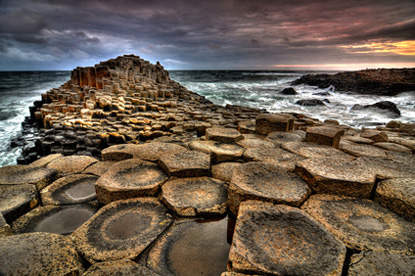
 The Giant's Causeway features over 40,000 interlocking basalt columns formed by volcanic activity around 60 million years ago. These distinctive hexagonal columns, reaching heights of up to 12 metres, were created when lava cooled and contracted, though local folklore attributes their construction to the giant Finn McCool. A fascinating new geological theory suggests the formation occurred when ground subsided as lava erupted and filled a depression, taking mere days rather than the thousands of years previously thought. Visitors can explore the site's UNESCO World Heritage status whilst sampling local delicacies at nearby establishments, including traditional Irish stew, seafood chowder, and homemade scones. The Bushmills Inn, considered one of the area's finest restaurants, serves sophisticated Irish dishes using local produce, including their renowned braised belted beef. |
County Armagh
 Armagh
County Cavan
Cloughoughter Castle (ruins)
County Donegal
| Glenveagh National Park |
|---|

Glenveagh National Park spans over 16,000 hectares of pristine wilderness, featuring a stunning Victorian castle built between 1867-1873 that once hosted celebrities like Marilyn Monroe and John Wayne. The park houses one of Ireland's largest herds of red deer and is home to reintroduced Golden Eagles, alongside foxes, badgers, and diverse birdlife. The Scottish baronial-style castle, accessible only by guided tour, showcases original antiques and is surrounded by renowned gardens including a Gothic Orangery, Italian Terrace, and Tuscan Garden. Visitors can explore six walking trails ranging from the gentle 1km Garden Trail to the challenging 8km Glen Walk, whilst the castle itself features a four-storey keep constructed from local granite with distinctive features such as corner turrets, mock watchtowers, and Irish stepped battlements. Wild camping is permitted in designated areas, and a shuttle bus service connects the visitor centre to various trail starting points. |
| Donegal Castle |
|---|

Donegal Castle, a beautifully restored 15th-century fortress, features a rectangular keep with walls up to 3 metres thick and a Jacobean manor house wing added in 1623. Originally built in 1474 by Hugh O'Donnell, it served as the stronghold of the powerful O'Donnell clan until 1607, when they destroyed parts of it during their departure in the Flight of the Earls. The castle's strategic location on a bend in the River Eske was so impressive that in 1566, the English Viceroy declared it "the largest and strongest fortress in all Ireland". After falling into ruins in the 18th century, the castle underwent extensive restoration in the 1990s using medieval methods and local limestone, and now showcases an impressive great hall with a vaulted ceiling and carved wooden fixtures that reflect its medieval origins. |
County Down
| Castle Ward |
|---|
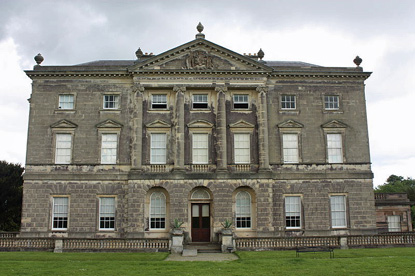
Castle Ward is a remarkable 18th-century mansion featuring a unique architectural split personality - its front façade is classical Palladian whilst its rear is Georgian Gothic, reflecting the opposing tastes of Bernard Ward and his wife Lady Ann Bligh. The 820-acre estate encompasses landscaped gardens, a Victorian laundry, a working corn mill, and a fortified tower house from 1610 that features defensive elements like murder-holes and machicolations. The property, which cost £40,000 to build in the 1760s, includes Temple Water, a man-made canal constructed in 1728 that powers the estate's mills and stands as Ireland's largest surviving ornamental water feature from the early 18th century. The house's divided architectural style extends throughout the interior, with Bernard's side featuring mahogany furnishings and marble fittings, whilst Ann's Gothic preferences are displayed in the opposite wing - a design choice that perhaps foreshadowed their eventual separation. |
| Hillsborough |
|---|

Hillsborough centres around its Georgian mansion, misleadingly called Hillsborough Castle, which serves as His Majesty The King's official residence in Northern Ireland and has hosted notable figures from Benjamin Franklin to the Dalai Lama. The estate originated in the 1650s when the Hill family built a fort to protect the road from Carrickfergus to Dublin. The castle, completed in 1788, is unusual for an Irish Big House as it forms part of the town square rather than being set apart from the settlement. The 100-acre castle grounds feature an 18th-century walled garden, a pinetum, and Lady Alice's Temple by the lake. Adjacent to the castle lies Hillsborough Forest, spanning 200 acres, which serves as a wildlife sanctuary where visitors can spot various waterfowl species. The village offers several dining establishments, including historic pubs such as The Plough Inn, The Hillside, and The Parson's Nose. |
Other attractions
Downpatrick
County Fermanagh
| Castle Coole |
|---|

Castle Coole is a magnificent neoclassical mansion built between 1789 and 1798 at a cost of £57,000 (equivalent to approximately £20 million today) for Armar Lowry-Corry, the first Earl of Belmore. The estate spans 1,200 acres of parkland and woodlands, featuring several lakes including Lough Coole, where visitors can spot prehistoric remnants such as a crannog. The mansion, designed by architect James Wyatt who never actually visited the site, showcases exquisite neoclassical architecture with Portland stone cladding, whilst its interior boasts remarkable features including a double-return cantilever staircase, gilded furniture, and delicate plasterwork by Joseph Rose. A fascinating feature of the house is its underground tunnel stretching 260 feet to the stable yard, which allowed servants to come and go unseen, maintaining the illusion of a perfect classical composition. The estate also includes historic walled gardens with former heated greenhouses that once grew melons, cherries and grapes, and an ice house that visitors can explore. |
Other attractions
 Marble Arch Caves Marble Arch Caves
| Florence Court |
|---|
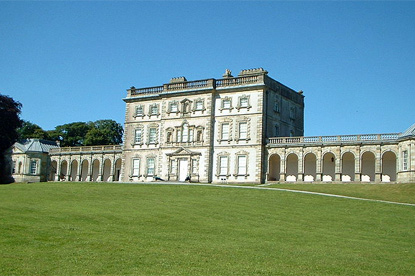
Florence Court is a grand Georgian mansion named after Florence Bourchier Wrey, wife of Sir John Cole who first built a house on the site in the early 18th century. The estate features spectacular gardens, including an American garden with rhododendrons and azaleas, and is home to the original Irish yew tree1. The house's architect remains a mystery, though its superb decorative plasterwork and Palladian design make it architecturally significant. The estate once encompassed nearly 30,000 acres and was largely self-sustaining, with its own tile works, sawmill, and extensive walled gardens which are currently being restored by volunteers. The 3rd Earl of Enniskillen, who lived there, was a notable palaeontologist whose fossil fish collection was eventually sold to the British Museum. After suffering a severe fire in 1955, much of the house was restored, though the nursery ceiling could not be recreated due to lack of photographic evidence. |
County Londonderry (Derry)
Londonderry
Mussenden Temple & ruins of Downhill House
County Tyrone
Strabane
|


 England Guide
 Scotland Guide
 Wales Guide


 Belfast offers a rich tapestry of attractions, from the world's largest Titanic visitor experience to the historic Crumlin Road Gaol dating back to the 19th century. The city boasts over forty public parks, with Ormeau Park being the oldest municipal park, opened in 1871. The iconic Cave Hill Country Park, whose silhouette resembles a sleeping giant, inspired Jonathan Swift's Gulliver's Travels and features five ancient caves along with McArt's Fort sitting 368 metres above sea level. The Botanic Gardens, established in 1828, houses exotic tree species and a unique red-brick greenhouse showcasing some of the oldest seed plants known today. The city's natural heritage is exemplified by the Lagan Valley Regional Park, where visitors might spot otters and kingfishers along the River Lagan. Two massive yellow-painted gantry cranes, named Samson and Goliath, have become defining features of Belfast's skyline.
 Dunluce Castle (ruins)
 The Giant's Causeway features over 40,000 interlocking basalt columns formed by volcanic activity around 60 million years ago. These distinctive hexagonal columns, reaching heights of up to 12 metres, were created when lava cooled and contracted, though local folklore attributes their construction to the giant Finn McCool. A fascinating new geological theory suggests the formation occurred when ground subsided as lava erupted and filled a depression, taking mere days rather than the thousands of years previously thought. Visitors can explore the site's UNESCO World Heritage status whilst sampling local delicacies at nearby establishments, including traditional Irish stew, seafood chowder, and homemade scones. The Bushmills Inn, considered one of the area's finest restaurants, serves sophisticated Irish dishes using local produce, including their renowned braised belted beef.
 Armagh


 Marble Arch Caves

 : Outstanding place
 : Must-see in the country
 : Top cities in Europe