Austria Guide  |
|---|
|
| | Austrian States |
|---|
|
| | Central Europe |
|---|
|
| | Europe Guide |
|---|
|
| | Travel Tools |
|---|
|
|
|
|
 Annaberg am Lammertal, Upper Austria Annaberg am Lammertal, Upper Austria

Introduction
Upper Austria (Oberösterreich) is a federal state in northern Austria that showcases a diverse landscape and rich cultural heritage. Located between the Inn and Enns rivers, the region is traversed by the mighty Danube River.
Geography and Landscape
The northeastern portion features the Austrian granite plateau, known as the Mühlviertel, which lies north of the Danube. This area has poor soil and extensive woodlands, with grasslands at lower elevations. The southern part is characterized by Alpine terrain, including limestone mountains and the scenic Salzkammergut resort region with its numerous lakes.
Historical Development
Salt deposits attracted settlers since prehistoric times, particularly around Hallstatt. In 1192, the region (then called Traungau) became part of the duchy of Austria. The area was officially separated from Lower Austria around 1450, with Linz becoming its capital in 1490. During the Anschluss (1938-1945), it was renamed to Reichsgau Oberdonau.
Culinary Heritage
Upper Austria's culinary landscape is particularly notable for:
- Spicy dumplings
- Linzer Torte, considered the oldest pastry named after a city, with a recipe dating back 360 years
- Local cider production
Attractions
| Linz |
|---|
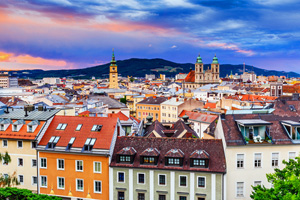
 Linz, Austria's third-largest city with around 200,000 inhabitants, originated as the Roman settlement of Lentia and later flourished as an important medieval trading centre along the Danube. The city features beautiful old houses on a vast medieval square, whilst also standing out as one of Austria's most modern cities with groundbreaking theatres, concert halls, and hi-tech museums. The city has a notable scientific heritage, as astronomer Johannes Kepler lived here and discovered that planets revolve around the sun in elliptical paths. Mozart composed 'The Linz Symphony' here in just three days. The harbour area has been transformed into an open-air gallery showcasing international graffiti and murals, whilst the city hosts the renowned Ars Electronica Festival and has been designated as a UNESCO City of Media Art. Visitors can also sample the famous Linzer Torte, which is reputed to be the world's oldest cake recipe. |
| Steyr |
|---|

 Steyr, a picturesque 1,000-year-old market town nestled at the confluence of the Enns and Steyr rivers in Upper Austria, boasts one of Austria's finest town squares and best-preserved historical centres. The town is renowned for its stunning Gothic and Baroque architecture, with the Bummerlhaus mansion, one of Austria's oldest buildings dating back to the 13th century, standing as a prime example of early Gothic design. The impressive Schloss Lamberg castle, with its distinctive blush pink hue, dominates the skyline and offers commanding views of the two rivers. The town's rich industrial heritage dates back to Celtic times, with iron ore mining playing a crucial role in its development. Today, Steyr charms visitors with its network of 119 bridges and walkways, cobblestone streets, and hidden stairways that connect the upper and lower parts of the old town, where elevation differences can reach up to 40 metres. The town's strategic importance was evident during World War II when it served as a major arms manufacturing centre. |
| Kremsmünster Abbey |
|---|

 Founded in 777 by Tassilo III, Duke of Bavaria, Kremsmünster Abbey remains a functioning Benedictine monastery to this day. The abbey showcases a fascinating blend of architectural styles from Romanesque to Gothic and Baroque, with its church dedicated to St. Agapitus featuring remarkable frescoes, sculptures and a high altar. The monastery's library houses over 160,000 volumes, including precious manuscripts and the Codex Millenarius from 800. Notably, it operates the world's only weather room that has remained in continuous operation at the same location since 1763, where meteorological observations are still conducted today. The abbey maintains one of the oldest wine-making traditions in Europe, with monks producing wine for more than 1,200 years since its foundation. The abbey's fig house holds the distinction of being Europe's oldest greenhouse. Its museum collections feature fascinating items including a cave bear skeleton, an Egyptian mummy, rare Blaschka glass models of invertebrates, and a sextant used by Kepler. |
| Hallstatt ※ |
|---|

Hallstatt, a picturesque village in Upper Austria's Salzkammergut region, boasts a remarkable history dating back to 7,000 BCE and is one of the world's oldest salt mining sites. This UNESCO World Heritage Site sits nestled between Lake Hallstatt and the dramatic Dachstein Alps, offering stunning panoramic views from its 360-metre-high Skywalk. The village is particularly known for its unique Beinhaus (Bone House), where painted and decorated human skulls are displayed due to limited burial space. Beyond its fairy-tale architecture and winding streets, Hallstatt offers fascinating attractions including ancient salt mines, which gave the village its Celtic name 'Hall' meaning salt, and the Hallstatt Museum showcasing Bronze and Iron Age artefacts. Visitors can savour traditional Austrian cuisine at lakeside restaurants, with local specialities including schnitzel, fresh fish, and regional wines such as Grüner Veltliner and Blaufränkisch. The compact village can be explored entirely on foot in just fifteen minutes, yet it packs centuries of history, culture, and natural beauty into its small confines. |
| Semmering railway ※ |
|---|
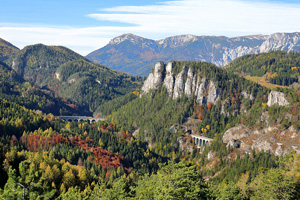
The Semmering Railway, a 41-kilometre-long railway line from Gloggnitz to Mürzzuschlag, was the world's first mountain railway when completed in 1854 and achieved UNESCO World Heritage status in 1998. Constructed between 1848 and 1854 under Carlo Ghega's direction, this engineering marvel features 14 tunnels, including a 1,431m summit tunnel, 16 viaducts, and over 100 stone arch bridges. The railway attracted the high society of the fin de siècle period, with notable guests including Sigmund Freud, Oskar Kokoschka, Alma Mahler-Werfel and Arthur Schnitzler. Today, trains take just 40 minutes to pass through the scenic landscape, where passengers experience new scenery behind every curve, with areas of craggy rock, distinctive galleries, and boldly stretched viaducts embedded in the enchanting landscape. Visitors can explore the railway hiking trail, which leads to impressive vantage points such as the "20 Schilling View", named after the viaduct view once depicted on Austria's 20 Schilling banknote. |
|


 Croatia Guide
 Czechia Guide
 Hungary Guide
 Poland Guide
 Slovakia Guide
 Slovenia Guide


 Linz, Austria's third-largest city with around 200,000 inhabitants, originated as the Roman settlement of Lentia and later flourished as an important medieval trading centre along the Danube. The city features beautiful old houses on a vast medieval square, whilst also standing out as one of Austria's most modern cities with groundbreaking theatres, concert halls, and hi-tech museums. The city has a notable scientific heritage, as astronomer Johannes Kepler lived here and discovered that planets revolve around the sun in elliptical paths. Mozart composed 'The Linz Symphony' here in just three days. The harbour area has been transformed into an open-air gallery showcasing international graffiti and murals, whilst the city hosts the renowned Ars Electronica Festival and has been designated as a UNESCO City of Media Art. Visitors can also sample the famous Linzer Torte, which is reputed to be the world's oldest cake recipe.
 Steyr, a picturesque 1,000-year-old market town nestled at the confluence of the Enns and Steyr rivers in Upper Austria, boasts one of Austria's finest town squares and best-preserved historical centres. The town is renowned for its stunning Gothic and Baroque architecture, with the Bummerlhaus mansion, one of Austria's oldest buildings dating back to the 13th century, standing as a prime example of early Gothic design. The impressive Schloss Lamberg castle, with its distinctive blush pink hue, dominates the skyline and offers commanding views of the two rivers. The town's rich industrial heritage dates back to Celtic times, with iron ore mining playing a crucial role in its development. Today, Steyr charms visitors with its network of 119 bridges and walkways, cobblestone streets, and hidden stairways that connect the upper and lower parts of the old town, where elevation differences can reach up to 40 metres. The town's strategic importance was evident during World War II when it served as a major arms manufacturing centre.
 Founded in 777 by Tassilo III, Duke of Bavaria, Kremsmünster Abbey remains a functioning Benedictine monastery to this day. The abbey showcases a fascinating blend of architectural styles from Romanesque to Gothic and Baroque, with its church dedicated to St. Agapitus featuring remarkable frescoes, sculptures and a high altar. The monastery's library houses over 160,000 volumes, including precious manuscripts and the Codex Millenarius from 800. Notably, it operates the world's only weather room that has remained in continuous operation at the same location since 1763, where meteorological observations are still conducted today. The abbey maintains one of the oldest wine-making traditions in Europe, with monks producing wine for more than 1,200 years since its foundation. The abbey's fig house holds the distinction of being Europe's oldest greenhouse. Its museum collections feature fascinating items including a cave bear skeleton, an Egyptian mummy, rare Blaschka glass models of invertebrates, and a sextant used by Kepler.

 : Local interest
 : Moderately interesting
 : Must-see in the country
 : Top cities in Europe