• Don't want to see ads? Install an adblocker like uBlock Origin or use a Europe-based privacy-friendly browser like Vivaldi or Mullvad.

E-V13 Frequencies and New Data

Proto-Albanians might have not even been in the Dardania area but even more north-eastern, I don't find it feasible to use this Dardanian notion in the context of antiquity even the Ancient Macedonian loanwords are relatively small. Also Illyrian lineages were eradicated by slavophones meanwhile proto-Albanians assimilated slavic lineages later on? I could be wrong here but wouldn't it make sense that a distinct population migrated in and assimilated these slavic lineages, whereas Illyrians would have harbored deep resentment towards south slavs.
I think this is unlikely!

I see that based on the current distribution and diversity, there is a tendency to asign E-v13 as a primary of Dacian origin. However, it is still just an assumption, but we need evidence!

We have evidence of Iron Age E-v13:

Cluster of E-v13 in Kapitan Andreevo (Bulgaria - Thracian Iron Age)

Single E-v13 in the southeastern part of North Macedonia (possibly Thracian, Paeonian or ancient Macedonian)

Single E-v13 in the present day Croatian Zagoria (possibly Illyrian)

Presence during the late Roman Empire, but before Slavic migration, in the eastern part of present-day Serbia (Timoch and Viminacium), and evidence of E-v13 in the Panonain plain in the middle Avar period 7-8th century CE.

So E-v13 was already in the southern Balkans during the Iron Age.

The whole territory that was considered Dardania during classical antiquity is un-sampled. Around this territory we have all the haplogroups: J2b-l283, R1b-PF7563, R1b-CTS1450 and E-v13. Dardania was not an isolated area, and it was one of the most exposed regions in the Balkans via the most important Morava-Vardar route since neolithic times. So a continuous stratification of all these haplogroups and material cultures could be expected, but we have no scientific evidence yet.

Finally, during classical antiquity, they were considered without a doubt as Illyrian in an ethnic sense, but as we see all over the different archeological sites where multiple haplogroups are found, this could be even more prevalent in Daradnian territory as it covered a part of the main artery of the Balkans (Morava - Varadar).

https://umap.openstreetmap.fr/en/map/ancient-human-dna_41837#7/45.248/23.752
 
Anyway, this thread has seriusly been derailed.

It is about E-V13 frequencies and new data so lets get back to that:

For every Illyrian linguistic correspondence that we find in Albanian, there are 2.5 as many Thracian correspondences.

Linguistically the origin of this obviously cannot be from the diber/mat/mirditë cluster (J2b-L283) as we know for sure these people were not Thracian or Dacian or Daco-Thracian.

So this leaves only the Dardanian/Moesia cluster as the source of this almost 3 fold Thracian linguistic material in Albanian.


This means E-V13 + R1b-Z2705 are the only candidates for the Thracian material in Albanian.

Compare for example the Albanian word Burrë. This must also have been culturally a very important word for patriarchal proto-Albanians.

Is it a surprise then that is one of the most widespread Daco-Thracian names:

Burridava, Perburidava, Burikodava, Buri, Burridensi, Burroi, Mukaburis, Burilas, Buris, Buraides, Burebistas, etc.

What is important however is not just corresponces like these as it is not enough to prove descendance, but specific phonetic changes that show up in the Daco-Thracian world that are very unique to Albanian.

Namely, the indo european /sk/ cluster becoming /h/ in Albanian.

In both Dacian and Thracian we see transitory states of this transformation happening.

Take the Dacian king called Scorilo, and then the Dacian king called Coryllus.

Or the Thracian name Skapsa and then the Thracian name Kapsa.

Likewise there is another very unique Albanian sound law of IE. /sp/ becoming /f/ for which we do find a Thracian parallel:

The Thracian name Sparadokos and the thracian name Pardokas

All this supports both the E-v13 origin of Albanian and its Daco-Thracian belonging


View attachment 18081
View attachment 18082
K. Dover, Aristophanes Frogs, Oxford, 1993, p. 270: «One of the three who appear now, Pardokas, has a comic name, for παρδείν is the aorist of πέρδεσθαι "fart" ; "Spartokos" was a name recurring in the royal house of the Crimean Bosporus (e.g. D.S. xii.31.1
The supposed /sp/ -> /p/ development is nothing more than a comical invention of the original name Spartokos since after all its a Comedy of Aristophanes, it’s also never mentioned in Onomasticon Thracium as a variant of Spartokos at all.
Referencing Dan Dana p.XCV on the evolutions of Thracian phonetics more often than not /s/ is either maintained or developed into /z/ f.e. /rs/ -> /rz/ from Cers-/Cerz-, Dorse-/Durze and /sd/ -> /zd/ from disd-/dizd-, but very rarely or most of the time never dropped.
As for Proto-Albanian *spara (seed) being related to Thracian *spara (spear), we already have the Albanian word shparr from Proto-Albanian *spara from the PIE root *sporH, which is cognates with similar words such as Latin *sparus and Old High German *sparro meaning Albanian and Thracian are not the only languages that developed similar words for spear.
 
This is not an explicit reference to them as an Illyrian tribe, it is open for interpretation.

Strabo 7.5:

These people, as also the Crobyzi and what are called the Troglodytae, live above88 the region round about Callatis, Tomis, and Ister. Then come the peoples who live in the neighborhood of the Haemus Mountain and those who live at its base and extend as far as the Pontus—I mean the Coralli, the Bessi, and some of the Medi and Dantheletae. Now these tribes are very brigandish themselves, but the Bessi, who inhabit the greater part of the Haemus Mountain, are called brigands even by the brigands. The Bessi live in huts and lead a wretched life; and their country borders on Mount Rhodope, on the country of the Paeonians, and on that of two Illyrian peoples—the Autariatae, and the Dardanians. Between these and the Ardiaei are the Dassaretii, the Hybrianes, and other insignificant tribes, which the Scordisci kept on ravaging until they had depopulated the country and made it full of trackless forests for a distance of several days' journey.

What makes it open for interpretation? What could have Strabo written to make it even clearer?

Proto-Albanians might have not even been in the Dardania area but even more north-eastern, I don't find it feasible to use this Dardanian notion in the context of antiquity even the Ancient Macedonian loanwords are relatively small.

Why do you believe that they should have many loanwords from the Macedonians? They constantly fought against them and Macedonians didn't even last for long as big power. After Alexander's death, they basically collapsed.

Further northeast from Dardania is Viminacium and it was not Proto-Albanian. Albanian could have been spoken from Naissus to the Adriatic from east to west probably in the north and central regions of the modern era.
 
To extend on this, to my surprise even both Strabo and Appian references are shady. Strabo in his Geographica in Book 7 references Dardanians:
Strabo: The Geography - Illyria - 'The Ardiaei were called by the men of later times "Vardiaei." Because they pestered the sea through their piratical bands, the Romans pushed them back from it into the interior and forced them to till the soil. But the country is rough and poor and not suited to a farming population, and therefore the tribe has been utterly ruined and in fact has almost been obliterated. And this is what befell the rest of the peoples in that part of the world; for those who were most powerful in earlier times were utterly humbled or were obliterated, as, for example, among the Galatae the Boii and the Scordistae, and among the Illyrians the Autariatae, Ardiaei, and Dardanii, and among the Thracians the Triballi; that is, they were reduced in warfare by one another at first and then later by the Macedonians and the Romans'

Strabo's geography - Illyria - 'The Bessi live in huts and lead a wretched life; and their country borders on Mount Rhodope, on the country of the Paeonians, and on that of two Illyrian peoples — the Autariatae, and the Dardanians"
Strabo leaves no room for interpretation. According to Strabo Dardanians were Illyrian tribe.


Appian, The Roman History- The Illyrian Wars

"Illyrius had six sons, Encheleus, Autarieus, Dardanus, Maedus, Taulas, and Perrhaebus, also daughters, Partho, Daortho, Dassaro, and others, from whom sprang the Taulantii, the Perrhaebi, the Enchelees, the Autarienses, the Dardani, the Partheni, the Dassaretii, and the Darsii. Autarieus had a son Pannonius, or Paeon, and the latter had sons, Scordiscus and Triballus, from whom nations bearing similar names were derived. But I will leave these matters to antiquarians."
"Such was the punishment which the god visited upon the Illyrians and the Celts for their impiety. But they did not desist from temple robbing, for again, in conjunction with the Celts, certain Illyrian tribes, especially the Scordisci, the Maedi, and the Dardani again invaded Macedonia and Greece together, and plundered many temples, including that of Delphi, but losing many men this time also."
Appian leaves no room for interpretation. According to Appian Dardanians were an Illyrian tribe.

Pliny the Elder: the Natural History

Epiros ipsa, ad Magnesiam Macedoniamque tendens, a tergo suo Dassaretas supra dictos, liberam gentem, mox feram Dardanos habet. Dardanis laevo Triballi praetendentur latere et Moesicae gentes, a fronte iunguntur Maedi ac Denselatae, quibus Threces ad Pontum usque pertinentes. ita succincta Rhodopes, mox et Haemi, vallatur excelsitas.
"Epirus itself, stretching towards Magnesia and Macedonia, has the free Dassaretes mentioned above, a nation at its rear, and the wild Dardanians at its rear. The Dardanians are flanked on the left by Triballus and the Moesian tribes, and the Maedi and Denselatae are joined at the front, to which the Thracians belong as far as Pontus. Thus the Rhodopes are enclosed, and soon also by the Haemians, and the heights are fenced off."
Pliny's reference is neutral as it does not specify if they were Illyrians or something else

Polybius: The Histories

"The Illyrians holding Phoenice at first united with Scerdilaïdas, and advancing to Helicranum encamped opposite the Achaeans the Aetoliansa who had come to the rescue, and were anxious to give battle. 4 But the ground was very difficult and unfavourable to them, and just at this time a dispatch came from Teuta ordering them to return home by the quickest route, as some of the Illyrians had revolted to the Dardanians."
"When he reached Pella in Macedonia, the Dardani, hearing of his arrival from some Thracian deserters, took fright and at once dismissed their army, although they were now close to Macedonia. Philip, on learning that the Dardani had abandoned their project, sent home all his Macedonians to gather in the harvest and returning to Thessaly spent the rest of the summer at Larisa."

"Perseus sent Pleuratus the Illyrian, who had taken refuge with him, and Adaeus of Beroea, as envoys to King Genthius, with instructions to announce to him what had happened in the war he was engaged in against the Romans and Dardanians, and for the present at least with the Epirots and Illyrians; and to solicit him to enter into an alliance with himself and the Macedonians. The envoys, crossing Mount Scardus, journeyed through the so‑called Desert Illyria, which not many years previously had been depopulated by the Macedonians in order to make it difficult for the Dardanians to invade Illyria and Macedonia.
Polybius references leave room for interpretation. Some may interpret it as Dardanians being distinct from both Illyrians and Thracians, and some may interpret it as a separate political entity.


Polybius gave the opinion in the 2nd century BC
Strabo and Pliny the elder gave the references from 1st century AD
Appian gives an opinion from 2nd century AD

 
Last edited:
Strabo: The Geography - Illyria - 'The Ardiaei were called by the men of later times "Vardiaei." Because they pestered the sea through their piratical bands, the Romans pushed them back from it into the interior and forced them to till the soil. But the country is rough and poor and not suited to a farming population, and therefore the tribe has been utterly ruined and in fact has almost been obliterated. And this is what befell the rest of the peoples in that part of the world; for those who were most powerful in earlier times were utterly humbled or were obliterated, as, for example, among the Galatae the Boii and the Scordistae, and among the Illyrians the Autariatae, Ardiaei, and Dardanii, and among the Thracians the Triballi; that is, they were reduced in warfare by one another at first and then later by the Macedonians and the Romans'

Strabo's geography - Illyria - 'The Bessi live in huts and lead a wretched life; and their country borders on Mount Rhodope, on the country of the Paeonians, and on that of two Illyrian peoples — the Autariatae, and the Dardanians"
Strabo leaves no room for interpretation. According to Strabo Dardanians were Illyrian tribe.


Appian, The Roman History- The Illyrian Wars

"Illyrius had six sons, Encheleus, Autarieus, Dardanus, Maedus, Taulas, and Perrhaebus, also daughters, Partho, Daortho, Dassaro, and others, from whom sprang the Taulantii, the Perrhaebi, the Enchelees, the Autarienses, the Dardani, the Partheni, the Dassaretii, and the Darsii. Autarieus had a son Pannonius, or Paeon, and the latter had sons, Scordiscus and Triballus, from whom nations bearing similar names were derived. But I will leave these matters to antiquarians."
"Such was the punishment which the god visited upon the Illyrians and the Celts for their impiety. But they did not desist from temple robbing, for again, in conjunction with the Celts, certain Illyrian tribes, especially the Scordisci, the Maedi, and the Dardani again invaded Macedonia and Greece together, and plundered many temples, including that of Delphi, but losing many men this time also."
Appian leaves no room for interpretation. According to Appian Dardanians were an Illyrian tribe.

Pliny the Elder: the Natural History

Epiros ipsa, ad Magnesiam Macedoniamque tendens, a tergo suo Dassaretas supra dictos, liberam gentem, mox feram Dardanos habet. Dardanis laevo Triballi praetendentur latere et Moesicae gentes, a fronte iunguntur Maedi ac Denselatae, quibus Threces ad Pontum usque pertinentes. ita succincta Rhodopes, mox et Haemi, vallatur excelsitas.
"Epirus itself, stretching towards Magnesia and Macedonia, has the free Dassaretes mentioned above, a nation at its rear, and the wild Dardanians at its rear. The Dardanians are flanked on the left by Triballus and the Moesian tribes, and the Maedi and Denselatae are joined at the front, to which the Thracians belong as far as Pontus. Thus the Rhodopes are enclosed, and soon also by the Haemians, and the heights are fenced off."
Pliny's reference is neutral as it does not specify if they were Illyrians or something else

Polybius: The Histories

"The Illyrians holding Phoenice at first united with Scerdilaïdas, and advancing to Helicranum encamped opposite the Achaeans the Aetoliansa who had come to the rescue, and were anxious to give battle. 4 But the ground was very difficult and unfavourable to them, and just at this time a dispatch came from Teuta ordering them to return home by the quickest route, as some of the Illyrians had revolted to the Dardanians."
"When he reached Pella in Macedonia, the Dardani, hearing of his arrival from some Thracian deserters, took fright and at once dismissed their army, although they were now close to Macedonia. Philip, on learning that the Dardani had abandoned their project, sent home all his Macedonians to gather in the harvest and returning to Thessaly spent the rest of the summer at Larisa."

"Perseus sent Pleuratus the Illyrian, who had taken refuge with him, and Adaeus of Beroea, as envoys to King Genthius, with instructions to announce to him what had happened in the war he was engaged in against the Romans and Dardanians, and for the present at least with the Epirots and Illyrians; and to solicit him to enter into an alliance with himself and the Macedonians. The envoys, crossing Mount Scardus, journeyed through the so‑called Desert Illyria, which not many years previously had been depopulated by the Macedonians in order to make it difficult for the Dardanians to invade Illyria and Macedonia.
Polybius references leave room for interpretation. Some may interpret it as Dardanians being distinct from both Illyrians and Thracians, and some may interpret it as a separate political entity.


Polybius gave the opinion in the 2nd century BC
Strabo and Pliny the elder gave the references from 1st century AD
Appian gives an opinion from 2nd century AD


Yes, just seen them, and once again the sources are really not to be taken as a rule written in stone and not be taken literally like this inconsistent quotes:

But they did not desist from temple robbing, for again, in conjunction with the Celts, certain Illyrian tribes, especially the Scordisci, the Maedi, and the Dardani again invaded Macedonia and Greece together, and plundered many temples, including that of Delphi, but losing many men this time also."
Appian leaves no room for interpretation. According to Appian Dardanians were an Illyrian tribe.

Neither Scordisci or Maedi were Illyrian tribes. We know that from archaeology, material culture, Scordisci were Celtic people basically mixed with Thracians and Illyrians who put an end to Autariate, and Maedi were a Thracian tribe related to Bessi living in Western Rhodopes.

Anyway, i will not continue repeating myself i already put my thoughts here clearly:

With all due respect, buddy, but you really don’t know what you’re talking about. Material culture is not just about trade, it shows how people lived, what they believed in, and who they were. If that didn’t matter, then archaeology as a whole would be useless, which obviously it’s not.

Yes, ancient writers like Strabo and Appian called the Dardanians Illyrians, no argument there. But their material culture tells a more complex story.

Even Milutin Garasanin, one of the most respected archaeologists in Yugoslavia, arguably the authority on Balkan prehistory, wrote that Dardanian culture showed mixed traits from both the Daco-Mysian and Illyrian spheres. And just to add, Garasanin himself had distant paternal Albanian roots, so he wasn’t pushing some biased narrative.

Also, if we are going to stick strictly to what ancient authors said, then by Herodotus logic the Etruscans came from Lydia in Anatolia. But archaeology showed they were locals, descendants of the Proto-Villanovan culture, and ancient DNA backed that up. So yeah, texts are useful, but they are not gospel.

Lastly, since we are now debating the name Dard/Dardani itself, many archaeologists believe it was inherited from their Daco-Mysian side, since similar name patterns show up across that part of the Balkans. It fits a broader linguistic and cultural trend in that sphere. Nothing extraordinary here, to add up lots of E-V13 among Albanians.
 
Last edited:
The Punic E-V13 from Sicily, closest ancient sample is the supposedly Iron Age North Macedonian female sample: https://www.exploreyourdna.com/sample/I7233/North_Macedonia.htm

Paeonian?

And the Croatian Zadar sample, again female: https://www.exploreyourdna.com/sample/r3746/croatia_zadar_roman.sg.htm

Macedonia_IA:I7233
Croatia_Zadar_Roman.SG:R3746.SG
Greece_BA_Mycenaean:I13514
Greece_BA_Mycenaean:I13518
Hungary_MidAvar:ALT-224.SG
Bulgaria_EIA:I20184
Italy_Sardinia_IA_1:I10366
Bulgaria_LIA:I19500
Bulgaria_EIA:I20183
Bulgaria_EIA:I20185
Bulgaria_EIA:I20180
Bulgaria_IA:I5769
Spain_Greek_oAegean:I8215
Bulgaria_EIA:I20186
Hungary_EarlyAvar:SZK-102.SG
Hungary_Tiszaregion_EAvar:I18185
Slovakia_IA_Vekerzug:I11722
Greece_BA_Mycenaean:I9041
Serbia_Viminacium_Roman_elite_3.SG:R6756.SG
Slovakia_IA_Vekerzug:I12097
Greece_BA_Mycenaean:I19366
Italy_Sicily_LBA:I3876
Italy_Lazio_Viterbo_Etruscan:TAQ007
Tunisia_Punic.SG:R11776.SG
Hungary_Conqueror_Commoner:SZOD-376.SG

[th]
Distance to:

[/th]​
[th]
Punic:I12848

[/th]
[td width="8em"]
0.03904649

[/td]​
[td width="8em"]
0.03917849

[/td]
[td width="8em"]
0.03924604

[/td]
[td width="8em"]
0.03927027

[/td]
[td width="8em"]
0.03928694

[/td]
[td width="8em"]
0.03945323

[/td]
[td width="8em"]
0.03948653

[/td]
[td width="8em"]
0.03974826

[/td]
[td width="8em"]
0.04068557

[/td]
[td width="8em"]
0.04171158

[/td]
[td width="8em"]
0.04189621

[/td]
[td width="8em"]
0.04246679

[/td]
[td width="8em"]
0.04275708

[/td]
[td width="8em"]
0.04328382

[/td]
[td width="8em"]
0.04405295

[/td]
[td width="8em"]
0.04405822

[/td]
[td width="8em"]
0.04408999

[/td]
[td width="8em"]
0.04418652

[/td]
[td width="8em"]
0.04434433

[/td]
[td width="8em"]
0.04442535

[/td]
[td width="8em"]
0.04459099

[/td]
[td width="8em"]
0.04463075

[/td]
[td width="8em"]
0.04491089

[/td]
[td width="8em"]
0.04509344

[/td]
[td width="8em"]
0.04552233

[/td]​


The Punic E-V13 from Sicily, closest ancient sample is the supposedly Iron Age North Macedonian female sample: https://www.exploreyourdna.com/sample/I7233/North_Macedonia.htm

Paeonian?

And the Croatian Zadar sample, again female: https://www.exploreyourdna.com/sample/r3746/croatia_zadar_roman.sg.htm


Dear Hawk,
The sample form North Macedonia, near Gevgelia, a border with Greece-river Strumica. It is male, not female
I10166:
Y-DNA: E1b1b1a1b1
https://www.science.org/doi/10.1126/science.abm4247

The samples from Iron Age Croatia, is not from Zadar, but from the region of Zagoria or nearby as I am not sure if the exact position of site is in Zagoria (near Zagreb), just a one or 2 km from the Slovenian border.
I5724:
mtDNA: U5b1d1a
Y-DNA: E1b1b1a1b1a1

https://adnaxp.github.io/?fbclid=Iw...xZveVe3KZpNxcRovuA_aem_qJQXxdhV5qB2G3Sr_sOJCA

All I wanted to imply is that E-v13 was already in Balkans during Iron Age, before that supposed Dacian migration.

As for Strabo and Appian, that's what they wrote not my opinion. I just wrote what contemporary ancient authors thought about Dardanians. Now if they were right or wrong, that is another thing.

And I expect from you to be more polite in comments as we are all giving our opinions on this topic.
 
Last edited:
German media like bild.de is reporting Vladimir Putin belongs to Y-DNA E-V13.
 
On which test is this based upon?

I don't know how reliable it is, but bild.de and one Austrian media reported it, apparently some hackers hacked his nephews or paternal cousin PC and found personal details, DNA results like his Y-DNA was E-V13.

 
I don't know how reliable it is, but bild.de and one Austrian media reported it, apparently some hackers hacked his nephews or paternal cousin PC and found personal details, DNA results like his Y-DNA was E-V13.


There you can see what the mass media do with such results:

Außerdem soll die DNA des Neffen zu der seltenen Haplogruppe E-V13 gehören. Die Haplogruppe E-V13 ist vor etwa 10.000 bis 20.000 Jahren entstanden und ist vor allem in Südeuropa und auf dem Balkan verbreitet, wobei sie über die männliche Linie vererbt wird. Dieser Genstrang hat seinen Ursprung im heutigen Kosovo - Kommt also der russische Präsident genetisch in seiner Urfamilie aus dem heutigen Kosovo?


Regardless of whether (Proto-Albanians) were E-V13, the modern frequency in Kosovo is in no way direct evidence for the deeper origins, as we both know. But how reliable the news is, well, who knows. But quite possible it is, surely.
 
Dear Hawk,
The sample form North Macedonia, near Gevgelia, a border with Greece-river Strumica. It is male, not female
I10166:
Y-DNA: E1b1b1a1b1
https://www.science.org/doi/10.1126/science.abm4247

The samples from Iron Age Croatia, is not from Zadar, but from the region of Zagoria or nearby as I am not sure if the exact position of site is in Zagoria (near Zagreb), just a one or 2 km from the Slovenian border.
I5724:
mtDNA: U5b1d1a
Y-DNA: E1b1b1a1b1a1

https://adnaxp.github.io/?fbclid=Iw...xZveVe3KZpNxcRovuA_aem_qJQXxdhV5qB2G3Sr_sOJCA

All I wanted to imply is that E-v13 was already in Balkans during Iron Age, before that supposed Dacian migration.

As for Strabo and Appian, that's what they wrote not my opinion. I just wrote what contemporary ancient authors thought about Dardanians. Now if they were right or wrong, that is another thing.

And I expect from you to be more polite in comments as we are all giving our opinions on this topic.

Emathia, the E-L618 very likely E-V13 sample is from Idomenae from classical times, this sample is different, from Early Iron Age and it looks it is a female: https://www.exploreyourdna.com/sample/I7233/North_Macedonia.htm

Btw, nobody is arguing E-V13 was not in Balkans during Iron Age, on contrary, it should have been, it was just way more present among people practicing cremation and they either came with Flutted-Ware/Channeled-Ware Carpathian Urnfielders or were Chalcolithic survivors close-to or from Haemus-Rhodopes Mountains mixing with Multi-Cordoned-Ware/Catacomb Culture from where they got their language.
 
There you can see what the mass media do with such results:


Regardless of whether (Proto-Albanians) were E-V13, the modern frequency in Kosovo is in no way direct evidence for the deeper origins, as we both know. But how reliable the news is, well, who knows. But quite possible it is, surely.

Yeah, looks like they went out of their element in many cases, like they likely saw the health autosomal DNA of higher prostate cancer, you know how they are, and attributed to the whole Y-DNA. Or maybe this whole report is not true, IDK.
 
Yeah, looks like they went out of their element in many cases, like they likely saw the health autosomal DNA of higher prostate cancer, you know how they are, and attributed to the whole Y-DNA. Or maybe this whole report is not true, IDK.

Another issue is, that he is (supposedly) just his cousin once removed. That means he just shares about 6-7 % DNA with him, which means they can't deduce a lot about Putin himself from the data, because he might or might not have inherited these specific pieces of DNA. Also, the predictions for disease predispositions from regular chips are not super reliable in all instances anyway, and even a predisposition means just that, it can be developed or not.

Therefore the haplogroup is the only safe thing to say, if anything, since even if the story is correct, there could have been a non-paternal event or the like as well, as unlikely as it is.
 
I think the Discover tool of FTDNA can be useful in many ways, especially if comparing various haplogroup branches and their patterns of demographic growth and founder events.

Recently I concentrated on the comparison of the rather central branch of Z5017 vs. the Northern branches of Z5018.

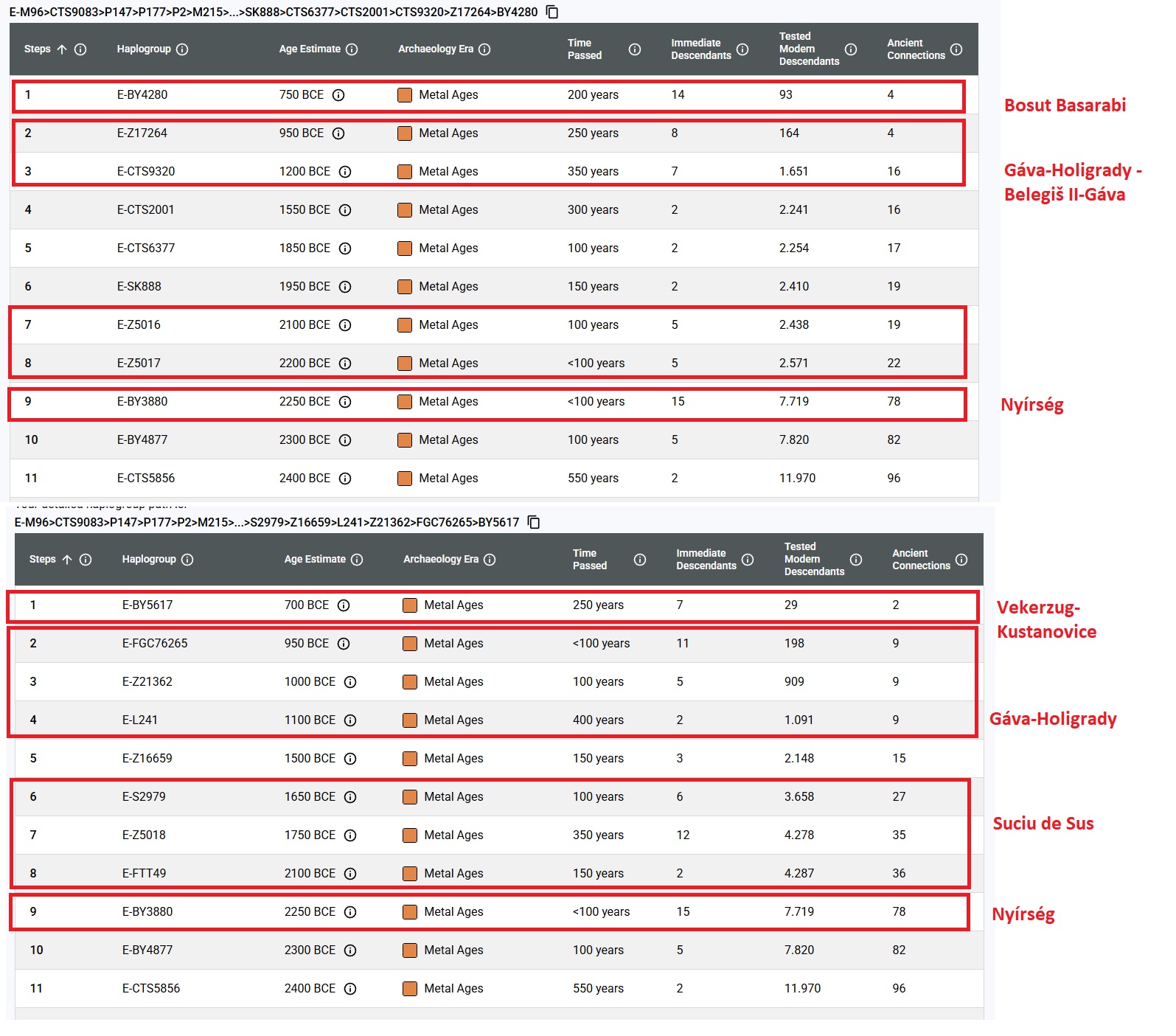
This time I made a comparison of the "Ancestral Path" view for two of the bigger branches involved. There is a very noticeable difference for Z5018 having a way bigger growth spurt right before/during/after the Koszider horizon and the emergence of Suciu de Sus at the Upper Tisza, which Z5017 doesn't have to the same extent.

Comparison-Ancestral-Path-Z5017vs-Z5018.jpg


Both branches have with Z5018 with the example of L241 and Z5017 with the example of CTS9320 significant growth with the Gáva-related Channelled Ware expansions in the Late Bronze to Early Iron Age.
But directly after that, already in the Early Iron Age, the period of developed Bosut-Basarabi, Z5017/CTS9320 descendants have a big expansion, really big. Z5018/L241 as a whole does as well, but there are no comparable single founder based huge expansion events like e.g. Z5017/CTS9320/BY4280 got it. One of those getting closest is BY5617, both smaller and bit later.
Therefore Z5018 seems to have kept a much larger population, based on its growth with Suciu de Sus in the Middle Bronze Age presumably, but it had fewer as gigantic founder events as CTS9320 had in the phase of Bosut-Basarabi, with which CTS9320 is very clearly most closely correlated with.

The pattern of L241 being pretty much mirrored by its brother branch so to say, if following the path of E-FGC11457 -> E-FGC11451 -> E-FGC11447, also under Z5018.

A broader base and more constant growth, but no spike in the developed Iron Age like Z5017/CTS9320 got it.

Therefore, and also based on the significant amount of Z5017 being found along the Danube, close to the Tisza-Danube interfluve and more in the Southern Avar groups, I'm now fairly confident that we will see Bosut-Basarabi being dominated by Z5017, with few other branches sprinkled in for sure, including some Z5018 branches, but mostly Z5017/CTS9320.

Z5018 main branches, especially L241 and FGC11451, I expect further to the North, most likely most concentrated in the Sanislau group of Vekerzug in the Iron Age and later Northern Dacians, more up the Tisza river, and well into areas like the Hernad valley in Eastern Slovakia and Transcarpathia.

The big unknown to me is right now the area of Oltenia, which could be both/in between, being after/with the Transtisza-Northern Carpathian area the probably most important heartland for E-V13.

Concerning the Northern Dacians, this publication is quite interesting. This quotation is instrumental in understanding the E-V13 find and Balkan-like autosomals in many of the samples from Chotin Vekerzug individuals in Western Slovakia:

Following a long and apparently stable,though regionally diverse (and poorly known), Bronze
Age (Romsauer 1981). the first items of La Tene type appeared in SouthwesternSlovakia around 400 BC.
These finds come almost exclusively from graves and are associated with Thraco-Scythian material.
Bronze Age traditions were maintained until around 300 BC when the first La Töne cemeteriesappeared.
Theseare concentratedin the southwestof the country, while elsewherelocal burial traditions persisted,
in some casesas late as 200 BC.

The hand made 'Dacian' pottery, characteristic of the sites to the east of the Váh river...

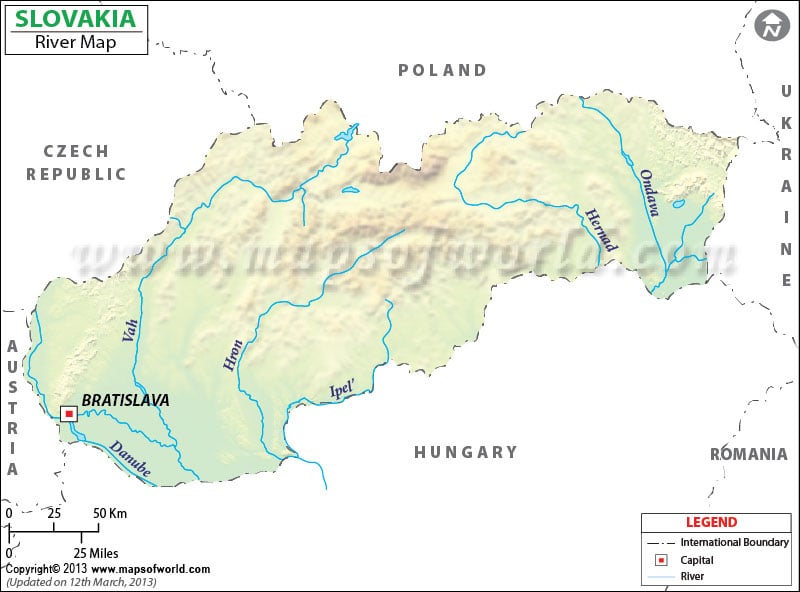
If looking at Bronze to Iron Age Slovakia, the area of the Hernad river and East of it is core North Thracian territory from the start, by and large. The area between the Vah and Hernad is more mixed, but strongly influenced, especially after the Dacian expansions in the later Iron Age, but also during the Vekerzug period:

slovakia-river-map.jpg


The sites in this area are conventionally describedas'Celto-Dacian', a term referring to the
characterof the material culture, and in particular to the pottery. The assemblages are characterised by
the co-occurence of wheel thrown pottery of La Töne type and hand made vessels of a style familiar from
Romania and the areas later referred to in written texts as the homeland of the Dacians
(Nandris 1976).

This is all the more important as we already know from the upcoming results from Transylvania that a small sample from a La Tene site yielded local (Carpatho-Balkan/Dacian) results only!

The Dacians seem to have regained control coming from the East, and mixing into Celtic-influenced areas, finally taking them over in the end phase:

The dating and sequenceof occupation of theseCelto-Dacian sites dependsupon the interpretation of the
stratigraphy of the site of Nitriansky Hrddok - ZameUk near the modern town of Surany. Excavations by
Tocfk (1959) revealedthree phasesof activity. A cemeteryof La Töne type, dating to La Töne Cl, was
overlain by a settlementconsisting of semi-sunkenhuts. These contained a small quantity of wheel
thrown 'Celtic' wares together with Dacian' forms.

There were different "Dacian waves" - note how this later phase is associated with the last significant founder evnets in the Pre-Roman/Roman period, especially for Z5018 branches!

This phase of occupation is consideredto represent an early wave of Dacian settlement and has been dated to
La Töne C2. The third phase,dated to the second half of the 1st century BC (La Töne D2), is
characterised by the same mixed material culture, but including a greater range of 'Celtic' pottery types,
including slip decoratedware (Tocik 1959:Figure 323, Schukin 1989:277-8).

The lowland sites (including those recently excavatedat Mikov
Dvor and Sindolka) appearto be a seriesof discontinuousundefendedvillages, which, if associatedwith
the defendedsite, suggestthat the group is similar in form to other sites of central characterfound in
Slovakia. A connection is generally madebetween this final phase and the campaignsof the Dacian king
Burebista (60 - 44 BC)

Note that in this very late phase, my assumption is that the central (Z5017) and even some Southern groups (BY5022), plus the Northern ones (Z5018) were united under one Dacian rule and might have intermixed on a new scale.

The power of thesegroups declined during the Ist century BC, and the Scordiscii were defeatedin 88 BC
by the Romans and between 65 - 50 BC by the Dacians. The latter, under Burebista, went on to defeat a
confederacyof the Boii and Tauriscii in about 45 BC, an event connectedwith the expansionof the
Dacian state and interpreted as the causeof the secondwave of Dacian colonisation in Slovakia and the
impulse for a final wave of Celtic tribal movements,in this casenorthwards.

Some of the most Northern regions of Dacian settlement, Kustanovice and its aftermath is highly important, in which even late Gáva traditions survived:

In easternSlovakia La Tone Cl and C2 are, as in other areas,rather obscure. The prolonged
survival of Bronze Age material culture is associated with the Kustanovice group which, until about 200
BC, is consideredto have co-existed with incoming 'Celtic' settlers. Benadik, in his summary of La Töne
settlementin EasternSlovakia (1965), has noted the appearanceof La Töne together with local material
in graves,both inhumation and cremation, which he considersas evidence of a'symbiotic' relationship
between the Kustanovice and Celtic populations (1965:64). The Celtic groups are judged to have entered
the area from the Tisza valley and the Danubeplain during the late 3rd and 2nd centuries BC. The site of
MukaLevo in the Ukraine, with a mixed'Celto - post-Kustanovice material culture is one of the few
settlement sites to have beenfound that is contemporarywith this early phaseof 'Celtic influence'.

But the main thrust came from a bit South, probably, with the Dacian colonisation, here it is notworthy to point to the long survival (up to the 2nd century AD at least):

Occupation ended late in the 2nd century BC and there is then an apparent gap in the settlementrecord until the foundation of the site of Zemplin in the mid Ist
century BC. Benadilc(1965:89) has linked this event with the appearanceof the secondwave of Dacian
material in Slovakia and the expansionof the Dacian stateunder Burebista. Zemplfn was not alone
during this period, and similar settlementshave been excavatedin the Ukraine and Romania
(Kotigoroshko 1989, Shchukin 1989). Thesesites were occupied from the mid Ist century BC into the
Ist century AD and are characterisedby the sameco-occurenceof 'Celtic' and 'Dacian' (or Geto-Dacian)
pottery as are the Celto-Dacian sites in southwestSlovakia. Other aspectsof the material culture, notably
the burial rite, link the sites with their immediate hinterland in the upper Tisza valley. This mixture of
traditions has led Shchukin to speakof a Zemplin culture' (1989:277). Zemplln itself was abandonedin
the later part of the Ist century BC, though the sites further east survived into the 2nd century AD
(Kotigoroshko 1989:57).


The "Celto-Dacian mix" is a common appearance in wide areas, but like the newest results have shown, many settlements of "mixed character" might have been actually nearly fully Dacian dominated. And the developed Dacian culture itself was a fusion of earlier Daco-Thracian traditions (Gáva, Basarabi etc.) with Celtic influences from the La Tene era contacts in the region. Therefore, probably similar to the "Scythianised" Vekerzug phenomenon, the locals adopted new customs, but didn't succumb to those or became highly mixed and assimilated by the newcomers. Even on the contrary. This seems to be the most prominent theme for the Thracians and North Thracians/Dacians in particular, that they adopted new customs coming from invaders and new settlers, but didn't lose their cohesion up to the Roman-Germanic-Avar-Slavic periods.
 
Last edited:
Stamov declared that the earliest appearances of E-V13 in Europe are from Neolithic Ukraine and later Pontic Steppe especially Usatovo and it is abundant in Chalcolithic Ukraine (likely unpublished samples as of yet).

Strange as it may be, the earliest appearance of this haplogroup in Europe — today mostly spread across the Balkans and the Mediterranean — is in the context of the Ukrainian Neolithic and later in the proto-Yamnaya. But this is in Europe.

The haplogroup is abundantly spread in Chalcolithic Ukraine and the Pontic Steppe of the Early Bronze Age (Usatove), from where it directly enters the genome of the early Indo-European groups, as well as of many later inhabitants of the Pontic Steppe.

They also found it in Chalcolithic Bulgaria, one E-V13 was found in a similar context as the golden man of Varna.


%CE%B5%CE%B9%CE%BA%CF%8C%CE%BD%CE%B1_2022-09-04_132705050.png


Earliest predecessor mutation of E-V13 respectively E-L618 lineage likely came from Black Sea Turkey, near Sinop, before that an ancestral lineage from Mesolithic Israel/Palestine among Natufians. E-V13 bulk spread mainly via maritime Black Sea from Sinop region. The Chalcolithic Cultures like Varna, Durankulak, Hamangia were founded by E-L618/E-V13 early spinoffs from Neolithic Ukraine migrating down. These cultures had different language, different customs and material culture than the more widespread EEF dominated by G2a and later I2a.

Now, this is a bit tricky regarding the direction of migration, but i assume he has hands on unpublished samples and he knows what he is talking when he says they came down.

Now, whether the Early Iron Age E-V13 from Kapitan Andreevo and classical Thracians formed via these Chalcolithic V13-ers in Dobruja or somewhere in the mountains in Carpathians is a question mark. There is conflicting autosomal matches between local Dobruja Chalcolithic and Carpathian Chalcolithic.
 
E-V13 is way more likely to have migrated down, since it is, like I said before, most likely very common in specific groups of Tripolye-Cucuteni, which, incidently, have similar burial rites as we later see them in late Cotofeni in Transylvania, in Nyirseg and later Gáva, finally Daco-Thracian historical people.
In fact, most of the Tripolye-Cucuteni samples as of yet are from rather unusual contexts, like this cave burials. The regular ones being mostly disposed in an undocumented way, just like later in the cultures I mentioned for the Bronze Age.

I often wonder however, when people say stuff like that, whether they even differentiated between E-L618 parallel branches and actual E-V13.

Where do you have that information from?
 
Here is how he emphasis:

First wave: Danubian farmers (G2a), overland from Anatolia.

Second wave: Maritime coastal migrants with E-L618, coming through Sinop and the Black Sea, reaching Ukraine and Balkans, possibly earlier than or parallel to the Danubian wave.

Third wave: A distinct population from Eastern Anatolia, expanding during the late Chalcolithic/Early Bronze Age into:

The Balkans

The Apennines (Italy)

With its cultural climax being Minoan Crete.


Adding to his comment which ties the link between Thracians and Mycenaeans:

Let me throw you something: the third wave might have participated in the genesis of the Thracians and the Mycenaeans, at the very least as an older resident population and a common link between these two Indo-European groups (Thracians and Mycenaeans). But I’ll refrain from going into detail on that for now.

Were these the so called Pelasgian? Were the Pelasgians related to Minoans? IDK.

Apparently something is in pipeline, either it will come together collectively with other Balkan countries, or they will publish independently.
 
Back
Top