• Don't want to see ads? Install an adblocker like uBlock Origin or use a Europe-based privacy-friendly browser like Vivaldi or Mullvad.

E-V13 Frequencies and New Data

Stamov declared that the earliest appearances of E-V13 in Europe are from Neolithic Ukraine and later Pontic Steppe especially Usatovo and it is abundant in Chalcolithic Ukraine (likely unpublished samples as of yet).


They also found it in Chalcolithic Bulgaria, one E-V13 was found in a similar context as the golden man of Varna.


%CE%B5%CE%B9%CE%BA%CF%8C%CE%BD%CE%B1_2022-09-04_132705050.png


Earliest predecessor mutation of E-V13 respectively E-L618 lineage likely came from Black Sea Turkey, near Sinop, before that an ancestral lineage from Mesolithic Israel/Palestine among Natufians. E-V13 bulk spread mainly via maritime Black Sea from Sinop region. The Chalcolithic Cultures like Varna, Durankulak, Hamangia were founded by E-L618/E-V13 early spinoffs from Neolithic Ukraine migrating down. These cultures had different language, different customs and material culture than the more widespread EEF dominated by G2a and later I2a.

Now, this is a bit tricky regarding the direction of migration, but i assume he has hands on unpublished samples and he knows what he is talking when he says they came down.

Now, whether the Early Iron Age E-V13 from Kapitan Andreevo and classical Thracians formed via these Chalcolithic V13-ers in Dobruja or somewhere in the mountains in Carpathians is a question mark. There is conflicting autosomal matches between local Dobruja Chalcolithic and Carpathian Chalcolithic.
Also there is one E-L618 in Crete XAN016 late broze age -1250 BCE.
 
Also there is one E-L618 in Crete XAN016 late broze age -1250 BCE.

I wrote about that one in the past and it looks like he was coming with Mycenaean Greeks. My comment then was that its funny if considering how the spread of E-V13 was seen some decades ago, that we now have evidence for E-L618 in Mycenaean Greeks, but no E-V13. It likely came down from the Western steppe or Bulgaria too.
 
E-V13 is way more likely to have migrated down, since it is, like I said before, most likely very common in specific groups of Tripolye-Cucuteni, which, incidently, have similar burial rites as we later see them in late Cotofeni in Transylvania, in Nyirseg and later Gáva, finally Daco-Thracian historical people.
In fact, most of the Tripolye-Cucuteni samples as of yet are from rather unusual contexts, like this cave burials. The regular ones being mostly disposed in an undocumented way, just like later in the cultures I mentioned for the Bronze Age.

I often wonder however, when people say stuff like that, whether they even differentiated between E-L618 parallel branches and actual E-V13.

Where do you have that information from?

He publicly posted them on social media, but honestly i even think he is mixing E-M34 with E-L618 and E-V13. It's a mess on what he says.

With all due respect to him. I even doubt the Sinop Black Sea route, there is no Cardium-Pottery signs there, IDK. Cardium Pottery likely split somewhere in Greece or in Bosphorus were they headed through the maritime route to North Pontic sites.
 
He is using few STR samples from Hungary, Serbia, Croatia and Italy that none have been confirmed as BY611+. The only currently confirmed BY611+ sample is that German from Poland who is BY611*

We only got a handful of Iron Age samples from near Albania and the percentage + diversity of CTS1450 is staggering between Cinamak, Kamenice and North Macedonia.
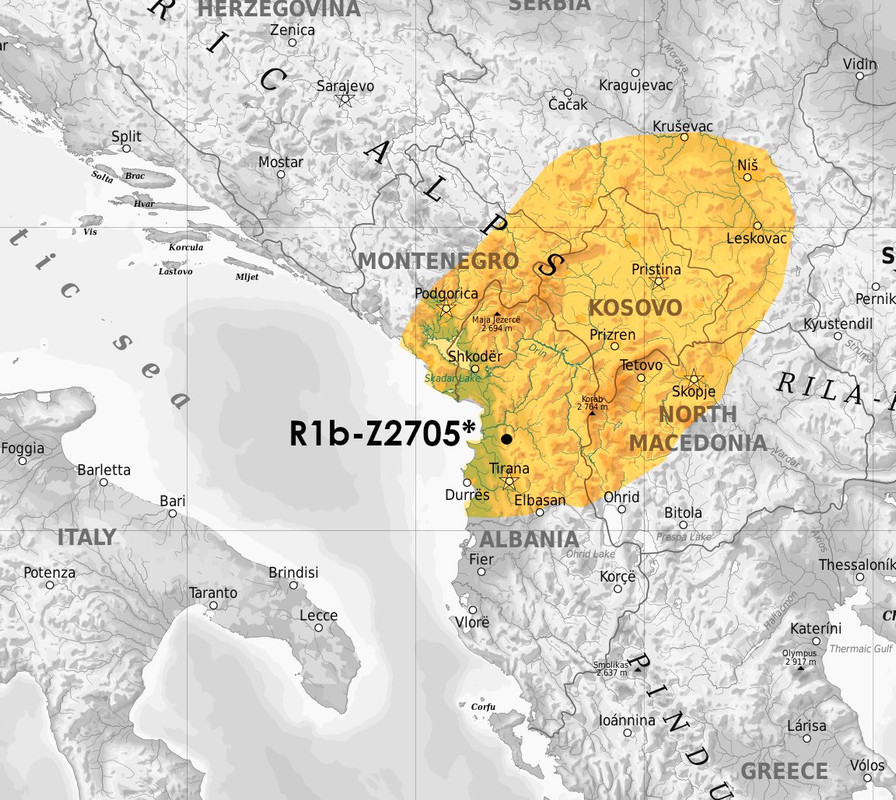
Modern diversity for undoubtedly Illyrian patrilineage R-BY611>Z2705 (by Arbanology on X). It overlaps with J-PH4679 and R-Z29758 diversity. This further strengthens the already ancient sampling proof regarding parallel branches of it under CTS1450 found in Albanian Bronze and Iron Age (Glasinac-Mati).
 
He publicly posted them on social media, but honestly i even think he is mixing E-M34 with E-L618 and E-V13. It's a mess on what he says.

With all due respect to him. I even doubt the Sinop Black Sea route, there is no Cardium-Pottery signs there, IDK. Cardium Pottery likely split somewhere in Greece or in Bosphorus were they headed through the maritime route to North Pontic sites.

if that stambov dude don't know the difference between e-L618 /e-v13 and e-m34
that's not good they are completely different branches of e1b1b1

what are your thought on
this branch E-FTG10187 under e-L618
it is shared between a modern iraqi tester and the Neolithic remain from zemunica cave croatia 🤔

 
I think its a side branch of Impresso-Cardial which didn't survive in Europe or only at a very low frequency, contrary to more successful branches of L618, especially V13 obviously.
 
if that stambov dude don't know the difference between e-L618 /e-v13 and e-m34
that's not good they are completely different branches of e1b1b1

what are your thought on
this branch E-FTG10187 under e-L618
it is shared between a modern iraqi tester and the Neolithic remain from zemunica cave croatia 🤔


What Riverman said basically, to add i think E-L618 was a minority Natufian lineage, i assume majority of Natufians were E-M34.

The Natufians were missing link between Paleolithic and Neolithic humans, they literally changed the trajectory of human development and history.
 
This is speculation, but:
We propose that Usatove was formed by the Suvorove–Novodanylivka (SuNo) branch of the Seredny Stig
groups of the North Pontic Steppe (NPS) interacting with incoming Varna–Karanovo VI–Gumelniţa (VKG)
migrants, who were fleeing the flooding of the west Pontic coastal areas at the end of the Atlantic Climatic Op-

timum (Nikitin and Ivanova, 2022), and Trypillia BI-II, expanding to the border of steppe and forest steppe in
southwest Ukraine. The VKG migration and Trypillia expansion happened between 4200 and 3900 BCE. 3900
BCE is the end of SuNo and the beginning of the Post-Stig/Katarzhino type phase of cultural periodization in
the North Pontic. It is likely that the Katarzhino type represents post-SuNo steppe population in the northwest
Pontic, continuing the SuNo nomadic lifeways. At the same time, the combined ancestries of SuNo and Trypil-
lia/VKG (with addition of the North Caucasus ancestry, discussed below) establish the Usatove culture, settled
around the brackish estuaries of the northwest Pontic after 3900 BCE.


To me, this seems like a natural outcome. I have read that the Varna culture did not survive long before the Yamnaya expansion, there was likely a major flood event, and the culture ceased to exist prior to that migration.

We will eventually have the ancient DNA to trace the precise route, but if E-V13 is found to be abundant in Chalcolithic Ukraine (Trypillia/Usatove) and not in earlier inland Balkan contexts, then the most likely origin would be a northward migration from the VKG complex into the steppe, rather than the reverse.

Maybe a proposed pathway:

Cardium-Pottery Culture -> Varna–Karanovo VI–Gumelniţa (VKG) -> Cucuteni-Trypillia -> Usatovo -> Cotofeni -> Ottomani/Wietenberg -> Gava/Flutted-Ware -> Stamped-Ware in Southern Carpathians/Eastern/Earlier Hallstatt.

The above is highly speculative.
 
Last edited:
The good thing is we have some hints already, like a couple of (not just single) E-L618 in Lengyel, Tripolye-Cucuteni, Tiszapolgar-Bodrogkeresztur and Usatovo-Gorodsk. And then we know that a couple of features we later find in the Tisza area/Transylvania were common in Tripolye-Cucuteni.

There was a specific subgroup of Tripolye-Cucuteni in Eastern Transylvania, this is the Ariusd group and the later Cernavoda and Cotofeni groups had clear influences from Tripolye-Cucuteni/Usatovo-Gorodsk. What makes this pathway so attractive is that it explains why E-V13 did start to expand with the steppe expansion, because it was part of it when it arrived in the Carpathian basin or at least already connected to it.
E-V13 starts to grow fairly early in the late Copper beginning Bronze Age. It is no late pick up.
 
A new presentation on the North Pontic ancient DNA results was published, which confirmed the essentially Thracian character of the local population in Western Ukraine:

Watch especially the passage from around 20:00 minutes. Here is a screenshot - in the video she clearly speaks of primarily Thracian ethnocultural people in Western Ukraine and with some samples going beyond:

Thracians-Western-Ukriane-Screenshot.jpg


Source:

They represent the locals contrary to the newly incoming steppe groups like the core (ethnic) Scythians. Western Scythians are therefore already more Thracian-shifted, and this will be even more pronounced in groups like Vekerzug-Sanislau and also the mixed Scythian-North Thracian Ciumbrud group in Transylvania.

It also shows, that autosomally, the difference between North Thracians and Illyrians is not necessarily big enough to safely differentiate, especially in a mixed group.

West of the Dnipro the local component was largely Thracian in character:

2300-spring.jpg

Chernyakhov culture is mainly a mix of Northern-Central European (Germanic) with South Eastern European (Daco-Thracian), as can be seen around minute 24:00 and even more clearly at around 33:00 minutes, when 2 Chernyakhov individuals being modelled as 100 % Thracian Hallstatt. This shows that the Daco-Thracian element persisted well into the Germanic/migration era period. The blue component too has obviously Daco-Thracian influence at least.

Also interesting, that there is a significant overlap between Alan and Bulgar genetic variation - not directly related to E-V13, but interesting nevertheless.
 
As for the supposed E-V13 in Northern Mesopotamia during Iron Age.

The Mushki which were always somehow connected with the Phrygians and the North-Western Anatolian Mysi and consenquently with the Moesi tribe in the Balkans looks like a solid candidate.

Mushki attempted to invade Assyrian Empire, likely they formed coalition with local Anatolian tribe and after ruining Hittite Empire they attempted several times to invade Assyrian Empire, once in LBA and then in Iron Age eventually making a pact with them.
 
That's a possibility, but I guess Sea Peoples and (Thraco-)Cimmerians, Scythians (backglow) are a more likely candidate, with all three having almost for sure some E-V13 in their ranks.
But even Thracians and Phrygians come to mind, from Anatolia.
 
This should be an interesting find:
Situated at the interface of the Aegean and the Adriatic in southeastern Albania, the Kamenicë Tumulus functioned predominantly as an inhumation burial site from 1700 to 500 BCE. This stands in contrast to the prevailing cremation rituals observed in Central Europe during the same period, which have typically impeded insights into archaeogenetic progressions. In this work, we generated genome-wide SNP data for 230 individuals buried in Kamenicë over its complete historical span, alongside 19 Iron Age individuals from North Macedonia and 2 Late Bronze Age individuals from southwestern Bulgaria. Our comprehensive dataset provides the unique and first possibility for insights into, on the one hand, genetic continuities and changes of Late Bronze Age and Iron Age Albania; on the other hand, the function and meaning of tumuli in prehistoric Europe. Different societal transformations identified in the wider region are associated with a genetically stable and genealogically continuous population at our site. Our results indicate that the Kamenicë population maintained a distinct genetic profile while participating in a regional kinship network extending over 300 kilometers, as demonstrated through identified biological relatedness up to the 10th degree. Moreover, for the first time, we found evidence linking a partial turnover of male lineages around 750 BCE in a patrilineal society to a substantial shift in the structure and material symbols of the cemetery.

There is and always was an interesting observation how nearby sites of Kamenice, i am not sure whether Kamenice is included into late Maliq phases and so called Devolll/Kuq I Zi, but archaeologists have noted a difference between Illyrian Mati Culture and this culture.

To me it looks like these people Enchelei, Dassareti, Paeonians and perhaps Bessi and Maedi were a Brygian-like substratum to Illyrians, Thracians and Macedonians and they seem to have been quite high in R1b-Z2103. Note that, R1b-Z2103 should be present in core Illyrian regions as well but probably in minority. It might perhaps have been present in minority among Thracians as well, especially South-West.

There has also been noted that Messapians have different burials surprisingly from Peuceti and Daunii, and Knobbed-Ware from Southern Apulia has a LBA-EIA analogy in Korakou, Troy, Lefkandi but Knobbed-Ware in Southern Apulia is younger.

So, there might have been a Brygian-like population that scretched from South-East Albania to South-Western Thrace and whole North Macedonia and maybe Southern/Eastern Dardania to North and part of Northern Greece.

We will find out eventually.
 
Alright, i find this interesting: https://onlinelibrary.wiley.com/doi/10.1002/ajpa.70037

So, it looks to me that this Anatolian/North Mesopotamian component in Thrace actually increased during BG_MLBA, and surprisingly along with it there was an increase of Steppe as well, likely a Steppe component with higher EHG ratio than CHG. Who were these group that migrated, and they didn't last much it looks, what was their Y-DNA?

Then after the LBA hiatus the BGR_EIA samples have more of a classic Steppe Yamnaya (in context of CHG + EHG) although less than prior groups but way more Neolithic autosomal.


bulgaria_ancient.jpg
 
The lack of haplogroup assignments is a big miss on this one. For the BGR-MLBA it completely depends on the exact archaeological group in question. Looking at the direct comparison of MLBA and IA, its possible that some of the MLBA survived as admixture into the IA, but not a lot and the main influx was high EEF plus a moderate steppe. One can also see that EBA has significantly more WHG ancestry, just like I said all the time, being closer in this respect to Encrusted Pottery and Monteoru than to later IA Thracians.
 
Now, an interesting observation.
The paper is dedicated to the origins of the culture Saharna-Solonceni. According to the concept substantiated by the author, it emerged in the Reut-Dniester interfluve and its major constituting component was the culture Costisa. The origins of the ornamented Hallstatt cultures on the Low Danube are studied as a process influenced by Saharna-Solonceni.
The first chapter is dedicated to collection of indirect evidences supporting the stated concept. The second and the third chapters consider the dating problem of the Saharna-Solonceni culture. The obtained results show that the Saharna-Solonceni culture must be synchronised with the cultures Chisinau-Corlateni, Belozerskaya and Belogrudovskaya, and the culture Gava on the stage Magala III. The next chapter studies correlations between the Saharna-Solonceni culture and the Danube cultures of ornamented Hallstatt by such parameters as «the role of fluted ornament» and «the role of stamped ornament». The conclusion is that the Saharna-Solonceni almost lacks flutes, and the carved ornament significantly predominates over the stamped ornaments. As during the early and the middle Hallstatt the Carpathian-Danube region and the Ukranian forest-steppe saw growing use of the fluted ornament, and as in the Danube cultures it already played a very important role, they could not be recognised as predecessors of the Saharna-Solonceni culture. The same is true about the stamped ornament – in Babadag II it is an exception, in Insula Banului it significantly dominates over the carved ornament, in Kozia the proportion is about balanced. Besides, comparison by these parameters infers that Saharna-Solonceni is older than the above mentioned cultures.
The fifth chapter analyses correlation of ornamental motifs in Saharna-Solonceni, Kozia and the Danube cultures. The conclusions are: given that Kozia lacks them completely, and the Saharna-Solonceni lacks Babadag and Insula Banului basic motifs on its earliest sites, it is another evidence to prove that these cultures cannot be recognised as predecessors of the Saharna-Solonceni. Also here, the author maintains that it is possible to distinguish at least four stages in the development of the Saharna-Solonceni culture. The sixth chapter shows emergence of the dented stamp in ornamented Hallstatt influenced by the Bronze cultures of the Northern Black Sea. The seventh chapter is dedicated to correlation between the Saharna-Solonceni and the cultures Balta, Tamaoani, Sihleanu and Rimnitele. The author substantiates impossibility to accept any of these cultures as predecessor of the Saharna-Solonceni. The final chapters study and substantiate the necessity to recognise the Costisa culture as the predecessor of the Saharna-Solonceni.


The complex of Ornamented Hallstatt Cultures (curved and stamped) is what connects Stamped-Ware Cultural Complex up north from Saharna Solonceni and down to Eastern Rhodopes. Respectively both these sites are the oldest in radiocarbon dating, bizarre scenario, archaeologists hoped that Babadag will be a mediator from Eastern Rhodopes -> Babadag -> Saharna Solonceni but it doesn't work that way.

In the paper i shared they propose Costisa Culture to be predecessor of Saharna-Solonceni but the problem is that Costisa is not ancestral to Pshenichevo, Insula Banului and Babadag. So, having Costisa as the originating point fails at the moment.

It is the combination of stamps and channeling/flutes combination which separates the Southern Ornamented Hallstatt Cultures. So, there was another element on the play.

It is hard to pinpoint exactly, but i guess somewhere along Southern Carpathian origin for E-V13 works just fine (maybe similar cultures like Tei, Verbicoara, Wietenberg?, but we shall not forget that Grla Mara-Dubovac Zuto Brdo essentially is somewhat of a Proto Stamped-Ware Culture (stamps with S letter imprinted are commonly found just as in Insula Banului, Pshenicevo and Babadag) and all of these cultures basically use a combination of stamps and flutes respectively some of them having one of the techniques dominating over the other), they expanded North then South as well, spreading the fluted/stamped ideation in pottery.
 
Last edited:
This should be an interesting find:


There is and always was an interesting observation how nearby sites of Kamenice, i am not sure whether Kamenice is included into late Maliq phases and so called Devolll/Kuq I Zi, but archaeologists have noted a difference between Illyrian Mati Culture and this culture.

To me it looks like these people Enchelei, Dassareti, Paeonians and perhaps Bessi and Maedi were a Brygian-like substratum to Illyrians, Thracians and Macedonians and they seem to have been quite high in R1b-Z2103. Note that, R1b-Z2103 should be present in core Illyrian regions as well but probably in minority. It might perhaps have been present in minority among Thracians as well, especially South-West.

There has also been noted that Messapians have different burials surprisingly from Peuceti and Daunii, and Knobbed-Ware from Southern Apulia has a LBA-EIA analogy in Korakou, Troy, Lefkandi but Knobbed-Ware in Southern Apulia is younger.

So, there might have been a Brygian-like population that scretched from South-East Albania to South-Western Thrace and whole North Macedonia and maybe Southern/Eastern Dardania to North and part of Northern Greece.

We will find out eventually.

To add up to my opinion:

Since the excavation of the Early Iron Age tumulus cemetery of Vergina (Bräunig – Kilian-Dirlmeier 2013) in the middle of the 20th century, these mounds have definitely become an emblematic feature of the funerary landscape of Northern Greece. Tumuli have been equally characteristic oft he Epirote highlands already since the Bronze Age, and their use continues deep into the Iron Age, not to mention the Medieval graves found in some of the mounds, as in Albania just across the border. In Epirus, most important are the tumuli of Pogoni, Liatovouni, a newly discovered mound near Igoumenitsa, and those in the monumental settlement of Xylokastro/Ephyra (Tartaron 2004: 148). Both Epirote and Southern Albanian tumuli (for the most recent publication of a tumulus excavation see Papadopoulos et al. 2014) often contained large numbers of graves (88 at Parapotamos, 202 at Rehovë) and the pottery and other finds are very similar on both sides of the modern borders. While the Macedonian, Epirote, and South-Albanian tumuli are built as earth mounds surrounded by a stone circle, the tumulus structure is quite different in Northern Albania and Dalmatia, where the overwhelming majority of them isentirely built with stones, making excavation extremely difficult.


Dozens of tumuli have been recently identified on coastal ridges in the Albanian districts of Lezha and Shkodra close to the border with Montenegro thanks to a new project carried out since 2014 by the Albanian Archaeological Institute. Their structure is quite similar to Montenegrinian tumuli, e.g. those of the Planinica Hill (Bugaj et al. 2013) and those even further North in Dalmatia. There, mounds became an extremely popular form of burial monument already during the Early Bronze Age, when the so-called Cetina culture spread over Dalmatia.


I think that Brygian-like population is very likely to have been a substrate to Illyrians, Northern Greeks and even South-Western Thracians.

One thing to note is that during LBA-EIA some material culture reminiscent of Balkan-Carpathian groups appear nearby and it resembles the ones from Korakou and Troy labelled as Bukkelkeramik or Barbarian-Ware depending on naming convention. Whether E-V13 reached nearby around during this period is a question mark, or these people interacted with E-V13 rich cultures. Tobias Krapf seems to write frequently about these cultures: https://www.academia.edu/113486548/...s_of_Sovjan_and_Maliq_Iliria_XLV_2021_199_218

On top of Matt-Painted Pottery Culture, during LBA-EIA the turban-dishes, with pronounced rims appear around this area, obviously this is the preferred stylistic material culture of so called Balkan-Danubian/Balkan-Carpathian network, how this will be reflected in aDNA time will tell.
 
Last edited:
The only plausible scenario in this respect is that there is a specific Costisa substrate in Cozia-Saharna, which might also help to explain the rather unusual haplogroups in e.g. Kartal beside E-V13.
 
From Genarchivist, where the Bulgarian yDNA results being reported:

vlrsThese appears to be the E-V13 included in that latest study about Bulgaria, so mostly from NW Bulgaria and Rhodopi mountain. Dominates what you call the "central Thracian branch" Z5017:

BG-NW03 Толовица1,19 E1b1b (for 67+ markers, try level for E-s, 60+ subclades) E1b1b V13>>z5017>> Z19851
BG-NW06 Брусарци1,32 E1b1b (for 67+ markers, try level for E-s, 60+ subclades) E1b1b V13>>z5017>> Z19851
BG-NW14 Лехчево1,04 E1b1b (for 67+ markers, try level for E-s, 60+ subclades) E1b1b V13
BG-NW15 Лехчево1,1 E1b1b (for 67+ markers, try level for E-s, 60+ subclades) E1b1b V13> PH1246> BY14151
BG-NW20 Ботуня1,19 E1b1b (for 67+ markers, try level for E-s, 60+ subclades) E1b1b V13>>z5017>> Z19851
BG-CW18 Бов0,74 E1b1b (for 67+ markers, try level for E-s, 60+ subclades) E1b1b V13>>Z5017>> Z17264
BG-RD04 Разлог0,79 E1b1b (for 67+ markers, try level for E-s, 60+ subclades) E1b1b V13>>Z5017>> Z17264
BG-RD16 Чокманово1,2 E1b1b (for 67+ markers, try level for E-s, 60+ subclades) E1b1b V13>>Z5018> A2192
BG-RD17 Старцево0,79 E1b1b (for 67+ markers, try level for E-s, 60+ subclades) E-V13 ??????
BG-RD18 Неделино1 E1b1b (for 67+ markers, try level for E-s, 60+ subclades) E1b1b V13
BG-CB09 Дедина0,67 E1b1b (for 67+ markers, try level for E-s, 60+ subclades) E1b1b V13>>Z5017>> Z17107
BG-CB13 Габрово1,11 E1b1b (for 67+ markers, try level for E-s, 60+ subclades) E1b1b V13>>Z5017
BG-VY05 Еркеч0,94 E1b1b (for 67+ markers, try level for E-s, 60+ subclades) E1b1b V13>>Z5017>> Z16988
BG-KP02 Садина1,11 E1b1b (for 67+ markers, try level for E-s, 60+ subclades) E1b1b V13 >> Y19509

In my opinion that supports the general notion that a large fraction of Bulgarian E-V13 is indeed Vlach derived, because the central branch E-Z5017 appears to be most strongly associated with Vlachs in the Balkans, with multiple big Vlach founder events.

It is also kind of funny that the same branch being found in the ancients Pribislav looked at from Crimea and the modern Bulgarians:

Especially since it is a rather rare branch of Z5018. This speaks for its early (at least partially) more Eastern distribution compared to the big Z5018 branches IMHO, at least at first glance.

And Z5017 is even more dominant in this sample than expected, which makes this specific Bulgarian sample even more Vlach oriented than some general observations from Romanian samples.
Under https://discover.familytreedna.com/y-dna/E-Z17264/tree is the big main Vlach Corvinus/Hunyadi branch which I think accounts for about 1-2 % of all male Bulgarians.

Also some ancients being added: https://genarchivist.net/showthread.php?tid=24&pid=49691#pid49691

PribislavPreliminary subclades for several E-V13 samples:

Crimea CGG021475:

https://www.yfull.com/tree/E-FGC68920/

Crimea CGG021473:

https://www.yfull.com/tree/E-A2192/

Sarmatian CGG021897:

https://www.yfull.com/tree/E-BY152552/

Gerulata CGG021935:

https://www.yfull.com/tree/E-A7065/

That is one Southern branch under E-BY5022 and two rare in the East, plus one big one under E-L241 from the West, from a Roman/Dacian/Celtic context. E-A7065 = E-BY5499 at FTDNA, downstream of E-BY5500:

Most of its branches are rather Western, primarily German (derived) and this is the second sample from the area of Hungary-Slovakia. The first Hungarian-Avar sample being in a subclade with an English with TMRCA of 300 BC, which aligns well with a Celtic-Dacian split.
Especially E-BY5610 is interesting, because it shows multiple spreads in two directions, one going towards to the Balkans and East, the other to Germany and West, roughly between the Dacian expansion and the Dacian defeat and Roman era.
My guess is, it was a major branch in Dacians and got redistributed in both the Roman and migration period, secondarily probably with Germans in the West and Vlachs in the East.

It is again pretty consistent that the only more common/main branch find being from around the Carpathian basin still.
 
Last edited:
So, we have the G25 coordinates of E-V13 Iron Age samples from Crimea.


cgg021474 as well if u look additional info of the study

and


CGG021475 looks typical Thraco-Greek, while cgg021473 and cgg021474 are very high on Steppe, slightly more than ~50% Yamnaya. I assume these two are the local Crimean Tauri people?

Code:
Ukraine_Crimea_Chersonesus_IA:CGG021472__BC_287__Cov_96.35%,0.113823,0.159438,-0.032055,-0.072029,0.004001,-0.030399,0.00423,-0.005769,-0.004295,0.031891,0.004222,0.012139,-0.018137,0.00234,-0.022258,-0.004375,0.01682,-0.001647,0.002137,-0.002126,-0.004617,0.001607,0.000863,-0.002169,-0.005149
Ukraine_Crimea_Chersonesus_IA:CGG021473__BC_400__Cov_77.20%,0.118376,0.100537,0.036204,0.035853,0.008617,0.015339,0.011281,0.005769,-0.009204,-0.014943,0.001949,-0.004196,-0.000892,0.004954,-0.000407,0.001724,0.000913,-0.005194,0.002388,-0.001876,-0.004617,0.00643,-0.003081,-0.003253,0.002874
Ukraine_Crimea_Chersonesus_IA:CGG021474__BC_400__Cov_77.39%,0.108132,0.054839,0.023759,0.056202,-0.016618,0.012271,-0.00141,-0.001615,-0.021066,-0.035536,-0.000487,-0.002248,0.002081,-0.025598,0.017236,0.016043,0.007823,0.00076,-0.001257,0.002126,-0.006988,0.000742,-0.008381,-0.00253,0.00467
Ukraine_Crimea_Chersonesus_IA:CGG021475__BC_400__Cov_74.05%,0.1161,0.149283,-0.003771,-0.057171,0.030159,-0.022869,0.005405,-0.001154,-0.007158,0.032802,0.000812,0.001649,-0.014271,0.00055,-0.016965,-0.004906,0.003781,0.00228,0.011313,-0.006753,-0.011605,0.00643,0.001479,0.004458,-0.00934
Ukraine_Crimea_Chersonesus_IA:CGG021476__BC_400__Cov_86.13%,0.113823,0.088351,0.009805,0.024225,-0.025235,0.01506,-0.00329,-0.006231,-0.035587,-0.0277,-0.00747,0.001798,0.000149,-0.005505,0.006922,-0.005304,-0.007041,0.003927,0.004399,0.001876,-0.001622,0.004451,0.007148,-0.00241,-0.000599

Spain_Greek_oAegean:I8215
Bulgaria_IA:I5769
Bulgaria_EIA:I20186
Italy_Bivio_Roman.SG:R1556.SG
Bulgaria_LIA:I19500
Hungary_Tiszaregion_EAvar:I18185
Greece_BA_Mycenaean:I15571
Italy_IA_Republic_oEasternMediterranean.SG:R437.SG
Italy_Tuscany_Siena_EarlyMedieval:ETR014
Hungary_MidLateAvar:KK1-245.SG
Greece_BA_Mycenaean:I13514
Greece_BA_Mycenaean:I19366
Hungary_MidAvar:ALT-224.SG
Bulgaria_EIA:I20185
Hungary_LateAvar:KK1-251.SG
Italy_IsolaSacra_RomanImperial.SG:R11109.SG
Italy_Imperial.SG:R836.SG
Italy_Medieval_EarlyModern.SG:R54.SG
Italy_Imperial.SG:R51.SG
Hungary_Transtisza_Maros_EAvar:I16750
Italy_Medieval_EarlyModern.SG:R65.SG
Tunisia_Punic.SG:R11780.SG
Italy_Medieval_EarlyModern.SG:R56.SG
Greece_BA_Mycenaean:I9041
Hungary_LateAvar:OBT-108.SG

[th]
Distance to:

[/th]​
[th]
Ukraine_Crimea_Chersonesus_IA:CGG021475__BC_400__Cov_74.05%

[/th]​
[td width="8em"]
0.02789753

[/td]
[td width="8em"]
0.02864766

[/td]
[td width="8em"]
0.03317658

[/td]
[td width="8em"]
0.03490365

[/td]
[td width="8em"]
0.03496084

[/td]
[td width="8em"]
0.03514648

[/td]
[td width="8em"]
0.03516375

[/td]
[td width="8em"]
0.03607232

[/td]
[td width="8em"]
0.03610607

[/td]
[td width="8em"]
0.03636174

[/td]
[td width="8em"]
0.03658032

[/td]
[td width="8em"]
0.03665167

[/td]
[td width="8em"]
0.03734727

[/td]
[td width="8em"]
0.03744145

[/td]
[td width="8em"]
0.03757984

[/td]
[td width="8em"]
0.03760595

[/td]
[td width="8em"]
0.03777902

[/td]
[td width="8em"]
0.03802690

[/td]
[td width="8em"]
0.03823479

[/td]
[td width="8em"]
0.03823499

[/td]
[td width="8em"]
0.03835505

[/td]
[td width="8em"]
0.03849295

[/td]
[td width="8em"]
0.03855866

[/td]
[td width="8em"]
0.03864745

[/td]
[td width="8em"]
0.03913547

[/td]​
 
Back
Top