

In the aftermath of World War II, the developed world celebrated a monumental victory. Vaccines, antibiotics, and improved sanitation were driving down death rates from infectious diseases that had plagued humanity for millennia. Polio vanished. Tuberculosis retreated. Childhood infections became rare. By the 1980s, children in industrialized countries lived in an environment unlike any in human history—one virtually free from the microbial burden that had shaped our immune systems for hundreds of thousands of years.
But something unexpected happened. As infectious diseases declined, a new epidemic emerged.
"Throughout the twentieth century, there were striking increases in the incidences of many chronic inflammatory disorders in the rich developed countries," wrote immunologist Jean-François Bach in his seminal 2002 review in The New England Journal of Medicine. These included autoimmune disorders such as Type 1 diabetes and multiple sclerosis—diseases that had been rare just decades before.
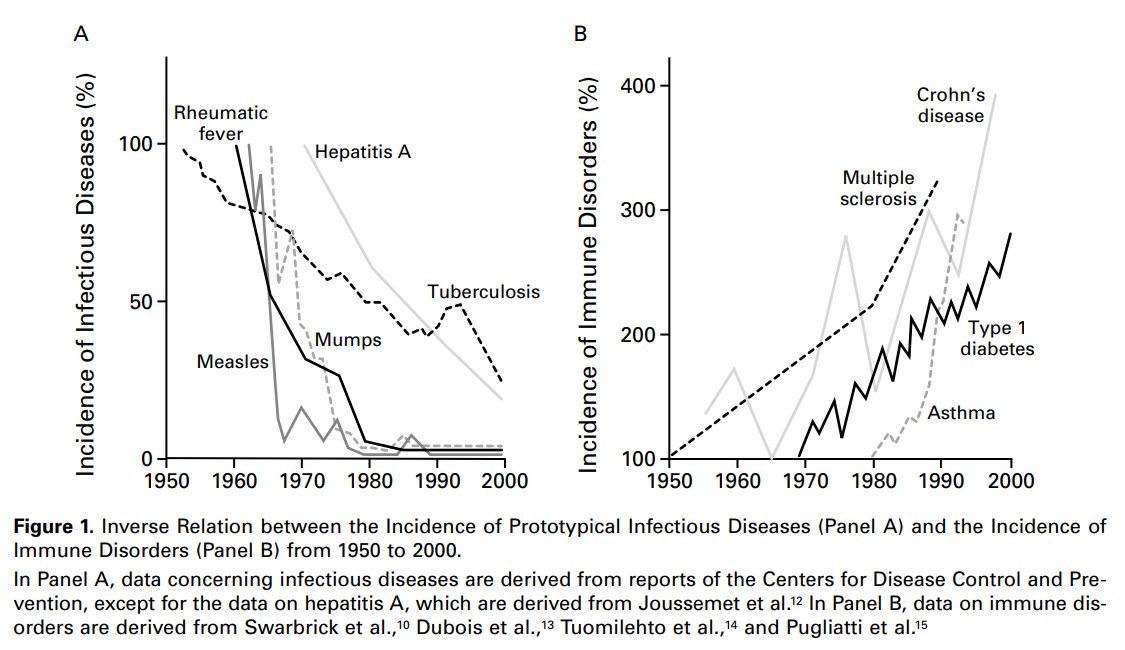
The pattern was unmistakable. Between 1979 and 1991, the prevalence of asthma, hay fever, and atopic dermatitis doubled in Swedish schoolchildren. In Lower Saxony, Germany, the same surge occurred. The mirror image was clear: as infections disappeared, immune diseases bloomed.
"Originally described for allergic diseases, the hygiene hypothesis was extended to autoimmune diseases in the early 2000s," explained Bach in a 2021 follow-up review. The hypothesis posits that a reduction in the frequency of infections contributes directly to the increase in autoimmune and allergic diseases.
The concept is counterintuitive. We know infectious agents cause disease—sometimes devastatingly. Yet the hypothesis suggests they could also have a protective effect against serious non-infectious illnesses.
David Strachan first proposed this idea in 1989 after noticing that hay fever and atopic dermatitis were less frequent in families with many children than in families with only one or two. His insight: common childhood infections may reduce the frequency of atopic diseases. By 2000, Strachan proposed that the increase in allergic diseases over the preceding decades could be ascribed to the decrease in infectious diseases.
But this wasn't about personal hygiene—hand washing or social distancing. The hygiene hypothesis concerns the environmental infectious burden that relies on socioeconomic context: quality of drinking water, cold chain respect, antibiotic use, and vaccine generalization. These are collective factors, not individual choices.
The critical detail: migration must occur before age 5 for allergic diseases or before age 15 for multiple sclerosis for the increase in incidence to manifest. This suggests the protective effect of infections develops over a fairly long period of childhood.
Genetic factors don't explain this phenomenon. Migrants carry the same genes whether they stay or leave. What changes is their infectious environment.
A dysbiosis—an imbalance of commensal bacteria—appears in these diseases, with reduced diversity and particularly decreased lactobacilli. This occurs in Type 1 diabetes, multiple sclerosis, and systemic lupus erythematosus.
Broad-spectrum antibiotics administered to mothers and newborns increase Type 1 diabetes frequency in NOD mice and experimental asthma.
"The progressive depletion of microbes and parasites due to increased socioeconomic improvement may lead to a derangement of immunoregulatory mechanisms," wrote Giuseppe Murdaca in a 2021 narrative review.
These organisms, termed "Old Friends," are depleted from the modern urban environment. Rather than considering fetal programming, neonatal programming, hygiene hypothesis, gut microbiota, and diet as separate hypotheses, researchers now integrate them under this single umbrella concept providing the missing immunoregulatory environmental factor.
These infectious agents contain TLR ligands. Systemic administration of chemically characterized TLR ligands reproduces the protective action of infectious agents. Importantly, infectious agents don't need to be alive—bacterial or parasitic extracts have the same effect.
TLR2 desensitization" prevents Type 1 diabetes in NOD mice. In humans, TLR4 desensitization induced by lipopolysaccharides (LPS) targets pulmonary epithelium, explaining why children raised on dairy farms (environments rich in LPS) present low allergy incidence.
• Interleukin-10 (IL-10): Predominant role attributed to probiotics
• TGF beta: Key role shown in protective mechanisms mediated by various parasites
• Regulatory T cells: CD4+CD25+FOXP3+ regulatory T lymphocytes involved in many protective effects
This appears paradoxical to the hygiene hypothesis—but reflects the complexity of infection-autoimmunity relationships. Some infections prevent autoimmunity; others trigger it.
• Geographic differences in autoimmune prevalence unexplained by genetics
• Seasonality affecting onset and severity of autoimmune diseases
• Neonatal and postnatal infection associations with autoimmune diseases
"Evolution gave rise to an improvement of immune responses against infectious agents under their pressure," Bach noted. Genes encoding Toll-like receptors evolved under selective pressure from environmental conditions as humans migrated from Africa to Asia and Europe.
But here's the crucial distinction: evolution through selection spanned hundreds of thousands of years, while the hygiene hypothesis applies to adaptation over just 50 years.
"We thus find ourselves in a situation where the time scale associated with selective pressure intersects with that of the hygiene hypothesis," Bach wrote. The immune system adapted to high pathogen loads through evolution, but now faces an environment where those pathogens are absent.
The study of lower incidence in large families suggests common childhood infections play a role. The chronological mirroring of major infectious disease decline with allergic/autoimmune increase argues for serious infectious diseases being involved.
Experimental models identify specific agents: bacteria, viruses, and especially parasites prevent allergic and autoimmune diseases.
In NOD mice (spontaneous Type 1 diabetes model), numerous infectious agents prevent autoimmune disease. In lupus B/W mice, kidney disease and survival improve considerably with viral or parasitic infections. The first convincing observation involved Plasmodium berghei (a parasite) preventing autoimmune disease.
Therapeutic trials show limited but promising results: Trichuris suis (live pig parasite) infestation showed favorable effects in multiple sclerosis patients.
Such claims seem difficult when allergic disease increases affect all clinical forms from atopic dermatitis to hay fever to food allergies. Moreover, the parallel evolution of autoimmune diseases doesn't support the allergenic environment hypothesis.
Another challenge: not all autoimmune diseases are concerned by the hypothesis, without knowing why some are and others aren't. Also difficult: determining which infections are involved.
Some studies demonstrate early microbial/parasite exposures prevent allergies and autoimmunity; others show these exposures can potentiate clinical scenarios.
2. Parasitic extracts: Rather than live parasites, using extracts with same protective effect
3. Microbiome modulation: Calibrated probiotics with sufficient bacterial numbers
4. Vitamin D supplementation: Complex interplay with microbial agents
5. Dietary interventions: Influencing microbiota composition
"From the point of view of precision medicine, the hygiene hypothesis represents a fundamental element together with genomics, microbiome, and proteomics in understanding the complex functioning of the immune system," Murdaca concluded.
Autoimmunity cannot be limited to the hygiene hypothesis alone, but it represents a fundamental element in precision medicine.
The rise of autoimmune diseases continues yearly by 19.1% globally, with rheumatological diseases like Sjögren's and lupus rising 7.1%. A 2023 UK study of 22 million people showed autoimmune disorders now affect about one in ten individuals.
We've created a world our immune systems didn't evolve for. The paradox of clean is that our victory against infectious disease may have cost us something precious: the microbial partners that taught our immune systems when to stop fighting.
The question now isn't whether to revert to less sanitary conditions—but how to provide the immunoregulatory benefits of those "Old Friends" without their disease risks. The answer may lie in the next generation of immunopharmacology, microbiome medicine, and precision therapeutics.
Our immune systems are waiting for instruction. We just need to learn what messages to send.
Sources: This article synthesizes findings from peer-reviewed research including Bach's 2002 NEJM review, Bach's 2021 Frontiers in Immunology review, Murdaca's 2021 Autoimmunity Reviews narrative review, and recent studies from 2020-2025 on microbiome, COVID-19, EBV, and TLR mechanism.
But something unexpected happened. As infectious diseases declined, a new epidemic emerged.
"Throughout the twentieth century, there were striking increases in the incidences of many chronic inflammatory disorders in the rich developed countries," wrote immunologist Jean-François Bach in his seminal 2002 review in The New England Journal of Medicine. These included autoimmune disorders such as Type 1 diabetes and multiple sclerosis—diseases that had been rare just decades before.
The pattern was unmistakable. Between 1979 and 1991, the prevalence of asthma, hay fever, and atopic dermatitis doubled in Swedish schoolchildren. In Lower Saxony, Germany, the same surge occurred. The mirror image was clear: as infections disappeared, immune diseases bloomed.
The Counterintuitive Theory
This observation gave rise to what seems at first a bizarre idea: the hygiene hypothesis."Originally described for allergic diseases, the hygiene hypothesis was extended to autoimmune diseases in the early 2000s," explained Bach in a 2021 follow-up review. The hypothesis posits that a reduction in the frequency of infections contributes directly to the increase in autoimmune and allergic diseases.
The concept is counterintuitive. We know infectious agents cause disease—sometimes devastatingly. Yet the hypothesis suggests they could also have a protective effect against serious non-infectious illnesses.
David Strachan first proposed this idea in 1989 after noticing that hay fever and atopic dermatitis were less frequent in families with many children than in families with only one or two. His insight: common childhood infections may reduce the frequency of atopic diseases. By 2000, Strachan proposed that the increase in allergic diseases over the preceding decades could be ascribed to the decrease in infectious diseases.
But this wasn't about personal hygiene—hand washing or social distancing. The hygiene hypothesis concerns the environmental infectious burden that relies on socioeconomic context: quality of drinking water, cold chain respect, antibiotic use, and vaccine generalization. These are collective factors, not individual choices.
The Evidence Gathers
Migration Studies: The Smoking Gun
The most compelling epidemiological evidence comes from migration studies. When people migrate from countries with low incidence of autoimmune or allergic diseases to countries with high incidence, they develop these diseases with the same frequency as host country residents from the first generation.The critical detail: migration must occur before age 5 for allergic diseases or before age 15 for multiple sclerosis for the increase in incidence to manifest. This suggests the protective effect of infections develops over a fairly long period of childhood.
Genetic factors don't explain this phenomenon. Migrants carry the same genes whether they stay or leave. What changes is their infectious environment.
The Finland-Karelia Mystery
Consider Finland and Karelia, contiguous countries with basically the same climate and genetic factors but different socioeconomic levels. Type 1 diabetes and allergy incidence is four to six times greater in Finland than in Karelia. Remarkably, this difference doesn't apply to islet-cell autoantibodies, suggesting hygiene affects the progression rather than the triggering of the autoimmune process.Socioeconomic Patterns
Allergic and autoimmune diseases consistently prove more common in high socioeconomic backgrounds and families with few children. This pattern holds across decades and continents.Infection Seropositivity Markers
Researchers analyzed prevalence of infection stigmata across populations. Atopy is more common when seropositivity against hepatitis A virus is low. Multiple sclerosis associates with lower seropositivity for cytomegalovirus (CMV) or Helicobacter pylori. The same observation was made for CMV in Type 1 diabetes. Multiple sclerosis also associates with abnormally low exposure to Toxoplasma gondii.The Modern Era: New Research, New Insights
The Gut Microbiome Revolution
The emergence of metagenomics over the past fifteen years opened a new chapter. Researchers can now characterize intestinal microbiota composition, revealing that decreased microbiota diversity contributes to autoimmune diseases.A dysbiosis—an imbalance of commensal bacteria—appears in these diseases, with reduced diversity and particularly decreased lactobacilli. This occurs in Type 1 diabetes, multiple sclerosis, and systemic lupus erythematosus.
Broad-spectrum antibiotics administered to mothers and newborns increase Type 1 diabetes frequency in NOD mice and experimental asthma.
"The progressive depletion of microbes and parasites due to increased socioeconomic improvement may lead to a derangement of immunoregulatory mechanisms," wrote Giuseppe Murdaca in a 2021 narrative review.
The "Old Friends" Concept
Immunologists have developed an umbrella concept: humans exist in a state of evolved dependence on organisms with which we co-evolved—organisms that had to be tolerated as inducers of immunoregulatory circuits.These organisms, termed "Old Friends," are depleted from the modern urban environment. Rather than considering fetal programming, neonatal programming, hygiene hypothesis, gut microbiota, and diet as separate hypotheses, researchers now integrate them under this single umbrella concept providing the missing immunoregulatory environmental factor.
Toll-Like Receptors: The Molecular Mechanism
At the molecular level, pathogens, bacteria, viruses, parasites, and commensal bacteria exert protective effects primarily through Toll-Like Receptor (TLR) interactions.These infectious agents contain TLR ligands. Systemic administration of chemically characterized TLR ligands reproduces the protective action of infectious agents. Importantly, infectious agents don't need to be alive—bacterial or parasitic extracts have the same effect.
TLR2 desensitization" prevents Type 1 diabetes in NOD mice. In humans, TLR4 desensitization induced by lipopolysaccharides (LPS) targets pulmonary epithelium, explaining why children raised on dairy farms (environments rich in LPS) present low allergy incidence.
Immunoregulatory Cytokines
Multiple mechanisms operate through immunoregulatory circuits:• Interleukin-10 (IL-10): Predominant role attributed to probiotics
• TGF beta: Key role shown in protective mechanisms mediated by various parasites
• Regulatory T cells: CD4+CD25+FOXP3+ regulatory T lymphocytes involved in many protective effects
Recent Discoveries (2020–2025)
COVID-19: A Paradox
The COVID-19 pandemic revealed unexpected connections. Researchers identified a 42.6% higher likelihood of acquiring an autoimmune condition 3–15 months after SARS-CoV-2 infection compared with non-COVID controls.This appears paradoxical to the hygiene hypothesis—but reflects the complexity of infection-autoimmunity relationships. Some infections prevent autoimmunity; others trigger it.
EBV and Multiple Sclerosis
Epstein-Barr Virus has been firmly established as associated with lupus, multiple sclerosis, and rheumatoid arthritis via molecular mimicry. This represents the double-edged nature of infections: they can protect through TLR stimulation but also trigger autoimmunity through molecular mimicry.Gut Bacteria Triggering Lupus
Yale researchers discovered in 2025 that Enterococcus gallinarum, a gut bacterium, can travel outside the gastrointestinal system and trigger autoimmune responses in lupus. This reveals specific bacterial species linked to autoimmune diseases.Mendelian Randomization Studies
A 2023 Frontiers in Genetics study using Mendelian randomization attempted to establish causal relationships between gut microbiota and allergic diseases, rather than mere correlations. However, the findings are complex and contradictory: while this particular study reported statistical associations between certain microbial markers and hay fever/eczema, the broader scientific literature consistently shows that Bifidobacterium (especially B. breve) is protective against allergic diseases. Infants colonized with B. breve had a reduced risk of developing eczema (OR = 0.15 at 3 months), and missing Bifidobacterium in early life is associated with a three-fold increase in allergy and eczema risk. Different Bifidobacterium species have opposite effects—B. breve protects while B. catenulatum increases risk—highlighting that the hygiene hypothesis concerns overall microbial diversity and depletion, not single bacterial species.NIAID Workshop Findings
A 2024 NIAID Workshop (reported 2025) highlighted mounting evidence connecting autoimmunity and infectious disease:• Geographic differences in autoimmune prevalence unexplained by genetics
• Seasonality affecting onset and severity of autoimmune diseases
• Neonatal and postnatal infection associations with autoimmune diseases
The Evolutionary Perspective
The hygiene hypothesis reveals something profound about human evolution. Changes in immune response genes occurred at remarkably rapid rates—often only a few thousand years, sometimes less during major epidemics."Evolution gave rise to an improvement of immune responses against infectious agents under their pressure," Bach noted. Genes encoding Toll-like receptors evolved under selective pressure from environmental conditions as humans migrated from Africa to Asia and Europe.
But here's the crucial distinction: evolution through selection spanned hundreds of thousands of years, while the hygiene hypothesis applies to adaptation over just 50 years.
"We thus find ourselves in a situation where the time scale associated with selective pressure intersects with that of the hygiene hypothesis," Bach wrote. The immune system adapted to high pathogen loads through evolution, but now faces an environment where those pathogens are absent.
Which Infections? The Unsolved Question
One of the most persistent mysteries: which infections are involved?The study of lower incidence in large families suggests common childhood infections play a role. The chronological mirroring of major infectious disease decline with allergic/autoimmune increase argues for serious infectious diseases being involved.
Experimental models identify specific agents: bacteria, viruses, and especially parasites prevent allergic and autoimmune diseases.
In NOD mice (spontaneous Type 1 diabetes model), numerous infectious agents prevent autoimmune disease. In lupus B/W mice, kidney disease and survival improve considerably with viral or parasitic infections. The first convincing observation involved Plasmodium berghei (a parasite) preventing autoimmune disease.
Therapeutic trials show limited but promising results: Trichuris suis (live pig parasite) infestation showed favorable effects in multiple sclerosis patients.
The Controversy Persists
Not all scientists accept the hygiene hypothesis. Many allergists explain increased allergic diseases through changes in the non-infectious environment—even incriminating increased pollen dissemination.Such claims seem difficult when allergic disease increases affect all clinical forms from atopic dermatitis to hay fever to food allergies. Moreover, the parallel evolution of autoimmune diseases doesn't support the allergenic environment hypothesis.
Another challenge: not all autoimmune diseases are concerned by the hypothesis, without knowing why some are and others aren't. Also difficult: determining which infections are involved.
Some studies demonstrate early microbial/parasite exposures prevent allergies and autoimmunity; others show these exposures can potentiate clinical scenarios.
The Future: Therapeutic Perspectives
The solutions won't come from reintroducing infections but from using "substitutes" retaining protective benefits.Promising Approaches
1. TLR-targeted immunopharmacology: Using specific TLR ligands to stimulate immunoregulation2. Parasitic extracts: Rather than live parasites, using extracts with same protective effect
3. Microbiome modulation: Calibrated probiotics with sufficient bacterial numbers
4. Vitamin D supplementation: Complex interplay with microbial agents
5. Dietary interventions: Influencing microbiota composition
"From the point of view of precision medicine, the hygiene hypothesis represents a fundamental element together with genomics, microbiome, and proteomics in understanding the complex functioning of the immune system," Murdaca concluded.
The Bigger Picture
The hygiene hypothesis teaches us about immunity's flexibility—under constant control by immunoregulation influenced by environment. It illuminates mechanisms underlying immune-related diseases and opens new perspectives on etiological factors distinguishing triggers from protectors.Autoimmunity cannot be limited to the hygiene hypothesis alone, but it represents a fundamental element in precision medicine.
The rise of autoimmune diseases continues yearly by 19.1% globally, with rheumatological diseases like Sjögren's and lupus rising 7.1%. A 2023 UK study of 22 million people showed autoimmune disorders now affect about one in ten individuals.
We've created a world our immune systems didn't evolve for. The paradox of clean is that our victory against infectious disease may have cost us something precious: the microbial partners that taught our immune systems when to stop fighting.
The question now isn't whether to revert to less sanitary conditions—but how to provide the immunoregulatory benefits of those "Old Friends" without their disease risks. The answer may lie in the next generation of immunopharmacology, microbiome medicine, and precision therapeutics.
Our immune systems are waiting for instruction. We just need to learn what messages to send.
Sources: This article synthesizes findings from peer-reviewed research including Bach's 2002 NEJM review, Bach's 2021 Frontiers in Immunology review, Murdaca's 2021 Autoimmunity Reviews narrative review, and recent studies from 2020-2025 on microbiome, COVID-19, EBV, and TLR mechanism.
Last edited: