• Don't want to see ads? Install an adblocker like uBlock Origin or use a Europe-based privacy-friendly browser like Vivaldi or Mullvad.

Genetic study The arrival of the Near Eastern ancestry in Central Italy predates the onset of the Roman Empire

That is a Persian myth, it is believed that the Roman Empire was found by Salm, borther of Iraj, ancestor of Iranians.
The Persian Emperors kept 2 thrones, one for themselves and one for any Roman Emperor who cared to visit the Persian Empire but not one did.
Instead there were numerous Roman-Persian/Parthian Wars which drained both empires so much that the Arab expansion in the 7th century was able to destroy Persian power and strip the Eastern Roman (Byzantine) Empire of half its land including the richest provinces, namely Egypt and Syria.
 
Then your original question doesn't make sense.

It's apparent that this type of ancestry that you associate to "Anatolians" arrived through the Greeks. No significant amount of Anatolians entered Italy in the IA.
It's not apparent, just merely a hypothesis on a random sample. The Greek samples of Himera are easily distinguished from this ancient individual.

The general census is that Hellenized Anatolians started flooding Hellenic orbits in Italy after Alexander's expansions, while my belief is that most of those came independently of Ancient Greek colonization, rather driven by the Roman Empire itself.

I am not sure about the few members in here, they might have different interpretations.
 
It's not apparent, just merely a hypothesis on a random sample.
To me it looks very well argued by forum members like f.e. Vitruvius, I've yet to read a more convincing alternative hypothesis.

The Greek samples of Himera are easily distinguished from this ancient individual.

The general census is that Hellenized Anatolians started flooding Hellenic orbits in Italy after Alexander's expansions, while my belief is that most of those came independently of Ancient Greek colonization, rather driven by the Roman Empire itself.
There was no Roman Empire at the time of this ancient individual.
 
The Persian Emperors kept 2 thrones, one for themselves and one for any Roman Emperor who cared to visit the Persian Empire but not one did.
Instead there were numerous Roman-Persian/Parthian Wars which drained both empires so much that the Arab expansion in the 7th century was able to destroy Persian power and strip the Eastern Roman (Byzantine) Empire of half its land including the richest provinces, namely Egypt and Syria.
Persians strongly believed a large part of Europe belonged to them, Old Persian inscriptions have been found as far as Gherla in the northwest of Romania: https://en.wikipedia.org/wiki/Gherla several centuries after the fall of Achaemenid empire, the Sassanid king Shapur II (309—379 AD) writes in his letter to Roman emperor Constantius II: "Even your own ancient records bear witness that my ancestors possessed all the country up to the Strymon and the frontier of Macedonia. And these lands it is fitting that I who (not to speak arrogantly) am superior to those ancient kings in magnificence, and in all eminent virtues, should now reclaim. But I am at all times thoughtful to remember that, from my earliest youth, I have never done anything to repent of." https://www.britannica.com/biography/Shapur-II
 
When do you think most Anatolians entered Italy at what time? Before 500BC or after 300BC?
500BC is a bit early as there were still significant Greek migrations occurring during this period. Most would had arrived by 300BC but would've been confined chiefly to their city states up until the italic social wars at ~100BC. Remember that the Pyrrhic war which cemented Roman dominance over southern Italy did not even start until 280BC.

So my stance remains that such people were in Italy by 300BC but the broad mixing with the center and rest of the southern old italic populations occurred a couple hundred years after once thorough romanization and legal/ethnic equivalency was achieved.
 
Carthaginians inside Byrsa surrendered by displaying an olive branch. Scipio agreed that the 50,000 Carthaginian survivors who had sheltered in Byrsa to survive and be sold into slavery,

above was the end of carthage in 146BC........50000 slaves was the greatest number at the time to eventually mix with the roman populace
 
of the 50000, what percentage where ex sicilian or sardinian who merged with the punic populace in earlier times
 
According to some Persian sources after the fall of the Persian empire and in the Alexander era, a group of Iranians who wanted to preserve their religion (Mithraism) migrated to the west and created the Roman empire.

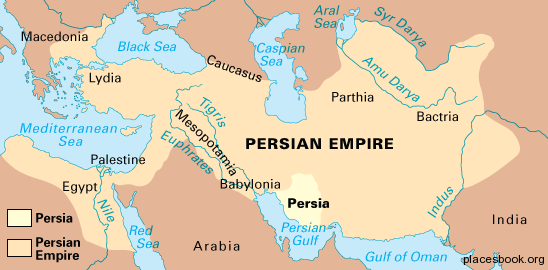
Ancient Iran was the birthplace of one of the world's great empires, founded by Cyrus the Great. At its greatest extent it stretched from India to the Aegean Sea, and south to Arabia and Egypt. The Persian Empire left an indelible legacy in the history of civilization, from political and administrative organization to contributions in art, literature and science. He played an essential role in several developments that shaped the ancient world.
For example, one of the most significant cultural contributions of the Persians was their dualistic religion Zoroastrianism, based on the belief in two antagonistic supreme being, Ahura-Mazda (the god of good, light, and order) and Ahriman (the god of evil, darkness, and chaos). This religion influenced other religions, such as Christianity.

Later, Islamic culture would never reach the heights it reached without the conquest of Persia by the Arabs, who learned the path of civilization from them. The Persians were the civilizers of the Arabs, like the Greeks of the Romans, gaining important places among Islamic philosophers, poets and historians.

The Persians have always made great contributions throughout history in the fields of mathematics, architecture, astronomy, finance, medicine. They have a glorious history of their own, there is no need to appropriate the history of other peoples with whom they have nothing to do, neither historically nor genetically.​
 
The Persians have always made great contributions throughout history in the fields of mathematics, architecture, astronomy, finance, medicine. They have a glorious history of their own, there is no need to appropriate the history of other peoples with whom they have nothing to do, neither historically nor genetically.​
You are right but I said "a group of Iranians", not "Persians", Persians lived in Persia, a region in the south of Iran:

6b8348e5262a92dea724f0323a67464b.gif


We know some different peoples lived in Iran and some of them migrated to different regions during the Achaemenid era, for example Hyrcanians who lived in the northeast of Iran migrated to the Hyrcanian plain in Lydia in the west of Anatolia: https://en.wikipedia.org/wiki/Hyrcanian_plain
 
Is interesting the answer to Rowsell from Hannah Moots as well:
"Having been so lucky to study the Iron Age central Mediterranean, I can say this is categorically untrue. Central Italy was hugely diverse in the Iron Age, with about 40% of the population having ancestries from elsewhere in the Mediterranean. https://nature.com/articles/s41559-023-02143-4"

She is a fraud. Even has her pronouns in her bio. What a clown show. This is precisely what I'm talking about in regards to this inflation of BS papers published by a bunch of heavily politicised mediocrities and spin shysters masquerading as scientists. A degree doesn't make you a scientist if you don't think and act like one. How did they conclude that 40% were migrants from one friggin' sample? These people should be called out for what they are. It's also amazing that these people never supplement their "research" with historical and archeological records. They add some superficial references at best.
 
Carthaginians inside Byrsa surrendered by displaying an olive branch. Scipio agreed that the 50,000 Carthaginian survivors who had sheltered in Byrsa to survive and be sold into slavery,

above was the end of carthage in 146BC........50000 slaves was the greatest number at the time to eventually mix with the roman populace
There is zero reason to believe that that such slaves were sold to Italy and that such slaves would've been at all mixing with Roman citizens. It also seems totally off topic considering that the individual from this study was most definitely not north african influenced or derived.
 
strange that some , keep pushing for an eastern med/ levant association with romans while under the republican rome period....
romans had more gallic, illyrian and celtic association than any eadtern med link in BC times
 
The findings from ancient DNA research can be politically sensitive, there is a concern in the scientific community about the potential to support nationalistic narratives about the purity and origins of populations. There is a concern of the misuse of these findings to advance some agendas or narratives, as seen in various instances where genetic research has been leveraged to justify claims about ethnic or national identity.
Simplistic interpretations of ancient DNA can be exploited to support some agendas or narratives, similar to the way cultural and archaeological history has been used in previous eras, for example the use in Nazi Germany of the work of early 20th century German archaeologist Gustaf Kossinna about Corded Ware.
Ancient DNA findings can either challenge or reinforce national narratives about the origins and purity of populations, impacting national identity and heritage, and influencing how people perceive their history and cultural roots.
In the spirit of the time, where ideologies of diversity and inclusion predominate, greater relevance is given today to aspects of diversity and migration over the concept of homogenous ancient groups.
By highlighting genetic diversity and migration, these scientists hope to help combat the misuse of genetic research to support nationalist or ethnic purity narratives. To avoid falling into one extreme, there is a tendency to go to the other extreme.
A more correct interpretation is not at one extreme or the other but will be more nuanced.


That is precisely the point. There is no doubt that genetics is politically sensitive, and attracts both left- and right-wing-driven agendas.

But this does not authorize a scholar to make false claims and to manipulate and exaggerate his/her data, as in the case of Moots. Her calculations are based on inflating the results of a sample of 22 individuals, but to date we have many more individuals analyzed from the Iron Age in central Italy, and if you do the percentages the non-locals are much less than 40 percent. Those from other areas of the Mediterranean even less. The reasons why she manipulates the data are obvious. And yes, it is about politics, no doubt. Because presenting Rome from the Republican final stage as a multi-ethnic society is useful for today's politics, starting precisely with that of the United States.

Politics, whether left or right, must stay out of ancient history, anthropology, archaeology, linguistics and genetics. Archaeologists began to come to terms with this many years ago. Geneticists never got started.
 
That is precisely the point. There is no doubt that genetics is politically sensitive, and attracts both left- and right-wing-driven agendas.

But this does not authorize a scholar to make false claims and to manipulate and exaggerate his/her data, as in the case of Moots. Her calculations are based on inflating the results of a sample of 22 individuals, but to date we have many more individuals analyzed from the Iron Age in central Italy, and if you do the percentages the non-locals are much less than 40 percent. Those from other areas of the Mediterranean even less. The reasons why she manipulates the data are obvious. And yes, it is about politics, no doubt. Because presenting Rome from the Republican final stage as a multi-ethnic society is useful for today's politics, starting precisely with that of the United States.

Politics, whether left or right, must stay out of ancient history, anthropology, archaeology, linguistics and genetics. Archaeologists began to come to terms with this many years ago. Geneticists never got started.
I agree. It is revolting to see every imbecile attempt to pigeon hole Roman Italy into a multicultural narrative. Italy during the Roman era received limited migrations from limited regions - specifically Greece and Anatolia. It was nothing like what we see in terms of today's multiculturalism associated with the US or the new world. A more comparable case to ancient Italy would be the Anglo & Saxon migrations to Britannia or Northern Germanic migrations into central Europe. We're speaking of the assimilation of northern mediterraneans who are not much dissimilar from one another to begin with despite not being from totally identical ethnic groups or genetic profiles.
 
She is a fraud. Even has her pronouns in her bio. What a clown show. This is precisely what I'm talking about in regards to this inflation of BS papers published by a bunch of heavily politicised mediocrities and spin shysters masquerading as scientists. A degree doesn't make you a scientist if you don't think and act like one. How did they conclude that 40% were migrants from one friggin' sample? These people should be called out for what they are. It's also amazing that these people never supplement their "research" with historical and archeological records. They add some superficial references at best.
I mostly agree with you, I was just quoting her, considering the statement that the East Mediterranean source arrived to Italy before imperial times, I think the influence from the East Med was mainly Greek, not Middle Eastern. I do Think Magna Graecia was a relevant source, and probably some late BA movements also contributed, at least on some Y Haplogroups. The fact that the oldest ancient latin script found in Rome, the Lapis Niger inscription (https://en.wikipedia.org/wiki/Lapis_Niger ), dated at the beginning of the Roman Republic, was written in a boustrophedon style with greek characters is a clear fact that greek culture was quite relevant in Rome, before their expansion to the south. I also think that part of the Trojan myths of some roman families, were probably an explanation of an Aegean origin of , at least their male ancestors.
 
I agree. It is revolting to see every imbecile attempt to pigeon hole Roman Italy into a multicultural narrative. Italy during the Roman era received limited migrations from limited regions - specifically Greece and Anatolia. It was nothing like what we see in terms of today's multiculturalism associated with the US or the new world. A more comparable case to ancient Italy would be the Anglo & Saxon migrations to Britannia or Northern Germanic migrations into central Europe. We're speaking of the assimilation of northern mediterraneans who are not much dissimilar from one another to begin with despite not being from totally identical ethnic groups or genetic profiles.
By Roman Italy do you include Gallia Cisalpina too?
 
By Roman Italy do you include Gallia Cisalpina too?
It ceased to be called that once the Gauls were expelled by the Romans under the late republic, but yes, I'm including Northern Italy here, complete with the Italian side of the alps. That being said I think northern Italy was much less affected by Aegean (be it magna graecian or otherwise) influence. Some areas like veneto, trentino and lombardy may not have even been affected at all by it, but at least Emelia and Piedmont show signs in the historic record that they were.
 
Last edited:
Back
Top