follow:
From an archaeological perspective, the appearance of channelled pottery within collective burials reflects a connection of NE Iberia with Central Europe<a data-track="click" data-track-action="reference anchor" data-track-label="link" data-test="citation-ref" title="Ruiz Zapatero, G. Bronce Final – Hierro: La naturaleza de los Campos de Urnas. in La Transició bronze final: 1a edat del ferro en els Pirineus i territoris veïns : XV Col·loqui Internacional d’Arqueologia de Puigcerdà. Congrés Nacional d’Arqueologia de Catalunya : Puigcerdà 17, 18 i 19 de novembre de 2011 (ed. Institut d’Estudis Ceretans) 635–658 (2014)." href="
https://www.nature.com/articles/s42003-025-08668-7#ref-CR49">49</a>, whereas the funerary architecture resembles the megalithic traditions present in the same area since the 4th millennium BCE<a data-track="click" data-track-action="reference anchor" data-track-label="link" data-test="citation-ref" title="Royo Guillén, J. I. et al. 193–215 (Arx, Colección Akademos, 2022)." href="
https://www.nature.com/articles/s42003-025-08668-7#ref-CR50">50</a>. The construction of the tumulus at Los Castellets II led archaeologists to consider the persistence of “old” funerary practices for at least some groups, despite the adoption of new cultural elements during the FBA<a data-track="click" data-track-action="reference anchor" data-track-label="link" data-test="citation-ref" title="Royo Guillén, J. I. El yacimiento de Los Castellets y su necrópolis tumular de inhumación e incineración. (Mequinenza, Zaragoza). Arqueol. Aragon. 1984, 47–53 (1986)." href="
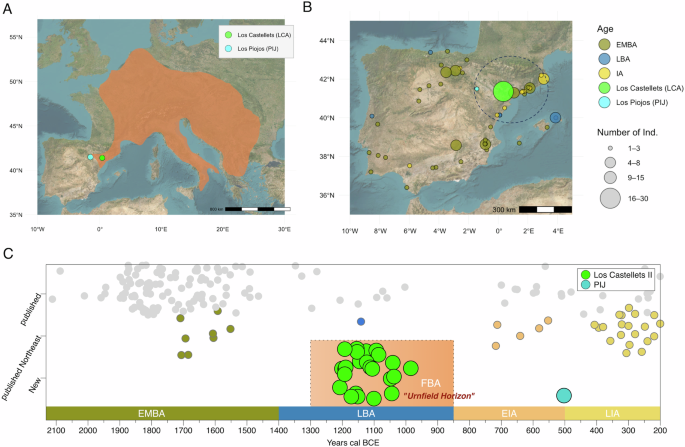
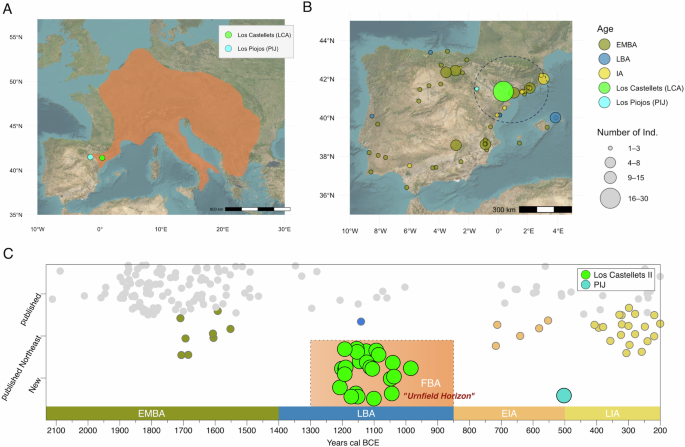
https://www.nature.com/articles/s42003-025-08668-7#ref-CR26">26</a>. Thus, our integrative analysis of the archaeological contexts alongside genomic data rules out the ideas of an invasion or colonisation by people associated with the Urnfield phenomenon in the region during the FBA, at least for the inhumed individuals at the site of Los Castellets II. However, there is evidence of a continuous, yet subtle, cultural connection and genetic affinity to regions east of Iberia during the Bronze Age, possibly through intermediate groups.
A full appraisal of the population dynamics in this region during the FBA is still limited by the data available to date, and several aspects need to be taken with caution. Most importantly, the community that co-inhabited the site but practised cremation remains unsampled. Inhumations and cremations coexisted and shared material culture at Los Castellets but the cremation persisted longer while inhumations disappeared by ~800 BCE. The individuals from burial Tumulus 2 are only representative of this initial occupation phase of Los Castellets II, but we cannot rule out the possibility that contemporaneous and later cremated individuals may exhibit different genetic profiles. Furthermore, the settlement patterns in northeastern inland regions such as Los Castellets are markedly different from the coastal lands, the western plain, and mountainous areas<a data-track="click" data-track-action="reference anchor" data-track-label="link" data-test="citation-ref" title="Ruiz Zapatero, G. Los Campos de urnas del NE de la Peninsula Ibérica. (Facultad de Geografía e Historia, Universidad Complutense de Madrid, 1983)." href="
https://www.nature.com/articles/s42003-025-08668-7#ref-CR7">7</a>,<a data-track="click" data-track-action="reference anchor" data-track-label="link" data-test="citation-ref" title="López, C. J. Necrópolis de incineración y arquitectura funeraria en el noreste de la Península Ibérica durante el Bronce Final y la Primera Edad del Hierro. Complutum 19, 139–171 (2008)." href="
https://www.nature.com/articles/s42003-025-08668-7#ref-CR21">21</a>, and subsequently the genetic history of FBA Iberia narrative could certainly be more complex.
The collective Tumulus 2 studied here stands out for its dimensions, the privileged location, and the number of individuals buried in it. Furthermore, the necropolis presents well-defined funeral sectors that have been associated with the existence of different family groups or clans<a data-track="click" data-track-action="reference anchor" data-track-label="link" data-test="citation-ref" title="Capuzzo, G. & López Cachero, J. De la inhumación a la cremación en el nordeste peninsular: cronología y sociedad. in Actas del Congreso de Cronometrías para la Historia de la Península Ibérica / coord. por Juan Antonio Barceló Álvarez, Igor Bogdanovich, Berta Morell Rovira 192–208 (2017)." href="
https://www.nature.com/articles/s42003-025-08668-7#ref-CR51">51</a>. In line with this hypothesis, Tumulus 2 was suggested to belong to a specific “family”, understanding it as a related group but without specifying the type of relatedness (biological, cohabitation, or affinity, for example). Here, we reveal the biological relationships between the individuals buried in Tumulus 2, and the results are consistent with an extended biological family in which biological ties were emphasised alongside other forms of kinship. Male individuals had more biological links at the site than female individuals, which suggests a patrilineal form of social/funerary organisation, albeit not as pronounced as it was reported for other EMBA sites<a data-track="click" data-track-action="reference anchor" data-track-label="link" data-test="citation-ref" title="Mittnik, A. et al. Kinship-based social inequality in Bronze Age Europe. Science 366, 731–734 (2019)." href="
https://www.nature.com/articles/s42003-025-08668-7#ref-CR43">43</a>,<a data-track="click" data-track-action="reference anchor" data-track-label="link" data-test="citation-ref" title="Villalba-Mouco, V. et al. Kinship practices in the early state El Argar society from Bronze Age Iberia. Sci. Rep. 12, 22415 (2022)." href="
https://www.nature.com/articles/s42003-025-08668-7#ref-CR44">44</a>,<a data-track="click" data-track-action="reference anchor" data-track-label="link" data-test="citation-ref" title="Penske, S. et al. Kinship practices at the early bronze age site of Leubingen in Central Germany. Sci. Rep. 14, 3871 (2024)." href="
https://www.nature.com/articles/s42003-025-08668-7#ref-CR45">45</a>,<a data-track="click" data-track-action="reference anchor" data-track-label="link" data-test="citation-ref" title="Sjögren, K.-G. et al. Kinship and social organization in Copper Age Europe. A cross-disciplinary analysis of archaeology, DNA, isotopes, and anthropology from two Bell Beaker cemeteries. PLoS One 15, e0241278 (2020)." href="
https://www.nature.com/articles/s42003-025-08668-7#ref-CR52">52</a>,<a data-track="click" data-track-action="reference anchor" data-track-label="link" data-test="citation-ref" title="Žegarac, A. et al. Ancient genomes provide insights into family structure and the heredity of social status in the early Bronze Age of southeastern Europe. Sci. Rep. 11, 10072 (2021)." href="
https://www.nature.com/articles/s42003-025-08668-7#ref-CR53">53</a>,<a data-track="click" data-track-action="reference anchor" data-track-label="link" data-test="citation-ref" title="Blöcher, J. et al. Descent, marriage, and residence practices of a 3,800-year-old pastoral community in Central Eurasia. Proc. Natl. Acad. Sci. USA 120, e2303574120 (2023)." href="
https://www.nature.com/articles/s42003-025-08668-7#ref-CR54">54</a>,<a data-track="click" data-track-action="reference anchor" data-track-label="link" data-test="citation-ref" title="Penske, S. et al. Life and work – A possible ›house community‹ at the Early Bronze Age settlement of Schiepzig in Central Germany. Kinship, Sex, and Biological Relatedness: The contribution of archaeogenetics to the understanding of social and biological relations vol. 26 183–194
https://doi.org/10.11588/PROPYLAEUM.1280.C18007 (2023)." href="
https://www.nature.com/articles/s42003-025-08668-7#ref-CR55">55</a>. Comparable results have also been reported from Neolithic monumental and collective burials where the right to be buried in the monumental graves was primarily granted when a biological connection with a specific adult male existed<a data-track="click" data-track-action="reference anchor" data-track-label="link" data-test="citation-ref" title="Fowler, C. et al. A high-resolution picture of kinship practices in an Early Neolithic tomb. Nature 601, 584–587 (2021)." href="
https://www.nature.com/articles/s42003-025-08668-7#ref-CR56">56</a>,<a data-track="click" data-track-action="reference anchor" data-track-label="link" data-test="citation-ref" title="Rivollat, M. et al. Extensive pedigrees reveal the social organization of a Neolithic community. Nature 620, 600–606 (2023)." href="
https://www.nature.com/articles/s42003-025-08668-7#ref-CR57">57</a>, but also in flat necropolises<a data-track="click" data-track-action="reference anchor" data-track-label="link" data-test="citation-ref" title="Fowler, C. et al. A high-resolution picture of kinship practices in an Early Neolithic tomb. Nature 601, 584–587 (2021)." href="
https://www.nature.com/articles/s42003-025-08668-7#ref-CR56">56</a>,<a data-track="click" data-track-action="reference anchor" data-track-label="link" data-test="citation-ref" title="Rivollat, M. et al. Extensive pedigrees reveal the social organization of a Neolithic community. Nature 620, 600–606 (2023)." href="
https://www.nature.com/articles/s42003-025-08668-7#ref-CR57">57</a>. The lack of 1st-degree relatives (only one pair of males) in the tumulus is unexpected and might reflect biases in sample preservation (e.g., skeletal remains of subadult individuals are less well preserved) or cultural practices with regard to the selection of individuals buried in these tumuli.
Additionally, we observe elevated levels of inbreeding in two individuals who belong to the extended biological group buried at Tumulus 2, and in the EIA individual from Los Piojos. Such levels of inbreeding have not been reported in previous chronologies for the Iberian Peninsula<a data-track="click" data-track-action="reference anchor" data-track-label="link" data-test="citation-ref" title="Villalba-Mouco, V. et al. Genomic transformation and social organization during the Copper Age-Bronze Age transition in southern Iberia. Sci. Adv. 7, eabi7038 (2021)." href="
https://www.nature.com/articles/s42003-025-08668-7#ref-CR42">42</a>, but are observed in Early Iron Age Navarra<a data-track="click" data-track-action="reference anchor" data-track-label="link" data-test="citation-ref" title="Papac, L. et al. Intramural child burials in Iron Age Navarra: How ancient DNA can contribute to household archaeology. in Kinship, Sex, and Biological Relatedness: The contribution of archaeogenetics to the understanding of social and biological relations. (Harald, M. et al. Eds.) Vol. 26, 263–295 (Heidelberg: Propylaeum, Tagungen des Landesmuseums für Vorgeschichte Halle, 2023)." href="
https://www.nature.com/articles/s42003-025-08668-7#ref-CR10">10</a>, and thus could be a distinctive feature of extended biological families. The endogamous practices themselves have been suggested as a way to claim origins in hierarchical groups, with close-kin unions among elites in ‘high-chiefdom’ groups serving as a strategy for leaders to consolidate power and enhance their authority by deliberately challenging societal taboos<a data-track="click" data-track-action="reference anchor" data-track-label="link" data-test="citation-ref" title="Goggin, J. M. & Sturtevant, W. C. The Calusa: A stratified, nonagricultural society (with notes on sibling marriage). in Explorations in cultural anthropology: Essays in honor of George Peter Murdock (ed. Goodenough, W. H.) 179–219 (New York: McGraw-Hill, 1964)." href="
https://www.nature.com/articles/s42003-025-08668-7#ref-CR58">58</a>,<a data-track="click" data-track-action="reference anchor" data-track-label="link" data-test="citation-ref" title="Kaplan, J. O. Endogamy and the Marriage Alliance: A Note on Continuity in Kindred-Based Groups. Man 8, 555–570 (1973)." href="
https://www.nature.com/articles/s42003-025-08668-7#ref-CR59">59</a>,<a data-track="click" data-track-action="reference anchor" data-track-label="link" data-test="citation-ref" title="Gates, H. Refining the Incest Taboo: with considerable help from Bronislaw Malinowski. in The State of Knowledge at the Turn of the Century (eds. Wolf, A. P. & Durham, W. H.) 139–160 (Stanford University Press, Redwood City, 2004)." href="
https://www.nature.com/articles/s42003-025-08668-7#ref-CR60">60</a>. This hypothesis finds support in the fact that the group was buried in a unique megalithic-like collective burial mound at the site, which might reflect a different social status and/or different beliefs. However, due to the limited data of FBA Iberian groups, we cannot exclude a more generalised practice during the LBA, and specifically the FBA.
Lastly, the particularities of this tumulus do not allow us to make inferences in other nearby tumuli from the same necropolises, as this is the only tumulus with such a large number of individuals, whereas others only contained a maximum of three individuals. The data obtained from the nearby Tumulus 27 (individual LCA031) were not of sufficient quality and quantity to estimate biological relatedness between all possible pairs, and no close relatives were found when testing was possible (>1000 overlapping sites) (Supplementary Information
1, Supplementary Data
1.7).
 www.nature.com