• Don't want to see ads? Install an adblocker like uBlock Origin or use a Europe-based privacy-friendly browser like Vivaldi or Mullvad.

Genomes of a LBA community in a tumulus of N-E Iberia

MOESAN

Elite member
Messages
6,372
Reaction score
1,615
Points
113
Location
Brittany
Ethnic group
more celtic
Y-DNA haplogroup
R1b - L21/S145*
mtDNA haplogroup
H3c
Last edited by a moderator:
Marina Bretos Ezcurra, Adam B. Rohrlach, Luka Papac, José Ignacio Royo Guillén, Rodrigo Barquera, Fabiola Gómez Lecumberri, Rafael Laborda Lorente, Roberto Risch, Johannes Krause, Jesús V. Picazo Millán, Wolfgang Haak & Vanessa Villalba-Mouco

Introduction​

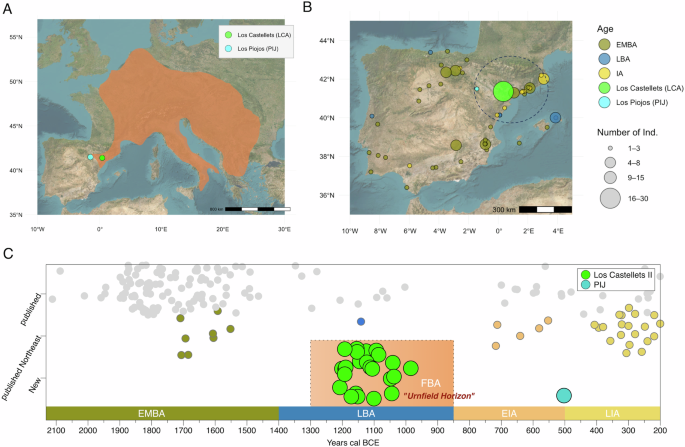
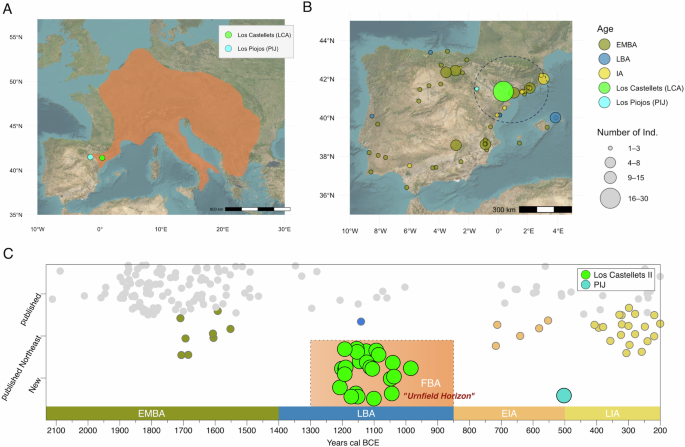
European prehistoric genetic diversity has been shaped by key demographic events, with the last major transformation being the influx of ancestry from Pontic-Caspian steppe-related pastoralists from 3000 BCE to 2000 BCE, e.g.,<a data-track="click" data-track-action="reference anchor" data-track-label="link" data-test="citation-ref" title="Haak, W. et al. Massive migration from the steppe was a source for Indo-European languages in Europe. Nature 522, 207–211 (2015)." href="https://www.nature.com/articles/s42003-025-08668-7#ref-CR1">1</a>,<a data-track="click" data-track-action="reference anchor" data-track-label="link" data-test="citation-ref" title="Allentoft, M. E. et al. Population genomics of Bronze Age Eurasia. Nature 522, 167–172 (2015)." href="https://www.nature.com/articles/s42003-025-08668-7#ref-CR2">2</a>,<a data-track="click" data-track-action="reference anchor" data-track-label="link" data-test="citation-ref" title="Olalde, I. et al. The genomic history of the Iberian Peninsula over the past 8000 years. Science 363, 1230–1234 (2019)." href="https://www.nature.com/articles/s42003-025-08668-7#ref-CR3">3</a>. However, in the Bronze Age (~2200–850 cal BCE), diverse cultural groups emerged and disseminated throughout the continent, which also generated debates about cultural diffusion versus cross-regional migrations that have not yet been explored in detail by archaeogenetic methods. Specifically, the final phase of the Bronze Age in Europe (~1300–850 cal BCE) is characterised by the appearance of the Urnfield culture, which extends westwards, from Central Europe to the Northeast of the Iberian Peninsula, and which established cremation as a novel and widespread funerary ritual among different shared traits<a data-track="click" data-track-action="reference anchor" data-track-label="link" data-test="citation-ref" title="Müller-Karpe, H. Beiträge zur Chronologie der Urnenfelderzeit nördlich und südlich der Alpen. Römischgermainsche Forschungen 22, Berlin., 306–307 (1959)." href="https://www.nature.com/articles/s42003-025-08668-7#ref-CR4">4</a>,<a data-track="click" data-track-action="reference anchor" data-track-label="link" data-test="citation-ref" title="Gimbutas, M. Bronze Age Cultures in Central and Eastern Europe. (De Gruyter Mouton, 1965)." href="https://www.nature.com/articles/s42003-025-08668-7#ref-CR5">5</a>,<a data-track="click" data-track-action="reference anchor" data-track-label="link" data-test="citation-ref" title="Sørensen, M. L. S. &amp; Rebay-Salisbury, K. Death and the Body in Bronze Age Europe: From Inhumation to Cremation. (Cambridge University Press, 2023)." href="https://www.nature.com/articles/s42003-025-08668-7#ref-CR6">6</a> (Fig. 1A). Cremations continued as the main funerary treatment in the ensuing Iron Age (IA) societies, where only infant individuals<a data-track="click" data-track-action="reference anchor" data-track-label="link" data-test="citation-ref" title="Ruiz Zapatero, G. Los Campos de urnas del NE de la Peninsula Ibérica. (Facultad de Geografía e Historia, Universidad Complutense de Madrid, 1983)." href="https://www.nature.com/articles/s42003-025-08668-7#ref-CR7">7</a>,<a data-track="click" data-track-action="reference anchor" data-track-label="link" data-test="citation-ref" title="Afonso, C. et al. Sex selection in late Iberian infant burials: Integrating evidence from morphological and genetic data. Am. J. Hum. Biol. 31, e23204 (2019)." href="https://www.nature.com/articles/s42003-025-08668-7#ref-CR8">8</a>,<a data-track="click" data-track-action="reference anchor" data-track-label="link" data-test="citation-ref" title="Rissech, C. et al. Skeletal remains of human perinatal individuals from the fortified Iberian Period settlement of Ca n’Oliver (6th century to 50 years BCE). Archaeol. Anthropol. Sci. 15, 158 (2023)." href="https://www.nature.com/articles/s42003-025-08668-7#ref-CR9">9</a>,<a data-track="click" data-track-action="reference anchor" data-track-label="link" data-test="citation-ref" title="Papac, L. et al. Intramural child burials in Iron Age Navarra: How ancient DNA can contribute to household archaeology. in Kinship, Sex, and Biological Relatedness: The contribution of archaeogenetics to the understanding of social and biological relations. (Harald, M. et al. Eds.) Vol. 26, 263–295 (Heidelberg: Propylaeum, Tagungen des Landesmuseums für Vorgeschichte Halle, 2023)." href="https://www.nature.com/articles/s42003-025-08668-7#ref-CR10">10</a> and some adults<a data-track="click" data-track-action="reference anchor" data-track-label="link" data-test="citation-ref" title="Agustí, B., Lara, L. &amp; Martín, A. Restauració i reestudi antropològic de quatre cranis del Museu d’Ullastret. Cypsela: revista de prehistòria i protohistòria, 307–319 (2011)." href="https://www.nature.com/articles/s42003-025-08668-7#ref-CR11">11</a> did not receive this treatment.

Fig. 1: Geographic locations and timeline of sites under study.
figure 1
A Geographic distribution of cremation burial practices associated with the Urnfield complex horizon c. 1300 BCE adapted from ref. <a data-track="click" data-track-action="reference anchor" data-track-label="link" data-test="citation-ref" title="Netchev, S. Map of the Urnfield Culture c. 1300 BCE (2021)." href="https://www.nature.com/articles/s42003-025-08668-7#ref-CR74">74</a>, with coloured circles denoting the new sites Los Castellets II (LCA) and Los Piojos (PIJ). B Map of Iberia with coloured circles denoting sites from where genome-wide data is available and the new sites Los Castellets II (LCA) and Los Piojos (PIJ), with the Iberian Northeast indicated by the dashed circle, and point size indicating samples sizes for each site. C Chronological time scale for published individuals from the Iberian Peninsula (dark green for EMBA and blue for LBA individuals from the Northeast of Iberia) and the new individuals analysed in this study (green and blue circles) (Supplementary Data 2.1). Directly radiocarbon-dated individuals are plotted according to their mean calibrated date (2-sigma range), and a jitter option within their specific time range was applied for individuals that were dated by archaeological context. Random jitter was only applied to the Y axis.
 
Marina Bretos Ezcurra, Adam B. Rohrlach, Luka Papac, José Ignacio Royo Guillén, Rodrigo Barquera, Fabiola Gómez Lecumberri, Rafael Laborda Lorente, Roberto Risch, Johannes Krause, Jesús V. Picazo Millán, Wolfgang Haak & Vanessa Villalba-Mouco

Introduction​

European prehistoric genetic diversity has been shaped by key demographic events, with the last major transformation being the influx of ancestry from Pontic-Caspian steppe-related pastoralists from 3000 BCE to 2000 BCE, e.g.,<a data-track="click" data-track-action="reference anchor" data-track-label="link" data-test="citation-ref" title="Haak, W. et al. Massive migration from the steppe was a source for Indo-European languages in Europe. Nature 522, 207–211 (2015)." href="https://www.nature.com/articles/s42003-025-08668-7#ref-CR1">1</a>,<a data-track="click" data-track-action="reference anchor" data-track-label="link" data-test="citation-ref" title="Allentoft, M. E. et al. Population genomics of Bronze Age Eurasia. Nature 522, 167–172 (2015)." href="https://www.nature.com/articles/s42003-025-08668-7#ref-CR2">2</a>,<a data-track="click" data-track-action="reference anchor" data-track-label="link" data-test="citation-ref" title="Olalde, I. et al. The genomic history of the Iberian Peninsula over the past 8000 years. Science 363, 1230–1234 (2019)." href="https://www.nature.com/articles/s42003-025-08668-7#ref-CR3">3</a>. However, in the Bronze Age (~2200–850 cal BCE), diverse cultural groups emerged and disseminated throughout the continent, which also generated debates about cultural diffusion versus cross-regional migrations that have not yet been explored in detail by archaeogenetic methods. Specifically, the final phase of the Bronze Age in Europe (~1300–850 cal BCE) is characterised by the appearance of the Urnfield culture, which extends westwards, from Central Europe to the Northeast of the Iberian Peninsula, and which established cremation as a novel and widespread funerary ritual among different shared traits<a data-track="click" data-track-action="reference anchor" data-track-label="link" data-test="citation-ref" title="Müller-Karpe, H. Beiträge zur Chronologie der Urnenfelderzeit nördlich und südlich der Alpen. Römischgermainsche Forschungen 22, Berlin., 306–307 (1959)." href="https://www.nature.com/articles/s42003-025-08668-7#ref-CR4">4</a>,<a data-track="click" data-track-action="reference anchor" data-track-label="link" data-test="citation-ref" title="Gimbutas, M. Bronze Age Cultures in Central and Eastern Europe. (De Gruyter Mouton, 1965)." href="https://www.nature.com/articles/s42003-025-08668-7#ref-CR5">5</a>,<a data-track="click" data-track-action="reference anchor" data-track-label="link" data-test="citation-ref" title="Sørensen, M. L. S. &amp; Rebay-Salisbury, K. Death and the Body in Bronze Age Europe: From Inhumation to Cremation. (Cambridge University Press, 2023)." href="https://www.nature.com/articles/s42003-025-08668-7#ref-CR6">6</a> (Fig. 1A). Cremations continued as the main funerary treatment in the ensuing Iron Age (IA) societies, where only infant individuals<a data-track="click" data-track-action="reference anchor" data-track-label="link" data-test="citation-ref" title="Ruiz Zapatero, G. Los Campos de urnas del NE de la Peninsula Ibérica. (Facultad de Geografía e Historia, Universidad Complutense de Madrid, 1983)." href="https://www.nature.com/articles/s42003-025-08668-7#ref-CR7">7</a>,<a data-track="click" data-track-action="reference anchor" data-track-label="link" data-test="citation-ref" title="Afonso, C. et al. Sex selection in late Iberian infant burials: Integrating evidence from morphological and genetic data. Am. J. Hum. Biol. 31, e23204 (2019)." href="https://www.nature.com/articles/s42003-025-08668-7#ref-CR8">8</a>,<a data-track="click" data-track-action="reference anchor" data-track-label="link" data-test="citation-ref" title="Rissech, C. et al. Skeletal remains of human perinatal individuals from the fortified Iberian Period settlement of Ca n’Oliver (6th century to 50 years BCE). Archaeol. Anthropol. Sci. 15, 158 (2023)." href="https://www.nature.com/articles/s42003-025-08668-7#ref-CR9">9</a>,<a data-track="click" data-track-action="reference anchor" data-track-label="link" data-test="citation-ref" title="Papac, L. et al. Intramural child burials in Iron Age Navarra: How ancient DNA can contribute to household archaeology. in Kinship, Sex, and Biological Relatedness: The contribution of archaeogenetics to the understanding of social and biological relations. (Harald, M. et al. Eds.) Vol. 26, 263–295 (Heidelberg: Propylaeum, Tagungen des Landesmuseums für Vorgeschichte Halle, 2023)." href="https://www.nature.com/articles/s42003-025-08668-7#ref-CR10">10</a> and some adults<a data-track="click" data-track-action="reference anchor" data-track-label="link" data-test="citation-ref" title="Agustí, B., Lara, L. &amp; Martín, A. Restauració i reestudi antropològic de quatre cranis del Museu d’Ullastret. Cypsela: revista de prehistòria i protohistòria, 307–319 (2011)." href="https://www.nature.com/articles/s42003-025-08668-7#ref-CR11">11</a> did not receive this treatment.

Fig. 1: Geographic locations and timeline of sites under study.
figure 1
A Geographic distribution of cremation burial practices associated with the Urnfield complex horizon c. 1300 BCE adapted from ref. <a data-track="click" data-track-action="reference anchor" data-track-label="link" data-test="citation-ref" title="Netchev, S. Map of the Urnfield Culture c. 1300 BCE (2021)." href="https://www.nature.com/articles/s42003-025-08668-7#ref-CR74">74</a>, with coloured circles denoting the new sites Los Castellets II (LCA) and Los Piojos (PIJ). B Map of Iberia with coloured circles denoting sites from where genome-wide data is available and the new sites Los Castellets II (LCA) and Los Piojos (PIJ), with the Iberian Northeast indicated by the dashed circle, and point size indicating samples sizes for each site. C Chronological time scale for published individuals from the Iberian Peninsula (dark green for EMBA and blue for LBA individuals from the Northeast of Iberia) and the new individuals analysed in this study (green and blue circles) (Supplementary Data 2.1). Directly radiocarbon-dated individuals are plotted according to their mean calibrated date (2-sigma range), and a jitter option within their specific time range was applied for individuals that were dated by archaeological context. Random jitter was only applied to the Y axis.
Throughout this text, we use the term Bronze Age (BA) to refer to the entire chronological period (2200–850 BCE) in Iberia. We divide this broad horizon into two phases: the Early-Middle BA (EMBA), which we will refer to as the date range between ~2200 and ~1400 BCE, and the Late Bronze Age (LBA), the period between ~1400 and ~850 BCE. The final LBA, which coincides with the appearance of cremations, will be referred to as Final Bronze Age (FBA), covering a chronological period between ~1300 and ~850 BCE for the region under study (Fig. 1C). In this way, we aim to resolve the discrepancies that exist in different geographic areas within and outside of the Iberian Peninsula concerning the horizon defined as the Middle BA.

The cremation and subsequent deposition of human remains inside urns present significant challenges for bioarchaeological research. From a molecular perspective, cremation drastically reduces the chances to recover collagen and/or ancient DNA<a data-track="click" data-track-action="reference anchor" data-track-label="link" data-test="citation-ref" title="Hansen, H. B. et al. Comparing Ancient DNA Preservation in Petrous Bone and Tooth Cementum. PLoS One 12, 1–18 (2017)." href="https://www.nature.com/articles/s42003-025-08668-7#ref-CR12">12</a>, which are the main sources of data for direct chronological, dietary, and demographic inference, adding further difficulties in the study of this period. However, recent advances in the analysis of cremated remains, including morphological, osteometric, and histological approaches, have substantially increased the information obtained from these materials<a data-track="click" data-track-action="reference anchor" data-track-label="link" data-test="citation-ref" title="Gigante, M. et al. Who was buried with Nestor’s Cup? Macroscopic and microscopic analyses of the cremated remains from Tomb 168 (second half of the 8th century BCE, Pithekoussai, Ischia Island, Italy). PLoS One 16, e0257368 (2021)." href="https://www.nature.com/articles/s42003-025-08668-7#ref-CR13">13</a>. In addition, improved wet lab protocols for Strontium ratio (⁸⁷Sr/⁸⁶Sr) analysis allowed researchers to infer individual mobility patterns during life in contexts where both inhumation and cremation practices coexisted<a data-track="click" data-track-action="reference anchor" data-track-label="link" data-test="citation-ref" title="Esposito, C. et al. Intense community dynamics in the pre-Roman frontier site of Fermo (ninth–fifth century BCE, Marche, central Italy) inferred from isotopic data. Sci. Rep. 13, 3632 (2023)." href="https://www.nature.com/articles/s42003-025-08668-7#ref-CR14">14</a>,<a data-track="click" data-track-action="reference anchor" data-track-label="link" data-test="citation-ref" title="Gigante, M. et al. Where Typhoeus lived: 87Sr/86Sr analysis of human remains in the first Greek site in the Western Mediterranean, Pithekoussai, Italy. iScience 28, 111927 (2025)." href="https://www.nature.com/articles/s42003-025-08668-7#ref-CR15">15</a>. There are only a few Bronze Age sites known where cremations and inhumations potentially co-occurred, e.g., ref. <a data-track="click" data-track-action="reference anchor" data-track-label="link" data-test="citation-ref" title="Peake, R., Delattre, V. &amp; Pihuit, P. La Nécropole de l’Âge du Bronze de ‘La Croix de la Mission’ à Marolles-sur-Seine (Seine-et-Marne). Bulletin de la Société préhistorique française, 581–605 (1999)." href="https://www.nature.com/articles/s42003-025-08668-7#ref-CR16">16</a>, and the site of Los Castellets II presented here is one such example (Supplementary Information1, Supplementary Fig. 1).
[...]
1756930614756.webp
 
more:
lalde and colleagues<a data-track="click" data-track-action="reference anchor" data-track-label="link" data-test="citation-ref" title="Olalde, I. et al. The genomic history of the Iberian Peninsula over the past 8000 years. Science 363, 1230–1234 (2019)." href="https://www.nature.com/articles/s42003-025-08668-7#ref-CR3">3</a> showed that steppe-related ancestry had increased during the transition from the BA to the IA, and suggested that the spread of the Urnfield culture from Central Europe could have been a possible cause for this change. However, the increased level of steppe-related ancestry was evaluated using the entire IA dataset available at that time, none of which was related to the core area of the Iberian urnfields. Therefore, our FBA dataset from an Urnfield necropolis, with contemporaneous inhumations and cremations and similar material culture in both types of funerary treatments, allows us to re-evaluate these conclusions using several approaches. Firstly, we formally tested if we can detect an increase in the amount of steppe ancestry at a regional level in Northeast Iberia by quantifying the amount of this ancestry using the distal qpAdm model proposed by ref. <a data-track="click" data-track-action="reference anchor" data-track-label="link" data-test="citation-ref" title="Patterson, N. et al. Large-scale migration into Britain during the Middle to Late Bronze Age. Nature 601, 588–594 (2022)." href="https://www.nature.com/articles/s42003-025-08668-7#ref-CR25">25</a> optimised to keep the standard errors as low as possible. This particular model uses WHG (Western Hunter gatherers), EEF (Eastern Early Farmers) and OldSteppe (Steppe pastoralists) sources, and a genetically close set of outgroups (Fig. 3B) (Supplementary Data 2.1). We ran this model individually and as a group for NE_Spain_EMBA, Los Castellets II, NE_Spain_FBA_Mortorum, NE_Spain_IA_Early (including the new EIA site Los Piojos) and NE_Spain_IA_Late to evaluate changes in the proportion of ancestral sources over time (Fig. 3B and Supplementary Data 2.2). Our results show an increase in the percentage of steppe-related ancestry between EMBA and FBA, although the increase detected is not significant (Wilcoxon rank-sum test; p = 0.06935). Using the PC2 coordinates as a proxy for steppe-related ancestry from the same individuals confirms a positive but non-significant trend between the two periods (Wilcoxon rank-sum test; p = 0.099). Significant differences in the proportion of steppe-related ancestry are only observed when comparing EMBA vs EIA and LIA from Northeastern Iberia (Supplementary Information 3.2, Supplementary Fig. 4, Supplementary Data 2.3). Furthermore, f4-statistics of the form f4(Mbuti, test; Russia_Samara_EBA_Yamnaya, Turkey_N) are consistently positive indicating an increase in steppe-related ancestry over the FBA, but are not statistically significant, applying |Z|≥ 3 (Supplementary Data 2.4, Supplementary Information S3.3, Supplementary Fig. 5). These results, obtained specifically from the northeastern part of the Iberian Peninsula, suggest patterns similar to those obtained by Olalde<a data-track="click" data-track-action="reference anchor" data-track-label="link" data-test="citation-ref" title="Olalde, I. et al. The genomic history of the Iberian Peninsula over the past 8000 years. Science 363, 1230–1234 (2019)." href="https://www.nature.com/articles/s42003-025-08668-7#ref-CR3">3</a> for the entire Iberian Peninsula. Altogether, we can not rule out the hypothesis that the increase in steppe-related ancestry could have begun in the FBA. However, additional data from FBA archaeological sites across different geographic regions are needed to document a potentially earlier increase of steppe-related ancestry and whether it was associated with specific cultural groups.

We next aimed to explore more proximal models in order to test different hypotheses inferred from archaeological evidence. First, we tested the hypothesis of autochthonous developments in which the null hypothesis assumes population (i.e., genetic) continuity through time. Specifically, we tested whether Los Castellets II is genetically indistinguishable from the preceding population from the same geographical area (NE_Iberia_EMBA or N_Iberia_EMBA). However, using a standard set of outgroups (Supplementary Data 2.5) Los Castellets II could not be successfully modelled with NE_Iberia_EMBA (p-value = 7.29E−05) nor N_Iberia_EMBA (p-value = 1.48E−05) as single source, which rejects the null hypothesis of population continuity in northeastern Iberia between EMBA and FBA (Supplementary Data 2.5). The single individual from the published Túmulo Mortorum with, presumably, a chronology slightly earlier than or similar (1300–1000 BCE) to Los Castellets II, could be modelled as 100% NE_Iberia_EMBA, but possibly due to a limited resolution and reduced statistical power when analysing a single individual (Supplementary Data 2.5).

We then explored alternative hypotheses that involved mixture models of two sources of genetic ancestry consistent with archaeological hypotheses about additional genetic influences from the Urnfield period and other potential demographic scenarios. Firstly, we tried to model Los Castellets II as a mixture of the preceding NE_Iberia_EMBA and Central Europe BA or Central Mediterranean BA groups as second sources (the territorial limits of the expansion of the Urnfield culture), but did not obtain a satisfactory model fit (p-values > 0.05) (see all combinations in Supplementary Data 2.6).

Since our ancestry modelling rejected genetic continuity between NE_Iberia_EMBA and the newly reported FBA individuals from Los Castellets II, and because adding additional ancestry from Central Europe or Central Mediterranean groups did not improve the model fit, we decided to specifically test if the ancestry could be explained by gene flow from southeastern Iberian EMBA groups. Early scholars such as Gimpera suggested a southern Iberian influence in the FBA groups from the northeast<a data-track="click" data-track-action="reference anchor" data-track-label="link" data-test="citation-ref" title="Bosch-Gimpera, P. Campanya arqueològica de l’Institut d’Estudis Catalans al límít de Catalunya i Aragó (Caseres, Calaceit i Maçalió). Anuari de l’Institut d’Estudis Catalans, 819–838, (1913–1914)." href="https://www.nature.com/articles/s42003-025-08668-7#ref-CR17">17</a>. We thus grouped individuals from the late archaeological phase of the Argaric sites La Almoloya and La Bastida and individuals belonging to the Ibero-Levantine/Valencian BA along the Mediterranean coast (La Horna, Cabezo Redondo, Peñón de la Zorra, and Puntal de los Carniceros) and merged these under the population label “Southeastern_Iberia_EMBA” (Supplementary Data 2.1). We then tested if this group could be used as a single source of ancestry for FBA individuals, or in combination with other BA sources in two-way mixture models. We modelled Los Castellets II as Southeastern Iberia EMBA plus a list of potential sources including local and non-local BA groups (Supplementary Data 2.7). We observed that adding Southeastern_Iberia_EMBA systematically improved the model fit. For example, we obtained a good model fit when using Southeastern_Iberia_EMBA and Central Europe BA as two sources of ancestry. However, the model with Southeastern_Iberia_EMBA and Local_EMBA (either NE_Iberia_EMBA or N_Iberia_EMBA) as two sources was not supported (Fig. 3C, Supplementary Data 2.7). We then performed rotating qpAdm models including both Southeastern_Iberia_EMBA and NE_Iberia_EMBA as either outgroups or sources, and the results support Southeastern_Iberia_EMBA as the best-fitting source population (Supplementary Information S3.4).
 
more:
lalde and colleagues<a data-track="click" data-track-action="reference anchor" data-track-label="link" data-test="citation-ref" title="Olalde, I. et al. The genomic history of the Iberian Peninsula over the past 8000 years. Science 363, 1230–1234 (2019)." href="https://www.nature.com/articles/s42003-025-08668-7#ref-CR3">3</a> showed that steppe-related ancestry had increased during the transition from the BA to the IA, and suggested that the spread of the Urnfield culture from Central Europe could have been a possible cause for this change. However, the increased level of steppe-related ancestry was evaluated using the entire IA dataset available at that time, none of which was related to the core area of the Iberian urnfields. Therefore, our FBA dataset from an Urnfield necropolis, with contemporaneous inhumations and cremations and similar material culture in both types of funerary treatments, allows us to re-evaluate these conclusions using several approaches. Firstly, we formally tested if we can detect an increase in the amount of steppe ancestry at a regional level in Northeast Iberia by quantifying the amount of this ancestry using the distal qpAdm model proposed by ref. <a data-track="click" data-track-action="reference anchor" data-track-label="link" data-test="citation-ref" title="Patterson, N. et al. Large-scale migration into Britain during the Middle to Late Bronze Age. Nature 601, 588–594 (2022)." href="https://www.nature.com/articles/s42003-025-08668-7#ref-CR25">25</a> optimised to keep the standard errors as low as possible. This particular model uses WHG (Western Hunter gatherers), EEF (Eastern Early Farmers) and OldSteppe (Steppe pastoralists) sources, and a genetically close set of outgroups (Fig. 3B) (Supplementary Data 2.1). We ran this model individually and as a group for NE_Spain_EMBA, Los Castellets II, NE_Spain_FBA_Mortorum, NE_Spain_IA_Early (including the new EIA site Los Piojos) and NE_Spain_IA_Late to evaluate changes in the proportion of ancestral sources over time (Fig. 3B and Supplementary Data 2.2). Our results show an increase in the percentage of steppe-related ancestry between EMBA and FBA, although the increase detected is not significant (Wilcoxon rank-sum test; p = 0.06935). Using the PC2 coordinates as a proxy for steppe-related ancestry from the same individuals confirms a positive but non-significant trend between the two periods (Wilcoxon rank-sum test; p = 0.099). Significant differences in the proportion of steppe-related ancestry are only observed when comparing EMBA vs EIA and LIA from Northeastern Iberia (Supplementary Information 3.2, Supplementary Fig. 4, Supplementary Data 2.3). Furthermore, f4-statistics of the form f4(Mbuti, test; Russia_Samara_EBA_Yamnaya, Turkey_N) are consistently positive indicating an increase in steppe-related ancestry over the FBA, but are not statistically significant, applying |Z|≥ 3 (Supplementary Data 2.4, Supplementary Information S3.3, Supplementary Fig. 5). These results, obtained specifically from the northeastern part of the Iberian Peninsula, suggest patterns similar to those obtained by Olalde<a data-track="click" data-track-action="reference anchor" data-track-label="link" data-test="citation-ref" title="Olalde, I. et al. The genomic history of the Iberian Peninsula over the past 8000 years. Science 363, 1230–1234 (2019)." href="https://www.nature.com/articles/s42003-025-08668-7#ref-CR3">3</a> for the entire Iberian Peninsula. Altogether, we can not rule out the hypothesis that the increase in steppe-related ancestry could have begun in the FBA. However, additional data from FBA archaeological sites across different geographic regions are needed to document a potentially earlier increase of steppe-related ancestry and whether it was associated with specific cultural groups.

We next aimed to explore more proximal models in order to test different hypotheses inferred from archaeological evidence. First, we tested the hypothesis of autochthonous developments in which the null hypothesis assumes population (i.e., genetic) continuity through time. Specifically, we tested whether Los Castellets II is genetically indistinguishable from the preceding population from the same geographical area (NE_Iberia_EMBA or N_Iberia_EMBA). However, using a standard set of outgroups (Supplementary Data 2.5) Los Castellets II could not be successfully modelled with NE_Iberia_EMBA (p-value = 7.29E−05) nor N_Iberia_EMBA (p-value = 1.48E−05) as single source, which rejects the null hypothesis of population continuity in northeastern Iberia between EMBA and FBA (Supplementary Data 2.5). The single individual from the published Túmulo Mortorum with, presumably, a chronology slightly earlier than or similar (1300–1000 BCE) to Los Castellets II, could be modelled as 100% NE_Iberia_EMBA, but possibly due to a limited resolution and reduced statistical power when analysing a single individual (Supplementary Data 2.5).

We then explored alternative hypotheses that involved mixture models of two sources of genetic ancestry consistent with archaeological hypotheses about additional genetic influences from the Urnfield period and other potential demographic scenarios. Firstly, we tried to model Los Castellets II as a mixture of the preceding NE_Iberia_EMBA and Central Europe BA or Central Mediterranean BA groups as second sources (the territorial limits of the expansion of the Urnfield culture), but did not obtain a satisfactory model fit (p-values > 0.05) (see all combinations in Supplementary Data 2.6).

Since our ancestry modelling rejected genetic continuity between NE_Iberia_EMBA and the newly reported FBA individuals from Los Castellets II, and because adding additional ancestry from Central Europe or Central Mediterranean groups did not improve the model fit, we decided to specifically test if the ancestry could be explained by gene flow from southeastern Iberian EMBA groups. Early scholars such as Gimpera suggested a southern Iberian influence in the FBA groups from the northeast<a data-track="click" data-track-action="reference anchor" data-track-label="link" data-test="citation-ref" title="Bosch-Gimpera, P. Campanya arqueològica de l’Institut d’Estudis Catalans al límít de Catalunya i Aragó (Caseres, Calaceit i Maçalió). Anuari de l’Institut d’Estudis Catalans, 819–838, (1913–1914)." href="https://www.nature.com/articles/s42003-025-08668-7#ref-CR17">17</a>. We thus grouped individuals from the late archaeological phase of the Argaric sites La Almoloya and La Bastida and individuals belonging to the Ibero-Levantine/Valencian BA along the Mediterranean coast (La Horna, Cabezo Redondo, Peñón de la Zorra, and Puntal de los Carniceros) and merged these under the population label “Southeastern_Iberia_EMBA” (Supplementary Data 2.1). We then tested if this group could be used as a single source of ancestry for FBA individuals, or in combination with other BA sources in two-way mixture models. We modelled Los Castellets II as Southeastern Iberia EMBA plus a list of potential sources including local and non-local BA groups (Supplementary Data 2.7). We observed that adding Southeastern_Iberia_EMBA systematically improved the model fit. For example, we obtained a good model fit when using Southeastern_Iberia_EMBA and Central Europe BA as two sources of ancestry. However, the model with Southeastern_Iberia_EMBA and Local_EMBA (either NE_Iberia_EMBA or N_Iberia_EMBA) as two sources was not supported (Fig. 3C, Supplementary Data 2.7). We then performed rotating qpAdm models including both Southeastern_Iberia_EMBA and NE_Iberia_EMBA as either outgroups or sources, and the results support Southeastern_Iberia_EMBA as the best-fitting source population (Supplementary Information S3.4).
The surprising thing is that they imply a southeastern Iberia BA input spite an allover increase in Steppe-like input between FBA and EIA. I cannot help thinking in a SE to NE spread of Iberic speakers, maybe at the cost of some kind of Ligurians? (just a specultion).
However, Southeastern_Iberia_EMBA ancestry does not fully explain the genetic makeup of the individuals from Los Castellets II. Additionally, a small proportion of ancestry best represented by central European BA groups with higher levels of steppe-related ancestry is required as a second source. Since we do not find any characteristic Y-chromosomal haplogroups from Central Europe, the Central European BA ancestry must have come through closer groups (e.g., southern LBA France), which in turn would have received gene flow from Central European BA groups. Patterns of female exogamy detected during BA in Europe could also explain subtle genetic shifts without introducing new Y-chromosomal haplogroups<a data-track="click" data-track-action="reference anchor" data-track-label="link" data-test="citation-ref" title="Mittnik, A. et al. Kinship-based social inequality in Bronze Age Europe. Science 366, 731–734 (2019)." href="https://www.nature.com/articles/s42003-025-08668-7#ref-CR43">43</a>,<a data-track="click" data-track-action="reference anchor" data-track-label="link" data-test="citation-ref" title="Villalba-Mouco, V. et al. Kinship practices in the early state El Argar society from Bronze Age Iberia. Sci. Rep. 12, 22415 (2022)." href="https://www.nature.com/articles/s42003-025-08668-7#ref-CR44">44</a>,<a data-track="click" data-track-action="reference anchor" data-track-label="link" data-test="citation-ref" title="Penske, S. et al. Kinship practices at the early bronze age site of Leubingen in Central Germany. Sci. Rep. 14, 3871 (2024)." href="https://www.nature.com/articles/s42003-025-08668-7#ref-CR45">45</a>.

Finally, we were not able to model the EIA individual from Los Piojos (PIJ001) as 100% ancestry from Los Castellets II FBA individuals (p-value = 0.03) (Supplementary Data 2.5). Using our FBA individuals plus additional ancestry from Central European BA individuals instead yielded a better model fit, which suggests continuous gene flow from Central Europe from FBA to EIA in Northeastern Iberia (Fig. 3C, Supplementary Data 2.6).


Discussion​

Our population genomic results suggest the existence of a genetic discontinuity between the EMBA and our FBA of the individuals from the Northeastern Iberian site of Los Castellets II, which could be explained by a Southeastern Iberian influence and an additional contributing source of ancestry, which was enriched in steppe-related ancestry.

However, the limited number of genetic samples from geographically intermediate sites and chronologies do not allow us to define precisely where and when these potential connections were established. Although the majority of individuals who used to identify this southern affinity were associated with the El Argar and the Ibero-Levantine/Valencian BA cultures, these Southeastern Iberia BA individuals predate the newly reported FBA individuals by several centuries. During this time, population movements and genetic mixture could have been extensive and pervasive. From an archaeological point of view, the Southeastern Iberian ancestry observed in our genetic model is plausible in the light of the socioeconomic and political changes around 1550 BCE, one of the proposed reasons for the decay of El Argar, attested by archaeological research<a data-track="click" data-track-action="reference anchor" data-track-label="link" data-test="citation-ref" title="Lull, V., Micò, R., Rihuete Herrada, C. &amp; and Risch, R. Political collapse and social change at the end of El Argar. in 1600 – Kultureller Umbruch im Schatten des Thera-Ausbruchs? 4. Mitteldeutscher Archäologentag vom 14. bis 16. Oktober 2011 in Halle (Saale) / 1600 – Cultural Change in the Shadow of the Thera- Eruption? 4th Archaeological Conference of Central Germany October 14–16, 2011 in Halle (Saale), (eds. Meller, H., Bertemes, F., Bork, H.-R. &amp; and Risch, R.) 283–302 (Landesamt für Denkmalpflege und Archäologie Sachsen-Anhalt, Landesmuseum für Vorgeschichte, Halle, 2013)." href="https://www.nature.com/articles/s42003-025-08668-7#ref-CR46">46</a> which more drastically affected the organisation of the Iberian BA groups from Southern Iberia. Although our genetic data found stronger support from a local southwestern Mediterranean source rather than a central Mediterranean one, there is also archaeological evidence that suggests generally increased levels of interaction with the Mediterranean realm since 1300 BCE<a data-track="click" data-track-action="reference anchor" data-track-label="link" data-test="citation-ref" title="Celestino Pérez, S., Rafel Fontanals, N. &amp; Armada, X. L. Contacto cultural entre el Mediterráneo y el Atlántico (siglos XII-VIII ane): la precolonización a debate. (Editorial CSIC - CSIC Press, 2008)." href="https://www.nature.com/articles/s42003-025-08668-7#ref-CR47">47</a>.

Additionally, ~17% of ancestry, as represented by central European BA proxies, is required to model the FBA individuals from Los Castellets II. However, our results support a more local/autochthonous phenomenon triggered by southeastern EMBA groups rather than exogenous/allochthonous contacts with central European BA sources. The central European BA ancestry is best understood as a genetic proxy, and this type of ancestry was likely contributed via a geographically more proximal source, that is largely unsampled LBA groups from southern France. The rationale behind this is that all of the Y-chromosomal lineages in Los Castellets II are consistent with the typical Iberian haplogroup (R1b-Z198), but none of these match the diversity found in Únětice groups from BA Central Europe<a data-track="click" data-track-action="reference anchor" data-track-label="link" data-test="citation-ref" title="Papac, L. et al. Dynamic changes in genomic and social structures in third millennium BCE central Europe. Sci. Adv. 7, eabi6941 (2021)." href="https://www.nature.com/articles/s42003-025-08668-7#ref-CR48">48</a>.
 
The surprising thing is that they imply a southeastern Iberia BA input spite an allover increase in Steppe-like input between FBA and EIA. I cannot help thinking in a SE to NE spread of Iberic speakers, maybe at the cost of some kind of Ligurians? (just a specultion).

However, Southeastern_Iberia_EMBA ancestry does not fully explain the genetic makeup of the individuals from Los Castellets II. Additionally, a small proportion of ancestry best represented by central European BA groups with higher levels of steppe-related ancestry is required as a second source. Since we do not find any characteristic Y-chromosomal haplogroups from Central Europe, the Central European BA ancestry must have come through closer groups (e.g., southern LBA France), which in turn would have received gene flow from Central European BA groups. Patterns of female exogamy detected during BA in Europe could also explain subtle genetic shifts without introducing new Y-chromosomal haplogroups<a data-track="click" data-track-action="reference anchor" data-track-label="link" data-test="citation-ref" title="Mittnik, A. et al. Kinship-based social inequality in Bronze Age Europe. Science 366, 731–734 (2019)." href="https://www.nature.com/articles/s42003-025-08668-7#ref-CR43">43</a>,<a data-track="click" data-track-action="reference anchor" data-track-label="link" data-test="citation-ref" title="Villalba-Mouco, V. et al. Kinship practices in the early state El Argar society from Bronze Age Iberia. Sci. Rep. 12, 22415 (2022)." href="https://www.nature.com/articles/s42003-025-08668-7#ref-CR44">44</a>,<a data-track="click" data-track-action="reference anchor" data-track-label="link" data-test="citation-ref" title="Penske, S. et al. Kinship practices at the early bronze age site of Leubingen in Central Germany. Sci. Rep. 14, 3871 (2024)." href="https://www.nature.com/articles/s42003-025-08668-7#ref-CR45">45</a>.

Finally, we were not able to model the EIA individual from Los Piojos (PIJ001) as 100% ancestry from Los Castellets II FBA individuals (p-value = 0.03) (Supplementary Data 2.5). Using our FBA individuals plus additional ancestry from Central European BA individuals instead yielded a better model fit, which suggests continuous gene flow from Central Europe from FBA to EIA in Northeastern Iberia (Fig. 3C, Supplementary Data 2.6).


Discussion​

Our population genomic results suggest the existence of a genetic discontinuity between the EMBA and our FBA of the individuals from the Northeastern Iberian site of Los Castellets II, which could be explained by a Southeastern Iberian influence and an additional contributing source of ancestry, which was enriched in steppe-related ancestry.

However, the limited number of genetic samples from geographically intermediate sites and chronologies do not allow us to define precisely where and when these potential connections were established. Although the majority of individuals who used to identify this southern affinity were associated with the El Argar and the Ibero-Levantine/Valencian BA cultures, these Southeastern Iberia BA individuals predate the newly reported FBA individuals by several centuries. During this time, population movements and genetic mixture could have been extensive and pervasive. From an archaeological point of view, the Southeastern Iberian ancestry observed in our genetic model is plausible in the light of the socioeconomic and political changes around 1550 BCE, one of the proposed reasons for the decay of El Argar, attested by archaeological research<a data-track="click" data-track-action="reference anchor" data-track-label="link" data-test="citation-ref" title="Lull, V., Micò, R., Rihuete Herrada, C. &amp; and Risch, R. Political collapse and social change at the end of El Argar. in 1600 – Kultureller Umbruch im Schatten des Thera-Ausbruchs? 4. Mitteldeutscher Archäologentag vom 14. bis 16. Oktober 2011 in Halle (Saale) / 1600 – Cultural Change in the Shadow of the Thera- Eruption? 4th Archaeological Conference of Central Germany October 14–16, 2011 in Halle (Saale), (eds. Meller, H., Bertemes, F., Bork, H.-R. &amp; and Risch, R.) 283–302 (Landesamt für Denkmalpflege und Archäologie Sachsen-Anhalt, Landesmuseum für Vorgeschichte, Halle, 2013)." href="https://www.nature.com/articles/s42003-025-08668-7#ref-CR46">46</a> which more drastically affected the organisation of the Iberian BA groups from Southern Iberia. Although our genetic data found stronger support from a local southwestern Mediterranean source rather than a central Mediterranean one, there is also archaeological evidence that suggests generally increased levels of interaction with the Mediterranean realm since 1300 BCE<a data-track="click" data-track-action="reference anchor" data-track-label="link" data-test="citation-ref" title="Celestino Pérez, S., Rafel Fontanals, N. &amp; Armada, X. L. Contacto cultural entre el Mediterráneo y el Atlántico (siglos XII-VIII ane): la precolonización a debate. (Editorial CSIC - CSIC Press, 2008)." href="https://www.nature.com/articles/s42003-025-08668-7#ref-CR47">47</a>.

Additionally, ~17% of ancestry, as represented by central European BA proxies, is required to model the FBA individuals from Los Castellets II. However, our results support a more local/autochthonous phenomenon triggered by southeastern EMBA groups rather than exogenous/allochthonous contacts with central European BA sources. The central European BA ancestry is best understood as a genetic proxy, and this type of ancestry was likely contributed via a geographically more proximal source, that is largely unsampled LBA groups from southern France. The rationale behind this is that all of the Y-chromosomal lineages in Los Castellets II are consistent with the typical Iberian haplogroup (R1b-Z198), but none of these match the diversity found in Únětice groups from BA Central Europe<a data-track="click" data-track-action="reference anchor" data-track-label="link" data-test="citation-ref" title="Papac, L. et al. Dynamic changes in genomic and social structures in third millennium BCE central Europe. Sci. Adv. 7, eabi6941 (2021)." href="https://www.nature.com/articles/s42003-025-08668-7#ref-CR48">48</a>.
follow:

From an archaeological perspective, the appearance of channelled pottery within collective burials reflects a connection of NE Iberia with Central Europe<a data-track="click" data-track-action="reference anchor" data-track-label="link" data-test="citation-ref" title="Ruiz Zapatero, G. Bronce Final – Hierro: La naturaleza de los Campos de Urnas. in La Transició bronze final: 1a edat del ferro en els Pirineus i territoris veïns : XV Col·loqui Internacional d’Arqueologia de Puigcerdà. Congrés Nacional d’Arqueologia de Catalunya : Puigcerdà 17, 18 i 19 de novembre de 2011 (ed. Institut d’Estudis Ceretans) 635–658 (2014)." href="https://www.nature.com/articles/s42003-025-08668-7#ref-CR49">49</a>, whereas the funerary architecture resembles the megalithic traditions present in the same area since the 4th millennium BCE<a data-track="click" data-track-action="reference anchor" data-track-label="link" data-test="citation-ref" title="Royo Guillén, J. I. et al. 193–215 (Arx, Colección Akademos, 2022)." href="https://www.nature.com/articles/s42003-025-08668-7#ref-CR50">50</a>. The construction of the tumulus at Los Castellets II led archaeologists to consider the persistence of “old” funerary practices for at least some groups, despite the adoption of new cultural elements during the FBA<a data-track="click" data-track-action="reference anchor" data-track-label="link" data-test="citation-ref" title="Royo Guillén, J. I. El yacimiento de Los Castellets y su necrópolis tumular de inhumación e incineración. (Mequinenza, Zaragoza). Arqueol. Aragon. 1984, 47–53 (1986)." href="https://www.nature.com/articles/s42003-025-08668-7#ref-CR26">26</a>. Thus, our integrative analysis of the archaeological contexts alongside genomic data rules out the ideas of an invasion or colonisation by people associated with the Urnfield phenomenon in the region during the FBA, at least for the inhumed individuals at the site of Los Castellets II. However, there is evidence of a continuous, yet subtle, cultural connection and genetic affinity to regions east of Iberia during the Bronze Age, possibly through intermediate groups.

A full appraisal of the population dynamics in this region during the FBA is still limited by the data available to date, and several aspects need to be taken with caution. Most importantly, the community that co-inhabited the site but practised cremation remains unsampled. Inhumations and cremations coexisted and shared material culture at Los Castellets but the cremation persisted longer while inhumations disappeared by ~800 BCE. The individuals from burial Tumulus 2 are only representative of this initial occupation phase of Los Castellets II, but we cannot rule out the possibility that contemporaneous and later cremated individuals may exhibit different genetic profiles. Furthermore, the settlement patterns in northeastern inland regions such as Los Castellets are markedly different from the coastal lands, the western plain, and mountainous areas<a data-track="click" data-track-action="reference anchor" data-track-label="link" data-test="citation-ref" title="Ruiz Zapatero, G. Los Campos de urnas del NE de la Peninsula Ibérica. (Facultad de Geografía e Historia, Universidad Complutense de Madrid, 1983)." href="https://www.nature.com/articles/s42003-025-08668-7#ref-CR7">7</a>,<a data-track="click" data-track-action="reference anchor" data-track-label="link" data-test="citation-ref" title="López, C. J. Necrópolis de incineración y arquitectura funeraria en el noreste de la Península Ibérica durante el Bronce Final y la Primera Edad del Hierro. Complutum 19, 139–171 (2008)." href="https://www.nature.com/articles/s42003-025-08668-7#ref-CR21">21</a>, and subsequently the genetic history of FBA Iberia narrative could certainly be more complex.

The collective Tumulus 2 studied here stands out for its dimensions, the privileged location, and the number of individuals buried in it. Furthermore, the necropolis presents well-defined funeral sectors that have been associated with the existence of different family groups or clans<a data-track="click" data-track-action="reference anchor" data-track-label="link" data-test="citation-ref" title="Capuzzo, G. &amp; López Cachero, J. De la inhumación a la cremación en el nordeste peninsular: cronología y sociedad. in Actas del Congreso de Cronometrías para la Historia de la Península Ibérica / coord. por Juan Antonio Barceló Álvarez, Igor Bogdanovich, Berta Morell Rovira 192–208 (2017)." href="https://www.nature.com/articles/s42003-025-08668-7#ref-CR51">51</a>. In line with this hypothesis, Tumulus 2 was suggested to belong to a specific “family”, understanding it as a related group but without specifying the type of relatedness (biological, cohabitation, or affinity, for example). Here, we reveal the biological relationships between the individuals buried in Tumulus 2, and the results are consistent with an extended biological family in which biological ties were emphasised alongside other forms of kinship. Male individuals had more biological links at the site than female individuals, which suggests a patrilineal form of social/funerary organisation, albeit not as pronounced as it was reported for other EMBA sites<a data-track="click" data-track-action="reference anchor" data-track-label="link" data-test="citation-ref" title="Mittnik, A. et al. Kinship-based social inequality in Bronze Age Europe. Science 366, 731–734 (2019)." href="https://www.nature.com/articles/s42003-025-08668-7#ref-CR43">43</a>,<a data-track="click" data-track-action="reference anchor" data-track-label="link" data-test="citation-ref" title="Villalba-Mouco, V. et al. Kinship practices in the early state El Argar society from Bronze Age Iberia. Sci. Rep. 12, 22415 (2022)." href="https://www.nature.com/articles/s42003-025-08668-7#ref-CR44">44</a>,<a data-track="click" data-track-action="reference anchor" data-track-label="link" data-test="citation-ref" title="Penske, S. et al. Kinship practices at the early bronze age site of Leubingen in Central Germany. Sci. Rep. 14, 3871 (2024)." href="https://www.nature.com/articles/s42003-025-08668-7#ref-CR45">45</a>,<a data-track="click" data-track-action="reference anchor" data-track-label="link" data-test="citation-ref" title="Sjögren, K.-G. et al. Kinship and social organization in Copper Age Europe. A cross-disciplinary analysis of archaeology, DNA, isotopes, and anthropology from two Bell Beaker cemeteries. PLoS One 15, e0241278 (2020)." href="https://www.nature.com/articles/s42003-025-08668-7#ref-CR52">52</a>,<a data-track="click" data-track-action="reference anchor" data-track-label="link" data-test="citation-ref" title="Žegarac, A. et al. Ancient genomes provide insights into family structure and the heredity of social status in the early Bronze Age of southeastern Europe. Sci. Rep. 11, 10072 (2021)." href="https://www.nature.com/articles/s42003-025-08668-7#ref-CR53">53</a>,<a data-track="click" data-track-action="reference anchor" data-track-label="link" data-test="citation-ref" title="Blöcher, J. et al. Descent, marriage, and residence practices of a 3,800-year-old pastoral community in Central Eurasia. Proc. Natl. Acad. Sci. USA 120, e2303574120 (2023)." href="https://www.nature.com/articles/s42003-025-08668-7#ref-CR54">54</a>,<a data-track="click" data-track-action="reference anchor" data-track-label="link" data-test="citation-ref" title="Penske, S. et al. Life and work – A possible ›house community‹ at the Early Bronze Age settlement of Schiepzig in Central Germany. Kinship, Sex, and Biological Relatedness: The contribution of archaeogenetics to the understanding of social and biological relations vol. 26 183–194 https://doi.org/10.11588/PROPYLAEUM.1280.C18007 (2023)." href="https://www.nature.com/articles/s42003-025-08668-7#ref-CR55">55</a>. Comparable results have also been reported from Neolithic monumental and collective burials where the right to be buried in the monumental graves was primarily granted when a biological connection with a specific adult male existed<a data-track="click" data-track-action="reference anchor" data-track-label="link" data-test="citation-ref" title="Fowler, C. et al. A high-resolution picture of kinship practices in an Early Neolithic tomb. Nature 601, 584–587 (2021)." href="https://www.nature.com/articles/s42003-025-08668-7#ref-CR56">56</a>,<a data-track="click" data-track-action="reference anchor" data-track-label="link" data-test="citation-ref" title="Rivollat, M. et al. Extensive pedigrees reveal the social organization of a Neolithic community. Nature 620, 600–606 (2023)." href="https://www.nature.com/articles/s42003-025-08668-7#ref-CR57">57</a>, but also in flat necropolises<a data-track="click" data-track-action="reference anchor" data-track-label="link" data-test="citation-ref" title="Fowler, C. et al. A high-resolution picture of kinship practices in an Early Neolithic tomb. Nature 601, 584–587 (2021)." href="https://www.nature.com/articles/s42003-025-08668-7#ref-CR56">56</a>,<a data-track="click" data-track-action="reference anchor" data-track-label="link" data-test="citation-ref" title="Rivollat, M. et al. Extensive pedigrees reveal the social organization of a Neolithic community. Nature 620, 600–606 (2023)." href="https://www.nature.com/articles/s42003-025-08668-7#ref-CR57">57</a>. The lack of 1st-degree relatives (only one pair of males) in the tumulus is unexpected and might reflect biases in sample preservation (e.g., skeletal remains of subadult individuals are less well preserved) or cultural practices with regard to the selection of individuals buried in these tumuli.

Additionally, we observe elevated levels of inbreeding in two individuals who belong to the extended biological group buried at Tumulus 2, and in the EIA individual from Los Piojos. Such levels of inbreeding have not been reported in previous chronologies for the Iberian Peninsula<a data-track="click" data-track-action="reference anchor" data-track-label="link" data-test="citation-ref" title="Villalba-Mouco, V. et al. Genomic transformation and social organization during the Copper Age-Bronze Age transition in southern Iberia. Sci. Adv. 7, eabi7038 (2021)." href="https://www.nature.com/articles/s42003-025-08668-7#ref-CR42">42</a>, but are observed in Early Iron Age Navarra<a data-track="click" data-track-action="reference anchor" data-track-label="link" data-test="citation-ref" title="Papac, L. et al. Intramural child burials in Iron Age Navarra: How ancient DNA can contribute to household archaeology. in Kinship, Sex, and Biological Relatedness: The contribution of archaeogenetics to the understanding of social and biological relations. (Harald, M. et al. Eds.) Vol. 26, 263–295 (Heidelberg: Propylaeum, Tagungen des Landesmuseums für Vorgeschichte Halle, 2023)." href="https://www.nature.com/articles/s42003-025-08668-7#ref-CR10">10</a>, and thus could be a distinctive feature of extended biological families. The endogamous practices themselves have been suggested as a way to claim origins in hierarchical groups, with close-kin unions among elites in ‘high-chiefdom’ groups serving as a strategy for leaders to consolidate power and enhance their authority by deliberately challenging societal taboos<a data-track="click" data-track-action="reference anchor" data-track-label="link" data-test="citation-ref" title="Goggin, J. M. &amp; Sturtevant, W. C. The Calusa: A stratified, nonagricultural society (with notes on sibling marriage). in Explorations in cultural anthropology: Essays in honor of George Peter Murdock (ed. Goodenough, W. H.) 179–219 (New York: McGraw-Hill, 1964)." href="https://www.nature.com/articles/s42003-025-08668-7#ref-CR58">58</a>,<a data-track="click" data-track-action="reference anchor" data-track-label="link" data-test="citation-ref" title="Kaplan, J. O. Endogamy and the Marriage Alliance: A Note on Continuity in Kindred-Based Groups. Man 8, 555–570 (1973)." href="https://www.nature.com/articles/s42003-025-08668-7#ref-CR59">59</a>,<a data-track="click" data-track-action="reference anchor" data-track-label="link" data-test="citation-ref" title="Gates, H. Refining the Incest Taboo: with considerable help from Bronislaw Malinowski. in The State of Knowledge at the Turn of the Century (eds. Wolf, A. P. &amp; Durham, W. H.) 139–160 (Stanford University Press, Redwood City, 2004)." href="https://www.nature.com/articles/s42003-025-08668-7#ref-CR60">60</a>. This hypothesis finds support in the fact that the group was buried in a unique megalithic-like collective burial mound at the site, which might reflect a different social status and/or different beliefs. However, due to the limited data of FBA Iberian groups, we cannot exclude a more generalised practice during the LBA, and specifically the FBA.

Lastly, the particularities of this tumulus do not allow us to make inferences in other nearby tumuli from the same necropolises, as this is the only tumulus with such a large number of individuals, whereas others only contained a maximum of three individuals. The data obtained from the nearby Tumulus 27 (individual LCA031) were not of sufficient quality and quantity to estimate biological relatedness between all possible pairs, and no close relatives were found when testing was possible (>1000 overlapping sites) (Supplementary Information 1, Supplementary Data 1.7).
follow:

From an archaeological perspective, the appearance of channelled pottery within collective burials reflects a connection of NE Iberia with Central Europe<a data-track="click" data-track-action="reference anchor" data-track-label="link" data-test="citation-ref" title="Ruiz Zapatero, G. Bronce Final – Hierro: La naturaleza de los Campos de Urnas. in La Transició bronze final: 1a edat del ferro en els Pirineus i territoris veïns : XV Col·loqui Internacional d’Arqueologia de Puigcerdà. Congrés Nacional d’Arqueologia de Catalunya : Puigcerdà 17, 18 i 19 de novembre de 2011 (ed. Institut d’Estudis Ceretans) 635–658 (2014)." href="https://www.nature.com/articles/s42003-025-08668-7#ref-CR49">49</a>, whereas the funerary architecture resembles the megalithic traditions present in the same area since the 4th millennium BCE<a data-track="click" data-track-action="reference anchor" data-track-label="link" data-test="citation-ref" title="Royo Guillén, J. I. et al. 193–215 (Arx, Colección Akademos, 2022)." href="https://www.nature.com/articles/s42003-025-08668-7#ref-CR50">50</a>. The construction of the tumulus at Los Castellets II led archaeologists to consider the persistence of “old” funerary practices for at least some groups, despite the adoption of new cultural elements during the FBA<a data-track="click" data-track-action="reference anchor" data-track-label="link" data-test="citation-ref" title="Royo Guillén, J. I. El yacimiento de Los Castellets y su necrópolis tumular de inhumación e incineración. (Mequinenza, Zaragoza). Arqueol. Aragon. 1984, 47–53 (1986)." href="https://www.nature.com/articles/s42003-025-08668-7#ref-CR26">26</a>. Thus, our integrative analysis of the archaeological contexts alongside genomic data rules out the ideas of an invasion or colonisation by people associated with the Urnfield phenomenon in the region during the FBA, at least for the inhumed individuals at the site of Los Castellets II. However, there is evidence of a continuous, yet subtle, cultural connection and genetic affinity to regions east of Iberia during the Bronze Age, possibly through intermediate groups.

A full appraisal of the population dynamics in this region during the FBA is still limited by the data available to date, and several aspects need to be taken with caution. Most importantly, the community that co-inhabited the site but practised cremation remains unsampled. Inhumations and cremations coexisted and shared material culture at Los Castellets but the cremation persisted longer while inhumations disappeared by ~800 BCE. The individuals from burial Tumulus 2 are only representative of this initial occupation phase of Los Castellets II, but we cannot rule out the possibility that contemporaneous and later cremated individuals may exhibit different genetic profiles. Furthermore, the settlement patterns in northeastern inland regions such as Los Castellets are markedly different from the coastal lands, the western plain, and mountainous areas<a data-track="click" data-track-action="reference anchor" data-track-label="link" data-test="citation-ref" title="Ruiz Zapatero, G. Los Campos de urnas del NE de la Peninsula Ibérica. (Facultad de Geografía e Historia, Universidad Complutense de Madrid, 1983)." href="https://www.nature.com/articles/s42003-025-08668-7#ref-CR7">7</a>,<a data-track="click" data-track-action="reference anchor" data-track-label="link" data-test="citation-ref" title="López, C. J. Necrópolis de incineración y arquitectura funeraria en el noreste de la Península Ibérica durante el Bronce Final y la Primera Edad del Hierro. Complutum 19, 139–171 (2008)." href="https://www.nature.com/articles/s42003-025-08668-7#ref-CR21">21</a>, and subsequently the genetic history of FBA Iberia narrative could certainly be more complex.

The collective Tumulus 2 studied here stands out for its dimensions, the privileged location, and the number of individuals buried in it. Furthermore, the necropolis presents well-defined funeral sectors that have been associated with the existence of different family groups or clans<a data-track="click" data-track-action="reference anchor" data-track-label="link" data-test="citation-ref" title="Capuzzo, G. &amp; López Cachero, J. De la inhumación a la cremación en el nordeste peninsular: cronología y sociedad. in Actas del Congreso de Cronometrías para la Historia de la Península Ibérica / coord. por Juan Antonio Barceló Álvarez, Igor Bogdanovich, Berta Morell Rovira 192–208 (2017)." href="https://www.nature.com/articles/s42003-025-08668-7#ref-CR51">51</a>. In line with this hypothesis, Tumulus 2 was suggested to belong to a specific “family”, understanding it as a related group but without specifying the type of relatedness (biological, cohabitation, or affinity, for example). Here, we reveal the biological relationships between the individuals buried in Tumulus 2, and the results are consistent with an extended biological family in which biological ties were emphasised alongside other forms of kinship. Male individuals had more biological links at the site than female individuals, which suggests a patrilineal form of social/funerary organisation, albeit not as pronounced as it was reported for other EMBA sites<a data-track="click" data-track-action="reference anchor" data-track-label="link" data-test="citation-ref" title="Mittnik, A. et al. Kinship-based social inequality in Bronze Age Europe. Science 366, 731–734 (2019)." href="https://www.nature.com/articles/s42003-025-08668-7#ref-CR43">43</a>,<a data-track="click" data-track-action="reference anchor" data-track-label="link" data-test="citation-ref" title="Villalba-Mouco, V. et al. Kinship practices in the early state El Argar society from Bronze Age Iberia. Sci. Rep. 12, 22415 (2022)." href="https://www.nature.com/articles/s42003-025-08668-7#ref-CR44">44</a>,<a data-track="click" data-track-action="reference anchor" data-track-label="link" data-test="citation-ref" title="Penske, S. et al. Kinship practices at the early bronze age site of Leubingen in Central Germany. Sci. Rep. 14, 3871 (2024)." href="https://www.nature.com/articles/s42003-025-08668-7#ref-CR45">45</a>,<a data-track="click" data-track-action="reference anchor" data-track-label="link" data-test="citation-ref" title="Sjögren, K.-G. et al. Kinship and social organization in Copper Age Europe. A cross-disciplinary analysis of archaeology, DNA, isotopes, and anthropology from two Bell Beaker cemeteries. PLoS One 15, e0241278 (2020)." href="https://www.nature.com/articles/s42003-025-08668-7#ref-CR52">52</a>,<a data-track="click" data-track-action="reference anchor" data-track-label="link" data-test="citation-ref" title="Žegarac, A. et al. Ancient genomes provide insights into family structure and the heredity of social status in the early Bronze Age of southeastern Europe. Sci. Rep. 11, 10072 (2021)." href="https://www.nature.com/articles/s42003-025-08668-7#ref-CR53">53</a>,<a data-track="click" data-track-action="reference anchor" data-track-label="link" data-test="citation-ref" title="Blöcher, J. et al. Descent, marriage, and residence practices of a 3,800-year-old pastoral community in Central Eurasia. Proc. Natl. Acad. Sci. USA 120, e2303574120 (2023)." href="https://www.nature.com/articles/s42003-025-08668-7#ref-CR54">54</a>,<a data-track="click" data-track-action="reference anchor" data-track-label="link" data-test="citation-ref" title="Penske, S. et al. Life and work – A possible ›house community‹ at the Early Bronze Age settlement of Schiepzig in Central Germany. Kinship, Sex, and Biological Relatedness: The contribution of archaeogenetics to the understanding of social and biological relations vol. 26 183–194 https://doi.org/10.11588/PROPYLAEUM.1280.C18007 (2023)." href="https://www.nature.com/articles/s42003-025-08668-7#ref-CR55">55</a>. Comparable results have also been reported from Neolithic monumental and collective burials where the right to be buried in the monumental graves was primarily granted when a biological connection with a specific adult male existed<a data-track="click" data-track-action="reference anchor" data-track-label="link" data-test="citation-ref" title="Fowler, C. et al. A high-resolution picture of kinship practices in an Early Neolithic tomb. Nature 601, 584–587 (2021)." href="https://www.nature.com/articles/s42003-025-08668-7#ref-CR56">56</a>,<a data-track="click" data-track-action="reference anchor" data-track-label="link" data-test="citation-ref" title="Rivollat, M. et al. Extensive pedigrees reveal the social organization of a Neolithic community. Nature 620, 600–606 (2023)." href="https://www.nature.com/articles/s42003-025-08668-7#ref-CR57">57</a>, but also in flat necropolises<a data-track="click" data-track-action="reference anchor" data-track-label="link" data-test="citation-ref" title="Fowler, C. et al. A high-resolution picture of kinship practices in an Early Neolithic tomb. Nature 601, 584–587 (2021)." href="https://www.nature.com/articles/s42003-025-08668-7#ref-CR56">56</a>,<a data-track="click" data-track-action="reference anchor" data-track-label="link" data-test="citation-ref" title="Rivollat, M. et al. Extensive pedigrees reveal the social organization of a Neolithic community. Nature 620, 600–606 (2023)." href="https://www.nature.com/articles/s42003-025-08668-7#ref-CR57">57</a>. The lack of 1st-degree relatives (only one pair of males) in the tumulus is unexpected and might reflect biases in sample preservation (e.g., skeletal remains of subadult individuals are less well preserved) or cultural practices with regard to the selection of individuals buried in these tumuli.

Additionally, we observe elevated levels of inbreeding in two individuals who belong to the extended biological group buried at Tumulus 2, and in the EIA individual from Los Piojos. Such levels of inbreeding have not been reported in previous chronologies for the Iberian Peninsula<a data-track="click" data-track-action="reference anchor" data-track-label="link" data-test="citation-ref" title="Villalba-Mouco, V. et al. Genomic transformation and social organization during the Copper Age-Bronze Age transition in southern Iberia. Sci. Adv. 7, eabi7038 (2021)." href="https://www.nature.com/articles/s42003-025-08668-7#ref-CR42">42</a>, but are observed in Early Iron Age Navarra<a data-track="click" data-track-action="reference anchor" data-track-label="link" data-test="citation-ref" title="Papac, L. et al. Intramural child burials in Iron Age Navarra: How ancient DNA can contribute to household archaeology. in Kinship, Sex, and Biological Relatedness: The contribution of archaeogenetics to the understanding of social and biological relations. (Harald, M. et al. Eds.) Vol. 26, 263–295 (Heidelberg: Propylaeum, Tagungen des Landesmuseums für Vorgeschichte Halle, 2023)." href="https://www.nature.com/articles/s42003-025-08668-7#ref-CR10">10</a>, and thus could be a distinctive feature of extended biological families. The endogamous practices themselves have been suggested as a way to claim origins in hierarchical groups, with close-kin unions among elites in ‘high-chiefdom’ groups serving as a strategy for leaders to consolidate power and enhance their authority by deliberately challenging societal taboos<a data-track="click" data-track-action="reference anchor" data-track-label="link" data-test="citation-ref" title="Goggin, J. M. &amp; Sturtevant, W. C. The Calusa: A stratified, nonagricultural society (with notes on sibling marriage). in Explorations in cultural anthropology: Essays in honor of George Peter Murdock (ed. Goodenough, W. H.) 179–219 (New York: McGraw-Hill, 1964)." href="https://www.nature.com/articles/s42003-025-08668-7#ref-CR58">58</a>,<a data-track="click" data-track-action="reference anchor" data-track-label="link" data-test="citation-ref" title="Kaplan, J. O. Endogamy and the Marriage Alliance: A Note on Continuity in Kindred-Based Groups. Man 8, 555–570 (1973)." href="https://www.nature.com/articles/s42003-025-08668-7#ref-CR59">59</a>,<a data-track="click" data-track-action="reference anchor" data-track-label="link" data-test="citation-ref" title="Gates, H. Refining the Incest Taboo: with considerable help from Bronislaw Malinowski. in The State of Knowledge at the Turn of the Century (eds. Wolf, A. P. &amp; Durham, W. H.) 139–160 (Stanford University Press, Redwood City, 2004)." href="https://www.nature.com/articles/s42003-025-08668-7#ref-CR60">60</a>. This hypothesis finds support in the fact that the group was buried in a unique megalithic-like collective burial mound at the site, which might reflect a different social status and/or different beliefs. However, due to the limited data of FBA Iberian groups, we cannot exclude a more generalised practice during the LBA, and specifically the FBA.

Lastly, the particularities of this tumulus do not allow us to make inferences in other nearby tumuli from the same necropolises, as this is the only tumulus with such a large number of individuals, whereas others only contained a maximum of three individuals. The data obtained from the nearby Tumulus 27 (individual LCA031) were not of sufficient quality and quantity to estimate biological relatedness between all possible pairs, and no close relatives were found when testing was possible (>1000 overlapping sites) (Supplementary Information 1, Supplementary Data 1.7).
follow:

From an archaeological perspective, the appearance of channelled pottery within collective burials reflects a connection of NE Iberia with Central Europe<a data-track="click" data-track-action="reference anchor" data-track-label="link" data-test="citation-ref" title="Ruiz Zapatero, G. Bronce Final – Hierro: La naturaleza de los Campos de Urnas. in La Transició bronze final: 1a edat del ferro en els Pirineus i territoris veïns : XV Col·loqui Internacional d’Arqueologia de Puigcerdà. Congrés Nacional d’Arqueologia de Catalunya : Puigcerdà 17, 18 i 19 de novembre de 2011 (ed. Institut d’Estudis Ceretans) 635–658 (2014)." href="https://www.nature.com/articles/s42003-025-08668-7#ref-CR49">49</a>, whereas the funerary architecture resembles the megalithic traditions present in the same area since the 4th millennium BCE<a data-track="click" data-track-action="reference anchor" data-track-label="link" data-test="citation-ref" title="Royo Guillén, J. I. et al. 193–215 (Arx, Colección Akademos, 2022)." href="https://www.nature.com/articles/s42003-025-08668-7#ref-CR50">50</a>. The construction of the tumulus at Los Castellets II led archaeologists to consider the persistence of “old” funerary practices for at least some groups, despite the adoption of new cultural elements during the FBA<a data-track="click" data-track-action="reference anchor" data-track-label="link" data-test="citation-ref" title="Royo Guillén, J. I. El yacimiento de Los Castellets y su necrópolis tumular de inhumación e incineración. (Mequinenza, Zaragoza). Arqueol. Aragon. 1984, 47–53 (1986)." href="https://www.nature.com/articles/s42003-025-08668-7#ref-CR26">26</a>. Thus, our integrative analysis of the archaeological contexts alongside genomic data rules out the ideas of an invasion or colonisation by people associated with the Urnfield phenomenon in the region during the FBA, at least for the inhumed individuals at the site of Los Castellets II. However, there is evidence of a continuous, yet subtle, cultural connection and genetic affinity to regions east of Iberia during the Bronze Age, possibly through intermediate groups.

A full appraisal of the population dynamics in this region during the FBA is still limited by the data available to date, and several aspects need to be taken with caution. Most importantly, the community that co-inhabited the site but practised cremation remains unsampled. Inhumations and cremations coexisted and shared material culture at Los Castellets but the cremation persisted longer while inhumations disappeared by ~800 BCE. The individuals from burial Tumulus 2 are only representative of this initial occupation phase of Los Castellets II, but we cannot rule out the possibility that contemporaneous and later cremated individuals may exhibit different genetic profiles. Furthermore, the settlement patterns in northeastern inland regions such as Los Castellets are markedly different from the coastal lands, the western plain, and mountainous areas<a data-track="click" data-track-action="reference anchor" data-track-label="link" data-test="citation-ref" title="Ruiz Zapatero, G. Los Campos de urnas del NE de la Peninsula Ibérica. (Facultad de Geografía e Historia, Universidad Complutense de Madrid, 1983)." href="https://www.nature.com/articles/s42003-025-08668-7#ref-CR7">7</a>,<a data-track="click" data-track-action="reference anchor" data-track-label="link" data-test="citation-ref" title="López, C. J. Necrópolis de incineración y arquitectura funeraria en el noreste de la Península Ibérica durante el Bronce Final y la Primera Edad del Hierro. Complutum 19, 139–171 (2008)." href="https://www.nature.com/articles/s42003-025-08668-7#ref-CR21">21</a>, and subsequently the genetic history of FBA Iberia narrative could certainly be more complex.

The collective Tumulus 2 studied here stands out for its dimensions, the privileged location, and the number of individuals buried in it. Furthermore, the necropolis presents well-defined funeral sectors that have been associated with the existence of different family groups or clans<a data-track="click" data-track-action="reference anchor" data-track-label="link" data-test="citation-ref" title="Capuzzo, G. &amp; López Cachero, J. De la inhumación a la cremación en el nordeste peninsular: cronología y sociedad. in Actas del Congreso de Cronometrías para la Historia de la Península Ibérica / coord. por Juan Antonio Barceló Álvarez, Igor Bogdanovich, Berta Morell Rovira 192–208 (2017)." href="https://www.nature.com/articles/s42003-025-08668-7#ref-CR51">51</a>. In line with this hypothesis, Tumulus 2 was suggested to belong to a specific “family”, understanding it as a related group but without specifying the type of relatedness (biological, cohabitation, or affinity, for example). Here, we reveal the biological relationships between the individuals buried in Tumulus 2, and the results are consistent with an extended biological family in which biological ties were emphasised alongside other forms of kinship. Male individuals had more biological links at the site than female individuals, which suggests a patrilineal form of social/funerary organisation, albeit not as pronounced as it was reported for other EMBA sites<a data-track="click" data-track-action="reference anchor" data-track-label="link" data-test="citation-ref" title="Mittnik, A. et al. Kinship-based social inequality in Bronze Age Europe. Science 366, 731–734 (2019)." href="https://www.nature.com/articles/s42003-025-08668-7#ref-CR43">43</a>,<a data-track="click" data-track-action="reference anchor" data-track-label="link" data-test="citation-ref" title="Villalba-Mouco, V. et al. Kinship practices in the early state El Argar society from Bronze Age Iberia. Sci. Rep. 12, 22415 (2022)." href="https://www.nature.com/articles/s42003-025-08668-7#ref-CR44">44</a>,<a data-track="click" data-track-action="reference anchor" data-track-label="link" data-test="citation-ref" title="Penske, S. et al. Kinship practices at the early bronze age site of Leubingen in Central Germany. Sci. Rep. 14, 3871 (2024)." href="https://www.nature.com/articles/s42003-025-08668-7#ref-CR45">45</a>,<a data-track="click" data-track-action="reference anchor" data-track-label="link" data-test="citation-ref" title="Sjögren, K.-G. et al. Kinship and social organization in Copper Age Europe. A cross-disciplinary analysis of archaeology, DNA, isotopes, and anthropology from two Bell Beaker cemeteries. PLoS One 15, e0241278 (2020)." href="https://www.nature.com/articles/s42003-025-08668-7#ref-CR52">52</a>,<a data-track="click" data-track-action="reference anchor" data-track-label="link" data-test="citation-ref" title="Žegarac, A. et al. Ancient genomes provide insights into family structure and the heredity of social status in the early Bronze Age of southeastern Europe. Sci. Rep. 11, 10072 (2021)." href="https://www.nature.com/articles/s42003-025-08668-7#ref-CR53">53</a>,<a data-track="click" data-track-action="reference anchor" data-track-label="link" data-test="citation-ref" title="Blöcher, J. et al. Descent, marriage, and residence practices of a 3,800-year-old pastoral community in Central Eurasia. Proc. Natl. Acad. Sci. USA 120, e2303574120 (2023)." href="https://www.nature.com/articles/s42003-025-08668-7#ref-CR54">54</a>,<a data-track="click" data-track-action="reference anchor" data-track-label="link" data-test="citation-ref" title="Penske, S. et al. Life and work – A possible ›house community‹ at the Early Bronze Age settlement of Schiepzig in Central Germany. Kinship, Sex, and Biological Relatedness: The contribution of archaeogenetics to the understanding of social and biological relations vol. 26 183–194 https://doi.org/10.11588/PROPYLAEUM.1280.C18007 (2023)." href="https://www.nature.com/articles/s42003-025-08668-7#ref-CR55">55</a>. Comparable results have also been reported from Neolithic monumental and collective burials where the right to be buried in the monumental graves was primarily granted when a biological connection with a specific adult male existed<a data-track="click" data-track-action="reference anchor" data-track-label="link" data-test="citation-ref" title="Fowler, C. et al. A high-resolution picture of kinship practices in an Early Neolithic tomb. Nature 601, 584–587 (2021)." href="https://www.nature.com/articles/s42003-025-08668-7#ref-CR56">56</a>,<a data-track="click" data-track-action="reference anchor" data-track-label="link" data-test="citation-ref" title="Rivollat, M. et al. Extensive pedigrees reveal the social organization of a Neolithic community. Nature 620, 600–606 (2023)." href="https://www.nature.com/articles/s42003-025-08668-7#ref-CR57">57</a>, but also in flat necropolises<a data-track="click" data-track-action="reference anchor" data-track-label="link" data-test="citation-ref" title="Fowler, C. et al. A high-resolution picture of kinship practices in an Early Neolithic tomb. Nature 601, 584–587 (2021)." href="https://www.nature.com/articles/s42003-025-08668-7#ref-CR56">56</a>,<a data-track="click" data-track-action="reference anchor" data-track-label="link" data-test="citation-ref" title="Rivollat, M. et al. Extensive pedigrees reveal the social organization of a Neolithic community. Nature 620, 600–606 (2023)." href="https://www.nature.com/articles/s42003-025-08668-7#ref-CR57">57</a>. The lack of 1st-degree relatives (only one pair of males) in the tumulus is unexpected and might reflect biases in sample preservation (e.g., skeletal remains of subadult individuals are less well preserved) or cultural practices with regard to the selection of individuals buried in these tumuli.

Additionally, we observe elevated levels of inbreeding in two individuals who belong to the extended biological group buried at Tumulus 2, and in the EIA individual from Los Piojos. Such levels of inbreeding have not been reported in previous chronologies for the Iberian Peninsula<a data-track="click" data-track-action="reference anchor" data-track-label="link" data-test="citation-ref" title="Villalba-Mouco, V. et al. Genomic transformation and social organization during the Copper Age-Bronze Age transition in southern Iberia. Sci. Adv. 7, eabi7038 (2021)." href="https://www.nature.com/articles/s42003-025-08668-7#ref-CR42">42</a>, but are observed in Early Iron Age Navarra<a data-track="click" data-track-action="reference anchor" data-track-label="link" data-test="citation-ref" title="Papac, L. et al. Intramural child burials in Iron Age Navarra: How ancient DNA can contribute to household archaeology. in Kinship, Sex, and Biological Relatedness: The contribution of archaeogenetics to the understanding of social and biological relations. (Harald, M. et al. Eds.) Vol. 26, 263–295 (Heidelberg: Propylaeum, Tagungen des Landesmuseums für Vorgeschichte Halle, 2023)." href="https://www.nature.com/articles/s42003-025-08668-7#ref-CR10">10</a>, and thus could be a distinctive feature of extended biological families. The endogamous practices themselves have been suggested as a way to claim origins in hierarchical groups, with close-kin unions among elites in ‘high-chiefdom’ groups serving as a strategy for leaders to consolidate power and enhance their authority by deliberately challenging societal taboos<a data-track="click" data-track-action="reference anchor" data-track-label="link" data-test="citation-ref" title="Goggin, J. M. &amp; Sturtevant, W. C. The Calusa: A stratified, nonagricultural society (with notes on sibling marriage). in Explorations in cultural anthropology: Essays in honor of George Peter Murdock (ed. Goodenough, W. H.) 179–219 (New York: McGraw-Hill, 1964)." href="https://www.nature.com/articles/s42003-025-08668-7#ref-CR58">58</a>,<a data-track="click" data-track-action="reference anchor" data-track-label="link" data-test="citation-ref" title="Kaplan, J. O. Endogamy and the Marriage Alliance: A Note on Continuity in Kindred-Based Groups. Man 8, 555–570 (1973)." href="https://www.nature.com/articles/s42003-025-08668-7#ref-CR59">59</a>,<a data-track="click" data-track-action="reference anchor" data-track-label="link" data-test="citation-ref" title="Gates, H. Refining the Incest Taboo: with considerable help from Bronislaw Malinowski. in The State of Knowledge at the Turn of the Century (eds. Wolf, A. P. &amp; Durham, W. H.) 139–160 (Stanford University Press, Redwood City, 2004)." href="https://www.nature.com/articles/s42003-025-08668-7#ref-CR60">60</a>. This hypothesis finds support in the fact that the group was buried in a unique megalithic-like collective burial mound at the site, which might reflect a different social status and/or different beliefs. However, due to the limited data of FBA Iberian groups, we cannot exclude a more generalised practice during the LBA, and specifically the FBA.

Lastly, the particularities of this tumulus do not allow us to make inferences in other nearby tumuli from the same necropolises, as this is the only tumulus with such a large number of individuals, whereas others only contained a maximum of three individuals. The data obtained from the nearby Tumulus 27 (individual LCA031) were not of sufficient quality and quantity to estimate biological relatedness between all possible pairs, and no close relatives were found when testing was possible (>1000 overlapping sites) (Supplementary Information 1, Supplementary Data 1.7).
They notice the lack of other Y-R-P312 apart DF27 so typical of Iberia spite an increase in steppeancestry. But this ancestry increase is rather moderate and could be the result of female exchanges by time with southern Gaul. The adoption of Urnfields burying tradition seem having been gradual and not hte fact of a male military taking of power (it has been the case in Germany yet where in some places females were cremated when their males were still inhumated spite their tombs showed Urnfields swords). The transmission of Celtic dialects during the Iberia Urnfields is still a fragile supposition, when we see the introgression of southeastern Iberians at the same time in this region of Catalonia.
 
Back
Top