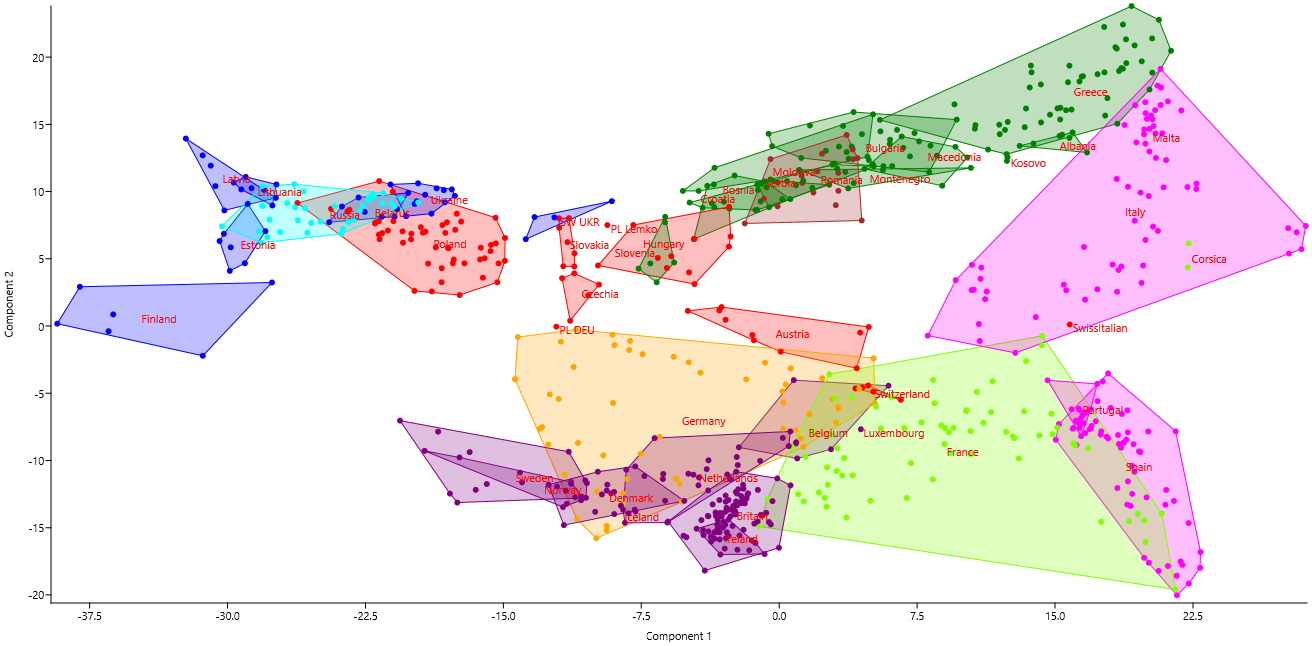
As for the Spanish, it is believed that population movements during the Reconquista contributed to their “genetic homogenization.” At that time, there were large-scale migrations, especially from north to south, which led to significant mixing of populations between regions and, as a result, the homogenization of the genetic profile (the greatest differences in Spain are between the east and the west, and much smaller, for example, between the northeast and the southeast; precisely because the mixing of people during the Reconquista took place mainly along the meridian axis).
That argument about the Reconquista is completely false, and I keep coming across it on X and forums. They are distorted and made-up extrapolations based on the 2019 study “Patterns of genetic differentiation and traces of historical migrations in the Iberian Peninsula.”
I think that same paper also led to the stupid idea that E-M81 is Arab, and since Galicians have peaks of 5–10% in some areas, they are supposedly the most “Arab” people in the peninsula.
E-M81 is Amazigh and arrived in the peninsula long before the Islamic invasions, and the E-M81 lineages in Galicians have nothing to do with ethnic Moors, who were never numerous and certainly never reached the north. But I suppose it is always funny to classify Spaniards as “Moors,” since that was what Anglo-Saxon scientific racism used to claim.
DF27 shows its highest and most diverse frequencies from 2700 BC in the peninsula. Both the ZZ12_1 and Z195 branches together consolidated more than 50 lineages between 2600–2500 BC, and all of them have been present since then. There is no DF27 arriving via any kind of mass migration from elsewhere, neither during the Bell Beaker period (since the Bell Beaker culture originates in Spain—only English and American authors dispute this) nor during the Celtic period, because all major DF27 clades are native to the Iberian Peninsula. Southern French populations with DF27 frequencies of up to 30% are derived from Iberian branches, not the other way around; this is supported by papers.
During the Reconquista, the lineage that expanded the most and benefited the most was Z195>Z278 (the most numerous Castilian haplogroup), increasing by up to 5–10% in areas where it was previously absent. It is the “glue” of all Spaniards. There is no evidence of massive ethnic replacement, neither during the conquest (7 million natives and 20,000 invaders) nor during the Reconquista. The internet has a very distorted view of Hispanic ethnogenesis.
The ethnic Moors were completely expelled. The frequencies of all haplogroups that uneducated people often label as “Moors” are usually of Phoenician, Greek, Egyptian, or Amazigh origin.
Of the haplogroups truly associated with Islam, the J1-FGC1721 lineage of Arab elites from the Islamic expansion is virtually nonexistent in Spain today. E-M81 rarely exceeds 5% in any region, and most of its sub-branches predate the Islamic invasion. Today there is more R1b-P312 in the Maghreb than E-M81 in Spain. This is because most of those expelled were native converts to Islam who had little interest in converting back to Christianity.
The Iberian Peninsula (including Portugal) formed its current autosomal mixture mainly between 3000–1000 BC at around 70–80%, and from 1000 BC onwards the rest arrived with Phoenicians, Greeks, Romans, and Amazigh populations.
I myself can be modeled in qpadm (not G25) as 80% EHU002 and 20% Mycenaean from the Palace of Nestor. A large part of Spain, regardless of haplogroup, can be modeled as 60–80% EHU002 plus some additional “eastern Mediterranean” component depending on the region (Phoenician-Greek-Roman).
The Visigoths and Arabs did not cause any significant genetic impact because we were already a very large population receiving very minor elite groups. From those periods, what exists are sampling biases and extrapolations that have nothing to do with reality.
The frequencies of U106, I1, and E-V13 did not arrive only during the Visigothic period; all of them have been found in earlier periods as well.