• Don't want to see ads? Install an adblocker like uBlock Origin or use a Europe-based privacy-friendly browser like Vivaldi or Mullvad.

Genetically diverse and homogenous ethnicities of Europe

Tomenable

Well-known member
Messages
5,992
Reaction score
1,714
Points
113
Location
Poland
Ethnic group
Polish
Y-DNA haplogroup
R1b-L617
mtDNA haplogroup
W6a
Examples of genetically heterogenous large ethnic groups of Europe:

- French
- Italians
- Germans
- Greeks

Examples of genetically homogenous large ethnic groups of Europe:

- English
- Spanish
- Romanians
- Belarusians

Examples of intermediate (neither too diverse nor homogenous) ones:

- Russians
- Poles
- Ukrainians*
- Dutch

*Ukrainians would be homogenous if not for South-Western Ukrainians.
 
I would say that when it comes to large ethnic groups of Europe (let's say at least 10 million people each), the English are the most homogenous, because despite there being almost 50 million ethnically English people in the UK, when you make a European PCA plot (for example based on K36 results), you will see that English people occupy very little space there relative to their number (about as much space as, for example, Danish people, despite being much more numerous than Danish people).

The Spanish occupy a larger space in this PCA (especially if you include the Basques and Catalans).
And Romanians occupy a similar or perhaps slightly larger space, but they are much less numerous.

Belarusians seem to be even more homogenous than the English, but they are much less numerous.

The Irish are also even more homogenous than the English, but again, they are less numerous.

When it comes to the most heterogenous large ethnic group, this is harder to conclude.
Because France, Italy and Germany occupy similar amounts of space in this European PCA (France and Italy a bit more).
It depends if you add populations like Memelland for Germans, or Corsica for the French.

But when it comes to Germans, there seems to be no such a thing as a "Central German" in genetic sense - they are quite sharply divided into NW Germans, South Germans and East Germans, with very few areas plotting truly "in-between". In case of France and Italy it is different, as in both countries you can discern respectively Central French and Central Italian clusters.

So France and Italy occupy more PCA space than Germany, but at least they have "central" clusters, while Germany doesn't.
 
As for the Spanish, it is believed that population movements during the Reconquista contributed to their “genetic homogenization.” At that time, there were large-scale migrations, especially from north to south, which led to significant mixing of populations between regions and, as a result, the homogenization of the genetic profile (the greatest differences in Spain are between the east and the west, and much smaller, for example, between the northeast and the southeast; precisely because the mixing of people during the Reconquista took place mainly along the meridian axis).
 
Exactly, lots of bigger/longer countries are heterogenous and it makes sense. Borders do change, a lot of the people from heterogenous country X live in a region that used to be called Y. Not saying that’s always the case but seems common…
What about Sweden/Norway, those countries are even longer than Italy iirc, would a northern Swede differ from a southern Swede?
 
Examples of genetically heterogenous large ethnic groups of Europe:

- French
- Italians
- Germans
- Greeks

Italy, Germany, and Greece share a common thread in that they only emerged as modern states in the 19th century. France is the exception, yet geography played a crucial role for all of them. While France is unique in stretching from Northern Europe to the Mediterranean, the geography of Germany and Italy, fragmented for centuries into pre-unitary states, was equally decisive. Germany spans from the Northern seas to the Alps and shares a long border with Eastern Europe, while Italy extends from the Alps into the far reaches of Southern Europe. Greece, meanwhile, borders the Slavic world to the north, while its network of islands serves as a bridge between Europe and Western Asia

Exactly, lots of bigger/longer countries are heterogenous and it makes sense. Borders do change, a lot of the people from heterogenous country X live in a region that used to be called Y. Not saying that’s always the case but seems common…
What about Sweden/Norway, those countries are even longer than Italy iirc, would a northern Swede differ from a southern Swede?

While it is true that Norway and Sweden are geographically longer than Italy, the comparison falls short in demographic terms. Not only is their population significantly smaller, as Norway has roughly the same number of inhabitants as Emilia-Romagna and Sweden as Lombardy, but it is also heavily concentrated in their southern regions. In contrast, Italy’s population is densely distributed across its entire length, making its genetic heterogeneity far more layered and widespread.
 
Last edited:
As for the Spanish, it is believed that population movements during the Reconquista contributed to their “genetic homogenization.” At that time, there were large-scale migrations, especially from north to south, which led to significant mixing of populations between regions and, as a result, the homogenization of the genetic profile (the greatest differences in Spain are between the east and the west, and much smaller, for example, between the northeast and the southeast; precisely because the mixing of people during the Reconquista took place mainly along the meridian axis).

That argument about the Reconquista is completely false, and I keep coming across it on X and forums. They are distorted and made-up extrapolations based on the 2019 study “Patterns of genetic differentiation and traces of historical migrations in the Iberian Peninsula.”

I think that same paper also led to the stupid idea that E-M81 is Arab, and since Galicians have peaks of 5–10% in some areas, they are supposedly the most “Arab” people in the peninsula.

E-M81 is Amazigh and arrived in the peninsula long before the Islamic invasions, and the E-M81 lineages in Galicians have nothing to do with ethnic Moors, who were never numerous and certainly never reached the north. But I suppose it is always funny to classify Spaniards as “Moors,” since that was what Anglo-Saxon scientific racism used to claim.

DF27 shows its highest and most diverse frequencies from 2700 BC in the peninsula. Both the ZZ12_1 and Z195 branches together consolidated more than 50 lineages between 2600–2500 BC, and all of them have been present since then. There is no DF27 arriving via any kind of mass migration from elsewhere, neither during the Bell Beaker period (since the Bell Beaker culture originates in Spain—only English and American authors dispute this) nor during the Celtic period, because all major DF27 clades are native to the Iberian Peninsula. Southern French populations with DF27 frequencies of up to 30% are derived from Iberian branches, not the other way around; this is supported by papers.

During the Reconquista, the lineage that expanded the most and benefited the most was Z195>Z278 (the most numerous Castilian haplogroup), increasing by up to 5–10% in areas where it was previously absent. It is the “glue” of all Spaniards. There is no evidence of massive ethnic replacement, neither during the conquest (7 million natives and 20,000 invaders) nor during the Reconquista. The internet has a very distorted view of Hispanic ethnogenesis.

The ethnic Moors were completely expelled. The frequencies of all haplogroups that uneducated people often label as “Moors” are usually of Phoenician, Greek, Egyptian, or Amazigh origin.

Of the haplogroups truly associated with Islam, the J1-FGC1721 lineage of Arab elites from the Islamic expansion is virtually nonexistent in Spain today. E-M81 rarely exceeds 5% in any region, and most of its sub-branches predate the Islamic invasion. Today there is more R1b-P312 in the Maghreb than E-M81 in Spain. This is because most of those expelled were native converts to Islam who had little interest in converting back to Christianity.

The Iberian Peninsula (including Portugal) formed its current autosomal mixture mainly between 3000–1000 BC at around 70–80%, and from 1000 BC onwards the rest arrived with Phoenicians, Greeks, Romans, and Amazigh populations.

I myself can be modeled in qpadm (not G25) as 80% EHU002 and 20% Mycenaean from the Palace of Nestor. A large part of Spain, regardless of haplogroup, can be modeled as 60–80% EHU002 plus some additional “eastern Mediterranean” component depending on the region (Phoenician-Greek-Roman).

The Visigoths and Arabs did not cause any significant genetic impact because we were already a very large population receiving very minor elite groups. From those periods, what exists are sampling biases and extrapolations that have nothing to do with reality.

The frequencies of U106, I1, and E-V13 did not arrive only during the Visigothic period; all of them have been found in earlier periods as well.
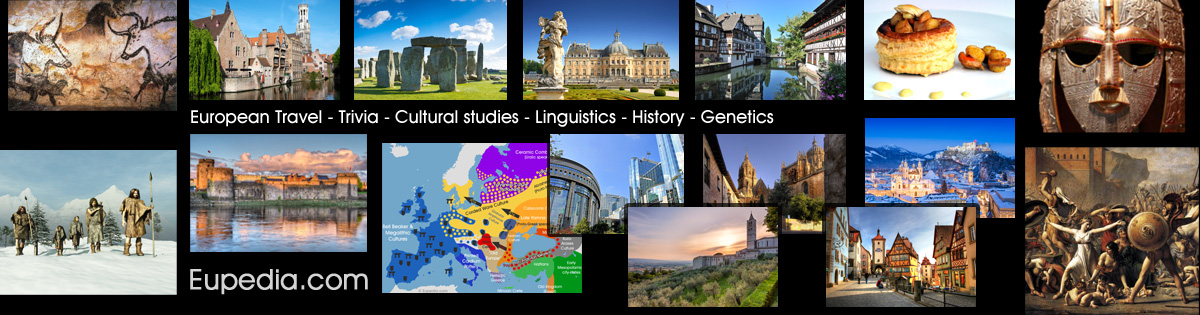
 
Here is my K36-based PCA to illustrate the points which I'm making in this thread:
(please note that for example Memelland is not included in Germany in this PCA)
(this PCA is based on regions - each dot is a regional average, not an individual)


Europe-PCA-New.png
 
would a northern Swede differ from a southern Swede?

If they are mixed with Saami or Finnic ancestry then they do differ!
 
Italy, Germany, and Greece share a common thread in that they only emerged as modern states in the 19th century. France is the exception, yet geography played a crucial role for all of them. While France is unique in stretching from Northern Europe to the Mediterranean, the geography of Germany and Italy, fragmented for centuries into pre-unitary states, was equally decisive. Germany spans from the Northern seas to the Alps and shares a long border with Eastern Europe, while Italy extends from the Alps into the far reaches of Southern Europe. Greece, meanwhile, borders the Slavic world to the north, while its network of islands serves as a bridge between Europe and Western Asia


While it is true that Norway and Sweden are geographically longer than Italy, the comparison falls short in demographic terms. Not only is their population significantly smaller, as Norway has roughly the same number of inhabitants as Emilia-Romagna and Sweden as Lombardy, but it is also heavily concentrated in their southern regions. In contrast, Italy’s population is densely distributed across its entire length, making its genetic heterogeneity far more layered and widespread.
that does make more sense, as you can have a huge geographic mass but most of the density is concentrated in a smaller area of that mass or country which diminishes diversity. Diversity gets even smaller when that population is as small as those Italian provinces.
Not the case with Italy, France, etc as the north of those countries is different from the south as populations are more spread out throughout those areas. Wider countries I’m willing to bet have east and west differences, assuming it isn’t like what’s going on in Sweden where the population is smaller and more “focused” not sure how to word that
 
that does make more sense, as you can have a huge geographic mass but most of the density is concentrated in a smaller area of that mass or country which diminishes diversity. Diversity gets even smaller when that population is as small as those Italian provinces.
Not the case with Italy, France, etc as the north of those countries is different from the south as populations are more spread out throughout those areas. Wider countries I’m willing to bet have east and west differences, assuming it isn’t like what’s going on in Sweden where the population is smaller and more “focused” not sure how to word that
There are a few issues with this reasoning.

First, geographic size alone does not determine diversity. Population history, migration patterns, linguistic fragmentation, political borders, and historical isolation matter much more. Italy, for example, is extremely diverse not simply because people are “spread out,” but because for centuries it was divided into separate states, kingdoms, and regional cultures with limited internal mobility. That produced strong regional identities, dialects, and even measurable genetic differences.

Second, the comparison with Sweden is somewhat misleading. Sweden’s population is concentrated in the south, but that does not automatically reduce diversity. Large parts of northern Sweden are sparsely populated for climatic and economic reasons, yet there are still meaningful regional distinctions (for example between Scania, central Sweden, the far north, and Sami populations). Population concentration and cultural diversity are not inversely proportional in a simple way.

Third, Italian provinces are not actually “small populations” in the sense implied here. Many Italian regions and provinces have populations comparable to entire European countries or U.S. states. Lombardy alone has around 10 million people (granted a few of those 10 million are mixed or even fully southern Italians). Sicily has about 5 million. Campania roughly 6 million. Historically, these populations were relatively stable and regionally rooted for centuries, which reinforced local differentiation.

Also, France is not diverse simply because the north differs from the south geographically. French regional diversity comes from layers of historical nations and linguistic groups: Breton, Occitan, Basque, Alsatian, Corsican, Catalan, Flemish, etc. Modern centralization reduced some of that diversity, but it still exists.

Finally, “wider countries” do not automatically have stronger east-west differences either. It depends on settlement history and internal barriers. The United States, China, Russia, and India have major regional contrasts because of different colonization waves, ethnic groups, climates, and historical development. Meanwhile, some geographically large countries can be relatively homogeneous if they experienced strong state centralization or recent population mixing.
 
There are a few issues with this reasoning.

First, geographic size alone does not determine diversity. Population history, migration patterns, linguistic fragmentation, political borders, and historical isolation matter much more. Italy, for example, is extremely diverse not simply because people are “spread out,” but because for centuries it was divided into separate states, kingdoms, and regional cultures with limited internal mobility. That produced strong regional identities, dialects, and even measurable genetic differences.

Second, the comparison with Sweden is somewhat misleading. Sweden’s population is concentrated in the south, but that does not automatically reduce diversity. Large parts of northern Sweden are sparsely populated for climatic and economic reasons, yet there are still meaningful regional distinctions (for example between Scania, central Sweden, the far north, and Sami populations). Population concentration and cultural diversity are not inversely proportional in a simple way.

Third, Italian provinces are not actually “small populations” in the sense implied here. Many Italian regions and provinces have populations comparable to entire European countries or U.S. states. Lombardy alone has around 10 million people (granted a few of those 10 million are mixed or even fully southern Italians). Sicily has about 5 million. Campania roughly 6 million. Historically, these populations were relatively stable and regionally rooted for centuries, which reinforced local differentiation.

Also, France is not diverse simply because the north differs from the south geographically. French regional diversity comes from layers of historical nations and linguistic groups: Breton, Occitan, Basque, Alsatian, Corsican, Catalan, Flemish, etc. Modern centralization reduced some of that diversity, but it still exists.

Finally, “wider countries” do not automatically have stronger east-west differences either. It depends on settlement history and internal barriers. The United States, China, Russia, and India have major regional contrasts because of different colonization waves, ethnic groups, climates, and historical development. Meanwhile, some geographically large countries can be relatively homogeneous if they experienced strong state centralization or recent population mixing.
True, should’ve made myself clear-when I said the north and south of France and Italy are different I didn’t mean geographically but genetically…ie South France being more Mediterranean than the north and southern Italy taking on a more Greek and Anatolian profile than the north.
 
Back
Top