• Don't want to see ads? Install an adblocker like uBlock Origin or use a Europe-based privacy-friendly browser like Vivaldi or Mullvad.

Ethnic groups of Central Europe 2025

Tomenable

Well-known member
Messages
6,012
Reaction score
1,732
Points
113
Location
Poland
Ethnic group
Polish
Y-DNA haplogroup
R1b-L617
mtDNA haplogroup
W6a
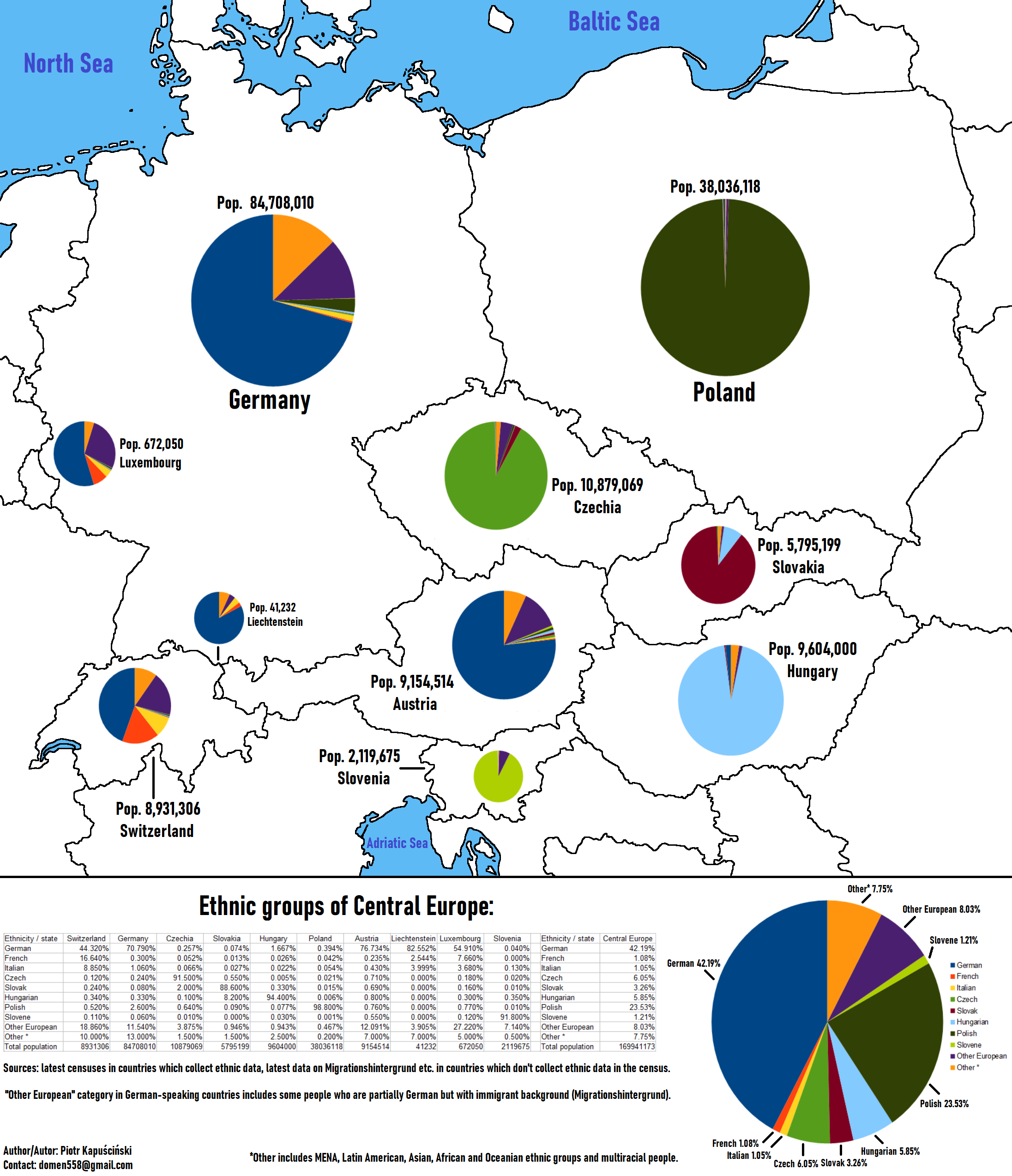
Map of Central Europe's ethnic groups:

LINK

C1hZdQR.png


Data is from the most recent censuses of each country and Wikipedia "Demographics of [country XYZ]" articles.

Slovenia is counted as Southeast Europe rather than Central Europe because this book includes it in SE Europe:

 
Last edited:
One mistake in the map fixed:

LINK

2hbrXx3.png
 
Updated:

1) I added Luxembourg and Slovenia.
2) I merged all German groups together.

Map - https://i.postimg.cc/5f1TccqF/Central-Europe-Map-Ethnic-Groups.png

Central-Europe-Map-Ethnic-Groups.png


If we split German-speakers into subgroups, then:

In Austria Austrian Germans are 73.60%
In Switzerland Swiss Germans are 40.13% (Native Swiss in total are 60%)
In Luxembourg Luxembourgers are 52.6%
In Liechtenstein Liechtensteiners are 66.0%
 
Last edited:
it's a weird mixture of numbers since all those countries have different systems to categorize their populations and so they are not comparable.

in german speaking countries the definition of migration background differs a lot.

for example in germany people who have at least one parent who was not born with german citizenship counts as a person with migrant background. everyone else doesn't.

in austria they only look at the birth place of the parents. if both of the parents have a place of birth abroad then the person has migration background. otherwise the person has no migration background even if noone has austrian citizenship.

the swiss one seems to be a bit more complicated and i'm not sure if i got it right. it seems that if at least one of the person's parents was born in switzerland and at least one of the parents(could also be the one not born in switzerland) aquired the swiss citizenship at some point before the birth of the person in question, then that person has no migration background. in addition if both parents were born in switzerland then the person doesn't have migration background even if noone has swiss citizenship.

in the non-german speaking countries listed here there is no such thing as "migration background" at all and also nothing comparable afaik.

edit: your post is a bit confusing. you say "ethnic groups" of central europe but what are your graphics trying to show? language groups, nationalities? the graphics show mostly this but then the "other" category you describe as "Mena, latin america....multiracial people" but none of these countries actually track something like that. where did you get those numbers from?
 
Last edited:
From population censuses and from "Demographics of Germany", "Demographics of Austria", etc. articles on Wikipedia.

For example the Polish numbers are from the 2021 population census. Most of my sources are in my ResearchGate article:

in your article you want to talk about ancestry, but those categories are mostly about nationalities. you look at them as language groups and add ethnic categories in there.
to my knowledge there isn't a "mixed race" category in any of these countries.
of course, you just want to make an approximation because there is no other data, but the numbers are far off of what you are trying to capture. perhaps you can do that approximation in eastern europe and eastern central europe. but not in the western part. for example in luxembourg according to their definition of migration background (at least one foreign born parent), 73% of their population has one. i think in austria and switzerland you would have similar discrepancies if they used similar definitions.
it's interesting though that out of all the countries here, germany still seems to look back furthest to differentiate between natives and people with migration background.
 
Back
Top