• Don't want to see ads? Install an adblocker like uBlock Origin or use a Europe-based privacy-friendly browser like Vivaldi or Mullvad.

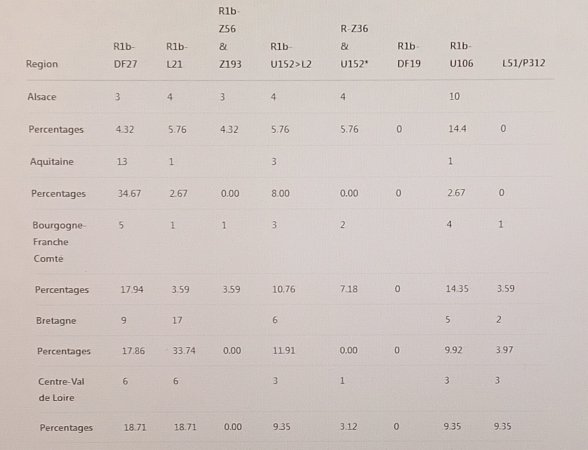
Breakdown of R1b subclades by French region

Nah, R1B-DF27 is more like an Ibero-Gaulish clade now, and very important among Celts.

In fact, recent studies about Iron Age Gauls also showed that R1B-DF27 was dominant among them.
Interestingly, R1b-D27 ins not very common in Northern Italy, the former Cisalpine Gaul.
 
Interestingly, R1b-D27 ins not very common in Northern Italy, the former Cisalpine Gaul.
Indeed. If I am not mistaken, the main study about it was published in April of 2022, but it was focused on the origin and mobility of Gauls in France, and that clade (DF27) was dominant in French Gaul. I don't know why French Gauls differ from Italian ones in that respect tbh 🤔

If I'm not mistaken, some Gaulish tribes migrated to Cisalpine Gaul in the 6th century. The reason for it may be that Cisalpine Gaul is only culturally galicized. It wouldn't be the first time, especially among Celts (in Ireland, for example).
 
Last edited:
The table no longer works.
 
Indeed. If I am not mistaken, the main study about it was published in April of 2022, but it was focused on the origin and mobility of Gauls in France, and that clade (DF27) was dominant in French Gaul. I don't know why French Gauls differ from Italian ones in that respect tbh 🤔

If I'm not mistaken, some Gaulish tribes migrated to Cisalpine Gaul in the 6th century. The reason for it may be that Cisalpine Gaul is only culturally galicized. It wouldn't be the first time, especially among Celts (in Ireland, for example).
I highly doubt that R1b-DF27 was dominant among Gauls. I don't know if it was a dominant haplo among any regional Celtic tribe at first, despite I think it was a western (vaguely proto-Italo-celtic) IE haplo. Surely it was dense among southern France pop's of the time that could have been celtized later. I think the most common haplo's were L21, dominant at first in West-Northwestern Gaul, AND U152, dominant at first among in Central and Eastern Gaul, with in between situations in other places, according to tribes moves and contacts between tribes (elites at least). All this is a rough "tableau" based on unsufficiant numbers in the samples, I notice very often it's taken conclusions based on small samples, what is very mistaking for haplo's if it isn't so betraying for autosomes. BTW I think U152 (subclades) was THE dominant among Ligurians and first Italics
The U152 bearers increase in influence in Gaul seems to me linked to IA rather then to BA, from eastern Celtic tribes. Concerning Italy, the fact U152 is shared by Celts, Italics (and maybe Ligurians) can complicate the scheme. We should have to find the geographic origin of the so called Celtic tribes of ancient Italy. Boians by instance were as well present in Bohemia, in the eastern Celtic area of these times. Evidently these personal thoughts could be modified by new numerous samples. Concerning the "celtic commercial koine" hypothesis I think Celts hadn't a sufficiently centralized organisation to have celtized a lot of nations when traders can do the job for exchanges, and they named the landscape in so numerous places in Europe without a solid demic impulse. This last question is stil an interesting subject of debate!
 
Indeed. If I am not mistaken, the main study about it was published in April of 2022, but it was focused on the origin and mobility of Gauls in France, and that clade (DF27) was dominant in French Gaul. I don't know why French Gauls differ from Italian ones in that respect tbh 🤔

If I'm not mistaken, some Gaulish tribes migrated to Cisalpine Gaul in the 6th century. The reason for it may be that Cisalpine Gaul is only culturally galicized. It wouldn't be the first time, especially among Celts (in Ireland, for example).
I highly doubt that R1b-DF27 was dominant among Gauls. I don't know if it was a dominant haplo among any regional Celtic tribe at first, despite I think it was a western (vaguely proto-Italo-celtic) IE haplo. Surely it was dense among southern France pop's of the time that could have been celtized later. I think the most common haplo's were L21, dominant at first in West-Northwestern Gaul, AND U152, dominant at first among in Central and Eastern Gaul, with in between situations in other places, according to tribes moves and contacts between tribes (elites at least). All this is a rough "tableau" based on unsufficiant numbers in the samples, I notice very often it's taken conclusions based on small samples, what is very mistaking for haplo's if it isn't so betraying for autosomes. BTW I think U152 (subclades) was THE dominant among Ligurians and first Italics
The U152 bearers increase in influence in Gaul seems to me linked to IA rather then to BA, from eastern Celtic tribes. Concerning Italy, the fact U152 is shared by Celts, Italics (and maybe Ligurians) can complicate the scheme. We should have to find the geographic origin of the so called Celtic tribes of ancient Italy. Boians by instance were as well present in Bohemia, in the eastern Celtic area of these times. Evidently these personal thoughts could be modified by new numerous samples. Concerning the "celtic commercial koine" hypothesis I think Celts hadn't a sufficiently centralized organisation to have celtized a lot of nations when traders can do the job for exchanges, and they named the landscape in so numerous places in Europe without a solid demic impulse. This last question is stil an interesting subject of debate!
 
I highly doubt that R1b-DF27 was dominant among Gauls. I don't know if it was a dominant haplo among any regional Celtic tribe at first, despite I think it was a western (vaguely proto-Italo-celtic) IE haplo. Surely it was dense among southern France pop's of the time that could have been celtized later. I think the most common haplo's were L21, dominant at first in West-Northwestern Gaul, AND U152, dominant at first among in Central and Eastern Gaul, with in between situations in other places, according to tribes moves and contacts between tribes (elites at least). All this is a rough "tableau" based on unsufficiant numbers in the samples, I notice very often it's taken conclusions based on small samples, what is very mistaking for haplo's if it isn't so betraying for autosomes. BTW I think U152 (subclades) was THE dominant among Ligurians and first Italics
The U152 bearers increase in influence in Gaul seems to me linked to IA rather then to BA, from eastern Celtic tribes. Concerning Italy, the fact U152 is shared by Celts, Italics (and maybe Ligurians) can complicate the scheme. We should have to find the geographic origin of the so called Celtic tribes of ancient Italy. Boians by instance were as well present in Bohemia, in the eastern Celtic area of these times. Evidently these personal thoughts could be modified by new numerous samples. Concerning the "celtic commercial koine" hypothesis I think Celts hadn't a sufficiently centralized organisation to have celtized a lot of nations when traders can do the job for exchanges, and they named the landscape in so numerous places in Europe without a solid demic impulse. This last question is stil an interesting subject of debate!
Maciamo published many samples from that 2022 study about Iron Age Gaul in Eupedia with the their respective Y Haplougroups. The two most common were R1B-DF27 and R1B-L21, with 4 each. 3 of these R1B-DF27 were found in more northern provinces, and only 1 in the south.

And it kind of makes sense, given the dominance of that haplogroup in modern France, be in the South or the North (Picardy or Pas-de-Calais). Even where it is not the most common, its frequency is rather high. If it was Celtic or italo-celtic, it's open to debate, but it is certainly Gaulish in France.
 
Last edited:
Maciamo published many samples from that 2022 study about Iron Age Gaul in Eupedia with the their respective Y Haplougroups. The two most common were R1B-DF27 and R1B-L21, with 4 each. 3 of these R1B-DF27 were found in more northern provinces, and only 1 in the south.

And it kind of makes sense, given the dominance of that haplogroup in modern France, be in the South or the North (Picardy or Pas-de-Calais). Even where it is not the most common, its frequency is rather high. If it was Celtic or italo-celtic, it's open to debate, but it is certainly Gaulish in France.
You 're aware that 4 individual are not sufficient to make conclusions! Concerning current pop's of France, I have not the subclades %'s by region even if I know L21 is dominant in Brittany and perhaps in Normandy. Based on some surveys I thought DF27 was more concentrated in southern modern France. If you have the accurate data about modern France, I 'll be glad to look at them.
 
You 're aware that 4 individual are not sufficient to make conclusions! Concerning current pop's of France, I have not the subclades %'s by region even if I know L21 is dominant in Brittany and perhaps in Normandy. Based on some surveys I thought DF27 was more concentrated in southern modern France. If you have the accurate data about modern France, I 'll be glad to look at them.
Well, if that data presented by Maciamo in this post and these 1902 samples are not enough to prove that R1B-DF27 is common all over France, I don't know what could be. I mean, it is not only common in the south but also in northern provinces. Even where it is not the most common, it tends to be either the second most common subclade or even.
 
Last edited:
According to FTDNA this is the distribution of the participants of the main branches of R-P312 in France at a national level.

Rp0P7xr.png


On this website we can also see the distribution of R1b by branch, by country:
Comparative overview of distribution of Y-DNA haplogroups in Europe

At a regional level I found this map some time ago, on reddit I believe, but I have no idea where the data came from, so I can't guarantee that it represents the real distribution by region.
Yellow - R-DF27
Green - R-U152
Blue - R-L21
Red - R-U106
85Ucmp5.png
 
Last edited:
According to FTDNA this is the distribution of the participants of the main branches of R-P312 in France at a national level.

Rp0P7xr.png


On this website we can also see the distribution of R1b by branch, by country:
Comparative overview of distribution of Y-DNA haplogroups in Europe

At a regional level I found this map some time ago, on reddit I believe, but I have no idea where the data came from, so I can't guarantee that it represents the real distribution by region.
Yellow - R-DF27
Green - R-U152
Blue - R-L21
Red - R-U106
85Ucmp5.png
R-U106, with its Germanic associations, reaches 19pc of all R1b in southern/central Italy and in Sicily?

Remarkable.
 
Well, if that data presented by Maciamo in this post and these 1902 samples are not enough to prove that R1B-DF27 is common all over France, I don't know what could be. I mean, it is not only common in the south but also in northern provinces. Even where it is not the most common, it tends to be either the second most common subclade or even.
what post of Maciamo, please? the first post of this thread is not understandable for me.
BTW I saw a NEW map of L58/U152 by Maciamo (thanks to him) which is different enough compared to the ones I had at hand, from him too.
If you have a clear table of the subclades in French regions, it'll be great. BTW, FTDNA résults are linked to the interest put by people in their ascendance, and this interest is variable according to regions and haplo's. Genealogy states and scientific works states (more based on hazard) are not the same thing.
Concerning DF27 geographical origin I suppose Atlantic Bronze could have had some input on its later distribution, before other historic collective and individual moves had their own input...
If you can provide what I ask you it would be great, and thanks beforehand.
 
The first post of this thread showed a table with frequencies of the main subclades of R1B (R1B-L21, R1B-DF27, R1B-U152, R1B-U106 and so on) in France, basically. R1B-DF27 was common both in the South and the North, R1B-L21 was most common in northwest (as expected) and R1B-U152 in the east.

Yea, I agree that R1B-DF27 in France is from the bronze age, and these peoples probably admixed later with their brothers (as both R1B-U152 and R1B-DF27 are derived from R1B-ZZ11) and R1B-L21, forming the Gauls.
 
Last edited:
It looks like Maciamo's code is in HTML language. Here's the converted table with the results:
 

Attachments

  • 20250407_160012.jpg
    20250407_160012.jpg
    199.6 KB · Views: 337
  • 20250407_160134.jpg
    20250407_160134.jpg
    168.1 KB · Views: 305
R-U106, with its Germanic associations, reaches 19pc of all R1b in southern/central Italy and in Sicily?
Remarkable.
Perhaps it is a consequence of the Norman conquest of southern Italy.
BTW, FTDNA résults are linked to the interest put by people in their ascendance, and this interest is variable according to regions and haplo's. Genealogy states and scientific works states (more based on hazard) are not the same thing.
In any case, FTDNA results allows us to have an idea, albeit imperfect, of the distribution of haplogroups and shows that R-DF27 is apparently a majority in France.

It looks like Maciamo's code is in HTML language. Here's the converted table with the results:
Good call Chris4522, here is the full table.
tFhZXMn.png
 
Perhaps it is a consequence of the Norman conquest of southern Italy.

In any case, FTDNA results allows us to have an idea, albeit imperfect, of the distribution of haplogroups and shows that R-DF27 is apparently a majority in France.


Good call Chris4522, here is the full table.
tFhZXMn.png

Most of the French R1b-DF27 is within DF27>Z195 from Iberia.
 
BTW the samples for today France are still weak. I wonder if the high %age of DF27/R1b (40%) in Northern France without any correspondance around (the most of North of the Loire régions have a ratio DF27/R1b between 23% and 28%, except Paris surroundings) it is not a statistical "accident" which could be corrected with a larger sample? Roughly said, the DF27 ratio tends to increase when we go southwards in France...
 
BTW the samples for today France are still weak. I wonder if the high %age of DF27/R1b (40%) in Northern France without any correspondance around (the most of North of the Loire régions have a ratio DF27/R1b between 23% and 28%, except Paris surroundings) it is not a statistical "accident" which could be corrected with a larger sample? Roughly said, the DF27 ratio tends to increase when we go southwards in France...
I doubt, to be honest. Despite small, It is also confirmed by Iron Age samples, and the genetic landscape of France didn't change that much since then, it seems. I remember seeing a map on anthrogenica with the same results of Maciamo using many FTDNA samples.
 
Last edited:
I doubt, to be honest. Despite small, It is also confirmed by Iron Age samples, and the genetic landscape of France didn't change that much since then, it seems. I remember seeing a map on anthrogenica with the same results of Maciamo using many FTDNA samples.
How much in IA sample?
 
I doubt, to be honest. Despite small, It is also confirmed by Iron Age samples, and the genetic landscape of France didn't change that much since then, it seems. I remember seeing a map on anthrogenica with the same results of Maciamo using many FTDNA samples.
How much in IA sample?
Few samples indeed, but it is in accordance with modern trends of FTDNA, especially if we take into account that most of these DF27 Iron Age samples were found in the North or close to it.
I fear you don't know how much states need concerning an unique trait. I maintain my opinion, but sure, more samples would be welcome. If they confirm you views, I 'll incline myself. Concerning FTDNA didn't Maciamo take the most of his modern samples from it?
 
Back
Top