• Don't want to see ads? Install an adblocker like uBlock Origin or use a Europe-based privacy-friendly browser like Vivaldi or Mullvad.

J2b2-L283 (proto-illyrian)

I haven't been able to identify a specific "Vlach" J2b-L283 cluster, but according to scientific studies, after the Albanians, Vlachs have the next highest J2b-L283 frequency at roughly 8-10%. If we look at Greece, J2b-L283 peaks in frequency in Thessaly, NW Greece, Euboea, Corinthia, at roughly 6-8%, on the other hand it seems to be close to non-existent in the Greek Islands. So this suggests it peaks in the areas where Vlachs and Arvanites are known to have settled.

J2 grouping at FTDNA is probably a bit outdated but I'll look at Greek haplotypes closer one of these days and report back. However, I have run into a few Greek haplotypes who belong to the same subclades as Albanians, like PH1751, Y23094, Y21878.

Obviously, I'm not implying that all Greek J2b-L283 is of Albanian and Vlach origin, but the above mentioned data suggests a good amount of it is. This raises the question if there was any J2b-L283 among Mycenaeans. My guess is that if they had any of it, most likely it will not be under Z1296, as I currently see this branch having a center of diversity in the western Balkans. And therefore any Z1296 there would be a later arrival, Dorians, Illyrians, Thracians, and later Vlachs, Albanians.
I'd theorize that if Mycenaeans had any J2b-L283 it will probably be upstream of Z2507, as those subclades seem to have more of a Mediterranean spread.


As far as Z631 goes, I still struggle to come up with a main theory of where it could've expanded from. Its TMRCA is only 2900 ybp, and it seems to be present basically throughout Europe, with a significant presence in NW Europe. But considering that it descends from Z1296, my guess is North Balkans and some of it may have been absorbed by the Celts, and later probably spread by the Romans also to places like NW Europe. The Tatar (Eastern Europe cluster) so far all belongs to Z631>>Z1043>>Y12000, so it seems to be a recent Middle Ages founder effect.

Just wanted to say this was written over 5 years ago here, and before we had any meaningful aDNA. It's precisely what we got in Mycenaean Greece :smile:
 
@Mount123
Thanks very much for this useful compilation.
You provide here the concerned places for all these J2b-L283+ .
Could you indicate me if other Y-haplo's (not J2b-L283) have been found in the concerned cultures/places?
Thank beforehand.
 
@MOESAN

You’re welcome. That doesn't relate to the thread's topic as there are more suitable threads for your question for instance:
To-burn-or-not-to-burn-LBA-EIA-Balkan-case or threads for the respective papers the samples were part of.

But nonetheless: The Cetina and Dinaric (late phase/ successor variant of Cetina) sites are basically exclusively J2b-L283 with except one, like wise for both periods, Middle Danubian Tumulus culture derived lineage. Similar to what we see early on in Italy with J2b-L283 samples being present there. Though there is a clear difference: during the time of aforementioned culture J2b-L283 due to the EBA Cetina expansion is in comparison actually much more common in Italy and beyond than Middle Danubian Tumulus culture lineages in Cetina (EBA-MBA) - Dinaric (MBA-LBA) where they are insignificant to non existent.

Things look different during LMBA/LBA/EIA: By the LBA-EIA Middle Danubian Urnfield culture is a serious antagonistic competitor of LBA Dinaric (late phase Cetina) in the North Western Balkans and adjacent microregions. The Urnfield complex is fundamental in the formation of the ethnos of Etruscans, Latins, generally Italics, Cisalpine Celts. Slovenia, for instance, by the time of the MD Urnfield's biggest expansion was an archeologically intermediary region.

Such an example is Zagorje ob Savi or Novo Mesto in Slovenia, Urnfield classified burials that in a way are an alteration of classic MDU burials meaning using a mixed non-Illyrian MD Urnfield and Illyrian inspired burial style (in Zagorje ob savi they were basically living side by side and did not form a merging burial style) where we see heterogenity for instance J2b-L283 and U106, with the latter lineage clearly being associated with the Middle Danubian Urnfielders along with other L151+ (L2, L21 etc.) haplogroups. Interestingly, you can always see the difference in the autosomes too. The Slovenian J2b-L283 are in the EIA Illyrian cluster whereas the L151+ in the Tumulus Culture/Urnfield cluster. Successors of aforementioned culture are the La Tene Celts. There is one Hungarian J2b-L283 La Tene Celt who confirms aforementioned autosomal pattern too.


The Roman Era is more complicated: samples come from mine workers, Citizens, Soldiers living in metropolitan settlements. There is diversity there due to displacements, replacements and population mobility in the Roman Empire. There is also appropriate threads for such papers as the „Stable population structure in Europe“ one. The Illyro-Roman wars and later Illyrian uprisings Bellum Batonianum are crucial negative key events in the ethnos of Illyrians.

There is also other influences in the South Eastern periphery coming from the Balkan-Carpathian archeological complex and Paeonians.

 
@MOESAN

You’re welcome. That doesn't relate to the thread's topic as there are more suitable threads for your question for instance:
To-burn-or-not-to-burn-LBA-EIA-Balkan-case or threads for the respective papers the samples were part of.

But nonetheless: The Cetina and Dinaric (late phase/ successor variant of Cetina) sites are basically exclusively J2b-L283 with except one, like wise for both periods, Middle Danubian Tumulus culture derived lineage. Similar to what we see early on in Italy with J2b-L283 samples being present there. Though there is a clear difference: during the time of aforementioned culture J2b-L283 due to the EBA Cetina expansion is in comparison actually much more common in Italy and beyond than Middle Danubian Tumulus culture lineages in Cetina (EBA-MBA) - Dinaric (MBA-LBA) where they are insignificant to non existent.

Things look different during LMBA/LBA/EIA: By the LBA-EIA Middle Danubian Urnfield culture is a serious antagonistic competitor of LBA Dinaric (late phase Cetina) in the North Western Balkans and adjacent microregions. The Urnfield complex is fundamental in the formation of the ethnos of Etruscans, Latins, generally Italics, Cisalpine Celts. Slovenia, for instance, by the time of the MD Urnfield's biggest expansion was an archeologically intermediary region.

Such an example is Zagorje ob Savi or Novo Mesto in Slovenia, Urnfield classified burials that in a way are an alteration of classic MDU burials meaning using a mixed non-Illyrian MD Urnfield and Illyrian inspired burial style (in Zagorje ob savi they were basically living side by side and did not form a merging burial style) where we see heterogenity for instance J2b-L283 and U106, with the latter lineage clearly being associated with the Middle Danubian Urnfielders along with other L151+ (L2, L21 etc.) haplogroups. Interestingly, you can always see the difference in the autosomes too. The Slovenian J2b-L283 are in the EIA Illyrian cluster whereas the L151+ in the Tumulus Culture/Urnfield cluster. Successors of aforementioned culture are the La Tene Celts. There is one Hungarian J2b-L283 La Tene Celt who confirms aforementioned autosomal pattern too.


The Roman Era is more complicated: samples come from mine workers, Citizens, Soldiers living in metropolitan settlements. There is diversity there due to displacements, replacements and population mobility in the Roman Empire. There is also appropriate threads for such papers as the „Stable population structure in Europe“ one. The Illyro-Roman wars and later Illyrian uprisings Bellum Batonianum are crucial negative key events in the ethnos of Illyrians.

There is also other influences in the South Eastern periphery coming from the Balkan-Carpathian archeological complex and Paeonians.


Do you have time periods for these J-L283 and others you mentioned as you would know La Tene first began in 450BC and Halstatt phase one began 1000BC
 
@mount123

Thanks

Glad I could help.

Do you have time periods for these J-L283 and others you mentioned as you would know La Tene first began in 450BC and Halstatt phase one began 1000BC
Of course. They are in the tabel I have posted before. Besides, I always adhere to what archeologists and scientists classify the sites as and what the genetic data indicates.

The sample I mentioned was the Hungarian La Tene Celt sample, namely:

[TABLE="class: cms_table_t1"]
[TR]
[TD="class: cms_table_td1"]ID I4998

[/TD]
[TD="class: cms_table_td1"]Hungary_IA_LaTene, Vas county, Kápolnadomb, Gór, Hungary

[/TD]
[TD="class: cms_table_td1"]391-208 BCE (~300 BCE)[/TD]
[TD="class: cms_table_td1"]J2b-L283>>Z615>Z597>Y15058>Z38240>BY161113>BY162321

[/TD]
[/TR]
[/TABLE]
 
Glad I could help.


Of course. They are in the tabel I have posted before. Besides, I always adhere to what archeologists and scientists classify the sites as and what the genetic data indicates.

The sample I mentioned was the Hungarian La Tene Celt sample, namely:

[TABLE="class: cms_table_t1"]
[TR]
[TD="class: cms_table_td1"]ID I4998

[/TD]
[TD="class: cms_table_td1"]Hungary_IA_LaTene, Vas county, Kápolnadomb, Gór, Hungary

[/TD]
[TD="class: cms_table_td1"]391-208 BCE (~300 BCE)[/TD]
[TD="class: cms_table_td1"]J2b-L283>>Z615>Z597>Y15058>Z38240>BY161113>BY162321

[/TD]
[/TR]
[/TABLE]


ok

do you have a split on all these samples prior to la tene ( 450BC ) and where they are on map ...............or a link ?
 
J2b-L283>Y23094 News

​Link to article: https://phylogeographer.com/j2b-yp26-ionian-sea-branch-of-j2b-y23094-now-confirmed-in-sicily/

Important: there is also a section about other Y23094 from Southern Italy and link for donations to the WGS Wishlist (entails other lineages too, has already been shared one page ago).

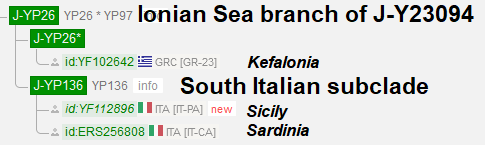
"​Using donations collected from those interested to advance the research into the deeper origins of our common J2b-L283 ancestors, I upgraded this man's sample to WGS at YSEQ (I recommend this WGS test) and now he's on the YFull YTree with the Kefalonia, Greece regional code.Fast forward to today and if you go to their branch of the tree you will find a third sample with regional code for Palermo, Italy.

J-YP26.png

(J2b-YP26 on the YFull YTree v10.08)

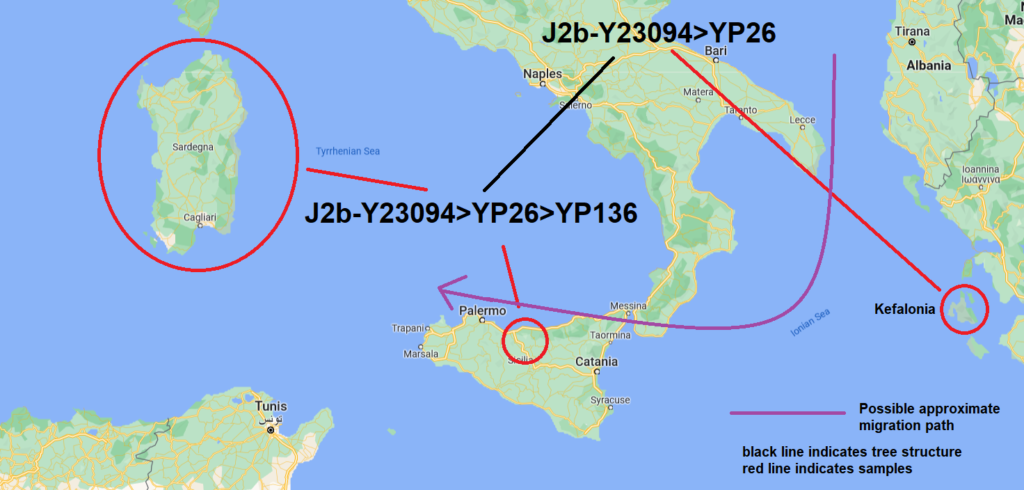
This man, who traces his male line to Polizzi Generosa, a town in northern-central Sicily, recently got his Big Y result and was found to share one SNP, YP136, with the sample from Sardinia that the Kefalonia-origin man was negative for.

...

J-YP26-map-1024x490.png


Map showing the paternal origins of the three samples of J2b-Y23094>YP26. Approximate theoretical migration path in purple coming from the Adriatic, the place with the highest diversity of related lineages of J2b-L283 based on samples dating to the Late Bronze Age. The possible approximate migration path I drew is simply connecting dots and using the very rough arc feature of MS Paint. It is not based on any specialized knowledge of Iron Age trade networks."
 
Foggia was a large base for Cetina culture, and in your map, it looks like a lot of the branching for southern Italy was out-flowing through there.
 
​Link to article: https://phylogeographer.com/j2b-yp26-ionian-sea-branch-of-j2b-y23094-now-confirmed-in-sicily/

Important: there is also a section about other Y23094 from Southern Italy and link for donations to the WGS Wishlist (entails other lineages too, has already been shared one page ago).

"​Using donations collected from those interested to advance the research into the deeper origins of our common J2b-L283 ancestors, I upgraded this man's sample to WGS at YSEQ (I recommend this WGS test) and now he's on the YFull YTree with the Kefalonia, Greece regional code.Fast forward to today and if you go to their branch of the tree you will find a third sample with regional code for Palermo, Italy.

J-YP26.png

(J2b-YP26 on the YFull YTree v10.08)

This man, who traces his male line to Polizzi Generosa, a town in northern-central Sicily, recently got his Big Y result and was found to share one SNP, YP136, with the sample from Sardinia that the Kefalonia-origin man was negative for.

...

J-YP26-map-1024x490.png


Map showing the paternal origins of the three samples of J2b-Y23094>YP26. Approximate theoretical migration path in purple coming from the Adriatic, the place with the highest diversity of related lineages of J2b-L283 based on samples dating to the Late Bronze Age. The possible approximate migration path I drew is simply connecting dots and using the very rough arc feature of MS Paint. It is not based on any specialized knowledge of Iron Age trade networks."


my albanian friend...who has twitter ( i never had twitter ) linked me a map stating that albanians say J-L283 is sumerian from 7000 years ago.............migrated to north caucasus, then modern hungaria, then western balkans and Italy
 
@torzio

Can you please not post pseudo scientific stuff on this thread? I have reported your post.
 
latest map 3 jan. 2023

 
@torzio

Can you please not post pseudo scientific stuff on this thread? I have reported your post.


I wanted your opinion .............whats your issue?..............I don't know if this twitter site is good or not..............I do not have twitter and will will ever have it
 
It is pseudoscientific garbage. What kind of opinion do you want from me? We have dozens of ancient J2b-L283 samples and neither the phylogeny nor the auDNA supports such a stupid internet fringe theorist claim.

There are scientific papers one should read.
 
my albanian friend...who has twitter ( i never had twitter ) linked me a map stating that albanians say J-L283 is sumerian from 8000 years ago.............migrated to north caucasus, then modern hungaria, then western balkans and Italy
Its possible but we dont have any J-L283 samples that old. Says it formed about 10,000 years ago or 9800 years ago which would be 7000BC. Not likely though since majority of J-L283 is within the boundaries of europe. But our earliest J-L283 sample is only about 3800 to 4000 years old.
We dont have any samples prior to their arrival in europe to know where it came from really. At least not yet
We know at j2b2 level some split off into india. So it could b3 they were in summeria before then but dont how long they would have been closer to india.
 
​Link to article: https://phylogeographer.com/j2b-yp26-ionian-sea-branch-of-j2b-y23094-now-confirmed-in-sicily/

Important: there is also a section about other Y23094 from Southern Italy and link for donations to the WGS Wishlist (entails other lineages too, has already been shared one page ago).

"​Using donations collected from those interested to advance the research into the deeper origins of our common J2b-L283 ancestors, I upgraded this man's sample to WGS at YSEQ (I recommend this WGS test) and now he's on the YFull YTree with the Kefalonia, Greece regional code.Fast forward to today and if you go to their branch of the tree you will find a third sample with regional code for Palermo, Italy.

J-YP26.png

(J2b-YP26 on the YFull YTree v10.08)

This man, who traces his male line to Polizzi Generosa, a town in northern-central Sicily, recently got his Big Y result and was found to share one SNP, YP136, with the sample from Sardinia that the Kefalonia-origin man was negative for.

...

J-YP26-map-1024x490.png


Map showing the paternal origins of the three samples of J2b-Y23094>YP26. Approximate theoretical migration path in purple coming from the Adriatic, the place with the highest diversity of related lineages of J2b-L283 based on samples dating to the Late Bronze Age. The possible approximate migration path I drew is simply connecting dots and using the very rough arc feature of MS Paint. It is not based on any specialized knowledge of Iron Age trade networks."
Interesting that lineage was probably mycenean that lead up to him migrating as an ionian greek to magna greacia
 
Interesting that lineage was probably mycenean that lead up to him migrating as an ionian greek to magna greacia


Mycenene and Argos are close together in Greece ..........sparta is south of them

Argos was trading with Salento peninsula ( taranto ) early on ............but Sparta used taranto to attack the Messapics

https://en.wikipedia.org/wiki/Iapygian–Tarentine_wars

Is this what you are aiming at ?
 
Last edited:
Interesting that lineage was probably mycenean that lead up to him migrating as an ionian greek to magna greacia
Via Mycenaeans with Cetina descent from Kefalonia? You should read the article. The ultimate migration pattern due to the phylogeny of so far found aDNA samples leaves room exactly for the suggestions Hunter made in this article.

Also, my last reply to the pseudo scientific false theories posted here: the oldest J2b-L283 samples are from the Western Balkans and not a single one in phylogeny nor autosomal DNA has any traces that would support that third worlder twitter fringe theorist claim posted here before for provocation. It was made by an Albanian twitter user who also posts on this forum (If he had some self respect he would delete that non sense). The same post claims E1b-V13 has very strong prehistoric presence in the East and West Adriatic. Well, we have dozens of samples now and we know that that is not true.

Second, the TMRCA of J2b-L283 is apprx. 5600 ybp.

The oldest due to be published J2b-L283 (unless upstream which I find super unlikely but who knows) sample is from Moldova 6500 - 5500 (~6000) ybp old which autosomally consists of mostly Steppe + Early European Farmer (ANF + WHG). This was talked about so you know this very well, Wanderer.

Or are all of these ancient people also kidnapped as you proposed for our first ancient sample before?
:lol2::lol2:
 
Via Mycenaeans with Cetina descent from Kefalonia? You should read the article. The ultimate migration pattern due to the phylogeny of so far found aDNA samples leaves room exactly for the suggestions Hunter made in this article.

Also, my last reply to the pseudo scientific false theories posted here: the oldest J2b-L283 samples are from the Western Balkans and not a single one in phylogeny nor autosomal DNA has any traces that would support that third worlder twitter fringe theorist claim posted here before for provocation. It was made by an Albanian twitter user who also posts on this forum (If he had some self respect he would delete that non sense). The same post claims E1b-V13 has very strong prehistoric presence in the East and West Adriatic. Well, we have dozens of samples now and we know that that is not true.

Second, the TMRCA of J2b-L283 is apprx. 5600 ybp.

The oldest due to be published J2b-L283 (unless upstream which I find super unlikely but who knows) sample is from Moldova 6500 - 5500 (~6000) ybp old which autosomally consists of mostly Steppe + Early European Farmer (ANF + WHG). This was talked about so you know this very well, Wanderer.

Or are all of these ancient people also kidnapped as you proposed for our first ancient sample before?
[emoji38]2:[emoji38]2:

Where is the study if its published?
From what I heard it was speculative but unpublished.
There is no evidence of J-L283 existing in northern Europe in ancient times. Or at least none has been presented for existing before Rome existing.
This J2B-L283 could have been absorbed by populations which had steppe ancestry and from then on appear to come from the steppe. We only ever have evidence of it existing in the medditernean adriatic, possibly agean and balkans. Where it probably was always at. After being absorbed by steppe peoples its always possible a few later migrated to the steppe due to their new relationship with steppe peoples. Maybe why we dont see many steppe J2b-L283.

If J2b-L283 originated from the steppe we should have surely seen J2b-L283 all over where steppe peoples migrated. You dont. You only see it in the balkans and medditernean. Not even west mediterranean. Central and east medditernean.
 
Back
Top