• Don't want to see ads? Install an adblocker like uBlock Origin or use a Europe-based privacy-friendly browser like Vivaldi or Mullvad.

Where does the Albanian language come from? [VIDEO]

I don't know yet, didn't see any bell beaker mention.
But i think it is undeniable now that J2b-L283 is a main Glasinac / Illyrian lineage for sure.

It looks like it. And E-V13 is related to the Danubian Urnfield migration in the Balkans down to the Aegean in specificity the Gava Culture. Proto-Albanoid is either earlier in Balkans as part of Yamnaya, or brought by Gava Culture from Carpathian Basin.
 
Google translated:

Copper and Early Bronze Ages in the Balkans
(4th-early 2nd millennium BC)


Only in the last few years have the new possibilities of genetics led to a useful reconstruction of earlier settlement processes in south-eastern Europe (Mathieson et al. 2018; Krause 2019, 115-134). I.


In the 6th mill. Anatolian farmers migrated to the Balkan Peninsula and gradually spread from here into the interior of Europe. At the beginning of the 3rd millennium then followed more and more intensive immigration slices, this time from the South Russian steppes.


This led to indo-Europeanization not only in south-eastern Europe, but also in large parts of Europe.


The steppe DNA is essentially composed of ancestral Northern Eurasians and immigrants from Iran. In the last third of the 4th millennium. the Yamnaja or pit grave culture emerged in the space between the Caspian and Black Sea. The invention of the wheel and cart, the domestication of the horse and the production of the first arsenic bronzes are attributed to her.


It was a highly mobile cattle herding society, for which the erection of huge burial mounds, so-called Kurgane, is characteristic. The exposed dead were mostly men and were buried in grave chambers with jewelry, weapons and a whole wagon, lying on their backs with their legs drawn up, often sprinkled with ocher. In addition to seasonal settlement areas, there were also permanent, sometimes fortified settlements in the river dividers, which suggests that not only cattle breeding but also arable farming (Parzinger 2014, 395-397).


Towards the end of the 4th millennium. there was a sudden drop in climate which led to the drying up of the South Russian steppe valley. Nomad groups of the Yamnaja culture first moved to the Hungarian Plain and the lower Danube region.


The manner of burial and the furnishing of the dead are marked by an astonishing similarity. For the first time, hill graves and battle axes and string-adorned clay cups appear in this area. The Vucedol culture in Pannonia, named after the settlement finds on the Ljubljana Moor, is regarded as an offshoot of the steppe nomadic Kurgan culture.


It took shape in several regional variants (Schnurbein 2010, 75). The DNA analyzes also show that the immigrants were mainly men, who often associated with the local women. The share of immigrants in the population was around 80% (Krause 2019, 128).


The giant grave figurines in the Bay of Kotor, which have been completely examined using modern methods, date from around 2800 BC. BC (Primate 1996). In the grave figurehead of Mala Gruda, next to the hips of the only burial, lay a shaft-hole ax made of a copper-silver alloy.


On his head the man wore five small gold rings of northwest Greek shape. He also owned a gold-bladed dagger of the Levantine type (Primas 1996, 17-18). Several phases of allocation and occupancy have been documented in Velika Gruda.


In the oldest period A, the grave figurehead already had a diameter of 23 m. It covered a stone box grave sunk into the natural ground. The adult man had been given an ax and two arsenic bronze knives, a cylindrical polishing stone, and two boar tusks. On his head he wore eight gold rings of a shape similar to that in Mala Gruda. A handle and a creator, both with deeply incised Vucedol patterns, are added to the ceramics.


The handle shell is, however, an Agaic shape (Primas 1996, 25-112). The double-edged knives, on the other hand, occur in Kurganen in the Dnieper region (Primas 1996, 93-94, Fig. 7.1) and are often with 'stone blocks' that were used as polishing stones (Primas 1996, 116-117, Fig. 8.3), socialized.

Hill graves of the early 3rd millennium. are also known from Cetina in northern Dalmatia. We also know the cremation that is customary here from Late Copper Age graves on the Lower Danube and in the Carpathian Basin (Primas 1996, 133, Fig. 9.3).


Early Bronze Age tumuli, which also still show characteristics of the Kurgan culture, have been researched in north and central Albanian necropolises on the lower Adriatic. The clay ware that was added is similar to the settlement ceramics in the Korca plain, which is to be placed there using 14-C data in the period between approx. 2850 and 2400 (Korkuti 2013, 397). In Shtoj near Shkodra, too, the strikingly large funerary cages 2 and 6 were erected at this early stage with several phases of partitioning. They are characterized by outer and inner stone circles and central graves sunk into the ground. The oldest core of Tumulus 6 was a hill made of earth and stones with a diameter of 11 m.


Underneath was the central grave 16, paneled with stones. The stool burial was carefully covered with a layer of small stones and sprinkled with ocher. There were six anthropomorphic clay figures on it. With the enlargement of the tumulus, burials 14 and 15 were introduced, in which, as in the cage filling, was decorated ceramics of the north Adriatic variant of the Vucedol culture (Korkuti 2013, 461-463).


Also in Pazhoku, just south of the Shkumbin Valley, the giant tumulus I with a diameter of 30 m and an outer stone circle dates to the early Bronze Age. The central burial was framed by its own stone circle. The person buried in the right stool position had a cattle skull (Korkuti 2013, 473, T. VIII b).

All of these findings point to eastern elements in burial customs as well as in the shape and decoration of ceramics and weapons. But it cannot be seen that other cultural currents, for example from the Agais, reached the Western Balkans.


K2XIzC3.png
 
These are too early for J2b2-L283 Illyrians, these must be some IE group represented by R1b-Z2103 and R1b PF7562.

From all known Albanian Y-DNA only E-V13 might not be Illyrian, E-V13 was a very small lineage even during Neolithic Europe, only from Middle Bronze Age and especially Late Bronze Age to Early Iron Age began to rise up dramatically in numbers:
https://www.academia.edu/20160198/A_New_World_Order_The_Spread_of_Channelled_Ware_in_Late_Bronze_Age_and_Early_Iron_Age_Transylvania
 
Some arguments against Thracian and Dacian origin.

There might of been some similar words with Dacian and Thracian in Albanian, through also common IE origin, and Romanian might of had some Thracian origin and Albanian some Thracian influence, and these three groups of people (Illyrian, Thracian and Dacian) lived in each others lands as minorities but I personally do not believe proto-Albanian came from Dacian or Thracian (Dacian and Thracian were considered one and the same). Some scholars even consider Romanian/Aromanian to of been Romanized proto-Albanian.

en.wikipedia.org/wiki/Dava_(Dacian)

en.wikipedia.org/wiki/List_of_Dacian_towns_and_fortresses

en.wikipedia.org/wiki/List_of_ancient_cities_in_Thrace_and_Dacia


Many city names of the Dacians were composed of an initial lexical element (often the tribe name) affixed to -dava, -daua, -deva, -deba, -daba or -dova

Many city names were composed of an initial lexical element affixed to -dava, -daua, -deva, -deba, -daba, or -dova, which meant "city" or "town" Endings on more southern regions are exclusively -bria ("town, city"), -disza, -diza, -dizos ("fortress, walled settlement"), -para, -paron, -pera, -phara ("town, village").

'Dava' 'Deva' 'Daba' etc was a suffix added among Dacian cities and towns and meant 'city' apparently or 'place' as was 'para' in Thracian villages which meant 'fort' and others such as -disza diza dizos etc , this type of combination of words never happens in Albanian, and if it does it can only happen in the opposite actually, and neither did it happen in Illyrian.

For example compare Illyrian cities and settlements and you never see this type of suffix

en.wikipedia.org/wiki/List_of_settlements_in_Illyria


Based on the data we have, which is mostly composed of place names, words etc, this is probably one of the biggest evidence to show Albanian could not of come from Dacian or Thracian.
 
No one is arguing about Dacian/Thracian neither Matzinger, there was a lot of Central Balkan tribes who had distinct character like Dardanii, Paeonians, Enchelei, and probably Messapi, also Epirotans and Macedonians who might have been mixed with Greek tribes and Hellenized.
 
Google translated:

Copper and Early Bronze Ages in the Balkans
(4th-early 2nd millennium BC)


Only in the last few years have the new possibilities of genetics led to a useful reconstruction of earlier settlement processes in south-eastern Europe (Mathieson et al. 2018; Krause 2019, 115-134). I.


In the 6th mill. Anatolian farmers migrated to the Balkan Peninsula and gradually spread from here into the interior of Europe. At the beginning of the 3rd millennium then followed more and more intensive immigration slices, this time from the South Russian steppes.


This led to indo-Europeanization not only in south-eastern Europe, but also in large parts of Europe.


The steppe DNA is essentially composed of ancestral Northern Eurasians and immigrants from Iran. In the last third of the 4th millennium. the Yamnaja or pit grave culture emerged in the space between the Caspian and Black Sea. The invention of the wheel and cart, the domestication of the horse and the production of the first arsenic bronzes are attributed to her.


It was a highly mobile cattle herding society, for which the erection of huge burial mounds, so-called Kurgane, is characteristic. The exposed dead were mostly men and were buried in grave chambers with jewelry, weapons and a whole wagon, lying on their backs with their legs drawn up, often sprinkled with ocher. In addition to seasonal settlement areas, there were also permanent, sometimes fortified settlements in the river dividers, which suggests that not only cattle breeding but also arable farming (Parzinger 2014, 395-397).


Towards the end of the 4th millennium. there was a sudden drop in climate which led to the drying up of the South Russian steppe valley. Nomad groups of the Yamnaja culture first moved to the Hungarian Plain and the lower Danube region.


The manner of burial and the furnishing of the dead are marked by an astonishing similarity. For the first time, hill graves and battle axes and string-adorned clay cups appear in this area. The Vucedol culture in Pannonia, named after the settlement finds on the Ljubljana Moor, is regarded as an offshoot of the steppe nomadic Kurgan culture.


It took shape in several regional variants (Schnurbein 2010, 75). The DNA analyzes also show that the immigrants were mainly men, who often associated with the local women. The share of immigrants in the population was around 80% (Krause 2019, 128).


The giant grave figurines in the Bay of Kotor, which have been completely examined using modern methods, date from around 2800 BC. BC (Primate 1996). In the grave figurehead of Mala Gruda, next to the hips of the only burial, lay a shaft-hole ax made of a copper-silver alloy.


On his head the man wore five small gold rings of northwest Greek shape. He also owned a gold-bladed dagger of the Levantine type (Primas 1996, 17-18). Several phases of allocation and occupancy have been documented in Velika Gruda.


In the oldest period A, the grave figurehead already had a diameter of 23 m. It covered a stone box grave sunk into the natural ground. The adult man had been given an ax and two arsenic bronze knives, a cylindrical polishing stone, and two boar tusks. On his head he wore eight gold rings of a shape similar to that in Mala Gruda. A handle and a creator, both with deeply incised Vucedol patterns, are added to the ceramics.


The handle shell is, however, an Agaic shape (Primas 1996, 25-112). The double-edged knives, on the other hand, occur in Kurganen in the Dnieper region (Primas 1996, 93-94, Fig. 7.1) and are often with 'stone blocks' that were used as polishing stones (Primas 1996, 116-117, Fig. 8.3), socialized.

Hill graves of the early 3rd millennium. are also known from Cetina in northern Dalmatia. We also know the cremation that is customary here from Late Copper Age graves on the Lower Danube and in the Carpathian Basin (Primas 1996, 133, Fig. 9.3).


Early Bronze Age tumuli, which also still show characteristics of the Kurgan culture, have been researched in north and central Albanian necropolises on the lower Adriatic. The clay ware that was added is similar to the settlement ceramics in the Korca plain, which is to be placed there using 14-C data in the period between approx. 2850 and 2400 (Korkuti 2013, 397). In Shtoj near Shkodra, too, the strikingly large funerary cages 2 and 6 were erected at this early stage with several phases of partitioning. They are characterized by outer and inner stone circles and central graves sunk into the ground. The oldest core of Tumulus 6 was a hill made of earth and stones with a diameter of 11 m.


Underneath was the central grave 16, paneled with stones. The stool burial was carefully covered with a layer of small stones and sprinkled with ocher. There were six anthropomorphic clay figures on it. With the enlargement of the tumulus, burials 14 and 15 were introduced, in which, as in the cage filling, was decorated ceramics of the north Adriatic variant of the Vucedol culture (Korkuti 2013, 461-463).


Also in Pazhoku, just south of the Shkumbin Valley, the giant tumulus I with a diameter of 30 m and an outer stone circle dates to the early Bronze Age. The central burial was framed by its own stone circle. The person buried in the right stool position had a cattle skull (Korkuti 2013, 473, T. VIII b).

All of these findings point to eastern elements in burial customs as well as in the shape and decoration of ceramics and weapons. But it cannot be seen that other cultural currents, for example from the Agais, reached the Western Balkans.

Middle Bronze and Early Late Bronze Ages
(approx. 1600-1100 BC)


With the complete excavation of the giant tumulus Velika Gruda in the Bay of Kotor, archaeological research has a solid insight into the burial customs and demographics of a late Bronze Age community of the 14th and 13th centuries. (Della Casa 1996).


The first, already very large, Copper Age tumulus (period A) was followed by a layer of stones set on its crest with a burial over which a thin layer of burn was drawn (period B). Then the grave hedgehog was considerably enlarged by a layer of clay and reached a diameter of 26 m (period C). Finally a massive stone packing was placed over the middle of the hill, in which the vast majority of the graves were inserted (period D). Much later, an early Iron Age burial was also carved into this stone mantle (period E).


The graves often contained collective burials with between two and 221 individuals who had been buried in a crouched position. The grave shafts had a gravel bed, the winds were lined with large stones or slabs. In addition to the body burials, there was also a bustum grave. Simultaneous bringing in of the dead can be ruled out, as the grave pits were designed in terms of size for only one individual each and only the last burials were undisturbed.


There were several depots of human skeletal remains on the edge of the hill. Passage fragments from these bone volutes and from the graves suggest that the graves were carefully cleared out in the course of the grave renovations and that the bones were partially buried elsewhere. Between and above the graves, 33 separate vessel depots were uncovered.


The equipment is generally very modest. In children it usually consists of just a small vessel, in adults it is occasionally made of some bronze jewelry (spiral ruffles, small spiral hoops on the head, double spiral straps, round hoops with a diameter of 10-12 cm and small 'knobs' with eyelets on the back, see Online — Fig. 1) and amber pearls (Della Casa 1996, 29-55)


Children and infants were buried in Pithoi and Grolsgeféilgen. Their share of the total number of people buried is strikingly high at 43%. Otherwise women and men of all ages are represented. There are a total of 156 individuals. 4,560 / 5,000Translation results
The average life expectancy at birth can be calculated at around 20 years. During the roughly 200-year occupancy during the early Late Bronze Age, only 5-6 nuclear families with a total of around 30 relatives lived in the small rural community (Harding 2013, 853).


The submission of selected grave inventories at the Glasinac by Benac and Covic ’is altogether reliable as far as the grave connections are concerned. After all, grave finds are also repeatedly described and illustrated without information ‘, i.e. without known socialization.


Unfortunately, from the excavations in the 19th century, there are no In addition to the anthropological determinations, also observations on the position of the buried and their items of equipment (Benac / Govic '1956; 1957). These publications now serve us for a closer evaluation.


There are only a few graves for the Middle Bronze Age phase Glasinac II a / b (approx. 1600-1375). They included, inter alia. Solid bracelets with line decoration, spiral wire bracelets, round, sometimes hat-shaped osseous buttons, spiral bracelets as well as a spiked disc and a pin with a recognizable reference to Pannonia.


Glasinac III a (approx. 1375-1250) corresponds to the early Spéitbronzezeit. Of 16 burials, most of which are female, two of them are incendiary burials. There are three main groups of equipment: a first with a choker, headdress rings, small buttons and spiral eyeglass pendants. Another group is characterized by decorative pins, ribbed arm cuffs and small buttons. 8 grave inventories are particularly rich with eyeglass pendants, often with a ribbed browband, a pair of solid bracelets and one each with incised osenfaleren or osseous buttons.


In the central Albanian town of Lofkendi, six of the dead belonging to phase I (approx. 1400-1200) wore decorative pins made of bone or bronze on their upper body garments. In another grave was a spiral scroll. There are men, women and one child among the buried (Papadopoulos et al. 2014).


For phase III b (1250-1100) 13 burials, including a cremation grave, can be evaluated at Glasinac. The first group is characterized by spiral wire bracelets, of which one to three specimens occur per grave. Solid studded bracelets with a triangular cross-section (one to five specimens) are also characteristic. Spiral rolls and are less common
Headdress rings (see online fig. 2).


A second, more prestigious group had incised neck bracelets and spiral wire bracelets, sometimes also eyeglass bracelets and violin bow brooches.


For phase II in Lofkendi (approx. 1200-1050) the equipment groups are difficult to define because of the lack of additions. Two burials have a bronze or iron needle. Three other burials belong to the upper class: they had smooth browbones, iron and glass beads,
Brooches and chain brooches, double-handled vessels and jugs. A young woman wore a small bronze disc as a headdress on which a spoked wheel was driven in the manner of a point hump (Papadopoulos et al. 2104).


In the northern Albanian Mat Valley, 17 burials, including three burials, from the 14th to 12th centuries can be viewed. 7 graves contained a lance, three of them a sword. A sword lay alone in a grave. Two other man diggers had tweezers with them. A knife, stepped Gsenknopfe and pearls were found only once in other burials (Islami 2013).


The comparison between early graves of the Late Bronze Age in Velika Gruda, Glasinac, Mat-Tal and Lofkéndi is not easy, since in Glasinac there are predominantly women graves, on the other hand the furnishings in the other necropolises are rather one-sided. It is also worth taking a look at early graves in the giant tumulus in Rehova in Kolonja in the south-east of Albania (Aliu 2012). The 37 burials in phase I date back to the 13th and 12th centuries.


A larger part of the graves contained one to three bronze needles and glass and amber beads. Another equipment group is indicated by knife accessories and occasionally tweezers. Then there are also warrior burials with a lance and graves that only contained clay vessels that otherwise also appear in the other groups, including double-handled and multiple vessels, handled cups and mugs. In comparison to the discussed grave complexes in other places, only those with the knife additions stand out as a clearly different equipment group.


zGBv2bM.png
 
No one is arguing about Dacian/Thracian neither Matzinger, there was a lot of Central Balkan tribes who had distinct character like Dardanii, Paeonians, Enchelei, and probably Messapi, also Epirotans and Macedonians who might have been mixed with Greek tribes and Hellenized.

Yes, the Balkan Indo European group also includes Phrygian, Armenian, etc. These languages also were neither Thracian nor Illyrian.
 
3 years ago, Lippert wrote this, now he apparently abandons any kind of Danubian Urnfield influence during LBA, there was an ongoing debate long time ago between Stipcevic criticizing the fully autochtonists and fully migrant theories and leaning more on a more complex scenario. But, i have heard the Southern arch paper is coming soon, so we will have samples from Croatia, Montenegro, Albania, Macedonia, Greece, Bulgaria. So, i guess we can scope it down further.

THE PROTOURBAN ILLYRIANS IN THE LATE IRON AGEAND THEIR CONTACTS TO THE GREEK WORLD


Already in the Early and so more in the Middle amd Late Bronze Aegean ceramics and weapons are imported and imitated. But there is also a strong influrence from the Danubian Urnfield culture.
Characteristic for the Late Bronze Age are large hilltop-settlements with wall fortifications. Since that age there is a continuity of the indigene material culture in the Southern Adriatic areas and the new cultural unity has been called Mat-Glasinac-Culture in reference to the North-Albanian river Mat and the tableland of Glasinac in the Herzegovina. In the Early Iron Age (11th - 8th cent. B.C.) the contacts to Greece increase steadily and reach a high level at the end of the Middle Iron Age in the 7th cent. with numerous imports of fine ware, ornaments and offensive as well as defensive arms, just as swords, helmets and greaves.

Public Lecture: emer.O.Prof. Dr. Andreas Lippert (University of Vienna)
8.11.2018, Kunsthistorisches Museum Wien


https://www.oeaw.ac.at/en/oeai/publ...ia/20181108-symposium-greek-and-roman-albania
 
3 years ago, Lippert wrote this, now he apparently abandons any kind of Danubian Urnfield influence during LBA,

The archaeological picture of the Illyrian ethnos


In the previous chapters, Bronze Age and Iron Age settlements, hoards and, above all, burial equipment in the south-western Balkans were examined in an overview. Of course, in connection with the basic topic, the question arises whether, from when and where one can speak of Illyrians. Not only linguistic research but also prehistory can provide answers.


First of all, it can be clearly seen that the steppe-nomadic Kurgan culture, which lived in parts of the Central and Western Balkans at the beginning of the 3rd millennium. has penetrated, has left clear traces: in grave customs, but also in the form of typical weapons such as the battle ax. The burial in grave hedges, which were erected over a ground grave, was continued. Material culture developed broadly and relatively uniformly during the Bronze Age. It is noteworthy, however, that women graves predominate on Glasinac and that there are no weapons additions, unlike in northern Albania, where warrior graves predominate.


The entire area between the hills and mountains south of the Save and the Epirus seems to have been largely untouched by the urn field culture that advanced on the Drava and Save up to the discovery of the Tisza. Imports or imitations of bronze objects occur at the beginning, in the 12th and 11th], but are numerically manageable.


In the 11th and 10th h. On the Glasinac, chokers and occasionally large ornamental discs are still common in the women's graves. But now there are also individual, large arched fibulae. At this time, neither forms of jewelry nor combinations of furnishings were associated with Lofkéndi in central Albania. Most likely it is the central grave principle in what is here, however, unusually large tumulus. The decorative pins, which are particularly common in female burials, find their parallel in south-east Albania, where they represent the typical women's costume. Northwestern Bosnia and the Croatian Lika, the later habitat of the Japods, set themselves apart from the Glasinac area first by neck bracelets and individual large spectacle brooches, later also by swords from the Spaturnenfeld era.


At the end of the 10th century, i.e. with the level Glasinac IV a, weapons made of iron were regularly added to the previously very rare bracelets and knives made of iron. With this the early Iron Age begins. Manner graves with lances and sometimes with rich jewelry appear on the Glasinac for the first time. The jewelry of men and women includes double-loop arch brooches, double and quadruple plate brooches and occasionally decorative needles. In Lofkéndi there are no gun graves, but needles and double-disc brooches form a bridge to the men's and women's costumes on Glasinac. There are also browbones as female jewelry, which is also characteristic of Glasinac from the 8th century. Two groups of ceramics are roughly equally represented in Loflkéndi: the incised gray ceramics, which is characteristic of the entire Glasinac-Mat area, and the matt painted earthenware, which shows a direct connection to Southeast Albania, Macedonia and Epirus.


The equipment patterns typical of Glasinac, consisting of certain types of weapons as well as needle, fibula, bracelet and girdle sheet shapes show from now on a clear continuity well into the Spéite Iron Age. This also applies to another area, namely western Serbia, western Kosovo / Kosova, Montenegro and northern and central Albania. The groups that can be identified in this area, which are hardly influenced by the Urnfield culture, are likely to be associated with an early Illyrian culture. To consolidate it into an Illyrian civilization - even if, as I said, regionally by no means homogeneous - the Illyrian civilization since the advanced 10th century now generally fibrous production of iron weapons as well as the emergence of a socially structured class of warriors contributed.


In the 8th and 7th centuries Then a noticeable number of warriors appear at Glasinac with swords, swords and lances or lances alone. The combination of

JEl2efw.png
 
The archaeological picture of the Illyrian ethnos


In the previous chapters, Bronze Age and Iron Age settlements, hoards and, above all, burial equipment in the south-western Balkans were examined in an overview. Of course, in connection with the basic topic, the question arises whether, from when and where one can speak of Illyrians. Not only linguistic research but also prehistory can provide answers.


First of all, it can be clearly seen that the steppe-nomadic Kurgan culture, which lived in parts of the Central and Western Balkans at the beginning of the 3rd millennium. has penetrated, has left clear traces: in grave customs, but also in the form of typical weapons such as the battle ax. The burial in grave hedges, which were erected over a ground grave, was continued. Material culture developed broadly and relatively uniformly during the Bronze Age. It is noteworthy, however, that women graves predominate on Glasinac and that there are no weapons additions, unlike in northern Albania, where warrior graves predominate.


The entire area between the hills and mountains south of the Save and the Epirus seems to have been largely untouched by the urn field culture that advanced on the Drava and Save up to the discovery of the Tisza. Imports or imitations of bronze objects occur at the beginning, in the 12th and 11th], but are numerically manageable.


In the 11th and 10th h. On the Glasinac, chokers and occasionally large ornamental discs are still common in the women's graves. But now there are also individual, large arched fibulae. At this time, neither forms of jewelry nor combinations of furnishings were associated with Lofkéndi in central Albania. Most likely it is the central grave principle in what is here, however, unusually large tumulus. The decorative pins, which are particularly common in female burials, find their parallel in south-east Albania, where they represent the typical women's costume. Northwestern Bosnia and the Croatian Lika, the later habitat of the Japods, set themselves apart from the Glasinac area first by neck bracelets and individual large spectacle brooches, later also by swords from the Spaturnenfeld era.


At the end of the 10th century, i.e. with the level Glasinac IV a, weapons made of iron were regularly added to the previously very rare bracelets and knives made of iron. With this the early Iron Age begins. Manner graves with lances and sometimes with rich jewelry appear on the Glasinac for the first time. The jewelry of men and women includes double-loop arch brooches, double and quadruple plate brooches and occasionally decorative needles. In Lofkéndi there are no gun graves, but needles and double-disc brooches form a bridge to the men's and women's costumes on Glasinac. There are also browbones as female jewelry, which is also characteristic of Glasinac from the 8th century. Two groups of ceramics are roughly equally represented in Loflkéndi: the incised gray ceramics, which is characteristic of the entire Glasinac-Mat area, and the matt painted earthenware, which shows a direct connection to Southeast Albania, Macedonia and Epirus.


The equipment patterns typical of Glasinac, consisting of certain types of weapons as well as needle, fibula, bracelet and girdle sheet shapes show from now on a clear continuity well into the Spéite Iron Age. This also applies to another area, namely western Serbia, western Kosovo / Kosova, Montenegro and northern and central Albania. The groups that can be identified in this area, which are hardly influenced by the Urnfield culture, are likely to be associated with an early Illyrian culture. To consolidate it into an Illyrian civilization - even if, as I said, regionally by no means homogeneous - the Illyrian civilization since the advanced 10th century now generally fibrous production of iron weapons as well as the emergence of a socially structured class of warriors contributed.


In the 8th and 7th centuries Then a noticeable number of warriors appear at Glasinac with swords, swords and lances or lances alone. The combination of

There are no curved swords and lances like in the Japodian region. Slotted calotte bosses, girdle necks and fittings are common property for women and men, while the new two-part glasses primer without figure eight and the forehead band are reserved for richly decorated women diggers. This jewelry can also be found in Velika Gruda in Montenegro and in the valley of the Mat in northern Albania. In the Japodian cultural area, chokers and often numerous sleep readings are typical, while the women of the southern neighbors of the Glasinac-Mat complex in Epirus, in the Korca basin and in Kolonia wear pairs of band-shaped armbands and figurative pendants. Decorative pins are particularly characteristic of the men's costume.


It should be emphasized that contacts or influences from the "Thraco-Cimmerian form circle" in the south-western Balkans are very small. Perhaps grindstones, which in upscale warrior burials are also provided with splendid bronze mounts, are most likely to be regarded as symbols of dignity inherited from the East.


Between the middle of the 6th and the end of the S.Jhs. The usual weapons and jewelry, which are increasingly used with tweezers for men and needles or double needles for women, continue on Glasinac as well as in northern Albania. Apart from regional peculiarities in jewelery, similar jewelery shapes and jewelery combinations can also be found in Kosovo / Kosova and in Montenegro. In Donja Dolina, warriors are equipped with lances, sometimes with a curved sword, and women with pairs of fibulae and bracelets. The Illyrian carriers of the Glasinac culture seem to have spread northward. On the other hand, the costume appears clearly separated from the Glasinac in Southeastern Bania, where sheet metal bracelets are combined with sleeping jewelry.


Finally, it should be mentioned that in the 5th and 4th centuries the furnishings in the inner and northern Illyria are seldom as rich as in earlier times, but otherwise persist in the brooches and bracelets. Gun graves are also only equipped with one lance on the Glasinac and with up to three lances in the valley of the Mat, but the grindstone is still part of the equipment.


A compilation of important object types at the Glasinac can help to capture the stages of the development of a pre-Illyrian and then Illyrian culture at a glance (> Fig. 17). It turns out that chokers and large decorative disks appear for the first time in level III a (14th / 13th century) and were worn by women of the upper class until the 10th century. At the same time there is now
also decorative elements such as spiral fills, sequin buttons, spiral wire bracelets, etc., which lasted until the late Iron Age.

But only from level IV a (end of the 10th century), which can be seen as a formative phase, weapons and specific fibula shapes, belt fittings and gaiters or pendants, which are completely new and also in the wider area of ​​the south-western Balkans, are used for the first time occur at least up to the 6th century. Knives and spiral wire bracelets made of iron appear sporadically in III c-2 (in the
first three quarters of the 10th century), while all assault weapons were forged from iron on it - a development that is, however, well known from other Balkan regions as well.

In any case, from the advanced 10th century consider the formation of the Illyrian culture to be largely complete. Of course there was a constant further development, as with many other prehistoric cultures as well, but against the background of common roots and characteristics.


From the point of view of the archaeological finds, the Illyrian habitat comprises the area south of the Neretva and the lower Sava, a broad strip of land between the Adriatic and Western Morava, the Weilfien and Schwarzen Drin and the Ohrid and Prespa lakes to the Vjosa in the south. It remains uncertain whether the zone north of the Neretva up to the Lika and the Flul3 Cetina was also Illyrian, although there are many indications, such as the spread of characteristic object forms and the coins of the Illyrian Daorsi (> Chap. B.4.5) or an altar script: in Bigeste (see online Fig. 11; cf. also the encyclopedic description of the Illyrians, Liburnians, Japods and Histrians in Terzan 2015). The archaeological evidence of the spread of Illyrian culture corresponds entirely to the Illyrian personal name area (> Section C.3.4).


mNrwptS.png
 
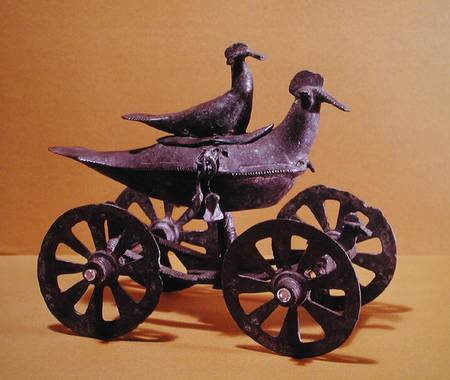
I really wonder, why the votice chariot with water birds appear in Glasinac. This was a trademark Danubian Urnfielder symbol:

votive_chariot_form_birds_gla_hi.jpg


as noted in Middle Bronze Age Dubovac Culture:

tumblr_n31oisoU661rolsbao1_640.jpg


and Bosut-Basarabi:

carul_de_la_bujoru_1.jpg


I guess, it might have been an influence instead.
 
I really wonder, why the votice chariot with water birds appear in Glasinac. This was a trademark Danubian Urnfielder symbol:

votive_chariot_form_birds_gla_hi.jpg


as noted in Middle Bronze Age Dubovac Culture:

tumblr_n31oisoU661rolsbao1_640.jpg


and Bosut-Basarabi:

carul_de_la_bujoru_1.jpg


I guess, it might have been an influence instead.

From page 95:


The bird-shaped or animal-shaped prison from grave and depot finds, which are common in Central and Southern Europe, can be seen in a somewhat different context.


It is one of the varied cult model wagons from the 9th to 6th centuries, which usually have a kettle, a basin or a container in the form of water birds.

Obviously there were ritual parades with a cart with healing water or intoxicating drink, in which requests for the fertility of humans, animals and fields were directed to a regionally responsible female or male deity, such as Apollo (see request for rain with the help of a tank wagon at Antigonos , Hist. Mirabil. 15).

The form of these votive wagons, reduced to a model, was placed in the grave with high-ranking personalities and was supposed to be a kind of water of life for the soul, that is, to serve its immortality.


Probably in the second half of the 7th century. The dating bronze wagon model with kettle-shaped bird figures (b Fig.27.1) was recovered from the center of a tumulus around 28 m in diameter near the town of Glasinac on the Glasinac plateau together with a Greek Olpe, a massive bracelet and two lance tips. A sleeping spiral circlet, belt fittings, a pair of double-looped arched brooches with an hourglass-shaped fulatte, a spectacle brooch without figure-eight loop, a belt buckle and a bronze rhyton (Fig. 27.2) as well as an iron arrowhead come from the same or another tumulus.


The cauldron and lid of the cart are designed as a mixed bird with the beak of a water bird, ears of a cattle and the crest of a rooster or the mane of a horse. There are other small birds on the crossbeams of the wagon axles and on the side walkers (I-Iochstetter, F. v. 1880/81; Seewald 1939).

Conceptually closely related to the Glasinac find are the tank wagons with strongly stylized water bird protomes from Bojoru on the lower Danube and Orastie in southern Siebenburgen and from Delphi. In addition, there are corresponding miniature pictures of the Thessalonian city of Krannon from the 4th century BC. Chr. (Pare 1987, 223-226, Figs. 27/1 and 28; T. 1/2). Other bird carts are known from Etruria, Salerno and Apulia.
 
Btw, Siebenburgen is the German word for Transylvania.
 
Here is also an explanation by Noel Malcolm on this matter

The strongest evidence, however, comes not from the meaning of the proper names (which is always open to doubt) but from their structure. Most Illyrian names are composed of a single unit; many Thracian ones are made of two units joined together. Several Thracian place-names end in -para, for example, which is thought to mean 'ford', or -diza, which is thought to mean 'fortress'. Thus in the territory of the Bessi, a well-known Thracian tribe, we have the town of Bessapara, 'ford of the Bessi'. The structure here is the same as in many European languages: thus the 'town of Peter' can be called Peterborough, Petrograd, Petersburg, Pierreville, and so on. But the crucial fact is that this structure is impossible in Albanian, which can only say 'Qytet i Pjetrit', not 'Pjeterqytet'. If para were the Albanian for 'ford', then the place-name would have to be 'Para e Besseve'; this might be reduced in time to something like 'Parabessa', but it could never become 'Bessapara'. And what is at stake here is not some superficial feature of the language, which might easily change over time, but a profound structural principle. This is one of the strongest available arguments to show that Albanian cannot have developed out of Thracian.
Other linguistic arguments which have been deployed in this Illyrian versus Thracian debate are more technical. Much ink has been spilt, for example, on the question of whether Illyrian was a satem language or a centum language. This is a traditional classification of all Indo-European languages according to their underlying patterns of consonant development. (The labels are taken from the Old Iranian and Latin for 'a hundred'.) Albanian is a satem language, and Thracian is thought to have been one too. Most scholars believed that Illyrian was a satem language, until linguists analysed the surviving inscriptions in Venetic, a language of north-eastern Italy which was assumed (on the authority of ancient authors) to be related to Illyrian. This turned out to be definitely centum, and persuaded some experts that the whole Illyrian group must therefore have been centum too - in which case Albanian could not have come from Illyrian. However, more recent research has shown that Venetic had nothing to do with Illyrian. (Similar problems caused by another language thought to be related to Illyrian, the Messapian language of southern Italy, have also been resolved in the same way.) Illyrian was probably satem after all.
And in any case, it is increasingly apparent that the whole satem/centum classification system does not correspond to the fundamental distinguishing features of the Indo-European languages: it may be the linguists' equivalent of one of those classifications of mammals by eighteenth-century biologists, which modern scientists have had to discard. Another technical (and much more speculative) argument for identifying early Albanian with Thracian was put forward by the Bulgarian linguist Georgiev, who divided Thracian into two languages, one north-western, the other south-eastern, and argued on the basis of consonantal changes that Albanian must have come from the north-western one. But his arguments (at least in relation to the supposed Albanian connection) have been thoroughly dismantled by other scholars.


I had to remove the sources but he seems to claim Messapian-Illyrian were maybe different after all ? Possibly maybe because Messapian was influenced by other people that lived in Southern Italy also. Or maybe because it split early from Illyrian when they settled Italy. Who really knows. But I agree with him on this matter.

Here are the sources he seemed to of used.


[SIZE=-1]42. For this important argument see Gjinari, 'De la continuation'. On Thracian compound names see Georgiev, 'Thrace et illyrien', p. 73; Katicic, Ancient Languages, pp. 139-41.[/SIZE]
[SIZE=-1]43. The best discussions of this issue are Pisani, 'Les Origines'; Cimochowski, 'Prejardhja', pp. 41-5. See also Mayer, Sprache der Illyrier, vol. 1, p. 12; Katicic, Ancient Languages, pp. 174, 184. One more recent attempt to prove that Illyrian was centum is by Schramm, Anfange, pp. 26-7. But his argument rests only on one speculative etymology for a river-name, connecting it with an Indo-European root for 'knee': this does not match the known derivation from that root in Albanian (see Huld, Basic Etymologies, p. 70).[/SIZE]
[SIZE=-1]44. Katicic, Ancient Languages, p. 163; Rosetti, Thrace, daco-mesien', p. 81.[/SIZE]
[SIZE=-1]45. Polome, 'Position'; Hamp, 'Position', p. 111. Based on the assumed Messapian link was another argument, about the accentuation of the first syllable in place-names (Brindisi, for example, preserves the Messapian accent): some Albanian names do this and others do not. Dropping the Messapian-Illyrian connection removes this problem from the agenda.[/SIZE]
[SIZE=-1]46. See Huld, Basic Etymologies, pp. 159-61. Huld finds the classification particularly unhelpful for Albanian, which diners in some ways from satem languages without being identifiable as centum.[/SIZE]
[SIZE=-1]47. Georgiev. 'Albanisch, dakisch-mysisch'. See Hamp, 'Position'; Rosetti, Thrace, daco-mesien'; and, for the fullest demolition, di Giovine, Tracio, dacio ed albanese'.[/SIZE]
[SIZE=-1]48. Cabej, 'Problem of Autochthony', p. 43; Katicic, Ancient Languages, p. 186; Mihaescu, 'Les filements', p. 325.[/SIZE]
[SIZE=-1]49. This claim is put forward as a prime argument against the 'Illyrian' origins of the Albanians by Schramm: Eroberer, pp. 33-4; Anfange, p. 23. It had already been answered by Cabej, who pointed out that the shift to 'h' belonged to a much earlier (pre-Roman) period of Albanian: 'Problem of Autochthony', p. 44. Schramm's case can be disproved by a series of Albanian borrowings from Latin, such as shkorse (rug) from scortea, shkendije (spark) from scantilla, shkemb (rock-formation) from scamnum, and shkop (staff) from scopae: see Capidan, 'Raporturile'. pp. 546-8; Philippide, Originea Rominilor, vol. 2, pp. 653-4; Cabej, 'Zur Charakteristik', p. 177; and the entries in Meyer, Etymologisches Worterbuch.[/SIZE]
 
Here is also an explanation by Noel Malcolm on this matter


I had to remove the sources but he seems to claim Messapian-Illyrian were maybe different after all ? Possibly maybe because Messapian was influenced by other people that lived in Southern Italy also.

Here are the sources he seemed to of used.


[SIZE=-1]42. For this important argument see Gjinari, 'De la continuation'. On Thracian compound names see Georgiev, 'Thrace et illyrien', p. 73; Katicic, Ancient Languages, pp. 139-41.[/SIZE]
[SIZE=-1]43. The best discussions of this issue are Pisani, 'Les Origines'; Cimochowski, 'Prejardhja', pp. 41-5. See also Mayer, Sprache der Illyrier, vol. 1, p. 12; Katicic, Ancient Languages, pp. 174, 184. One more recent attempt to prove that Illyrian was centum is by Schramm, Anfange, pp. 26-7. But his argument rests only on one speculative etymology for a river-name, connecting it with an Indo-European root for 'knee': this does not match the known derivation from that root in Albanian (see Huld, Basic Etymologies, p. 70).[/SIZE]
[SIZE=-1]44. Katicic, Ancient Languages, p. 163; Rosetti, Thrace, daco-mesien', p. 81.[/SIZE]
[SIZE=-1]45. Polome, 'Position'; Hamp, 'Position', p. 111. Based on the assumed Messapian link was another argument, about the accentuation of the first syllable in place-names (Brindisi, for example, preserves the Messapian accent): some Albanian names do this and others do not. Dropping the Messapian-Illyrian connection removes this problem from the agenda.[/SIZE]
[SIZE=-1]46. See Huld, Basic Etymologies, pp. 159-61. Huld finds the classification particularly unhelpful for Albanian, which diners in some ways from satem languages without being identifiable as centum.[/SIZE]
[SIZE=-1]47. Georgiev. 'Albanisch, dakisch-mysisch'. See Hamp, 'Position'; Rosetti, Thrace, daco-mesien'; and, for the fullest demolition, di Giovine, Tracio, dacio ed albanese'.[/SIZE]
[SIZE=-1]48. Cabej, 'Problem of Autochthony', p. 43; Katicic, Ancient Languages, p. 186; Mihaescu, 'Les filements', p. 325.[/SIZE]
[SIZE=-1]49. This claim is put forward as a prime argument against the 'Illyrian' origins of the Albanians by Schramm: Eroberer, pp. 33-4; Anfange, p. 23. It had already been answered by Cabej, who pointed out that the shift to 'h' belonged to a much earlier (pre-Roman) period of Albanian: 'Problem of Autochthony', p. 44. Schramm's case can be disproved by a series of Albanian borrowings from Latin, such as shkorse (rug) from scortea, shkendije (spark) from scantilla, shkemb (rock-formation) from scamnum, and shkop (staff) from scopae: see Capidan, 'Raporturile'. pp. 546-8; Philippide, Originea Rominilor, vol. 2, pp. 653-4; Cabej, 'Zur Charakteristik', p. 177; and the entries in Meyer, Etymologisches Worterbuch.[/SIZE]

This clown Matzinger has changed his tune like 16 times. First Albanian was not related to Illyrian, then it was distantly related, now it's some "Eastern Italic" group when the Venetic/Illyrian link was debunked ages ago. Like I said, he's a hoaxer trying to sell books.

All of this stems from the fact that there was Albanian/Romanian contact, so he's trying to remove Albanians from the territory of Albania by making up ghost populations and fake migrations. The issue with this is:

(1) Albanian-Romanian contact was not bi-directional. It was uni-directional from Albanian to Romanian. Romanian has 0 influence on modern day Albanian. See for example the word "barz" related to the word Bardhe from Albanian. This means Albanians expanded into Proto-Romanian territory, not that ALL Albanians lived next to Romanians.

(2) Since it's assumed the city of Nis (due to its name) was inhabited by Albanian before Slavs, he assumes this is where Albanians came from. The issue is that Naissus was originally Celtic colony and then Roman, and southern Serbia has almost no other Albanian topology.

This historian (Rexhep Ismajli) pretty much talks about this and explains that Nis was the border of Albanians not its core.

Albanian, Illyrian, Messapic are part of a larger Messapo-Illyrian branch as Eric Hamp put it ages ago.

(i) Albanian and Messapian are linked together through grammar, cognates, structure, etc...

(ii) Messapian and Illyrian are linked together through placenames and personal names

(iii) Albanian and Illyrian are linked together through tribe names that are related to animals/plants. Taulant, Dardan, Delminium, Brindisi, Ulqin, etc...

The issue with Matzinger is he's not smart enough to realize these names are just approximations/exonyms, and he treats them as their original form.
 
I believe that his book is very cautiously made, atleast from archeological perspective, i have the feeling they leaned too much on that part to Albanian and Yugoslav archaeologists, but i understand them because that's to the level of state affair, each state has it's own archeologists and you have to lean on them on any information.

A totally good chronological order, an example of how a book should be done.

Here, what you are doing is character assassination because you don't like what he is saying. And that's not good at all, if you have proofs and facts to prove him wrong go ahead, but i really doubt that you have that capacity.
 
On the intense linguistic contacts between Proto-Albanian and Proto-Romanian speakers, they are dated roughly to around the 400-600AD period by Rusakov

The zone of contact is located in the Nish - Sofia - Skopje triangle, a region inhabited by Dardanians, Dentheletae, etc.

I have wondered whether the "Dentheletae" name can have any etymological relation to

Albanian. Dhen (herd of small animals)

from PIE *ǵenh1-ti- ‘family, clan; race’


Possibly meaning "shepherds"?


Compare "çobanët" [shepherds] one of the Albanian names for Aromanians.

And this is where the famous Illyrian name Gentius comes from. You see the stark contrast with Albanian.

Anyway there is another placename in that triangle of Albanian-Romanian contacts which might be a mixture of Albanian and Illyrian Dardanian. Another indication of the Dardano-Illyrian influence on Albanian and origin of the Albanians from there.

Albanians and Romanians have genetically something in common, not overly too much, but there was some contact as attested linguistically.

Aside from that. Is it not odd that J-L283 does not have a single cluster widespread in both Geghs and Tosks such as R-Z2705 and some E-V13 branches? Could this be because the presence of J-L283 in Albanian postdates the Gheg-Tosk separation?

J-L283 are just locals assimilated by the early Albanian incomers from the Central Balkans? Maybe they carried J-PH1751 too, other than that clade very hard to make a case for anything else.
 
Some arguments against Thracian and Dacian origin.

There might of been some similar words with Dacian and Thracian in Albanian, through also common IE origin, and Romanian might of had some Thracian origin and Albanian some Thracian influence, and these three groups of people (Illyrian, Thracian and Dacian) lived in each others lands as minorities but I personally do not believe proto-Albanian came from Dacian or Thracian (Dacian and Thracian were considered one and the same). Some scholars even consider Romanian/Aromanian to of been Romanized proto-Albanian.

en.wikipedia.org/wiki/Dava_(Dacian)

en.wikipedia.org/wiki/List_of_Dacian_towns_and_fortresses

en.wikipedia.org/wiki/List_of_ancient_cities_in_Thrace_and_Dacia


'Dava' 'Deva' 'Daba' etc was a suffix added among Dacian cities and towns and meant 'city' apparently or 'place' as was 'para' in Thracian villages which meant 'fort' and others such as -disza diza dizos etc , this type of combination of words never happens in Albanian, and if it does it can only happen in the opposite actually, and neither did it happen in Illyrian.

For example compare Illyrian cities and settlements and you never see this type of suffix

en.wikipedia.org/wiki/List_of_settlements_in_Illyria


Based on the data we have, which is mostly composed of place names, words etc, this is probably one of the biggest evidence to show Albanian could not of come from Dacian or Thracian.


Albanian does not come from Illyrian either .............the language comes from the land locked Dardanian people ( modern Kosovo and southern serbia )

Dardanians are related very close to Paeonians , their southern neighbours


proto-albanians are not aligned with Illyrian, Thracian, Celtic, Italic or Greek people....................

there are many years of this nonsense that albanians originated next to the sea
 
And this is where the famous Illyrian name Gentius comes from. You see the stark contrast with Albanian.

Anyway there is another placename in that triangle of Albanian-Romanian contacts which might be a mixture of Albanian and Illyrian Dardanian. Another indication of the Dardano-Illyrian influence on Albanian and origin of the Albanians from there.

Albanians and Romanians have genetically something in common, not overly too much, but there was some contact as attested linguistically.

Aside from that. Is it not odd that J-L283 does not have a single cluster widespread in both Geghs and Tosks such as R-Z2705 and some E-V13 branches? Could this be because the presence of J-L283 in Albanian postdates the Gheg-Tosk separation?

J-L283 are just locals assimilated by the early Albanian incomers from the Central Balkans? Maybe they carried J-PH1751 too, other than that clade very hard to make a case for anything else.

If that Southern-arch paper gets published before New Year, then hell, we will have a lot of information in our hands. We can scope it down the picture of Ancient Balkans.

What's your opinion, was E-V13 present among Ancient Greeks?
 
Albanian does not come from Illyrian either .............the language comes from the land locked Dardanian people ( modern Kosovo and southern serbia )
Dardanians are related very close to Paeonians , their southern neighbours
proto-albanians are not aligned with Illyrian, Thracian, Celtic, Italic or Greek people....................
there are many years of this nonsense that albanians originated next to the sea

Albanian vocabulary has no maritime terms of its own... But is has more than plenty of indigenous terms relating to pastoral herding life.

Dardanians were archeologically related to Paeonians indeed in LBA/EIA.
 
Back
Top