Google translated:
Copper and Early Bronze Ages in the Balkans
(4th-early 2nd millennium BC)
Only in the last few years have the new possibilities of genetics led to a useful reconstruction of earlier settlement processes in south-eastern Europe (Mathieson et al. 2018; Krause 2019, 115-134). I.
In the 6th mill. Anatolian farmers migrated to the Balkan Peninsula and gradually spread from here into the interior of Europe. At the beginning of the 3rd millennium then followed more and more intensive immigration slices, this time from the South Russian steppes.
This led to indo-Europeanization not only in south-eastern Europe, but also in large parts of Europe.
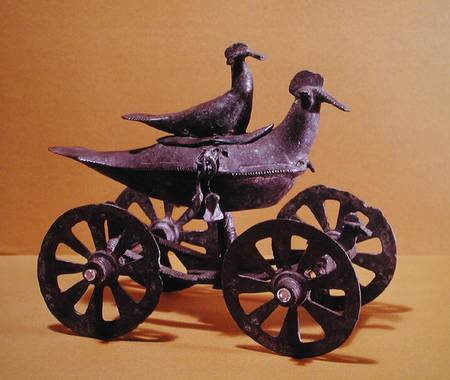
The steppe DNA is essentially composed of ancestral Northern Eurasians and immigrants from Iran. In the last third of the 4th millennium. the Yamnaja or pit grave culture emerged in the space between the Caspian and Black Sea. The invention of the wheel and cart, the domestication of the horse and the production of the first arsenic bronzes are attributed to her.
It was a highly mobile cattle herding society, for which the erection of huge burial mounds, so-called Kurgane, is characteristic. The exposed dead were mostly men and were buried in grave chambers with jewelry, weapons and a whole wagon, lying on their backs with their legs drawn up, often sprinkled with ocher. In addition to seasonal settlement areas, there were also permanent, sometimes fortified settlements in the river dividers, which suggests that not only cattle breeding but also arable farming (Parzinger 2014, 395-397).
Towards the end of the 4th millennium. there was a sudden drop in climate which led to the drying up of the South Russian steppe valley. Nomad groups of the Yamnaja culture first moved to the Hungarian Plain and the lower Danube region.
The manner of burial and the furnishing of the dead are marked by an astonishing similarity. For the first time, hill graves and battle axes and string-adorned clay cups appear in this area. The Vucedol culture in Pannonia, named after the settlement finds on the Ljubljana Moor, is regarded as an offshoot of the steppe nomadic Kurgan culture.
It took shape in several regional variants (Schnurbein 2010, 75). The DNA analyzes also show that the immigrants were mainly men, who often associated with the local women. The share of immigrants in the population was around 80% (Krause 2019, 128).
The giant grave figurines in the Bay of Kotor, which have been completely examined using modern methods, date from around 2800 BC. BC (Primate 1996). In the grave figurehead of Mala Gruda, next to the hips of the only burial, lay a shaft-hole ax made of a copper-silver alloy.
On his head the man wore five small gold rings of northwest Greek shape. He also owned a gold-bladed dagger of the Levantine type (Primas 1996, 17-18). Several phases of allocation and occupancy have been documented in Velika Gruda.
In the oldest period A, the grave figurehead already had a diameter of 23 m. It covered a stone box grave sunk into the natural ground. The adult man had been given an ax and two arsenic bronze knives, a cylindrical polishing stone, and two boar tusks. On his head he wore eight gold rings of a shape similar to that in Mala Gruda. A handle and a creator, both with deeply incised Vucedol patterns, are added to the ceramics.
The handle shell is, however, an Agaic shape (Primas 1996, 25-112). The double-edged knives, on the other hand, occur in Kurganen in the Dnieper region (Primas 1996, 93-94, Fig. 7.1) and are often with 'stone blocks' that were used as polishing stones (Primas 1996, 116-117, Fig. 8.3), socialized.
Hill graves of the early 3rd millennium. are also known from Cetina in northern Dalmatia. We also know the cremation that is customary here from Late Copper Age graves on the Lower Danube and in the Carpathian Basin (Primas 1996, 133, Fig. 9.3).
Early Bronze Age tumuli, which also still show characteristics of the Kurgan culture, have been researched in north and central Albanian necropolises on the lower Adriatic. The clay ware that was added is similar to the settlement ceramics in the Korca plain, which is to be placed there using 14-C data in the period between approx. 2850 and 2400 (Korkuti 2013, 397). In Shtoj near Shkodra, too, the strikingly large funerary cages 2 and 6 were erected at this early stage with several phases of partitioning. They are characterized by outer and inner stone circles and central graves sunk into the ground. The oldest core of Tumulus 6 was a hill made of earth and stones with a diameter of 11 m.
Underneath was the central grave 16, paneled with stones. The stool burial was carefully covered with a layer of small stones and sprinkled with ocher. There were six anthropomorphic clay figures on it. With the enlargement of the tumulus, burials 14 and 15 were introduced, in which, as in the cage filling, was decorated ceramics of the north Adriatic variant of the Vucedol culture (Korkuti 2013, 461-463).
Also in Pazhoku, just south of the Shkumbin Valley, the giant tumulus I with a diameter of 30 m and an outer stone circle dates to the early Bronze Age. The central burial was framed by its own stone circle. The person buried in the right stool position had a cattle skull (Korkuti 2013, 473, T. VIII b).
All of these findings point to eastern elements in burial customs as well as in the shape and decoration of ceramics and weapons. But it cannot be seen that other cultural currents, for example from the Agais, reached the Western Balkans.
Middle Bronze and Early Late Bronze Ages
(approx. 1600-1100 BC)
With the complete excavation of the giant tumulus Velika Gruda in the Bay of Kotor, archaeological research has a solid insight into the burial customs and demographics of a late Bronze Age community of the 14th and 13th centuries. (Della Casa 1996).
The first, already very large, Copper Age tumulus (period A) was followed by a layer of stones set on its crest with a burial over which a thin layer of burn was drawn (period B). Then the grave hedgehog was considerably enlarged by a layer of clay and reached a diameter of 26 m (period C). Finally a massive stone packing was placed over the middle of the hill, in which the vast majority of the graves were inserted (period D). Much later, an early Iron Age burial was also carved into this stone mantle (period E).
The graves often contained collective burials with between two and 221 individuals who had been buried in a crouched position. The grave shafts had a gravel bed, the winds were lined with large stones or slabs. In addition to the body burials, there was also a bustum grave. Simultaneous bringing in of the dead can be ruled out, as the grave pits were designed in terms of size for only one individual each and only the last burials were undisturbed.
There were several depots of human skeletal remains on the edge of the hill. Passage fragments from these bone volutes and from the graves suggest that the graves were carefully cleared out in the course of the grave renovations and that the bones were partially buried elsewhere. Between and above the graves, 33 separate vessel depots were uncovered.
The equipment is generally very modest. In children it usually consists of just a small vessel, in adults it is occasionally made of some bronze jewelry (spiral ruffles, small spiral hoops on the head, double spiral straps, round hoops with a diameter of 10-12 cm and small 'knobs' with eyelets on the back, see Online — Fig. 1) and amber pearls (Della Casa 1996, 29-55)
Children and infants were buried in Pithoi and Grolsgeféilgen. Their share of the total number of people buried is strikingly high at 43%. Otherwise women and men of all ages are represented. There are a total of 156 individuals. 4,560 / 5,000Translation results
The average life expectancy at birth can be calculated at around 20 years. During the roughly 200-year occupancy during the early Late Bronze Age, only 5-6 nuclear families with a total of around 30 relatives lived in the small rural community (Harding 2013, 853).
The submission of selected grave inventories at the Glasinac by Benac and Covic ’is altogether reliable as far as the grave connections are concerned. After all, grave finds are also repeatedly described and illustrated without information ‘, i.e. without known socialization.
Unfortunately, from the excavations in the 19th century, there are no In addition to the anthropological determinations, also observations on the position of the buried and their items of equipment (Benac / Govic '1956; 1957). These publications now serve us for a closer evaluation.
There are only a few graves for the Middle Bronze Age phase Glasinac II a / b (approx. 1600-1375). They included, inter alia. Solid bracelets with line decoration, spiral wire bracelets, round, sometimes hat-shaped osseous buttons, spiral bracelets as well as a spiked disc and a pin with a recognizable reference to Pannonia.
Glasinac III a (approx. 1375-1250) corresponds to the early Spéitbronzezeit. Of 16 burials, most of which are female, two of them are incendiary burials. There are three main groups of equipment: a first with a choker, headdress rings, small buttons and spiral eyeglass pendants. Another group is characterized by decorative pins, ribbed arm cuffs and small buttons. 8 grave inventories are particularly rich with eyeglass pendants, often with a ribbed browband, a pair of solid bracelets and one each with incised osenfaleren or osseous buttons.
In the central Albanian town of Lofkendi, six of the dead belonging to phase I (approx. 1400-1200) wore decorative pins made of bone or bronze on their upper body garments. In another grave was a spiral scroll. There are men, women and one child among the buried (Papadopoulos et al. 2014).
For phase III b (1250-1100) 13 burials, including a cremation grave, can be evaluated at Glasinac. The first group is characterized by spiral wire bracelets, of which one to three specimens occur per grave. Solid studded bracelets with a triangular cross-section (one to five specimens) are also characteristic. Spiral rolls and are less common
Headdress rings (see online fig. 2).
A second, more prestigious group had incised neck bracelets and spiral wire bracelets, sometimes also eyeglass bracelets and violin bow brooches.
For phase II in Lofkendi (approx. 1200-1050) the equipment groups are difficult to define because of the lack of additions. Two burials have a bronze or iron needle. Three other burials belong to the upper class: they had smooth browbones, iron and glass beads,
Brooches and chain brooches, double-handled vessels and jugs. A young woman wore a small bronze disc as a headdress on which a spoked wheel was driven in the manner of a point hump (Papadopoulos et al. 2104).
In the northern Albanian Mat Valley, 17 burials, including three burials, from the 14th to 12th centuries can be viewed. 7 graves contained a lance, three of them a sword. A sword lay alone in a grave. Two other man diggers had tweezers with them. A knife, stepped Gsenknopfe and pearls were found only once in other burials (Islami 2013).
The comparison between early graves of the Late Bronze Age in Velika Gruda, Glasinac, Mat-Tal and Lofkéndi is not easy, since in Glasinac there are predominantly women graves, on the other hand the furnishings in the other necropolises are rather one-sided. It is also worth taking a look at early graves in the giant tumulus in Rehova in Kolonja in the south-east of Albania (Aliu 2012). The 37 burials in phase I date back to the 13th and 12th centuries.
A larger part of the graves contained one to three bronze needles and glass and amber beads. Another equipment group is indicated by knife accessories and occasionally tweezers. Then there are also warrior burials with a lance and graves that only contained clay vessels that otherwise also appear in the other groups, including double-handled and multiple vessels, handled cups and mugs. In comparison to the discussed grave complexes in other places, only those with the knife additions stand out as a clearly different equipment group.