Introduction
Namur (Namen in Dutch ; pop. 107,000) is the capital of the Province of Namur and of the Walloon Region.
Namur is often described by the Belgians as a bourgeois town, as opposed to the working-class cities in former coal mining areas like Charleroi or Liège. Its scenic geographical location at the confluence of the Rivers Meuse and Sambre, and its beautiful 17th and 18th-century architecture have also made it a favourite place to live among well-to-do Belgians (mostly but not only Walloons).
Trivia & Celebrities
Namur hosts every year the International Competition for Young Violinists "Bravo!".
One of Belgium's most famous tennis clubs, the T.C. Géronsart is located in Namur's twin town of Jambes. It has seen many great names of Walloon tennis, like the brothers Christophe Rochus and Olivier Rochus, and of course Justine Henin (who lives in the suburb of Wépion when she isn't in Monaco).
Other well-known Namurois include actor Benoît Poelvoorde and actress Cécile de France.
The world-famous jam, compote and juice producer Materne-Confilux has been based in the picturesque suburb of Floreffe since its foundation in 1880. Floreffe is also renowned for its Premonstratensian abbey, established in 1121 by Saint Norbert of Xanten (c. 1080-1134), and which produces one of Belgium's famous abbey beers.
| Brocante de Temploux |
|---|
|
The village of Temploux, 10 km north-west of central Namur, hosts one of Europe's largest secondhand market (brocante in French) on the 3rd weekend of August each year. It is spread on 6 km with over 1,500 stands. Sellers do not only come from the Benelux, but also France, Germany, Denmark and Britain, attracting between 200,000 and 300,000 visitors over just 36 hours. The market has the particularity of being open continously from Saturday morning to Sunday evening, night included. Check the multilingual official website for more information. |
History

View of Namur around 1600 (by Adrien de Montigny)
Prehistory
The region of Namur has been settled since times immemorial. Homo Neanderthalis lived here at least 100,000 years ago, as attested by the skeletons found in various caves in the region (Spy, Sclayn).
The first Homo Sapiens (Cro-Magnon) also settled in the region's numerous caves. Canine remains dating from 31,700 years ago were found in Goyet's Caves, a few kilometers south-east of Namur (in the municipality of Gesves). They are the world's oldest reported case of dog domestication. There is no evidence of dog domestication in other parts of the world until about 15,000 BCE.
Ancient times
During the Iron Age, Namur was the site of Oppidum Atuatucorum (or Aduaticorum), the oldest pre-Roman fortified settlement in the Benelux. It was probably the capital of the Atuatuci tribe, who had for immediate neighbours the Condrusi (south, in the hilly Condroz region), the Nervii (north, in Brabant) and the Eburones (east, in the present provinces of Liège and Limburg).
In 57 BCE was fought the Battle of the Sabis (Sabis being the Latin name of the River Sambre) , opposing eight Roman legions (45,000 men) against a confederation of 15 Belgic tribes under the leadership of Galba, king of the Suessiones. The battle culminated with the siege of Oppidum Atuatucorum (see map). Julius Caesar described the place as large enough to shelter 57,000 people, though the total number of Belgae warriors must have been between 15,000 and 25,000. The tough battle resulted in a Roman victory, and the Belgic tribes surrendered, with the exception of the Eburones (and some Nervii), who kept resisting until 54 BCE, before being anihilated.
After the Roman conquest of Gallia Belgica, a castrum (fort) replaced the oppidum, but the settlement remained at the bottom of the hill, as attested by Gallo-Roman artefacts found in the old town of Namur.
Medieval to modern times
In the 7th century, the civitas (town) was mentioned under the name of Navinucum Centrum or Numucum, and was an occasional place of residence for Merovingian kings.

Namur, as it eventually became known from the 12th century, developed into a prosperous merchant town in the late Middle Ages. The historical core of the medieval town (and probably of the previous Celtic and Roman settlements) was built at the foot of the citadel, within the angle formed by the confluence of the Sambre and Meuse Rivers. This spot, where the Walloon Parliament now stands, is known to the locals as the Grognon.
In 1421 the County of Namur is sold by the Count of Flanders to Philip the Good, Duke of Burgundy. The Burgundian Netherlands are incorporated by marriage to the nascent Habsburgian Empire in 1482. In 1556, Emperor Charles V grants the Low Countries to his son Philip, along with Spain and its American colonies. It is during this period of the Spanish Netherlands that most of today's old town was built (mostly in the 17th century).
Louis XIV of France besieged and took Namur in 1692. The town was fortified by ramparts made by Louis XIV's great military architect Vauban, in addition to the city walls. The town was besieged again in 1695, by William III of England this time.
Namur's strategic location made it a target of the German bombers during WWII.
Orientation
Namur is a small town that can easily be seen on foot. The number of pedestrian streets make it in fact rather difficult to penetrate by car.
The Old Town is locked between the Sambre and Meuse rivers South, and the Railway line North. The four main axes around which all the shopping and sights are to be found are: Rue de Fer (Iron Street), Rue de l'Ange (Angel's street), Rue de Bruxelles (Brussels' Street) and Rue Emile Cuvelier.
Attractions
The historical centre dates from the mid-17th century to 18th century. Most buildings were constructed on 5 or 6 storeys in typical Mosan style, using red bricks with bluestone window frames. The narrow shopping streets and little squares filled with cafés and restaurants make for a very pleasant way of spending a sunny afternoon.
| Citadel & Medieval Castle |
|---|

 Dominating the hill at the confluence of the Meuse and the Sambre, this huge stone fortress has a history going back over 2,000 years. Site of a Celtic oppidum, it later became a Roman fort, then the Castle of the Counts of Namur. The extensive citadel around the castle was built by Menno van Coehoorn and improved by Vauban in the 17th century. The Guy Delforge Perfumery is located on top of the citadel. |
| St Alban's Cathedral |
|---|

 Built between 1751 and 1767, the Cathédrale Saint-Aubain is the only Baroque cathedral in the Benelux, as well as the only cathedral in the Low Countries built after 1559. It was designed by Italian architect Gaetino Pizzoni in a blend of styles combining late Baroque, Rococo, and Neoclassical elements (such as the Corinthian capitals). It replaced the earlier St Albans' Collegiate Church, which was founded in 1047 by the Counts of Namur. |
| St Lupus' Church |
|---|

Located in Rue du Collège, the Eglise Saint-Loup is another fine example of Belgian Baroque. It was constructed by Jesuit Father Huyssens in 1621 as the Church of the Jesuit College facing it. Originally named St Ignacius', it became St Lupus' Church when the Jesuits Order was suppressed by the Pope in 1773. Its facade was rebuilt in 1867 with local bluestone instead of black marble. |
| Royal Theatre |
|---|

Entirely renovated a few years ago, the Royal Theatre of Namur looks like a scaled down version of the Opéra Garnier in Paris. Visitors can enter freely, although the main hall, with its particularly remarkable Baroque ceiling, may not be accessible during rehearsals. |
| Halle al'Chair |
|---|

Constructed between 1588 and 1590, the Halle al'Chair served as Namur's meat and fish market until 1806. It has housed the Archeological Museum (Tue-Sun 10am-5pm, 3 €) since 1855. On display are artefacts from the Bronze Age, Gallo-Roman and Merovingian periods from the Namur region. |
| Ancien Arts Museum |
|---|

Housed in the 18th-century Hôtel de Gaiffier d'Hestroy, the Musée des Arts Anciens du Namurois (Tue-Sun 10am-6pm; 3 €) exhibits Mosan art from the 11th to 16th centuries. One of the highlights is the Trésor d'Oignies, gold and silver reliquaries made by Hugo d'Oignies in the early 13th century. The museum is located Rue de Fer 24. |
| Walloon Parliament |
|---|

The state parliament of Wallonia is housed in the Hospice Saint-Gilles building, the former Hospital of Namur. First mentioned in 1229, the hospital was last rebuilt between 1667 and 1724. Closed in 1965, the building was finally rehabilitated for its current usage from 1990 and inaugurated in 1998. |
| Former Episcopal Palace |
|---|

Built in 1730 by Bishop Thomas de Strickland, the old residence of the Bishops of Namur is now the seat of the Pronvincial Council. It is located opposite the cathedral. Guided tours are only held occasionally. |
| Félicien Rops Museum |
|---|

 The Musée Félicien Rops (daily 10am-6pm, closed Mon except during July & Aug; 2.50 €) is dedicated to the Namur-born painter and illustrator. Rops, who spent most of his life in Brussels and Paris, is famous for his erotic and macabre drawings, usually based on religious themes. The museum is located Rue Fumal 12. |
Other attractions
Beffroi: built in 1388 as part of the city walls, St. James' tower became Namur's belfry in 1746. It is a UNESCO World Heritage Site.
Musée de Groesbeeck-de Croix: housed in an 18th-century manor that once belonged to the Marquis de Croix, this museum (Tue-Sun 10am-12noon and 1:30pm-5pm, 2 €) is dedicated to 18th-century decorative arts. It is located Rue Joseph Saintraint 3, 100 metres from the cathedral.
Arsenal: built by Louis XIV in 1692 after the successful siege of the city, the arsenal of Namur was used to stock ammunitions until WWII. It now belongs to the University of Namur and is frequently used by students to hold parties.
Fêtes de Wallonie
The third weekend of September each year, Namur hosts Belgium's answer to Munich's Oktoberfest : 3 days of almost uninterrupted binge drinking and partying in the streets of the Walloon capital. Despite the country's reputation for beer (Belgium produces more beer per capita than Germany), it is the local peket, a variety of fruity Jenever, that is king during the Fêtes de Wallonie.
Other Walloon cities, like Liège or Andenne also host similar events, but the biggest and most famous is the one held in Namur and symbolises the Walloon spirit of conviviality. The festival ends with a big fireworks above the citadel.
Shopping & Entertainment
Namur has plenty of fashionable boutiques, pleasant cafés and restaurants (see below). As a university town, it is also a good place to buy CD's and DVD's, books, stationery. etc. The main shopping streets are the Rue de Fer, Rue de l'Ange and Rue de Bruxelles, as well as in front of the train station. But many boutiques are located in the small pedestrian streets in the old town. The small Inno department store is located between Rue de l'Ange and Place d'Armes.
There are two big cinemas: the Eldorado in Rue de Fer (between the old town and the train station) and Acinapolis at the end of Avenue Materne in Jambes, on the other side of the Meuse.
Recommended Restaurants
Train station area
- Chez Chen, 8, Rue Borgnet - 5000 Namur. (Chinese)
Old Town (left bank)
- L'Espieglerie, 13, Rue des Tanneries - 5000 Namur. (Gastronomic French)
- La Petite Fugue, 5, Place Chanoine Descamps - 5000 Namur. (French)
- Fenêtre sur Cour, 35, Rue du President - 5000 Namur. (French)
- San Marino, 6, Rue Haute Marcelle - 5000 Namur. (Italian)
- Primo Primo, 11/13, Rue de la Halle - 5000 Namur (Mexican)
Grognon (between the two rivers)
- Pépite
 , 44, Rue Notre-Dame - 5000 Namur. (Gastronomic French)
- Asia Garden, 3, Avenue de la Plante - 5000 Namur. (Chinese)
Jambes (right bank)
How to get there
Namur's central position make it easily accesible by car or train. Namur is at the junction of the North-South axis of the E411 and N4 motorways from Luxembourg to Brussels and the E42 from Lille (France) and Charleroi to Liege and Aachen (Germany).
By train, the city is about 50min from Brussels or Liege and about 2 hours from Luxembourg. The Thalys bullet-train links Namur to Paris in 2 hours 30 minutes (two trains per day, both around 7:30am).
Travel Community
Ask your travel questions on the Benelux Travel Forum


 Dominating the hill at the confluence of the Meuse and the Sambre, this huge stone fortress has a history going back over 2,000 years. Site of a Celtic oppidum, it later became a Roman fort, then the Castle of the Counts of Namur. The extensive citadel around the castle was built by Menno van Coehoorn and improved by Vauban in the 17th century. The Guy Delforge Perfumery is located on top of the citadel.
 Built between 1751 and 1767, the Cathédrale Saint-Aubain is the only Baroque cathedral in the Benelux, as well as the only cathedral in the Low Countries built after 1559. It was designed by Italian architect Gaetino Pizzoni in a blend of styles combining late Baroque, Rococo, and Neoclassical elements (such as the Corinthian capitals). It replaced the earlier St Albans' Collegiate Church, which was founded in 1047 by the Counts of Namur.


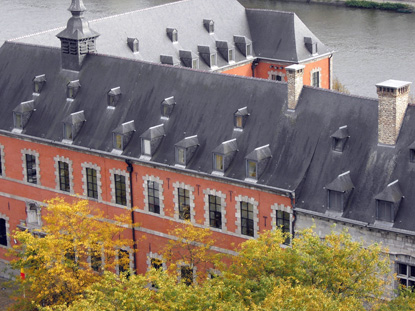


 The Musée Félicien Rops (daily 10am-6pm, closed Mon except during July & Aug; 2.50 €) is dedicated to the Namur-born painter and illustrator. Rops, who spent most of his life in Brussels and Paris, is famous for his erotic and macabre drawings, usually based on religious themes. The museum is located Rue Fumal 12.


