


 Belgium Guide
 Luxembourg Guide
Introduction
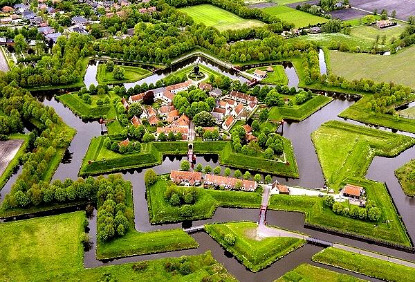
Fort Bourtange, a remarkable star-shaped fortress nestled in the village of Bourtange in the Groningen province of the Netherlands, stands as one of the most well-preserved historical fortifications in the country. Built under the strategic orders of William the Silent during the Dutch Revolt and completed in 1593 during the Eighty Years' War against Spain, its primary purpose was to control the only road between Germany and the city of Groningen, which was then under Spanish control. The fort's distinctive pentagram shape, meticulously designed by renowned military engineer Menno van Coehoorn, allowed defenders to effectively cover all approaches with overlapping fields of fire, making it nearly impregnable to attackers of the period.
The fortress is surrounded by a complex system of moats and canals that formed an essential part of its defensive strategy, creating a formidable barrier against potential invaders. These waterways could be strategically flooded to create an impassable marshy terrain around the fortress, further enhancing its defensive capabilities. The interior of the fort features a carefully planned layout with a central parade ground, barracks, powder magazines, and other military structures arranged to maximise efficiency during times of siege. The five bastions at each point of the star allowed for comprehensive defensive coverage, with each bastion named after one of the provinces that funded the fort's construction.
History
Fort Bourtange was constructed under the orders of William the Silent and completed in 1593 during the Eighty Years' War (1568-1648). The fort's strategic purpose was to control the only road between Germany and the city of Groningen, which was then under Spanish control. Designed by military engineer Menno van Coehoorn, the fortress's distinctive star shape with triangular bastions was revolutionary, allowing defenders to cover all approaches whilst being protected by surrounding marshlands. This ingenious design successfully cut off supplies to Spanish forces stationed in Groningen, contributing to the city's recapture in 1594.
The fortress proved its military worth throughout its operational history. In 1672, during the Franco-Dutch War, Fort Bourtange faced a significant siege from the forces of Christoph Bernhard von Galen, the Prince-Bishop of Münster. Captain Protts, the fort's governor, famously refused to surrender despite being offered a substantial bribe of 200,000 guilders or a country estate. The fort's robust defences and the surrounding marshes successfully repelled the invading army, cementing Bourtange's reputation as an impregnable stronghold. The fortifications were strengthened several times, notably in 1665 and 1672, reaching their maximum extent in 1742.
By the late 18th century, advancements in military technology and changes in warfare led to the fort's decline. Additionally, agricultural practices had dried up the protective marshlands, diminishing the fortress's defensive capabilities. In 1851, Bourtange was decommissioned as a military installation, its ramparts dismantled, moats filled, and military facilities sold or abandoned as it converted into a civilian village. However, the historical significance of this remarkable structure was not forgotten. Between 1964 and 1973, the local government undertook an extensive restoration project to return the fort to its 1740-1750 appearance. Today, Fort Bourtange serves as a living museum, offering visitors a fascinating glimpse into Dutch military history with its preserved defences, historical buildings, and picturesque setting.
How to get there
To reach the Fortress of Bourtange, travelling by car is the most convenient option, with the N365 being the main road into the village. It's approximately a 50-minute drive from Groningen city, or about 3 hours from Amsterdam. If relying on public transport, prepare for a longer journey; from Groningen, take a train to Winschoten (about 23 minutes), then bus line 11 to Bourtange, with the total journey taking around 1.5 hours and costing roughly €11. Alternatively, bus line 72 stops at Bourtange, Bakovensweg, which is a 12-minute walk from the fortress. Once you arrive, park at the large free visitor car park near the information centre, from where you'll cross three charming red wooden bridges to enter the fortress. Inside the star-shaped fortification, everything is conveniently walkable, with the entire village being charmingly compact. During summer months, a tourist minibus and horse carriages are available for tours through and around the fort—simply enquire at the tourist information office upon arrival. The information centre also provides wheelchair loans if needed.