
• Don't want to see ads? Install an adblocker like uBlock Origin or use a Europe-based privacy-friendly browser like Vivaldi or Mullvad.

Society Young Americans avoid dating across party lines

Maciamo

Veteran member
Admin
Messages
10,647
Reaction score
4,480
Points
113
Location
Lothier
Ethnic group
Italo-celto-germanic
A new study found that young Americans tend to reject potential partners from opposing political parties much more strongly than they prefer those who share their own political views.

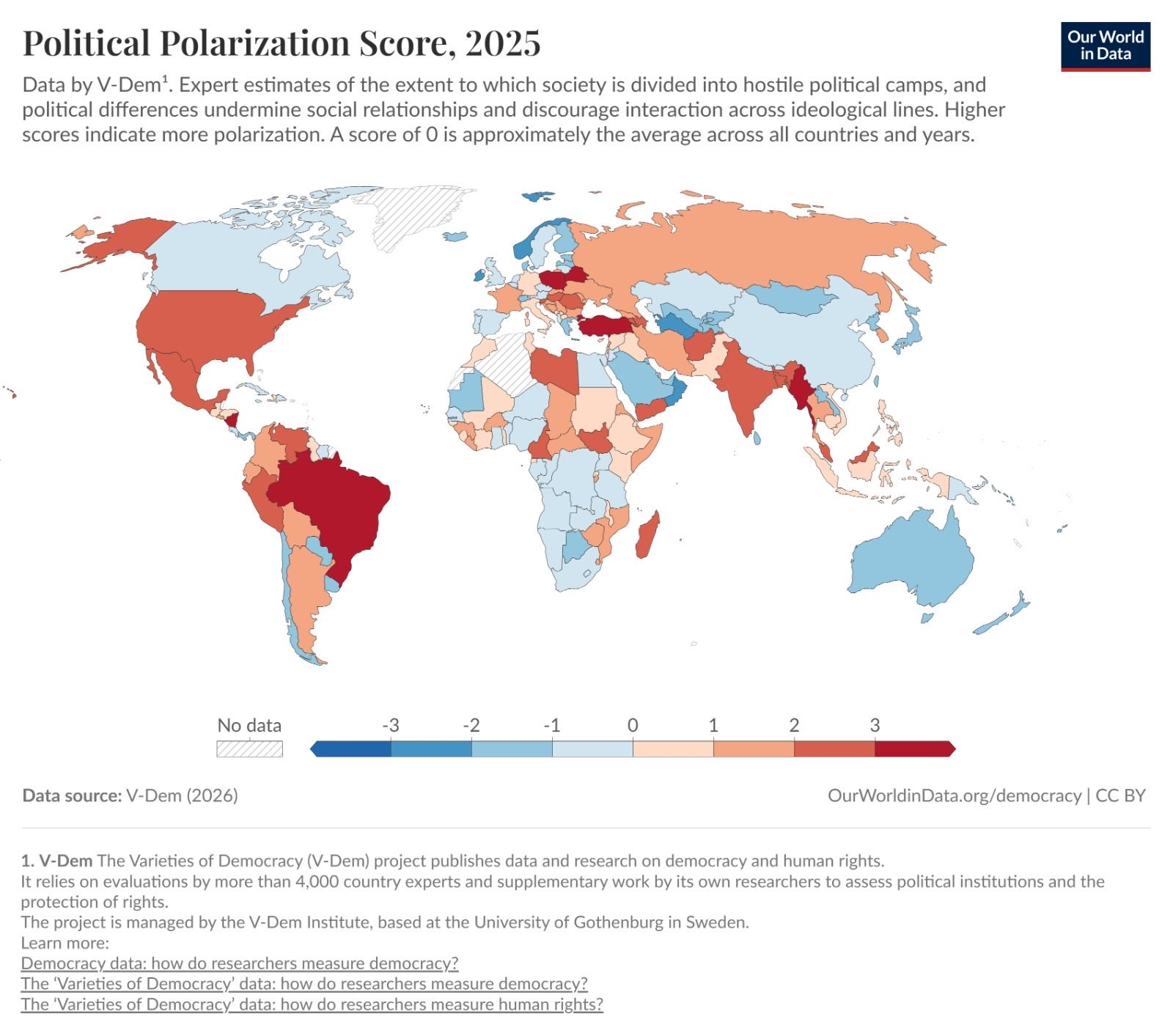
I recently posted a map of political polarisation and it won't surprise anyone to see that US society is heavily polarised politically,
1780983857291.png


The study examined why politically similar partners are preferred in online dating and whether these effects differ by gender and party. Using a survey experiment with 1,097 US Americans aged 20–33, participants rated fictional dating profiles that randomly displayed "Democrat," "Republican," or no party affiliation.

Rejection Over Preference​

The headline finding is that romantic avoidance of out-partisans drove behavior more than attraction to co-partisans. In other words, people weren't mainly swiping right on their own party — they were swiping left on the other one. The negative effect of seeing an opposing party label was consistently 2–3× larger than the positive effect of seeing a matching one.

Why It Happens: The Three Mechanisms​

Three psychological pathways explained the partisan dating gap:
  • Perceived similarity (values & lifestyle) — the strongest mediator in both co-partisan preference and out-partisan rejection; people assume shared or clashing worldviews based on party alone
  • Expected social approval — concern that friends and family would disapprove of dating an out-partisan was the second biggest driver of rejection
  • Perceived character quality (intelligence, kindness, honesty) — out-partisans were judged as having worse character, though this played a smaller role than similarity
Essentially, people use party affiliation as a proxy for personality and lifestyle, not just politics.

Who Shows It Most?​

The effects varied significantly by gender and party:
  • Republican men and women showed the strongest in-group preference (favoring co-partisans)
  • Democratic women showed the strongest out-group rejection (avoiding Republicans most intensely)
This partially supports the "asymmetric affective polarization" theory — Democratic women are the most affectively polarized group — but Republican in-group preference aligns more with the "dating market" theory, where Republicans have more favorable co-partisan dating prospects.
 
The political situation in the United States is very unusual for a developed country in that there are only two major parties. In this setting it is easy for polarisation to take place. As soon as the Democrats and Republicans lost their moderate Centre, it became a case of Us versus Them, and once that process is started it's only getting worse over time.

In contrast, in a country like Belgium, where there are five main political parties in each linguistic half (French speaking and Dutch speaking), plus a few minor parties, it's much harder to see things in black or white. When there are only two parties, you get a line and polarization happens once the parties move in opposite direction against that line toward the extremities. But if you have five parties that share a lot of similar core values (universal healthcare, social security, free education, fighting climate change, pro-EU, pro-abortion, anti-death penalty, and so on) and only differ in the specifics, it's almost impossible for society to become politically polarized.
 
Both of my kids are married to similar political leaning people. Marriage is hard enough to navigate through without political friction. It is hard to argue with somebody when you cannot agree what the facts are.
 
Both of my kids are married to similar political leaning people. Marriage is hard enough to navigate through without political friction. It is hard to argue with somebody when you cannot agree what the facts are.

I completely agree. If I lived in the US, I would also socialise with people with the same political values. My point was that in countries where there is little political polarisation like Belgium it's very hard for people to viciously argue with one another as most parties and most of the population agree on the fundamentals. There is often more diversity of opinions within a political party than between parties themselves. And these differences of opinion usually are about the specifics of how some reforms should be done, not the core values.

For example, all political parties in Belgium agree that fighting climate change is important, unlike in the U.S. where many republican politicians are climate skeptics that reject the very idea of climate change, (including Trump himself). What differs between parties is how the government should tackle climate change and what percentage of the budget should be allocated to it, as opposed to other policies. All parties agree that there should be social security, but liberals (i.e. the centre-right in Belgium) are more likely to say that unemployment benefits should be reduced, while the socialist would prefer a more generous system.

These are relatively minor arguments that very rarely break friendships and tear family apart. Actually, people in Belgium are much more likely to have a serious argument about US politics than Belgian politics, especially if someone says they support or generally agree with Trump. So it's very easy to understand how bad things can get in the US within families.
 
Back
Top