

A new study found that young Americans tend to reject potential partners from opposing political parties much more strongly than they prefer those who share their own political views.
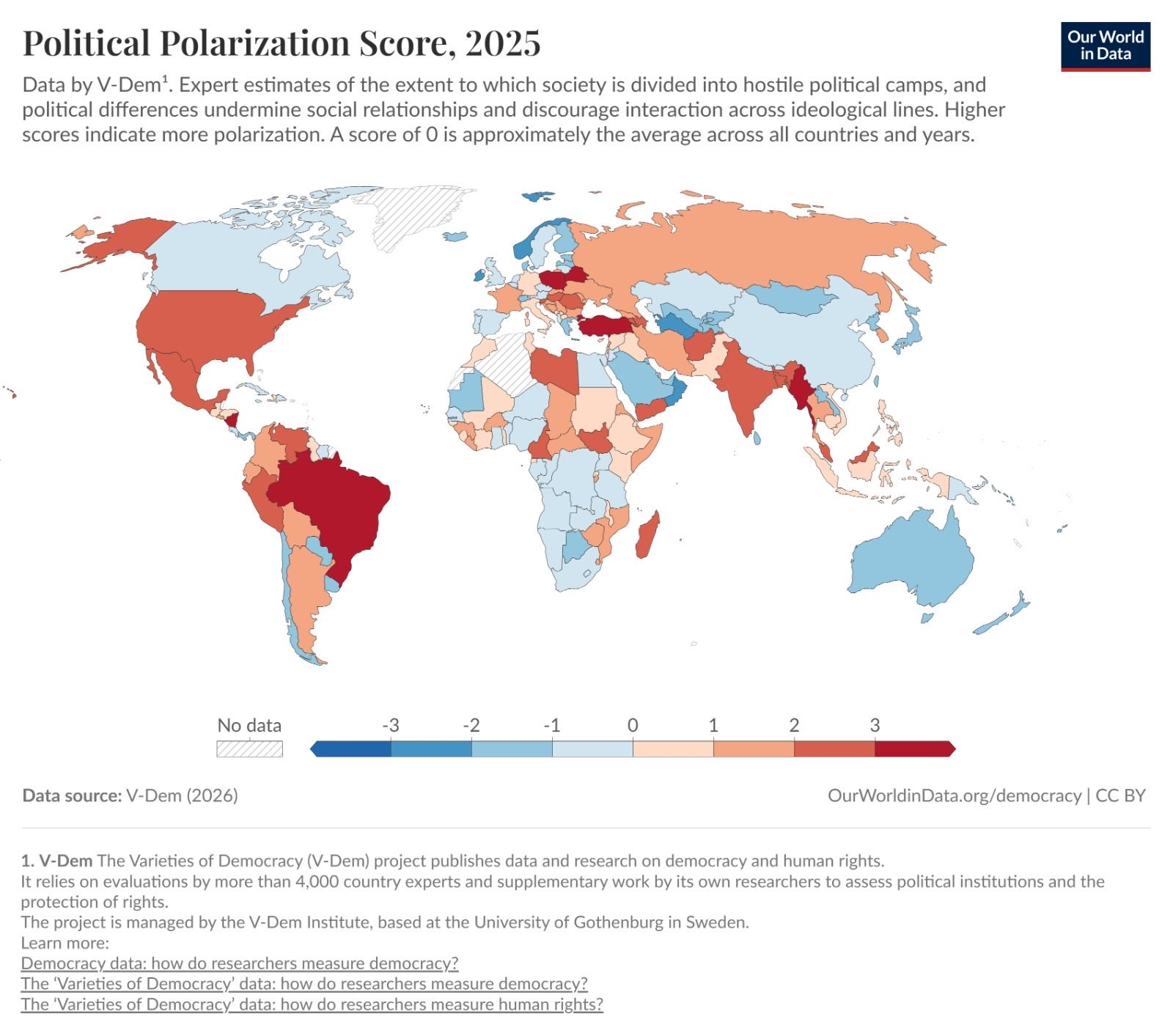
I recently posted a map of political polarisation and it won't surprise anyone to see that US society is heavily polarised politically,
The study examined why politically similar partners are preferred in online dating and whether these effects differ by gender and party. Using a survey experiment with 1,097 US Americans aged 20–33, participants rated fictional dating profiles that randomly displayed "Democrat," "Republican," or no party affiliation.
I recently posted a map of political polarisation and it won't surprise anyone to see that US society is heavily polarised politically,
The study examined why politically similar partners are preferred in online dating and whether these effects differ by gender and party. Using a survey experiment with 1,097 US Americans aged 20–33, participants rated fictional dating profiles that randomly displayed "Democrat," "Republican," or no party affiliation.
Rejection Over Preference
The headline finding is that romantic avoidance of out-partisans drove behavior more than attraction to co-partisans. In other words, people weren't mainly swiping right on their own party — they were swiping left on the other one. The negative effect of seeing an opposing party label was consistently 2–3× larger than the positive effect of seeing a matching one.Why It Happens: The Three Mechanisms
Three psychological pathways explained the partisan dating gap:- Perceived similarity (values & lifestyle) — the strongest mediator in both co-partisan preference and out-partisan rejection; people assume shared or clashing worldviews based on party alone
- Expected social approval — concern that friends and family would disapprove of dating an out-partisan was the second biggest driver of rejection
- Perceived character quality (intelligence, kindness, honesty) — out-partisans were judged as having worse character, though this played a smaller role than similarity
Who Shows It Most?
The effects varied significantly by gender and party:- Republican men and women showed the strongest in-group preference (favoring co-partisans)
- Democratic women showed the strongest out-group rejection (avoiding Republicans most intensely)