• Don't want to see ads? Install an adblocker like uBlock Origin or use a Europe-based privacy-friendly browser like Vivaldi or Mullvad.

Y-DNA haplogroups of ancient populations

Tomenable

Well-known member
Messages
5,996
Reaction score
1,717
Points
113
Location
Poland
Ethnic group
Polish
Y-DNA haplogroup
R1b-L617
mtDNA haplogroup
W6a
For example Thracians were ca. 90% E1b1b1a1 (based on 10 currently available samples):


q48rtB7.png
 
For example Thracians were ca. 90% E1b1b1a1 (based on 10 currently available samples):


q48rtB7.png
Yes, we got these samples quite some time ago. They are all from he (Post-) Psenichevo group which grew out of Zimnicea-Plovdiv-Cerkovna and subsequent Channelled/Fluted/Knobbed Ware which got heavily influenced by Gáva-related Channelled Ware (especially Belegis II-Gáva, Vartop, Insula Banului etc.).
They represent South Thracians and so far, most downstream assignment led to the specifically more South Thracian branch of E-V13, which is E-BY5022:

This could be related, theoretically, to Zimnicea-Plovdiv-Cerkovna, which expanded from the Southern Gáva-relative of Verbicoara-Tei/Fundeni-Govora.

The more Western/Northern branches, so far not found in more Southern Thracian territories, probably associated with North Thracians/Dacians, most notably the majority of branches of E-Z5018, has a later TMRCA and huge expansion event in the time of Gáva-related Channelled Ware, in the Late Bronze to early Iron Age, between about 1.300-1.000 BC, which is much weaker in South Thracian E-BY5022.
 
I compiled the data on Y-DNA haplogroups from Early Medieval Poland:


Let me know in case if I forgot to add any samples to this datasheet.

=====

Currently there are:

Haplogroup - # ----- %
R1a ----- 112 ----- 64.74%
I2a ----- 13 ----- 7.51%
N1 ----- 3 ----- 1.73%
R1b ----- 20 ----- 11.56%
I1 ----- 9 ----- 5.20%
E1b ----- 9 ----- 5.20%
J2a ----- 4 ----- 2.31%
J1 ----- 1 ----- 0.58%
Q ----- 1 ----- 0.58%
C ----- 1 ----- 0.58%
Total - 173 samples
 
Last edited:
Number of Early Medieval Polish Y-DNA samples by region:

Wielkopolska - 67
Lubuskie - 34
Śląsk - 23
Mazowsze - 19
Podlasie - 10
Kujawy - 9
Pomorze - 5
Świętokrzyskie - 4
Małopolska - 2

And a regional breakdown of Polish Y-DNA haplogroups:
(these R1b-s in Silesia are mainly samples from Niemcza)

R9V0OZT.png


So Early Medieval Wielkopolska had around 77% R1a (n=67 samples).

Modern Wielkopolska has only 54% R1a (n=201) according to this study:

https://www.termedia.pl/Badania-populacji-W...,23736,1,0.html
 
Last edited:
Update because I have added several more samples:

Early Medieval Poland:

Haplogroup - # ----- %
R1a ----- 119 ----- 65.03%
I2a ----- 15 ----- 8.20%
N1 ----- 3 ----- 1.64%
R1b ----- 20 ----- 10.93%
I1 ----- 9 ----- 4.92%
E1b ----- 9 ----- 4.92%
J2 ----- 4 ----- 2.19%
J1 ----- 1 ----- 0.55%
G ----- 1 ----- 0.55%
Q ----- 1 ----- 0.55%
C ----- 1 ----- 0.55%
Total - 183 samples

Number of samples by region:

Wielkopolska - 71
Lubuskie - 34
Śląsk - 24
Mazowsze - 20
Podlasie - 10
Kujawy - 10
Świętokrzyskie - 7
Pomorze - 5
Małopolska - 2

Y-DNA haplogroups from the Early Medieval Poland:

qpbLRO9.png


Y-DNA hgs from modern Poland (Grochowalski 2020):

yCJv8Pr.png
 
Last edited:
Świętokrzyskie samples have been added to Małopolska group.
 
Slavs from Niederwünsch in Germany (n=94) were even over 90% R1a and the rest mostly I2a:

ll2FhyZ.png
 
From pre-Roman Iron Age Britain we have 160 Y-DNA samples including:

R1b-L21
R1b-DF27
R1b-U152>L2
other R1b subclades
G2a-L497
I2a2a-M223
I2a1a-M26

As well as:

R1b-U106>S264 (just one sample!)
I1-M253 (just one sample!)

What is interesting is the lack of E1b1b, J2, J1 and T. While in modern England these four haplogrups are about 6-7% of the total.
 
99% of Illyrian samples in Croatia and Montenegro were J-L283, except for R-L2 Italic tribes in the northern parts. There were also some other Y-DNA.
The Illyrian samples in Albania were majority J-L283, R-PF7563 and R-Z2103 ... unpublished samples from southern albania will be 99% R-Z2103 and R-PF7563
 
Updated frequencies of Y-DNA hgs from modern Poland:

ruTMcYU.png
 
Iron Age Scythian Y-DNA haplogroups (found on Reddit):

mY6yJob.png
 
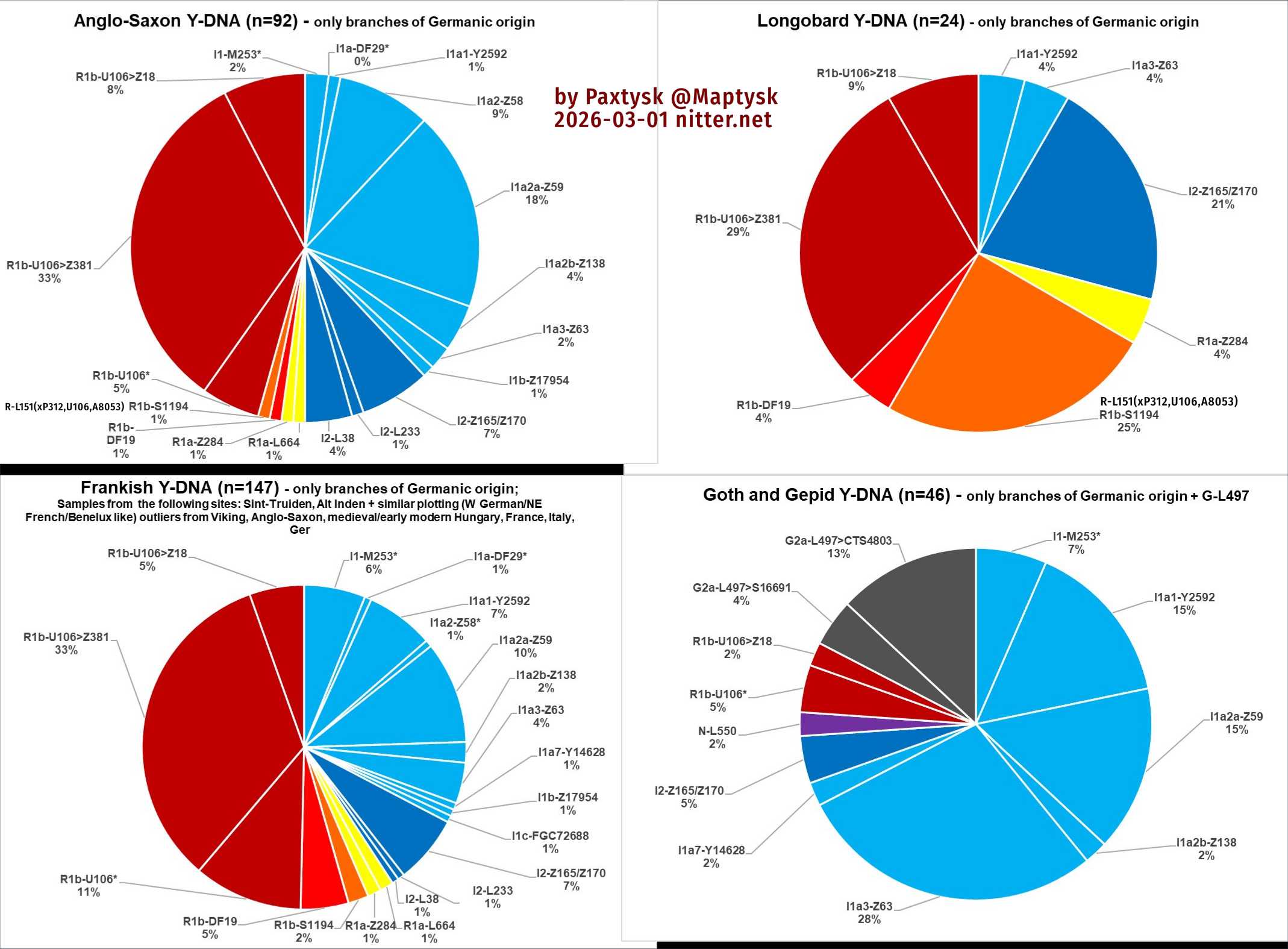
Y-DNA haplogroups of various Germanic tribes:

Germanic-YDNA.jpg
 
Comment from GenArchivist:

At a quick glance, it definitely seems to be missing a few samples. For example, the chart is missing two R1a-Y2395+ samples among the Goths (R10620 and PL067).

It also appears to be missing a couple of N-L550 Langobards from Szeleste published in this study along with 7 I1 samples from the same site, including some L22+. Then there's the L22 > FGC21810 Langobard from Szólád that also appears to be missing. I'm sure there could be others as well.

I would probably also be hesitant to label all U106 > Z381 as "Germanic" since ancient DNA has shown that it was fairly widespread early on and clearly predates Germanic presence in many places. For example, Z381's child branch Z156 has been found in the Knoviz culture, the Unetice culture, LBA/EIA Britain, the Bronze Age Netherlands, Iron Age Slovenia, Iron Age Switzerland, and it's also represented in a few La Tène culture samples from Czechia and in 6-7 or so La Tene individuals from Bucy-le-Long in France, etc. There's also a few U106+ samples from Bronze Age Spain published in Yediay 2025 that will likely turn out to be Z381, as would probably the Etruscan U106+ samples (TAQ013 and AZZA006) if their coverage allowed for deeper assignments.

I still think it's a commendable effort and I understand that the person who made it must have been working with a lot of samples and it's hard to get everything right.
 
For example Thracians were ca. 90% E1b1b1a1 (based on 10 currently available samples):


q48rtB7.png

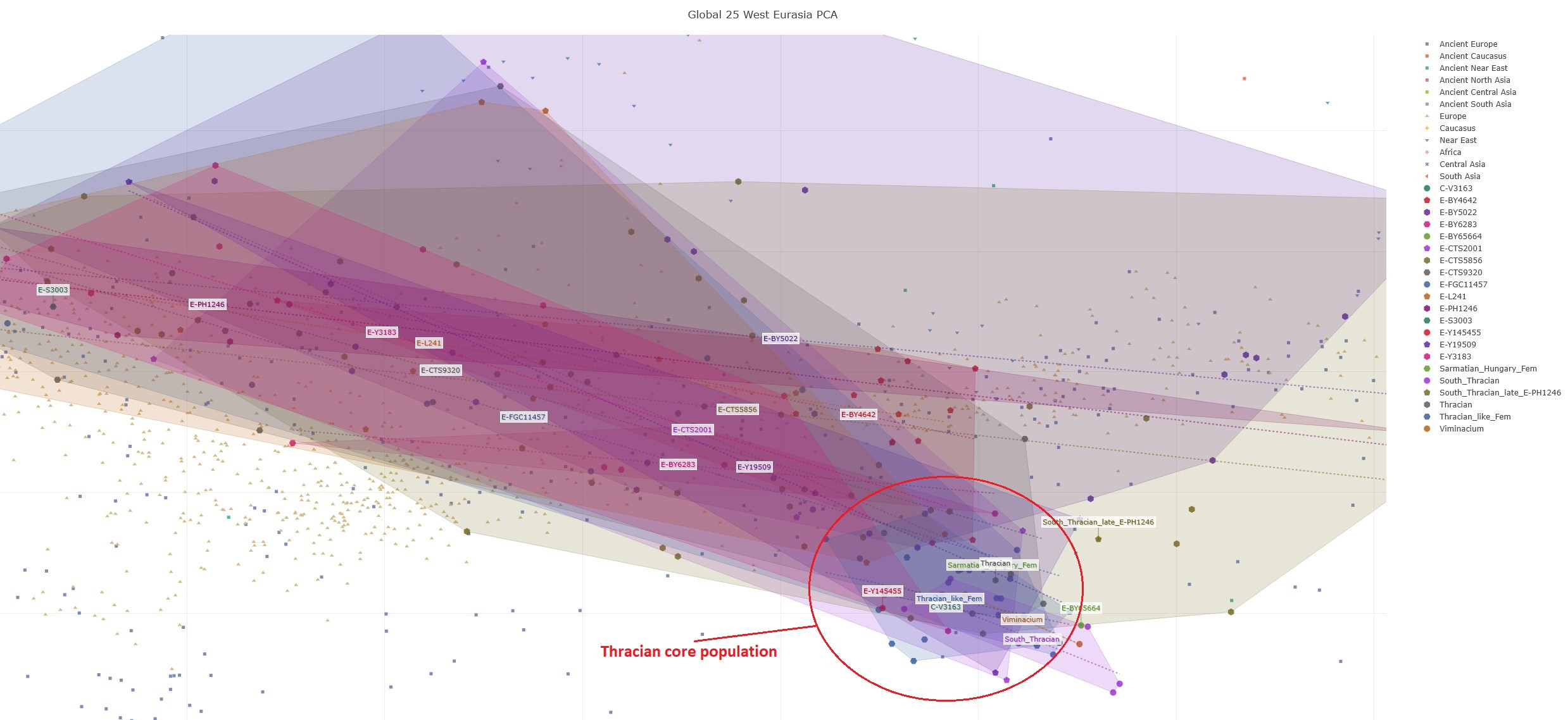
These results being now confirmed by the Akbari data set also. This data set has more than 10.000 new samples and of these are less than 300 E-V13 carriers. Yet, among those with a typical Thracian ancestral profile (roughly 75 % ANF : 25 % Steppe with only trace levels of other ancestries), which cluster in the right corner of the PCA, more than 90 % are E-V13!

This proves that the connection of E-V13 and the Thracian autosomal profile is absolute.

Additionally, practically every single main branch of E-V13 has at least one sample either in the core Thracian profile cluster or very close to it. Regardless of whether they plot mostly in North Western Europe or the Near East in moderns: All E-V13 branches share the same typical Thracian profile common ground:

The relationship can be therefore described as reciprocal:
Every major E-V13 branch is Thracian and the main Thracian population was completely dominated (far above 90 %) by E-V13.

One of the main haplogroups which repeatedly appears in core Thracian autosomal individuals and earlest Thracian finds is C-V3163, which seems to have come from the same Carpatho-Danubian network as E-V13, which connected Bodrogkeresztur-Salcuta-Gumelnita going by IBD matching and mtDNA also. It seems to have been there, at least in the Iron Age. Otherwise there is no strong, truly solid correlation of the Thracian ancestry and IBD networks with any other haplogroup.

This is the PCA plot with the E-V13 and additional Thracian (females, C-V3163 Thracians etc.) branches - the Thracian core ancestral cluster being marked in red:

q6nOEmu.jpg
 
This is quite interesting.
 
Back
Top