• Don't want to see ads? Install an adblocker like uBlock Origin or use a Europe-based privacy-friendly browser like Vivaldi or Mullvad.

Genetic study Whole-genome ancestry of an Old Kingdom Egyptian

traveller

Regular Member
Messages
194
Reaction score
106
Points
43
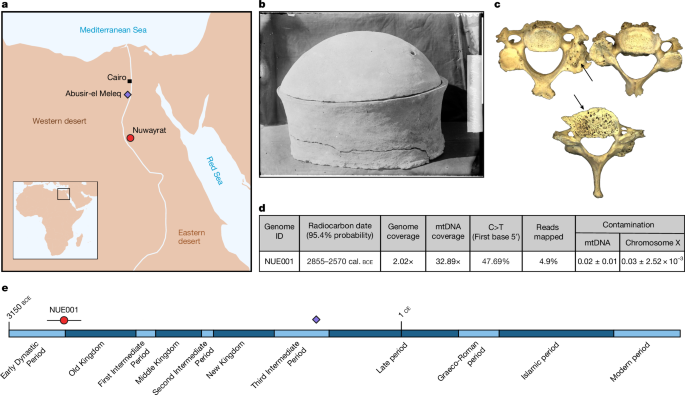
Ancient Egyptian society flourished for millennia, reaching its peak during the Dynastic Period (approximately 3150–30 BCE). However, owing to poor DNA preservation, questions about regional interconnectivity over time have not been addressed because whole-genome sequencing has not yet been possible. Here we sequenced a 2× coverage whole genome from an adult male Egyptian excavated at Nuwayrat (Nuerat, نويرات). Radiocarbon dated to 2855–2570 cal. BCE, he lived a few centuries after Egyptian unification, bridging the Early Dynastic and Old Kingdom periods. The body was interred in a ceramic pot within a rock-cut tomb1, potentially contributing to the DNA preservation. Most of his genome is best represented by North African Neolithic ancestry, among available sources at present. Yet approximately 20% of his genetic ancestry can be traced to genomes representing the eastern Fertile Crescent, including Mesopotamia and surrounding regions. This genetic affinity is similar to the ancestry appearing in Anatolia and the Levant during the Neolithic and Bronze Age2,3,4,5. Although more genomes are needed to fully understand the genomic diversity of early Egyptians, our results indicate that contacts between Egypt and the eastern Fertile Crescent were not limited to objects and imagery (such as domesticated animals and plants, as well as writing systems)6,7,8,9 but also encompassed human migration.
 
No SSA and Bell Beaker ancestry as expected but I doubt this will change anything in the minds of some fanatics.

This is the Nuwayrat individual‘s facial reconstruction:

IMG_3061.png
 
No SSA and Bell Beaker ancestry as expected but I doubt this will change anything in the minds of some fanatics.

It's too early for Bell Beaker. That would have probably entered in the 1st Intermediate period.
 
It's too early for Bell Beaker. That would have probably entered in the 1st Intermediate period.
You’re still thinking about the leaked samples from few years ago? That was a contaminated sample Phil, even the lab confirmed that. The contamination came from a single guy from North western Italy.

My prediction: There won’t be any Bell Beaker ancestry in the natives of ancient Egypt before the Hellenistic period, low SSA might show up though.

By the way, CNN just published an article on the paper:
https://edition.cnn.com/2025/07/02/...nwILtc1dI-kRfDzieg_aem_ow53eUSslD_jk5U-2GCVKA
 
Last edited:
This finding seems to validate the work of traditional physical anthropologists and Egyptologists such as Petrie and Smith, along with craniometry and anthropometry.

Based on their classification of skulls and human remains, Egyptologists Smith and Petrie concluded that there was a migration from Mesopotamia to Egypt during predynastic times. According to their theory, which is referred to as "the dynastic race theory", Mesopotamian invaders established the first dynasty and introduced culture and civilization to Egypt.

Nevertheless, the proposal that the advanced culture of Egypt was brought in by Mesopotamian immigrants or conquerors rather than developing locally is still a matter of debate, IMO.
 
Here's some Wiki info about the dynastic race theory.
The dynastic race theory was the earliest thesis to attempt to explain how predynastic Egypt developed into the sophisticated monarchy of Dynastic Egypt. The theory holds that the earliest roots of the ancient Egyptian dynastic civilisation were imported by invaders from Mesopotamia who then founded the First Dynasty and brought culture to the indigenous population. This theory had strong supporters in the Egyptological community in the first half of the 20th century, but has since lost mainstream support.[1][2] [3][4][5]
Origins

In the early 20th century, Egyptologist Sir William Matthew Flinders Petrie deduced that skeletal remains found at pre-dynastic sites at Naqada (Upper Egypt) indicated the presence of two different races, with the Dynastic Race, also referred to as the "Followers of Horus",[6] differentiated physically by a noticeably larger skeletal structure and cranial capacity.[7] Petrie concluded that the physical differences of the remains in conjunction with the previously unknown burial styles, uncharacteristic tomb architecture, and abundance of foreign artifacts, implied this race must have been an invading ruling elite that was responsible for the seemingly sudden rise of Egyptian civilization. Based on plentiful cultural evidence, Petrie determined that the invader race had come from Mesopotamia, and imposed themselves on the native Badarian culture to become their rulers. Petrie adduced new architectural styles—the distinctly Mesopotamian "niched-facade" architecture—pottery styles, cylinder seals and a few artworks, as well as numerous Predynastic rock and tomb paintings depicting Mesopotamian style boats, symbols, and figures.

This came to be called the "dynastic race theory"[8][9] The theory further argued that the Mesopotamians then conquered both Upper and Lower Egypt and founded the First Dynasty. Predynastic and First Dynasty burial sites similar to Naqada were also found at Abydos, Sakkara, and Hieraconpolis.[6]

Versions of the Dynastic race model were adopted by scholars as L. A. Waddell,[10] and Walter Bryan Emery, a former Chair of Egyptology at University College London.
Decline

The dynastic race theory is no longer an accepted thesis in the field of predynastic archaeology. While there is clear evidence the Naqada II culture borrowed abundantly from Mesopotamia, the most commonly held view today is that the achievements of the First Dynasty were the result of a long period of cultural and political development.[11] Such borrowings are much older than the Naqada II period,[12] the Naqada II period had a large degree of continuity with the Naqada I period,[13] and the changes which did happen during the Naqada periods happened over significant amounts of time.[14]

A version of the theory has been revived by some modern scholars, most notably David Rohl.[15]

Modern Egyptology largely maintains the view that "state formation occurred as a mainly indigenous process", although significant differences in morphology indicated migration along the Nile Valley also took place.[16] The Dynastic Race theory has been largely replaced by the theory Egypt was a hydraulic empire.
 
You’re still thinking about the leaked samples from few years ago? That was a contaminated sample Phil, even the lab confirmed that. The contamination came from a single guy from North western Italy.

My prediction: There won’t be any Bell Beaker ancestry in the natives of ancient Egypt before the Hellenistic period, low SSA might show up though.

By the way, CNN just published an article on the paper:
https://edition.cnn.com/2025/07/02/...nwILtc1dI-kRfDzieg_aem_ow53eUSslD_jk5U-2GCVKA
To be honest, I was very surprised that Predynastic Egyptians resembled Moroccan Neo folks rather than being predominantly Natufian-like. The Levant is next door to Egypt, while Morocco lies on the opposite side in North Africa.

Moreover, Moroccan Neo is of partially Anatolian farmer ancestry. Anyway, it's an intriguing paper.
 
To be honest, I was very surprised that Predynastic Egyptians resembled Moroccan Neo folks rather than being predominantly Natufian-like. The Levant is next door to Egypt, while Morocco lies on the opposite side in North Africa.

Moreover, Moroccan Neo is of partially Anatolian farmer ancestry. Anyway, it's an intriguing paper.

Yes, I was surprised, too. Don’t know what to make out of this. Was there a migration from western North Africa or is just because of scarcity of samples? It’s baffling.
 
You’re still thinking about the leaked samples from few years ago? That was a contaminated sample Phil, even the lab confirmed that.

The lab didn't confirm any such thing.

The samples with apparent Bell Beaker autosomal ancestry also had European Bell Beaker-related haplogroups, identified by earlier and completely different studies with no relation to the lab in Italy. How do you explain that? A magical coincidence?
 
To be honest, I was very surprised that Predynastic Egyptians resembled Moroccan Neo folks rather than being predominantly Natufian-like. The Levant is next door to Egypt, while Morocco lies on the opposite side in North Africa.

Moreover, Moroccan Neo is of partially Anatolian farmer ancestry. Anyway, it's an intriguing paper.

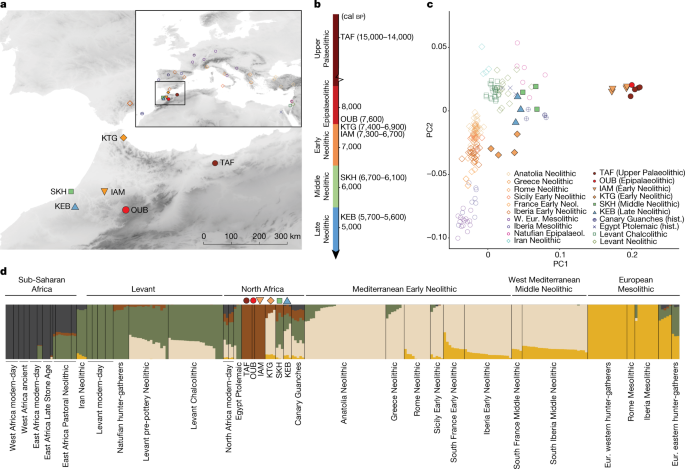
It's Middle Neolithic Morocco (SKH), which is ~76.4% Levant Neolithic and ~23.6% Taforalt. No European farmer ancestry. To me this just suggests that Taforalt-like hunter-gatherers lived across North Africa as far as Egypt.

 
The lab didn't confirm any such thing.

The samples with apparent Bell Beaker autosomal ancestry also had European Bell Beaker-related haplogroups, identified by earlier and completely different studies with no relation to the lab in Italy. How do you explain that? A magical coincidence?
Miro the person who had leaked the samples said he had the contamination information from annotation file which means it is from the lab.

What other studies with confirmed Bell Beaker haplogroups?
 
It's Middle Neolithic Morocco (SKH), which is ~76.4% Levant Neolithic and ~23.6% Taforalt. No European farmer ancestry. To me this just suggests that Taforalt-like hunter-gatherers lived across North Africa as far as Egypt.

Thanks a lot; I conflate it with the KEB, late Neo-Moroccan, which was 50% local North African and 50% EEF.
 
Miro the person who had leaked the samples said he had the contamination information from annotation file which means it is from the lab.

What other studies with confirmed Bell Beaker haplogroups?

Djehutynakht: mtDNA U5b2b5. Originally from western Europe and found in Bell Beaker samples.

- Tested by the Harvard and FBI labs, same result, no evidence of contamination:


Takabuti, mtDNA H4a1. Oldest samples from western Europe and found in Bell Beaker samples.

- Tested by the Manchester Institute of Biotechnology, no evidence of contamination.

 
Djehutynakht: mtDNA U5b2b5. Originally from western Europe and found in Bell Beaker samples.

- Tested by the Harvard and FBI labs, same result, no evidence of contamination:

There is difference in saying that this is a Bell Beaker Haplogroup and it from being from Western Europe. It could have entered Egypt from a different route and populations.

Interestingly, its TMRCA (3900BC) is also older than Bell Beakers and there are branches from ancient Egypt, apparently: https://www.yfull.com/mtree/U5b2b5/

Do you know more about that ancient Egyptian sample from Al Minya in the mtree?

However, this is what the paper says about that mtDNA:

Given limited available data and the fact that U5 is the dominant mitochondrial haplogroup found among hunter-gatherers in Europe [83,84], the recovery of a haplogroup U5b2b5 sequence from the mummy of Djehutynakht raises the question of data authenticity, despite the molecular metrics suggesting otherwise. When the mummy’s mtDNA sequence is viewed in the context of modern mtDNA diversity, however, the observed U5 lineage could potentially reflect interactions between Egypt and the Near East that date as far back as the Predynastic and Early Dynastic periods [85].


Takabuti, mtDNA H4a1. Oldest samples from western Europe and found in Bell Beaker samples.

- Tested by the Manchester Institute of Biotechnology, no evidence of contamination.

The same as above applies here with this younger sample. The TMRCA (1100BC) is even younger than Bell Beakers : https://www.yfull.com/mtree/H4a1/
 
Last edited:
There is difference in saying that this is a Bell Beaker Haplogroup and it from being from Western Europe. It could have entered Egypt from a different route and populations.

Interestingly, its TMRCA (3900BC) is also older than Bell Beakers and there are branches from ancient Egypt, apparently: https://www.yfull.com/mtree/U5b2b5/

Do you know more about that ancient Egyptian sample from Al Minya in the mtree?

However, this is what the paper says about that mtDNA:


The same as above applies here with this younger sample. The TMRCA (1100BC) is even younger than Bell Beakers : https://www.yfull.com/mtree/H4a1/

I said they're Bell Beaker-related. The earliest samples are from Spain and Portugal, actually from the same areas in Spain and Portugal, they pre-date the Bell Beaker culture but become associated with BB and are found in various BB samples. They're rare lineages so can be tracked in the archaeogenetic record. H4a1 is also associated with Bell Beaker ancestry in the Guanches from the Canary Islands.

Both haplogroups have been found in Bronze Age samples from Italy with Bell Beaker ancestry. Interestingly the male sample from Italy with U5b2b5 has Y-DNA G2a2a, which is the same as Djehutynakht according to the leaked data (sample GCP002, 1556 BC).

The Al Minya sample on MTree is Djehutynakht. U5b2b5 has also been found in 10 Nubian samples from the Christian period, which are related to the Djehutynakht sequence: https://pmc.ncbi.nlm.nih.gov/articles/PMC8671435/

The only ancient U5b2b5 samples outside of Europe are from Egypt and Nubia. On MTree there are also two modern samples from Morocco and Lebanon, as well as a modern sample from Egypt.

Ancient samples with H4a1 are also restricted to Europe except for the Egyptian sample and a Philistine sample from Ashkelon, possibly related to the Sea People, and then four Guanche samples which date from after 540 AD. On MTree there are a few modern samples outside of Europe, three from Algeria, one each from Lebanon and Syria, and a couple from Turkey.

The TMRCA and formation dates for H4a1 on MTree are wrong, the oldest samples date from c. 5300 BC in Iberia. The oldest U5b2b5 samples date from c. 3800-3400 BC in Iberia.

So far there's no evidence for either haplogroup in ancient samples from North Africa or anywhere else outside of Europe before the Bell Beaker culture. The age of U5b2b5 (3900 BC) also seems a bit late for it to have reached Egypt in Predynastic times. It might be possible that both haplogroups reached Egypt in the Predynastic , but there's no evidence for that yet whilst the leaked data indicating Bell Beaker autosomal ancestry in both Egyptian samples along with the other evidence supports a Bell Beaker origin.
 
Last edited:
What's the admix of Middle Neolithic Morocco? Isn't it mostly Natufian like and some Iberomaurusian?
 
I said they're Bell Beaker-related. The earliest samples are from Spain and Portugal, actually from the same areas in Spain and Portugal, they pre-date the Bell Beaker culture but become associated with BB and are found in various BB samples. They're rare lineages so can be tracked in the archaeogenetic record. H4a1 is also associated with Bell Beaker ancestry in the Guanches from the Canary Islands.

Both haplogroups have been found in Bronze Age samples from Italy with Bell Beaker ancestry. Interestingly the male sample from Italy with U5b2b5 has Y-DNA G2a2a, which is the same as Djehutynakht according to the leaked data (sample GCP002, 1556 BC).

The Al Minya sample on MTree is Djehutynakht. U5b2b5 has also been found in 10 Nubian samples from the Christian period, which are related to the Djehutynakht sequence: https://pmc.ncbi.nlm.nih.gov/articles/PMC8671435/

The only ancient U5b2b5 samples outside of Europe are from Egypt and Nubia. On MTree there are also two modern samples from Morocco and Lebanon, as well as a modern sample from Egypt.

Ancient samples with H4a1 are also restricted to Europe except for the Egyptian sample and a Philistine sample from Ashkelon, possibly related to the Sea People, and then four Guanche samples which date from after 540 AD. On MTree there are a few modern samples outside of Europe, three from Algeria, one each from Lebanon and Syria, and a couple from Turkey.

The TMRCA and formation dates for H4a1 on MTree are wrong, the oldest samples date from c. 5300 BC in Iberia. The oldest U5b2b5 samples date from c. 3800-3400 BC in Iberia.

So far there's no evidence for either haplogroup in ancient samples from North Africa or anywhere else outside of Europe before the Bell Beaker culture. The age of U5b2b5 (3900 BC) also seems a bit late for it to have reached Egypt in Predynastic times. It might be possible that both haplogroups reached Egypt in the Predynastic , but there's no evidence for that yet whilst the leaked data indicating Bell Beaker autosomal ancestry in both Egyptian samples along with the other evidence supports a Bell Beaker origin.
So, they‘re both older than Bell Beakers and could have entered from different routes like the paper you posted said. I see we agree to disagree. Let’s wait for new samples and see who’s right on this.
 
I said they're Bell Beaker-related. The earliest samples are from Spain and Portugal, actually from the same areas in Spain and Portugal, they pre-date the Bell Beaker culture but become associated with BB and are found in various BB samples. They're rare lineages so can be tracked in the archaeogenetic record. H4a1 is also associated with Bell Beaker ancestry in the Guanches from the Canary Islands.

Both haplogroups have been found in Bronze Age samples from Italy with Bell Beaker ancestry. Interestingly the male sample from Italy with U5b2b5 has Y-DNA G2a2a, which is the same as Djehutynakht according to the leaked data (sample GCP002, 1556 BC).

The Al Minya sample on MTree is Djehutynakht. U5b2b5 has also been found in 10 Nubian samples from the Christian period, which are related to the Djehutynakht sequence: https://pmc.ncbi.nlm.nih.gov/articles/PMC8671435/

The only ancient U5b2b5 samples outside of Europe are from Egypt and Nubia. On MTree there are also two modern samples from Morocco and Lebanon, as well as a modern sample from Egypt.

Ancient samples with H4a1 are also restricted to Europe except for the Egyptian sample and a Philistine sample from Ashkelon, possibly related to the Sea People, and then four Guanche samples which date from after 540 AD. On MTree there are a few modern samples outside of Europe, three from Algeria, one each from Lebanon and Syria, and a couple from Turkey.

The TMRCA and formation dates for H4a1 on MTree are wrong, the oldest samples date from c. 5300 BC in Iberia. The oldest U5b2b5 samples date from c. 3800-3400 BC in Iberia.

So far there's no evidence for either haplogroup in ancient samples from North Africa or anywhere else outside of Europe before the Bell Beaker culture. The age of U5b2b5 (3900 BC) also seems a bit late for it to have reached Egypt in Predynastic times. It might be possible that both haplogroups reached Egypt in the Predynastic , but there's no evidence for that yet whilst the leaked data indicating Bell Beaker autosomal ancestry in both Egyptian samples along with the other evidence supports a Bell Beaker origin.
Hi Philjames100: Thanks for the interesting post. These leaked samples, are these the ones from that EURAC paper that has ancient Egyptian DNA going back to 4000 BC up to 800 AD? That project from what I read was completed in February of this year (2025) and thus it seems we can expect the final published paper from this EURAC study sometime later this year? we can hope.
 
So, they‘re both older than Bell Beakers and could have entered from different routes like the paper you posted said. I see we agree to disagree. Let’s wait for new samples and see who’s right on this.

Hypothetically could have, but the evidence doesn't support that. The apparent absence of European Neolithic ancestry in the Nuwayrat sample also provides some further evidence against it.
 
Back
Top