• Don't want to see ads? Install an adblocker like uBlock Origin or use a Europe-based privacy-friendly browser like Vivaldi or Mullvad.

Where does the Albanian language come from? [VIDEO]

He just expressed in a way what Bruzmi was trying to propagate all the way. He is not trying to prove Illyrian ancestry for E-V13, he is desperately trying to disprove any connection of E-V13 with Thracians and propose Middle Age expansion of E-V13 so it better fits his narrative/imagination. I have seen several times from some circles pushing this narrative.

Why even give these people a platform for their existential crisis coping?

R1b-Z2705 (I am assuming that is what that person is referring to) is by all means more in sync with E1b-V13 in terms of expansion in the Balkans.

Bruzmi was very upset way early on when we got the first J2b-L283 MBA Dalmatian sample and did not really change after Patterson/Reich et. al and the Daunian paper. He is definitely still pushing in a very odd obsessive way an entire Illyrian origin for E-V13 which aDNA does not support whatsoever.

The problem I see with him and many other irrelevant nationalistic people is a very science refusing mentality: everything has to be narrative-fitting.
 
Me neither, we are just discussing all possible options, so to summarize what options do we have:

1. Channeled-Ware ancestry of Albanoid
2. Illyrian/Glasinac-like ancestry of Albanoid (an option which Matzinger is not considering, thinking Albanian and Illyrian are two separate languages but had extensive contact)
2. Brnjica Culture ancestry of Albanoid

Outside these three scopes, i doubt we will have different possibilities.

I think Channeled-Ware is the most indicative one with a considerable amount of contact with the Illyrian language.
 
Why even give these people a platform for their existential crisis coping?

R1b-Z2705 (I am assuming that is what that person is referring to) is by all means more in sync with E1b-V13 in terms of expansion in the Balkans.

Bruzmi was very upset way early on when we got the first J2b-L283 MBA Dalmatian sample and did not really change after Patterson/Reich et. al and the Daunian paper. He is definitely still pushing in a very odd obsessive way an entire Illyrian origin for E-V13 which aDNA does not support whatsoever.

The problem I see with him and many other irrelevant nationalistic people is a very science refusing mentality: everything has to be narrative-fitting.

Even if E-V13 is to be found in Iron Age Albania, i think the Early Iron Age-Middle Iron Age Glasinac(J2b2-L283) expansion might have assimilated them. The Yugoslav and Albanian archaeologist are very strict on their interpretation that this culture developed from Early/Middle Bronze Age, it looks like even Andreas Lippert dropped his previous supposition of Late Bronze Age Urnfield influence with preferring largely untouched continuation.

Here is what he says in 2018:

THE PROTOURBAN ILLYRIANS IN THE LATE IRON AGEAND THEIR CONTACTS TO THE GREEK WORLD


Already in the Early and so more in the Middle amd Late Bronze Aegean ceramics and weapons are imported and imitated. But there is also a strong influrence from the Danubian Urnfield culture.
Characteristic for the Late Bronze Age are large hilltop-settlements with wall fortifications. Since that age there is a continuity of the indigene material culture in the Southern Adriatic areas and the new cultural unity has been called Mat-Glasinac-Culture in reference to the North-Albanian river Mat and the tableland of Glasinac in the Herzegovina. In the Early Iron Age (11th - 8th cent. B.C.) the contacts to Greece increase steadily and reach a high level at the end of the Middle Iron Age in the 7th cent. with numerous imports of fine ware, ornaments and offensive as well as defensive arms, just as swords, helmets and greaves.

But in 2021 in the archaeology section of that Matzinger book he seems to rely totally on what Frano Prendi, Muzafer Korkuti and Mario Gavranovic and previously Benac have said, no Danubian Urnfield influence, and largely left untouched. So now, it's up to aDNA from these regions to determine what was the composition and then combine it with archaeological records to make sense out of them.

But Glasinac-Mat seem to have had contacts with Urnfielders-Hallstatt latter on, especially with Proto-Dacian Bessarabi Culture where they were trading, during that time Illyrians from Glasinac started using the machaira swords which were smithed among Bassarabi as well but also the Dardanian blacksmiths.

The origin of makhaira-like swords is unknown but ultimate Urnfield origin makes sense, they made them more curved for more powerful slashes, especially after adopting mounted warfare on horseback. It's amazing to see that a simple geometrical curve like this makes the slash far more dangerous than a straight sword.


ebed929ddc6076dfdfe9ee55f86256a4.jpg


These are some of West Balkans sword variants (sword 3 and 7 variants are definitely from Western Balkans).

Types-and-variants-of-short-single-edge-swords-1-Balta-Verde-II-after-Vulpe-1990-2.ppm


https://www.researchgate.net/figure...ta-Verde-II-after-Vulpe-1990-2_fig2_347511054
 
I think Channeled-Ware is the most indicative one with a considerable amount of contact with the Illyrian language.

Let's see what further facts indicate us. Matzinger also alludes that Messapian is not Illyrian but rather somehow connected to Albanian, i guess core Messapian Y-DNA can give us a hint and connect the dots. Some more Illyrii Proprii Dicti aDNA as well, then we can talk with more confidence when we combine aDNA, linguistics and archaeology.

1. First answer we need, who were these East Alpine Proto-Illyrian language bearers? Were they J2b2-L283 carriers or the Hugelgraberkultur/Tumulus-grave (R1b-L51 joined by J2b2-L283 somewhere along the way) people originally(Riverman's hypothesis)?

2. Secondly, if Messapian is related to Albanian and both of these languages are not related to Illyrian then what is the Y-DNA variants among core Messapi groups (are they similar to Daunians or different)?

But, given the evidences so far, i'll go with Channeled-Ware, unless we have some new facts that oppose that in any way.
 
Let's see what further facts indicate us. Matzinger also alludes that Messapian is not Illyrian but rather somehow connected to Albanian, i guess core Messapian Y-DNA can give us a hint and connect the dots. Some more Illyrii Proprii Dicti aDNA as well, then we can talk with more confidence when we combine aDNA, linguistics and archaeology.

1. First answer we need, who were these East Alpine Proto-Illyrian language bearers? Were they J2b2-L283 carriers or the Hugelgraberkultur/Tumulus-grave (R1b-L51 joined by J2b2-L283 somewhere along the way) people originally(Riverman's hypothesis)?

2. Secondly, if Messapian is related to Albanian and both of these languages are not related to Illyrian then what is the Y-DNA variants among core Messapi groups (are they similar to Daunians or different)?

But, given the evidences so far, i'll go with Channeled-Ware, unless we have some new facts that oppose that in any way.
Dude, if Messapic is connected to Albanian then they’re the Illyrians, not the other Proto-Celto-Italics or whatever they were. How in hell did they reach Italy if they weren’t even on the Eastern Adriatic shore? They built 1000 ships overnight and sailed secretly?

It’s the Southern Illyrians that the Greeks came into contact with, not Pannonians. So those people you’re so stubbornly calling Illyrian need another name. Is it so hard to come to this conclusion on your own?

But there’s another issue here since it is supposed the Iapygians came from Liburnia/Dalmatia. So they’re Illyrian too?

Then we have Northern Amantini and Amantes in Epirus and 2 Atintani, Dessareti, etc. And those Southern tribes were Illyrian, so what about the Northern ones with the same ethnonym?

Similarly, since we know of Iapodians - Iapygians, Galabri - Calabri, Apuli (Dacia) - Apuli, I wonder if it’s pure coincidence the existence of Siculotae (Dalmatia) - Siculi (Sicily) called also Siculots, as well as Sardiatae (Dalmatia) - Sardinians.

Perhaps another coincidence, but at the Wiki page for Sardinians it says “Sard belongs to the Pre-Indo-European linguistic substratum” and it’s similar to Dard, considering how we have Dessareti and Sessarethi, D-S shift. Sard is also encountered in Anatolia (Sardis).

Perhaps Dard is pre-IE too and unrelated to Albanian dardhë. Naming a tribe after a fruit is indeed weird. That part of the world (including Italy) had mainly animal totems.
 
Let's see what further facts indicate us. Matzinger also alludes that Messapian is not Illyrian but rather somehow connected to Albanian, i guess core Messapian Y-DNA can give us a hint and connect the dots. Some more Illyrii Proprii Dicti aDNA as well, then we can talk with more confidence when we combine aDNA, linguistics and archaeology.

1. First answer we need, who were these East Alpine Proto-Illyrian language bearers? Were they J2b2-L283 carriers or the Hugelgraberkultur/Tumulus-grave (R1b-L51 joined by J2b2-L283 somewhere along the way) people originally(Riverman's hypothesis)?

2. Secondly, if Messapian is related to Albanian and both of these languages are not related to Illyrian then what is the Y-DNA variants among core Messapi groups (are they similar to Daunians or different)?

But, given the evidences so far, i'll go with Channeled-Ware, unless we have some new facts that oppose that in any way.

As far as I know, there is no aDNA to support this HGC/TC hypotheses and seems more than unlikely to me. Given the aDNA I'll definitely go with J2b-L283 as carriers of the Proto-Illyrian language and them being responsible for the spread of it clearly centered in the Western Balkans and partially West Adriatic. More Cetina/Posusje finds will give us a clearer picture.

I agree with you on Channeled Ware regarding Proto-Albanian since for now that is the most likely scenario for it. As for Messapic: the problem with Messapic is that it has even less written records than Illyrian so similarities between it and Albanian can simply turn out to be Illyrian toponyms that entered Proto-Albanian at the time the Illyrians were incorporated.

More aDNA from Illyrii Proprie Dicti, Messapic areas and Central-/Eastern Balkans will definitely answer the for now open questions.
 
Last edited:
The Daunians were originally people of Illyrian descent that setteled along the West Adriatic where they merged with Italic groups. This is also evident in their auDNA:

Two Daunian samples as per example:


Distance to: ITA_Daunian:SGR002
0.04822567 HRV_MBA:I4332
0.04977726 ITA_Daunian:ORD009
0.04986320 ITA_Etruscan_Tarquinia:TAQ004
0.05235255 ITA_Etruscan_PoggioRenzo:PRZ001
0.05281908 CHE_IA:SX18
0.05351022 ITA_Etruscan_Casenovole:CSN001
0.05459409 ITA_Etruscan_Casenovole:CSN013
0.05501516 HUN_LBA:I25504
0.05582612 SVN_EIA:I5692
0.05653730 ITA_Etruscan_Chiostraccio:UDC_P
0.05683961 SVN_EIA:I23978
0.05722009 ITA_Etruscan_Tarquinia:TAQ006
0.05730353 ITA_Etruscan_Tarquinia:TAQ008
0.05735746 HUN_MA_Szolad:SZ28
0.05747687 Bell_Beaker_ITA:I1979
0.05771377 SRB_BA_Maros:I23209
0.05786989 HUN_IA_La_Tene:I25510
0.05805128 ITA_Villanovan:RMPR1015
0.05813587 HUN_IA_La_Tene:I18531
0.05831200 ITA_Etruscan:RMPR474b
0.05840398 ITA_Etruscan_Magliano:MAG001
0.05856106 ITA_Etruscan_Casenovole:CSN009
0.05857096 SRB_Mokrin_EBA_Maros:MOK20
0.05883529 ITA_Etruscan_Tarquinia:TAQ013
0.05891547 HUN_IA_La_Tene:I25512


Distance to: ITA_Daunian:ORD009
0.02981895 SRB_Mokrin_EBA_Maros:I23208
0.03083687 HRV_MBA:I4332
0.03313425 HUN_MA_Szolad:SZ28
0.03375870 HRV_EIA:I26742
0.03378740 ITA_Etruscan:RMPR474b
0.03450379 HRV_MBA:I4331
0.03479787 HUN_IA_La_Tene_o:I4998
0.03606988 HRV_Pop_CA:POP39
0.03617607 SRB_BA_Maros:I23209
0.03618780 HUN_MA_Szolad:SZ43
0.03626469 HUN_IA_Syrmian_SremGroup:I18259
0.03647183 ITA_Etruscan_Casenovole:CSN009
0.03711918 Bell_Beaker_CZE_late:PRU001.A0101
0.03823249 SVK_IA_Vekerzug:I11721
0.03842457 ITA_Rome_Late_Antiquity:RMPR33
0.03856108 SVN_EIA:I5692
0.03857368 SRB_Mokrin_EBA_Maros:MOK13
0.03893338 HRV_LIA_La_Tene:I26735
0.03899771 ITA_Tarquinia_EMA:TAQ022
0.03916572 HUN_IA_La_Tene:I18529
0.03918999 SRB_Mokrin_EBA_Maros:MOK20
0.03976882 HRV_EIA:I24882
0.03991316 ITA_Etruscan_Casenovole:CSN013
0.03992100 ITA_Rome_MA:RMPR55
0.04017425 HUN_BA:I7043

I posted this since some users are still spreading misinformation regarding the for now available IA Illyrian and BA Dalmatian samples. The aDNA J2b-L283 samples from modern day Croatia form their own cluster and are clearly affiliated with the Illyrians. There is nothing Celtic about them.


But, given the evidences so far, i'll go with Channeled-Ware, unless we have some new facts that oppose that in any way.

About Channelled Ware in Albania:
Channelled Ware dominated especially in the transitional period, when they came down from the North. This paper concentrates on Sovjan, but its close enough and has a wider perspective.

The top of level 5c1 is marked by the appearance of EIA elements, such as
channelled ware, 75 bowls with in-turned rims, and finger impressed bands that are no longer
just horizontal. This transitional period corresponds to the layers 13 and 12 of Kastanas. LH
IIIC to Submycenaean potsherds further suggest a late date for the end of level 5c1.76 While
maliq IIId corresponds to level 5c1, the transitional phase (according to Zh. Andrea)77 maliq
IVa has a considerable depth of 0.4 to 0.7 m and covers not only this thin transitional layer
of Sovjan, but also large parts of level 5b.

The most typical feature is the matt painted pottery, which becomes now popular and
develops its typical style. In maliq, the layers with matt painted pottery have correctly been
re-dated by Zh. Andrea to the LBA-EIA transition and the EIA. 78 The introduction of this
decoration style is considerably late in comparison to Central and even Upper macedonia,
a fact that might surprise when one considers other features of foreign inspiration, already
adapted during the LBA, such as the pyraunoi, and the mycenaean imports, which most
probably came from this direction. The same accounts for Epirus, which shares many traits
with the SE Albanian EIA tumuli. Characteristic shapes of matt painted pottery in Sovjan
are bowls with a marked out-turned rim and a clear cut edge inside at the junction of
rim and shoulder and a spherical body (Fig. 12.1, 11), kantharoi, horizontal handled bowls
(Fig. 12.10), jugs (Fig. 13.2) and amphorae (Fig. 13.1)

Channelled Ware was widespread in Albania, Matt Pained pottery too, whereas the older Balkanic decoration technique of Incised Pottery became rare:

Alongside matt painted pottery, channelled ware occupies a significant place in
the EIA assemblages of Sovjan as well. In contrast to the matt painted ware, this type of
decoration is much more widespread in Albania and is also popular in the North of the
modern country.
81 Best known are the turban dishes (Fig. 13.13), but there are also deeper
bowls with a marked shoulder (Fig. 12.8 and 13.7), bowls with in-turned rim and horizontal
grooves on their shoulder (Fig. 13.14) and even channelled handles (Fig. 12.7 and 13.8).
Bowls with in-turned rim become generally very popular (Fig. 12.5 and 13), accompanied by
bowls with unpronounced profile (Fig. 13.11). As mentioned above, the incised ware is still
used (Fig. 12.4) but in much lower percentages than the matt painted ware.
Finger impressed
bands are no longer simply horizontal, but also vertical and curvilinear and different bands
can intersect (Fig. 12.9).

https://halshs.archives-ouvertes.fr/halshs-03208442/document

Based on the development of this type
in the north, it seems plausible to date the ribbed bracelets from northeast Albania
in the LBA, rather than to the EIA as it has been proposed. In grave 2 of tumulus
4 of K?net?, the pair of ribbed bracelets is associated by a small kantharos with
channeled decoration (otherwise called kanellure decoration) consisting of widely
spaced vertical or slightly oblique grooves or ribbings, which can be considered as
one of the earliest appearances of this type of decoration in LBA Albania. In the
Lofk?nd tumulus one one-handle vessel, with a similar round base and with the
same type of widely spaced grooves was dated to the 12-11 th centuries B.C.77 At
around the same dates, this decoration appears in central and southeast Albania78.
Considering also the northern origin proposed for this type of decoration in LBA
Albania, the dating of our pair of ribbed bracelets around the last phase of their
development in the Glasinac plateau, or in the 13th century, should not be excluded.

For southeast see andrea 2009, p. 17-19; gori -krapf 2015, p. 117, 119; further
analysis on the channelled ware in Albania is provided by N. Bodinaku, referring
also to its first appearance in the tumuli of Pazhok, in central Albania, since the
13th century B.C., see bodinaku 1982, p. 72-73, 98, Tab. IX: v. 43; see also prendi
1978, p. 14-15.


Two major competing spheres in Albania, which both being part of larger networks outside of the country, to its North:

The emergence of pins in the funerary record
since probably the end of the MBA, and their particularly frequent occurrence
from the end of 15th century in north and south Albania, is part of a generally
shared trend or fashion with an ancestry in the Central Europe, and encountered
during this period in Italy, Central Balkans, the Aegean and as far as Near East.
However, the earliest pins in Albania and most of the types developed during the
14 th
-13th centuries have a clear ancestry in Central Europe, a fact that supports a
northern influence for the emergence of this fashion. The actual evidence supports
stronger communication lines along the inner Balkan routes, such as the Drina
and Morava river valleys, or the Vardar valley further south. On the other hand,
there is also strong evidence to suggest a local development of these ?northern?
types of pins in Albania, which corresponds to the last stage of their use further
north. Furthermore, the development of distinct types between the northeast and
the southeast, suggests the presence of different manufacturing centers in these
two regions of the country where copper mines are also present. It also implies the
presence of closer regional preferences as it concerns the burial costume, which are
depended on the cultural orientations of the two regions. The southern region more
closely related to the western Macedonian territory, whereas the northeast region
more oriented towards the neighboring Kosovo and the regions further north in
the Central Balkans, along the Morava river valley. It is also important to note that
both areas, northeast Albania and southeast Albania/western Macedonia represent
a frontier zone, as each corresponds to the southernmost limit of the development
of the respective types of pins of ?northern origin?, few of which are encountered
only sporadically further south in the Aegean.

https://halshs.archives-ouvertes.fr/halshs-01695818/document
 
Let's see what further facts indicate us. Matzinger also alludes that Messapian is not Illyrian but rather somehow connected to Albanian, i guess core Messapian Y-DNA can give us a hint and connect the dots. Some more Illyrii Proprii Dicti aDNA as well, then we can talk with more confidence when we combine aDNA, linguistics and archaeology.
1. First answer we need, who were these East Alpine Proto-Illyrian language bearers? Were they J2b2-L283 carriers or the Hugelgraberkultur/Tumulus-grave (R1b-L51 joined by J2b2-L283 somewhere along the way) people originally(Riverman's hypothesis)?
2. Secondly, if Messapian is related to Albanian and both of these languages are not related to Illyrian then what is the Y-DNA variants among core Messapi groups (are they similar to Daunians or different)?
But, given the evidences so far, i'll go with Channeled-Ware, unless we have some new facts that oppose that in any way.
Messapian is the language of the Daunians once they settled a hundred or so years near foggia Italy, mixing with the local italian tribes ( most likely Umbri-Samnite tribes ) , it is not a language that the Daunians brought with them when they arrived from modern northern Croatia.

Iapodes is the original name of the Daunians in Croatia and it became the Iapydes (or Iapodes, Japodes; Greek: Ἰάποδες ) once they mixed with the local Italics ........................bear in mind, these Daunians then isolated for over 500 years, trading only with the Dalmatian coast for pottery and other stuff.

The only change in language occurred once the Daunians began making their own pots in circa 400BC and trading them to the Epirotes and some of their 14 tribes ...................the language would have changed then to reflect a NW Greek/Albanian language spoken in the area of Butrint
 
Dude, if Messapic is connected to Albanian then they’re the Illyrians, not the other Proto-Celto-Italics or whatever they were. How in hell did they reach Italy if they weren’t even on the Eastern Adriatic shore? They built 1000 ships overnight and sailed secretly?

It’s the Southern Illyrians that the Greeks came into contact with, not Pannonians. So those people you’re so stubbornly calling Illyrian need another name. Is it so hard to come to this conclusion on your own?

But there’s another issue here since it is supposed the Iapygians came from Liburnia/Dalmatia. So they’re Illyrian too?

Then we have Northern Amantini and Amantes in Epirus and 2 Atintani, Dessareti, etc. And those Southern tribes were Illyrian, so what about the Northern ones with the same ethnonym?

Similarly, since we know of Iapodians - Iapygians, Galabri - Calabri, Apuli (Dacia) - Apuli, I wonder if it’s pure coincidence the existence of Siculotae (Dalmatia) - Siculi (Sicily) called also Siculots, as well as Sardiatae (Dalmatia) - Sardinians.

Perhaps another coincidence, but at the Wiki page for Sardinians it says “Sard belongs to the Pre-Indo-European linguistic substratum” and it’s similar to Dard, considering how we have Dessareti and Sessarethi, D-S shift. Sard is also encountered in Anatolia (Sardis).

Perhaps Dard is pre-IE too and unrelated to Albanian dardhë. Naming a tribe after a fruit is indeed weird. That part of the world (including Italy) had mainly animal totems.


Iapodes in Croatia are the Iapygians once they mixed with the local Italic tribes

The Liburnians took these Iapodes to Italy ...who else controlled all the adriatic sea from 1200BC to 700BC ................the liburnians even held/owned Corfu until 720BC

 
The Daunians were originally people of Illyrian descent that setteled along the West Adriatic where they merged with Italic groups. This is also evident in their auDNA:

Two Daunian samples as per example:


Distance to: ITA_Daunian:SGR002
0.04822567 HRV_MBA:I4332
0.04977726 ITA_Daunian:ORD009
0.04986320 ITA_Etruscan_Tarquinia:TAQ004
0.05235255 ITA_Etruscan_PoggioRenzo:PRZ001
0.05281908 CHE_IA:SX18
0.05351022 ITA_Etruscan_Casenovole:CSN001
0.05459409 ITA_Etruscan_Casenovole:CSN013
0.05501516 HUN_LBA:I25504
0.05582612 SVN_EIA:I5692
0.05653730 ITA_Etruscan_Chiostraccio:UDC_P
0.05683961 SVN_EIA:I23978
0.05722009 ITA_Etruscan_Tarquinia:TAQ006
0.05730353 ITA_Etruscan_Tarquinia:TAQ008
0.05735746 HUN_MA_Szolad:SZ28
0.05747687 Bell_Beaker_ITA:I1979
0.05771377 SRB_BA_Maros:I23209
0.05786989 HUN_IA_La_Tene:I25510
0.05805128 ITA_Villanovan:RMPR1015
0.05813587 HUN_IA_La_Tene:I18531
0.05831200 ITA_Etruscan:RMPR474b
0.05840398 ITA_Etruscan_Magliano:MAG001
0.05856106 ITA_Etruscan_Casenovole:CSN009
0.05857096 SRB_Mokrin_EBA_Maros:MOK20
0.05883529 ITA_Etruscan_Tarquinia:TAQ013
0.05891547 HUN_IA_La_Tene:I25512


Distance to: ITA_Daunian:ORD009
0.02981895 SRB_Mokrin_EBA_Maros:I23208
0.03083687 HRV_MBA:I4332
0.03313425 HUN_MA_Szolad:SZ28
0.03375870 HRV_EIA:I26742
0.03378740 ITA_Etruscan:RMPR474b
0.03450379 HRV_MBA:I4331
0.03479787 HUN_IA_La_Tene_o:I4998
0.03606988 HRV_Pop_CA:POP39
0.03617607 SRB_BA_Maros:I23209
0.03618780 HUN_MA_Szolad:SZ43
0.03626469 HUN_IA_Syrmian_SremGroup:I18259
0.03647183 ITA_Etruscan_Casenovole:CSN009
0.03711918 Bell_Beaker_CZE_late:PRU001.A0101
0.03823249 SVK_IA_Vekerzug:I11721
0.03842457 ITA_Rome_Late_Antiquity:RMPR33
0.03856108 SVN_EIA:I5692
0.03857368 SRB_Mokrin_EBA_Maros:MOK13
0.03893338 HRV_LIA_La_Tene:I26735
0.03899771 ITA_Tarquinia_EMA:TAQ022
0.03916572 HUN_IA_La_Tene:I18529
0.03918999 SRB_Mokrin_EBA_Maros:MOK20
0.03976882 HRV_EIA:I24882
0.03991316 ITA_Etruscan_Casenovole:CSN013
0.03992100 ITA_Rome_MA:RMPR55
0.04017425 HUN_BA:I7043

I posted this since some users are still spreading misinformation regarding the for now available IA Illyrian and BA Dalmatian samples. The aDNA J2b-L283 samples from modern day Croatia form their own cluster and are clearly affiliated with the Illyrians. There is nothing Celtic about them.


all the red markers are J-L283 ................the albanians are claiming snp Z638 ................there is only one in Montenegro ( Illyrii Proprie Dicti,........southern Illyrians .......non-celtinized Illyrians )


Similarly, since we know of Iapodians - Iapygians, Galabri - Calabri, Apuli (Dacia) - Apuli, I wonder if it’s pure coincidence the existence of Siculotae (Dalmatia) - Siculi (Sicily) called also Siculots, as well as Sardiatae (Dalmatia) - Sardinians.

Perhaps another coincidence, but at the Wiki page for Sardinians it says “Sard belongs to the Pre-Indo-European linguistic substratum” and it’s similar to Dard, considering how we have Dessareti and Sessarethi, D-S shift. Sard is also encountered in Anatolia (Sardis).

Perhaps Dard is pre-IE too and unrelated to Albanian dardhë. Naming a tribe after a fruit is indeed weird. That part of the world (including Italy) had mainly animal totems.
I too have found those parallels very interesting, there are so many similar names across Balkans, Italy, and Anatolia that I'm sure it can't all just be coincidence, some must be from ancient Balkan tribes migrating over and carrying the same name

I've heard an etymology for Dardhe before, to come from Albanian 'Derdhe", which makes more sense to me. When you bite out of a pear, it "spills" liquid, and 'derdhe' also means 'plentiful, overflowing' so it could have been a reference to the river ways in the area, or reference to having plentiful resources for making weapons, etc. IIRC I think maybe enter_tain or Excine mentioned this etymology or I read it somewhere else.
 
Do we have any other non-Albanian/non-Balkan living Albanologist despite Joachim Matzinger? Would be interesting how he aligns with Matzinger's idea in his book.

As for Albanian ones, Bardhyl Demiraj's intake should be valuable as well.

John Basset Trumper is the one i think, who has shown interest in Albanian but not particularly focused on Albanian.
 
Do we have any other non-Albanian/non-Balkan living Albanologist despite Joachim Matzinger? Would be interesting how he aligns with Matzinger's idea in his book.

As for Albanian ones, Bardhyl Demiraj's intake should be valuable as well.

John Basset Trumper is the one i think, who has shown interest in Albanian but not particularly focused on Albanian.

There are linguists like Michiel De Vaan, Brian Joseph, Shumacher, Prendergast, Lopuhaa, Rusakov, etc, but they are more focused on the purely linguistic aspect of Albanian, and comment on the historical matters about Illyrians far less.
 
About Channelled Ware in Albania:
Channelled Ware dominated especially in the transitional period, when they came down from the North. This paper concentrates on Sovjan, but its close enough and has a wider perspective.


Channelled Ware was widespread in Albania, Matt Pained pottery too, whereas the older Balkanic decoration technique of Incised Pottery became rare:


https://halshs.archives-ouvertes.fr/halshs-03208442/document


Two major competing spheres in Albania, which both being part of larger networks outside of the country, to its North:


https://halshs.archives-ouvertes.fr/halshs-01695818/document

Sovjan is in Korce, South-East Albania, that is in the realm of Trebeniste Culture, one of the contributing cultures of Illyrians alongside Glasinac-Mat. Enchelei were the antiquity name given to archaeologically known Trebeniste Culture:

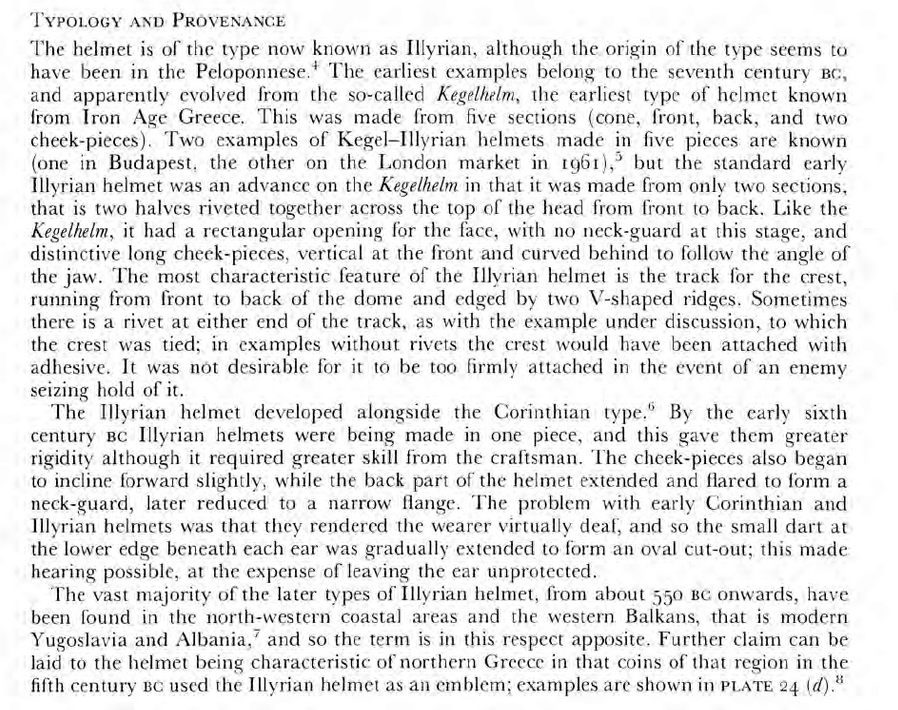
On this occasion, special attention is given to the Tomb of the Warriors (Tomb 1) in which 6 warriors were buried together with their complete military armor. The tomb (dimensions: 5.50 x 4.50 m) was built with a row of larger limestone blocks, and after the cremation burial it was filled with amorphous stones and earth, shaping a low mound-like structure. The pyre was set in the central part of the tomb, and around it, embedded and arranged in a specially brought lake sand, were the military attributes: 6 bronze helmets, 11 greaves, and 15 iron spears, with features suggesting some military subordination or simply warriors who have died in a battle being “the Leader and his comrades.”https://pebasite.wordpress.com/peba-2020/representations-of-power-an-ancient-macedonian-elite/

odpXbDI.jpg
 
K4d8S9c.png


@Johane Derite

You cited Georgiev for Burebista < burrë. Hamp criticizes a derivation of Burebista from burrë + bisht, which means that he criticizes both Bure < burrë and bista < bisht. If you want to pick an etymology by an old Bulgarian linguist because it supports what you believe that's up to you, but don't present it as fact.

It seems that the Arb- root was related to many Illyrian peoples/names.

https://www.uni-trier.de/fileadmin/forschung/projekte/ZAT/CEL/cover.pdf
A relation to the hitherto unexplained PNs Arbusius (Trier) and Arbussonius
(Novaria/Vercella) could be taken into account, but they may well be of ‘Illyrian’ origin. For Arbusius cf. H. Finke, in: 17. Bericht der Römisch-Germanischen Komission 1927 [1929], no. 44; for Arbussonius CIL 5.6541, 6547, 6517, 6695; further Weisgerber Rhen. 141, ACS 1.80f. with other Arb-names; Alföldy 155 considers an ‘Illyrian’ root for Arbo (in Germany and Dacia). There are some interesting parallels to refer to. The only three records of Arbust(t)us seem to indicate that the name has been forged as a Latin CN in a Celtic environment (CIL 2.4975=10.8059: signaculum,12.5423). Several Arbuscula-inscriptions found in Rome or central Italy certainly reflect
a Latin tradition, but the fact that the only Arbusculus is attested in Moesia Inferior (CIL 3.7482), could imply an autochthonic background and a particular Celtic approach to the Latin word. Likewise, despite the female gender of arbor, the PN Arborius had deliberately been restricted to men for centuries, before the first Arboria emerges in 6th century Carthage (L. Ennabli: Les inscriptions funéraires chrétiennes de Carthage, vol. III: Carthage intra et extra muros, Paris 1991, no. 545)
 
@Johane Derite

You cited Georgiev for Burebista < burrë. Hamp criticizes a derivation of Burebista from burrë + bisht, which means that he criticizes both Bure < burrë and bista < bisht.

)

No it doesnt mean that at it all. That is a logical non-sequitor. Regardless, here hamp doesn't even give an argument so not only can you not at all infer that he must therefore reject both, but you also don't have any argument as to why, so we are just supposed to take it on faith? Lets see his reasoning please?

I am 100% sure that if there was an Illyrian king called Burebista, and the Greek. Pistandros argument was made, it would be impossible for anyone to convince you guys it wasn't related to Albanian. Burrë. I have no doubt in my mind.

This one sided skepticism is totally cancerous.

Suddenly when something is thracian or dacian you all turn to rigorous and cautious scientists, but with any Illyrian name, even the most stretched possible parallel with Albanian is taken at face value.

Andros and Burrë have the exact same meaning, so this for me is interesting enough to merit mention. If i see argumentation why its wrong that makes sense, I will change my mind. It can be some coincidence, but to intentionally play dumb and ask to supress it is entirely disngenous.

Likewise the name of a Dacian king Diegis and the personal Dacian name Degis have been argued to be related with Albanian. Djeg

I think that a relation is possible here also. How distant this relation is I dont know, but some archaic calendar names (djegagur, digjepiq etc) and old toponyms like " kuji djegsinës, lugu djegsinës" . make me think this would have been used also in personal names also in antiquity.
 
No it doesnt mean that at it all. That is a logical non-sequitor. Regardless, here hamp doesn't even give an argument so not only can you not at all infer that he must therefore reject both, but you also don't have any argument as to why, so we are just supposed to take it on faith? Lets see his reasoning please?
I am 100% sure that if there was an Illyrian king called Burebista, and the Greek. Pistandros argument was made, it would be impossible for anyone to convince you guys it wasn't related to Albanian. Burrë. I have no doubt in my mind.
This one sided skepticism is totally cancerous.
Suddenly when something is thracian or dacian you all turn to rigorous and cautious scientists, but with any Illyrian name, even the most stretched possible parallel with Albanian is taken at face value.
Andros and Burrë have the exact same meaning, so this for me is interesting enough to merit mention. If i see argumentation why its wrong that makes sense, I will change my mind. It can be some coincidence, but to intentionally play dumb and ask to supress it is entirely disngenous.
Likewise the name of a Dacian king Diegis and the personal Dacian name Degis have been argued to be related with Albanian. Djeg
I think that a relation is possible here also. How distant this relation is I dont know, but some archaic calendar names (djegagur, digjepiq etc) and old toponyms like " kuji djegsinës, lugu djegsinës" . make me think this would have been used also in personal names also in antiquity.
Oh and I forgot, also there is a related Thracian king Diegulis, identical -ulis suffix as Bardulis.

Given that many of you were adamant that -ulis suffix must mean Yll, this Thracian kings name must therefore mean Djegylli. (burning star) proof that Albanian is Thracian confirmed💪

https://en.m.wikipedia.org/wiki/Diegylis
https://en.m.wikipedia.org/wiki/Diegis
 
all the red markers are J-L283 ................the albanians are claiming snp Z638 ................there is only one in Montenegro ( Illyrii Proprie Dicti,........southern Illyrians .......non-celtinized Illyrians )

This map is highly incorrect and is not in line with genetic data. As for the Gudnja cave J2b-L283>Z638+ it is a Middle Bronze Age sample and by all means another Proto-Illyrian. He plots the same as the other Illyrian samples and the even older MBA Dalmatian sample. I repeat this once again: there is absolutely nothing Celtic about these. This Gudnja cave is by all means a harbinger as to what is to be expected in other Adriatic and inland samples from the same area and further South.

Ancient J2b-L283>Z638+ samples will also more than likely be found in the North.
 
Back
Top