

Tautalus
Regular Member
- Messages
- 580
- Reaction score
- 1,482
- Points
- 93
- Ethnic group
- Portuguese
- Y-DNA haplogroup
- I2-M223 / I-FTB15368
- mtDNA haplogroup
- H6a1b2y
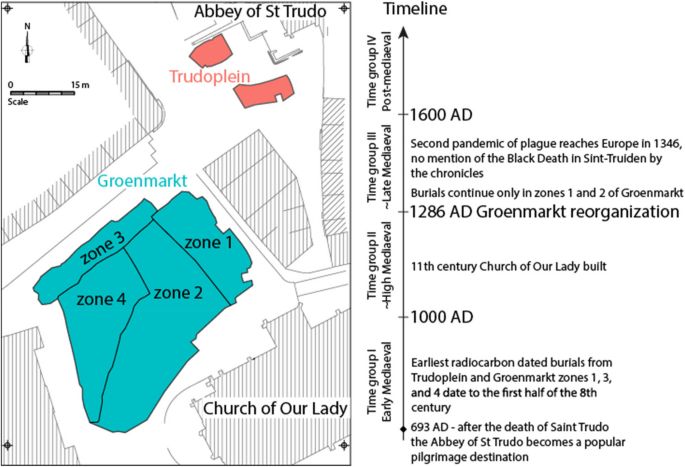
The paper analyzed whole‐genome data from hundreds of individuals spanning the 8th to the 18th century from Sint-Truiden (northern Belgium). The researchers modeled the genetic ancestry using two primary sources. One proxy was Late Iron Age (LIA) French genomes representing “Gaulish” ancestry, and the other was Early Medieval (EMA) genomes from the Netherlands representing “Germanic” ancestry. Using qpAdm, they found that, on average, the Sint-Truiden individuals derived about 63% of their genome from Gaulish ancestry and 37% from Germanic ancestry, a composition that remained largely stable from the Early Middle Ages onward.
During the Early and High Medieval periods, the population exhibited greater individual variability in ancestry proportions. Over time, as long-distance migration diminished and local admixture continued, the population became genetically homogenized.
The admixture between the Gaulish and the Germanic ancestries established a genetic cline that is observable in the Low Countries (Belgium, Netherlands, Luxembourg) today.
Abstract
Background
Processes shaping the formation of the present-day population structure in highly urbanized Northern Europe are still poorly understood. Gaps remain in our understanding of when and how currently observable regional differences emerged and what impact city growth, migration, and disease pandemics during and after the Middle Ages had on these processes.
Results
We perform low-coverage sequencing of the genomes of 338 individuals spanning the eighth to the eighteenth centuries in the city of Sint-Truiden in Flanders, in the northern part of Belgium. The early/high medieval Sint-Truiden population was more heterogeneous, having received migrants from Scotland or Ireland, and displayed less genetic relatedness than observed today between individuals in present-day Flanders. We find differences in gene variants associated with high vitamin D blood levels between individuals with Gaulish or Germanic ancestry. Although we find evidence of a Yersinia pestis infection in 5 of the 58 late medieval burials, we were unable to detect a major population-scale impact of the second plague pandemic on genetic diversity or on the elevated differentiation of immunity genes.
Conclusions
This study reveals that the genetic homogenization process in a medieval city population in the Low Countries was protracted for centuries. Over time, the Sint-Truiden population became more similar to the current population of the surrounding Limburg province, likely as a result of reduced long-distance migration after the high medieval period, and the continuous process of local admixture of Germanic and Gaulish ancestries which formed the genetic cline observable today in the Low Countries.
During the Early and High Medieval periods, the population exhibited greater individual variability in ancestry proportions. Over time, as long-distance migration diminished and local admixture continued, the population became genetically homogenized.
The admixture between the Gaulish and the Germanic ancestries established a genetic cline that is observable in the Low Countries (Belgium, Netherlands, Luxembourg) today.
Abstract
Background
Processes shaping the formation of the present-day population structure in highly urbanized Northern Europe are still poorly understood. Gaps remain in our understanding of when and how currently observable regional differences emerged and what impact city growth, migration, and disease pandemics during and after the Middle Ages had on these processes.
Results
We perform low-coverage sequencing of the genomes of 338 individuals spanning the eighth to the eighteenth centuries in the city of Sint-Truiden in Flanders, in the northern part of Belgium. The early/high medieval Sint-Truiden population was more heterogeneous, having received migrants from Scotland or Ireland, and displayed less genetic relatedness than observed today between individuals in present-day Flanders. We find differences in gene variants associated with high vitamin D blood levels between individuals with Gaulish or Germanic ancestry. Although we find evidence of a Yersinia pestis infection in 5 of the 58 late medieval burials, we were unable to detect a major population-scale impact of the second plague pandemic on genetic diversity or on the elevated differentiation of immunity genes.
Conclusions
This study reveals that the genetic homogenization process in a medieval city population in the Low Countries was protracted for centuries. Over time, the Sint-Truiden population became more similar to the current population of the surrounding Limburg province, likely as a result of reduced long-distance migration after the high medieval period, and the continuous process of local admixture of Germanic and Gaulish ancestries which formed the genetic cline observable today in the Low Countries.
Urbanization and genetic homogenization in the medieval Low Countries revealed through a ten-century paleogenomic study of the city of Sint-Truiden - Genome Biology
Background Processes shaping the formation of the present-day population structure in highly urbanized Northern Europe are still poorly understood. Gaps remain in our understanding of when and how currently observable regional differences emerged and what impact city growth, migration, and...genomebiology.biomedcentral.com
PCA of selected modern (B) and ancient (C) genomes

qpAdm based Gaulish (blue) and Germanic (orange) ancestry estimates in Flemish and Dutch provinces.

Y chromosome haplogroup frequencies

The genetic admixture of Germanic and Gaulish is also reflected in the distribution of haplogroups, with U106 and P312 both being common and with the three major subclades of P312 (U152, S461 (L21) and DF27) all being represented.
Last edited:

