• Don't want to see ads? Install an adblocker like uBlock Origin or use a Europe-based privacy-friendly browser like Vivaldi or Mullvad.

To burn or not to burn: LBA/EIA Balkan case

Status
Not open for further replies.
I don't think Carpathian Urnfielders pushed or conquered Tumulus people, it was the other way around, they clashed and pushed the Balkan-Carpathian people further south, it was somewhere in Northern Serbia where very late in EIA where Tumulus people were completely decapitated by Channeled-Ware/Stamped-Ware people. Sort of similar with what happened with Gauls in historical times when Dacians expelled them and massacred them after hundred of years of pushing and expansions of Gauls.

The Tumulus people pushed the Encrusted Pottery People (I2a mainly) more east as well.

Also, it's up yet to see if even E-V13 was on the other side of the Danube, up the northern side during that time.
It surely was up there, North of the Danube, even if it would have been at that point in time mostly concentrated in Belegis I and Verbicoara, because even those groups reached to the Danube and beyond.
And there is no way that Belegis II-Gáva and the Southern Romanian groups, could be left out of the equation, this is impossible because they spread Channelled Ware to the Balkans. The only other influential group was Noua-Coslogeni, before Babadag, and if those would have been E-V13 on their own and kind of undermining Channelled Ware, which is just almost impossible, but in some strange ways thinkable, then it would have been E-V13 from Wietenberg into Noua, rather, again from North of the Danube.


Typical succession of layers in Southern Romania:

After revision study of documentation and archaeological material from
Lepena it is possible to ernend to the certain extent the stratigraphic picture about
this prehistoric settlement. Four cultural strata are clearly distinguishable within
2 meters thick cultural layer. They indicate that settlement lived with larger or
smaller interruptions from the end of Eneolithic until the advanced lron Age.

Boljetin I - the earliest habitation horizon dating from the end of
Eneolithic. Distinguished according the sparse pottery finds of Kostolac -
Coţofeni type
in the lowest layers in some of the trenches.
Boljetin II - the remains of the Middle Bronze Age settlement, 0.40 to 0.60
m thick. According to the type of pottery decoration it is possible to identify two
phases: Boljetin Ila, earlier (lower) horizon with characteristics of Verbicioara III
culture
and Boljetin Ilb, later (upper) horizon with characteristics of Crvenka -
Corneşti type.
Boljetin III - Late Bronze Age settlement, horizon with channeled pottery
of Mala Vrbica - Hinova -Balta Verde type.
Boljetin IV - Early Iron Age settlement of the Bosul group with two
phases: Boljetin IVa - Kalakaca horizon and Boljetin IVb - Basarabi horizon.
Link
 
Last edited:
"Patterson et al. 2022 study examined 18 samples from the Middle Bronze Age up to Early Iron Age Croatia, which was part of Illyria. Out of the nine Y-DNA samples retrieved, which coincide with the historical territory where Illyrians lived (including tested Iapydes and Liburni sites), almost all belonged to the patrilineal line J2b2a1-L283 (>J-PH1602 > J-Y86930 and >J-Z1297 subclades) with the exception of one R1b-L2.
"In northern Albania, IA Çinamak, half of them men carried J-L283 (> J-Z622, J-Y21878) and the other half R-M269 (R-CTS1450, R-PF7563). The oldest sample in Çinamak dates to the first era of post-Yamnaya movements (EBA) and carries R-M269.[43] "
Speaking of - Y21878

Screenshot_825.png
 
Your are lucky waiting for dacians dna studies is like hell
Hopefully soon. Had to wait myself for a couple of years.
 
The crucial original transmission was surely peaceful. The religion was spread in many regions by force, but the first transmission happened between former foes (Tumulus culture vs. Carpathian block) through intermediate groups (Carpathian Tumulus culture, Piliny). The evidence is pretty clear about this.

It is not just one item and innovation, but many, which floated in both directions. The religion was just an integral part of it.

You missed my other bit above but I added it late. If you look at this, Urnfield expanded from the east part of Tumulus so I still believe it was V13 elites responsible -
 

Attachments

  • mom_2259-4884_2012_act_58_1_T29_0337_0000.jpeg
    mom_2259-4884_2012_act_58_1_T29_0337_0000.jpeg
    126.2 KB · Views: 372
Last edited:
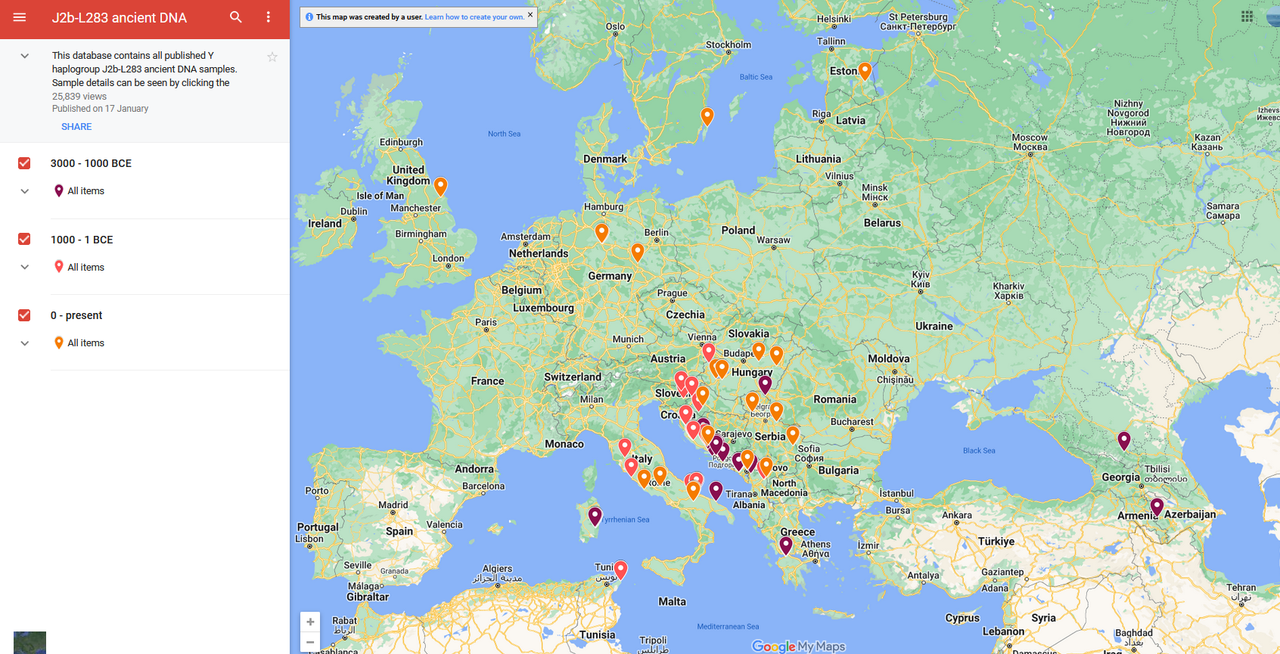
the last map I received of J-L283 ...............8 months ago........................note these Ydna where already in Italy in the bronze age, the Daunians arriving from modern Croatia to Foggia Italy in the bronze-age, lived next to the Samnites in Venosa and where completely emerged as Italian people before even the Romans formed

 
This is important information to follow up movements.

As the 14C data known so far and other elements of absolute chronology indicate, we candate the Babadag culture to the 10th-9th centuryBC, a chronological frame to which are also attributed in general the other groups with stamped pottery. The presence of the stamped andincised decorations at the beginning of the Early Iron Age in SE Europe should be linked inparticular to the Protogeometric. This connection is sustained by the associations with pottery decorated in this style from Troy VIIb3and Kastanas (levels 10-4), as well as by someanalogies already brought forward by BernhardHänsel and others among the finds from Babadag, Ljubenkova, Ovčarovo or Rogozinovoand Protogeometric sites in Greece.2


Map-showing-Troy-and-other-Protogeometric-sites-in-the-northern-Aegean-prepared-by-G.png


Map showing Troy and other Protogeometric sites in the northern Aegean (prepared by G. Bieg, Troia Project, based on Catling 1998, ).


Worth mentioning that Protogeomtric in Troy is called Knobbed-Ware while in Greece Handmade-Burnished Ware. There was an attempt or atleast a belief from Greek archaeologists that it was a local phenomenon, but, hard to grasp that when it followed burial change, pottery change. Definitely worth checking out.
 
Last edited:
In my opinion the Protogeometric style can be best understood by Greeks taking up the new influences brought in by Channelled Ware people and creating something new based on the fusion of their old and these new foreign customs.

Therefore its Greek, but it wouldn't have developed without the foreign, Northern influences from the Channelled Ware sphere in the first place. Some pieces look like more elaborated, more sophisticated Gáva-style pots, like the appear in Knobbed Ware. It kind of signals the revival of the Greek people, after their demise, and is a turning point as from there onwards, the Northern people rather received Greek influences than giving some.
That was also true for the Mycenaean period, but completely reverted during Channelled Ware, when all major influences came from the Carpathian zone down.

Traditionally Troy VII b2 was absolutely dated between 1120 and 950 B.C. In an article on the„Buckelware” associated with this phase and its cultural context, Dietrich Koppenhöfer (Koppenhöfer1997, 314–315; 334–347) still relies on Bernhard Hänsel’s parameters for the absolute dates of the cultural groups of the Lower Danube region in regard to the chronology of Troy (Hänsel 1976, 229–236with older references). Hänsel suggested a possible lifespan of pottery from the Dobrudzha/Dobrogea inRomania and the Tundža-Marica region in Bulgaria beginning around 1100 and ending around 800 BC,the date when the Basarabi style emerges. $ e absolute chronology of Troy/Troia VII still depends onthe Aegean pottery based chronology of the LH III C period and the start of the Protogeometric Period.$ erefore, the recent higher (14C) dates for the Protogeometric period25, which are still under discussion,might also e* ect the absolute chronology for the cultural groups of the Lower Danube and east Balkanregion. Some 14C-measurements of material from Troia VII b2-contexts associated with Knobbed Warehave produced several dates; the most convincing are 938–906 cal. B.C. and 984–961 cal. B.C. (Koppenhöfer 1997, 314)26. $ is makes the „Buckelware” or Knobbed Ware contemporary with the channelled horn-like knobs in central Transylvania or even Srem (Kalakača), which are independently dated.I would like to stress again what I have tried to show in this article: in central Transylvaniathe presence of channelled pottery with horn-like knobs is dated to a later Gáva horizon (Gáva II) andcan very likely be regarded as the result of a cultural contact in what so ever form with the areas of theKnobbed Ware’s origin, such as the Lăpuş and Suciu Valleys in Northwest Transylvania. % e similarity ofthe Bulgarian vessels some of which are characterised by channelled knobs (i. e., Hänsel 1976, Pl. 25/15;29/13; 69/5 and Fig. 6/3) with the Troy * nds is so striking that the question of immigration was raisedalmost immediately a+ er the Knobbed ware horizon Troy VII b2 was discovered (Blegen et al. 1958;Pintér 2005).


To me its clear that we find Gáva-related Channelled Ware + Steppe (over Belozerka and Cimmerians) + Aegean-Anatolian influences in the developing Stamped Pottery.
Just like the Protogeometric pottery in Greece was the result of Channelled Ware influences on the Greeks. On the emergence of Protogeometric:
The emergence of Protogeometric pottery traces back to the 12th century BC, during which the Minoan-Mycenaean civilization collapsed. The collapse led to the disappearance of the arts, and wars made people spend a lot of time in caves. Literacy, trade, and writing also disappeared, and most of the pottery was poorly done. Greece became more settled between 1050-900 BCE, and artists began producing better pottery. The pottery made during this time was characterized by abstract shapes mainly reflecting the Mycenaean pottery. This new form of art was the Protogeometric pottery and emerged in the initial phases of the Great Dark Ages. Art made during this Classical period remains one of the most popular forms of art.

Around 900 BCE, more intricate geometric designs emerged, marking the beginning of the Geometric period. Designs such as triangle patterns emerged in Geometric Greek art. Artists then introduced animal figures in the pottery. By 770 BCE, the artists had introduced human figures into the pottery. The Geometric period lasted up to 700BCE and saw the situation improve with population growth and the reemergence of trade. This period was also the end of the Greek Dark Age.


Note the timing, because the safe dates for Stamped Pottery are not older than that. So when things got settled down, new, more elaborate styles emerged, from the fusion of different influences. I think that best explains the shift from Channelled Ware to Stamped Pottery, which still incorporated Channelled Ware elements or both styles were used side by side quite often.
 
It's starting to come together now

Trojans = Thracians = Dardanoi = Dardanians
 
This author summarised some of the Dacians remains and the available evidence. Unfortunately, like pointed out not often enough, practically all burials were cremations, just like in all North Thracian-Dacian groups and contrary to the earlier Mezocsat and Basarabi period, also contrary to the South Thracians, where inhumation while not the rule was used more often.

It is, quite clearly, a defining marker of the North Thracian-Dacian tribes, that they regularly and fairly strictly burnt their dead, just like Channelled Ware people before.

There are however human remains from "non-funerary contexts", like described by the author on page 64:

Sirbu lists threse last finds amongst 196 examples of uncremated remians in a "non-funerary" contexts, of which 77 (39 %) were complete skeletons.

Despite these examples, the principal characteristic of this period is the lack of burials.


That was typical for Suciu de Sus and Gáva - even Nyirseg in the EBA - the lack of burials but eivdence for a big population. This suggests the remains were burnt and scattered or deposed in another way which left little behind.

One of the complete skeletons had practically all his bones broken, therefore it might have been a brutal execution if it was happening ante mortem, which is not for sure.

These might be all kind of people and its not as good as getting the elite male with his three sacrificed horses, but if sampling more than a dozen or so males from those contexts, locals should be included eventually, if not majority wise.

Typically many of the body burials being mass graves in pits, similar to the situation in post-Psenichevo Bulgaria, from where we got the South Thracian E-V13, similar to Babadag, to Gáva and to Belegis II-Gáva and Kalakacza sites, of which one between those two groups and Basarabi might be sampled soon and hopefully. Or even two sites if we're lucky.

Rustoiu, also wrote about the Celtic hybridisation in Transylvania and the mobility of the warrior class:

Other strontium isotope analyses carried out in the la Tène cemeteries from Nebringen, on the Rhine, Monte Bibele, in northern Italy, Radovesice and kutna Hora, in Bohemia, showed that inside certain communities the individual mobility was low, most of the deceased being locals. Also, the individual mobility was more prevalent amongst men than women. Finally, it was noted that in the cemeteries from Bohemia the funerary inventories of the dead coming from other areas contained weapons, a fact that illustrates up to a certain point the mobility of the warriors (Scheeres et al. 2013; 2014).

This explains the appearance of the E-V13 minority throughout the Celtic zone in the Later Iron Age. Some Sardinian branches which split from Central Europeans in that period have a TMRCA of around 250 BC, which means they must have been at least in the vicinity of Northern Italy by 300 BC.

On Daco-Thracian survival between the Celtic settlements:

Nevertheless, it has to be emphasized that not all of the regions from inside the mountain range were occupied by the celts. Fortiied or rural settlements have been discovered in the Maramureş Depression and the depressions from eastern Transylvania, as well as cemeteries belonging to the local populations, which continued to evolve according to the older, Early Iron Age traditions. These people were more likely connected to cultural models from the eastern carpathians and the lower Danube regions (Rustoiu 2008, 80–86; Rustoiu 2014a, 153–156).

That's a clear reference to Basarabi and the connections between the Daco-Thracian provinces, well-established since hte Channelled Ware expansion (Eastern Slovakia, Transcarpathian Ukraine, Romania, Moldova, much of Serbia, Bulgaria, European Turkey basically).

The Celtic invasion resulted in a hybrid culture in the West, in which presumably R-L2 and E-V13 dominated, with Celts being dominant, but strong local elements persisting. Sometimes in a mixed context, sometimes side by side. This Celtic period ended however and quite clearly so:


The fate of the communities belonging to the ‘celtic horizon’ in Transylvania can be archaeologically traced until the end of the lT c1 (beginning of the second century Bc), when a sudden disappearance of the cemeteries can be noted both in Transylvania and the Great Hungarian Plain and across wider central European areas. The phenomenon was considered to be a consequence of major changes in the local beliefs and funerary practices. In the lT c2–D1 period (second–irst centuries Bc), the bodies of the dead were disposed of in a manner that left no archaeologically visible traces. Some researchers suggested the use of cremation, followed by scattering of the burned remains in places that cannot be investigated today (lakes, rivers, groves etc.), or of corpse exposing/decomposing (Sîrbu 1993, 37–38; about the social and ritual changes that led to the emergence of this phenomenon, and also about the ritual and social treatment of the deceased, see Egri 2012, 507–509). New cultic places, in which human or animal sacriices were performed, appeared in the same period (Petres 1972).
There was however some general continuity of the mixed habitation, but not in the later clearly Dacian zone:
The situation is entirely diferent in Transylvania. The celtic horizon, with typical la Tène cemeteries and settlement inventories, abruptly ceased to exist at the end of the lT c1. Other types of habitation and burials appeared almost instantly in the next period. This kind of cremation graves in a simple pit or the tumulus ones, sometimes organized in small ‘familial’ cemeteries, were mostly discovered in south-western Transylvania, for instance at cugir and călan (tumulus graves), or at Blandiana, Tărtăria, Teleac, Hunedoara, Piatra craivii etc. (cremation graves in a pit). Recent inds allowed the identiication of such burials towards north, for instance in the surroundings of the Malaja kopanja fortress, on the right bank of the upper Tisza River, in Trans-carpathian ukraine (Fig. 27).

That clearly reads like migration. Channelled Ware traditions re-appear, but this time they come from the South:

Finally, weapons and harness ittings speciic to this horizon were recently discovered at Bulbuc, Alba county (Fig. 28) (Borangic 2014). The funerary inventories comprise weaponry which deines the characteristic panoply: long swords of the la Tène type, spears, curved daggers, sometimes having the blade decorated with geometric or zoomorphic symbols, shields and sometimes chain-mails and helmets. They are associated with harness ittings among which the so-called ‘Thracian’ horse bits are the most typical ones. With regard to the pottery, the vessels placed in graves (complete or fragmentary) no longer resemble the forms of the previous horizon, but evolved from shapes that are characteristic for the northern Balkans region. Amongst them can be listed the jar-like vessels with knobs, the so-called ‘fruit-bowls’ (bowls with a tall foot, the larger ones being probably used in convivial practices), one handle beakers (usually handmade and sometimes used as funerary urns), large bi-truncated vessels with two handles etc. (Rustoiu 2008, 142–163).

The warrior complex:

comparable funerary assemblages containing panoplies of weapons that are typologically and functionally homogenous were found on a relatively extended area in the northern part of the Balkan Peninsula and on both banks of the Danube, downstream from the Iron Gates (Fig. 27). The entire phenomenon was designated by the archaeologists as the Padea–Panagjurski kolonii group, on the basis of two cemeteries discovered on the territories of Romania and Bulgaria respectively (Woźniak 1974, 74–138; Woźniak 1976, 388–394).
Regardless of the unitary aspect of the weaponry, elements of the funerary rite and ritual difered from one region to another, which leads to the hypothesis of their belonging to warrior elites who shared the same symbolic means of expressing the identity, but with diferent ethnic origins. The ancient authors mention diferent populations in the regions in question, of which the lesser Scordisci, the Triballi and the Dacians are better known.

Therefore this new, kind of royal warrior class, which later formed the Dacian kingdom, had different tribal affinities united under its banner, according to the Rustoiu.

In conclusion, the funerary contexts from Transylvania which chronologically follow the cemeteries and settlements of the celtic horizon suggest a migration from the south of the warrior elite coming from the northern Balkans or the lower Danube regions, which ended the celtic domination on the area, imposing new organisational structures.
Basically Dacians-North Thracians from outside of the Celtic zone of dominance pushed Celts back, which were however mixed with related tribes which lived to the North long before. It is kind of funny that even in the later Dacian period, the "fruit bowls" still show elements introduced by Channelled Ware, most notably in Lapus I to Lapus II-Gáva, in the Upper Tisza zone.

Quote:The military elite, who arrived in Transylvania from the northern Balkans and ended the celtic way of life, later generated a coherent political and social class. The outcome of this process was the appearance of the Dacian kingdom, which in the time of Burebista, who was caesar’s contemporary, expanded greatly, from the Middle Danube to the Black Sea.

 
Some comments on Kustanovice and the Sanislau group of Vekerzug, which many consider Proto-Dacian:

The Kustanovice group area, considered by most specialists to be of Thracian ethnicity, lies north of the Tisa, in a hilly area of Trans-Carpathian Ukraine. Unfortunately, the pottery of that particular group (whose activity lasted from the end of the 7th century/the beginning of the 6th , to the middle of the 3rd century BC) is mostly known from funeral finds, the settlement being too little investigated. At Solotvino-„CETATE”, however, as with Kuătanovice, the wheel-made pots are rarely used. A number of pottery items are to be found in both areas, but the materials, generally speaking, do not coincide. To the west, in the Szentes-Vekerzug environment, and especially in the Sănislău-Nir group area they used wheel-made pottery in large numbers. At least a quarter of the pottery inventory of the settlements is represented by such containers. Some of those were used by the local communities even after the arrival of the Celts, around the middle or the second half of the 4th century BC. This type of pottery is not to be found at Solotvino-„CETATE”.

The group Kustanovice, which territory was part of the very core of Gáva in the LBA-EIA, with the Upper Tisza region and Transcarpathia, being seen as Thracian/Daco-Thracian by the majority of researchers.

The Solotvino-„CETATE” settlement, located in a relatively isolated area, underwent a normal evolution, not being influenced by the „shock” o f the Celts' arrival. That could explain why most of the pottery is similar to those in Daco-Getic settlements of the 4th-3rd centuries BC, south and east o f the Carpathians. In some cases (the bowl with punctured horizontal handles) we can even consider them as imports from that region. The occurrence of some wheel-made items (especially Greek) in the extra-Carpathian settlements and their absence at Solotvino-„CETATE” are natural, considering the closeness (in the first case) or the long distance (in the second) from the Pontic cities. Therefore, the first Dacian settlement from Solotvino could be active between the 4th and 3rd centuries BC. Even though some pottery items inherit First Iron Age features, the absence o f some specific pots (like the bowls with a lobated mouth) indicate a starting date for the settlement towards the end o f the 4th century BC or the beginning o f the next. As for the end of the settlement at Solotvino-„CETATE”, the items discovered suggest it was the end o f the 3r d century BC.

The first Dacian level at Solotvino-”CETATE” reflects the existence of a Dacian community very well structured and organized long before the events happening during the time of Burebista. This fact poses a series o f problems in the interpretation of the ethno-cultural and historical processes that occurred in the upper Tisa area during the second Iron Age. Those aspects will be dealt with after we analyze the finds of the second Dacian habitation.


For the end o f the first Iron Age, small cultural groups have been observed, archaeologically. The most specific phenomenon, the Szentes-Vekerzug culture, occupied an important part of the Pannonian Plain (Alfold). At the limits of its diffusion, east and north-east, a series of local manifestations have been revealed, such as the Sanislau-Nir group (in the area of Satu Mare-Carei in NW Romania), or the SE Slovakian finds. Also, the discoveries o f tum ular graves in the hill-country of Transcarpathian Ukraine (very rarely extended to the plain) have given shape to a peculiuar archaeologic aspect: the Kustanovice group. Finally, recent diggings at Belaja Cerkov’ (Biserica Alba) in Transcarpathian Ukraina, and the older ones at Sarasau seem to suggest the existence of a late Hallstatt horizon specific to the Maramures depression, a relatively secluded area. From an ethnic point of view, all those cultural phenomena were attributed to northern Thracians, although Scythian elements should be taken into account in the case of the Szentes-Vekerzug culture. Those elements, however, are absent from the Sanislau-Nir and KuStanovice, from SE Slovakia and from Maramures, a fact which confirms the attribution of those discoveries to the great Thracian block.

The cultural and ethnic configuration of the area changed after the middle of the 4th c. B.C. At the end of La Tene B l and the beginning of the B2 sub-phase the first groups of Celts penetrated the eastern part o f the Tisa Plain. The first horizon of the Piscolt necropolis (Satu Mare), and certain finds in Crisana belong to that period. The symbiosis of the Sanislau-Nir natives with the newcomers may be detected in certain forms of Hallstatt pottery (bitronconical vessels, or some wheel-made and hand-made pots, etc.) which were perpetuated into the next period, during which they occur together with La Tene artefacts in typical Celtic settlements and necropoles. During the same time, Thracian communities of SE Slovakia, those of Transcarpathian Ukraine and o f Maramures continued their evolution without „contamination” by elements specific to the Celts, who did not reach those regions

The displacement of Celtic communities in the context of the events of 280-277 also caused the expansion o f the area occupied by them . Thus, in the plain area of Transcarpathian Ukraine and in SE Slovakia there appear new Celtic settlements and necropoles. such as the ones at Izkovce and Valaliky-Kostany. During the same period, imported La Tene wares (fibulae, bracelets, pots, etc.) reached the area of Kustanovice and the hilly country, some of those artefacts being dicovered in tumular graves. They mark the last manifestations of the Kustanovice group, which ends its evolution towards the middle of the 3rd c. B.C. As regards Maramures, the existence of well-structured centres o f local power (such as the Dacian fortified settlement of Solotvino, which was already functional during the former half o f the 3rd c. B.C.) prevented the penetration of Celtic groups in the area. In his analysis o f the finds of the second Iron Age in Transcarpathian Ukraine, J. Kobal rightly observed that Celtic settlements never occurred east of the Reka (i.e. in Maramures), that river marking the border between the two ethnic groups.

In the period of the Dacian kingdom, Southern Dacian tribes and those of the Upper Tisza-Transcarpathia region seems to have fused:

It is significant that the earliest burials of the Zemplin necropolis belong to that period, and their inventories include weapons coming from southern Dacian territories. It was at the same time that artefacts from the south (hemispherical cups with ornaments in relief or undecorated, curved daggers, etc.) also reached Tisa settlements, Malaja Kopanja and Solotvino. Two main opinions have been expressed as regards the ethnic situation of the area under discussion. The former, sustained especially by I.H. Crisan, observes uninterrupted continuity of Dacian communities from late Hallstatt to the time of the Dacian kingdom and even after that. The second hypothesis implies that there are no sufficient arguments to assert cultural continuity from late Hallstatt to the end of the second Iron Age, the „classical” Dacian finds (like those of Zemplin) being regarded as due to the expansion under Burebista. However, the Solotvino-”CETATE” diggings prove, at least for the Maramures depression, a long evolution of local elements, the finds showing specific Dacian features. Also, it is evident that the expansion of „historical” Dacians under Burebista „enriched” the already existing fund of the Dacian ethnic component, thus integrating the space under discussion in the sphere of the kingdom ruled by the dynasts of Sarmizegetusa.

Differentiation of the Western Upper Tisza and East Carpathian Dacians based on burial rites (cremation of course, but flat vs. tumuli):

Finds from SE Slovakia (especially from Zemplin), Transcarpathian Ukraine and Maramures (Malaja Kopanija, Solotvino, Oncesti, etc.) have been attributed by some specialists to the Lipica culture. Although the materials are similar (both east ans west o f the Carpathians), that aspect should be explained by the common Dacian fund in both areas. Burials are decisive in the interpretation of that aspect: the necropoles and isolated graves specific to the Dacian group of Lipica (concentrated mainly in the upper Dniester basin) are flat, while the funeral complexes so far discovered on the upper Tisa are tumular. That fact indicates different communities.

After the establishment of Dacia as Roman province, the upper Tisa area remained outside the Roman limes. Dacians o f that area, coexisting with various Germanic communities which arrived there one by one, maintained close ties with the Empire.

From: Vasiliev_Rustoiu_Balaguri_Cosma_Solotvino-Cetate_2002 (1)


The most likely conclusion based on this is that we deal with different Daco-Thracian tribal formation in those areas, which were overformed by the Dacian aristocratic expansion, but not replaced, rather united. Therefore we can assume that the different Dacian regions, while likely all being dominated by E-V13, might have had regional differences in minority haplogroups and E-V13 subclades, as well as autosomal make up.
 
I don't know if i shared this before:
Towards the end of the Bronze Age, there were movements among the Proto-Thracian tribes from the Middle Danube and their vicinity (south-west Romania, north-east Yugoslavia, south-east Hungary and north to the area of the Upper Tisza). They were linked to the so-called "preliminaries" of the "great Aegean migration", which liquidated the Mycenaean civilization and the Hittite state at the end of the 12th century BC. The "sea peoples", who reached Egypt (where they were rejected in 1190 BC), seem to have represented an ethnocultural conglomerate composed of western and northwestern Thracian and Illyrian elements.

In such circumstances, the bearers of the culture of the tumulus graves from the Middle Danube triggered pressure and disturbances on the block of Carpathian civilizations. At the same time, from the east, the bearers of the North-Pontic Sabotinovka culture pressed and infiltrated into the southeast of Moldova and the Romanian Plain. The reaction of the proto-Thracian communities in our area to the two directions of pressure (western and eastern) or the "counter-offensive of the Carpathian block" consisted in triggering the Hallstattization process, which produced a series of restructurings. Thus, against the background of some cultures from the end of the Bronze Age, two cultural complexes were formed belonging to the early Hallstatt in the Carpatho-Danube area: one located in the west, north and northeast areas and characterized by fluted ceramics, and the other located in the southern and southeastern regions and individualized through printed ceramics. The cultures and cultural groups of Susani-Belegiş, Gava-Holihrade, Gava-Lăpuş II, Reci, Mediaş, Grăniceşti-Mahala and Corlăteni-Chişinău belong to the first horizon, and the cultures of Insula Banului, Babadag-Pšenicevo, Cozia belong to the second horizon -Stoicani, Saharna-Solonceni.

tab.gif
In the middle period of this era, the Basarabi culture was formed and spread over almost the entire Carpatho-Danubian territory, attributed to the northern Thracians (individualized by the southern ones) or the old Geto-Dacians. This culture and some external influences were directly at the basis of the establishment, in late Hallstatt, of the Geto-Dacian cultural groups Ferigile, Bârseşti, Balta Verde, Gogoşu, Vraţa, Dobrina-Varna, Ravna-Canlia, Vekerzug-Chotin, Sanislau, Cumbrud, Kustanovice-Kcruglic-Cernăuţi, Trestiana-Curteni, Stânceşti-Cotnari, etc.
tab.gif
In the area of all Hallstattian cultures or cultural groups we find open settlements and fortified settlements. Some of the latter have large or very large dimensions and fortification elements more complex or stronger than those of the Bronze Age, being considered fortresses of refuge in case of danger for the communities in their vicinity. The presence of these fortresses and the frequency of weapons attest to the continuation or even the amplification of the warrior phenomenon in the life of the Thracian-Geto-Dacian population from the first Iron Age.

From a cultural point of view, the period itself begins with the penetration of the tribes of the Gava culture into the western area of Romania, which corresponds to a cultural standardization over an extremely vast area. Military power, highlighted by the appearance of fortified centers, indicates the formation of powerful tribes and even the appearance of Thracian tribal unions. Towards the middle of the Hallstatt era, but especially in the late Hallstatt, we have documented numerous graves of fighters, who were part of a rising military aristocracy.
It is generally considered that the first iron age corresponds to a period of climatic cooling, a fact that would have attracted a focus of the communities towards raising animals and less towards cultivating the land. But the discovery of a significant number of agricultural tools (especially bronze sickles) shows us at least a balance between the two main occupations.

The spiritual life of the communities of the first Iron Age represents, in general terms, a continuation of that of the Bronze Age. Solar symbols (water carts from Bujoru or Văidei, heads of aquatic birds made of bronze, decorative motifs on ceramics or metal vessels) become predominant.
tab.gif


The funeral rite and ritual attested for early and middle Hallstatt attest to both the practice of inhumation and cremation. A radical change can be seen beginning with the Ha D period, with the penetration of a Scythian population on the territory of Romania and especially Transylvania, which led to a generalization of the burial rite, rarely practicing cremation by the native population.


I think the general Romanian and Hungarian archaeologists are pretty clear in the matter, Bulgarian and Romanian EBA Cultures(inner and eastern territories) are not Proto-Thracian. It is these Earlier/Eastern Hallstatt Cultures during LBA which they consider Proto-Thracian. I believe that during EBA there was far more diversity of different people/cultures in the territories of Balkans, to be reduced by LBA migrations/catastrophes.
 
Last edited:
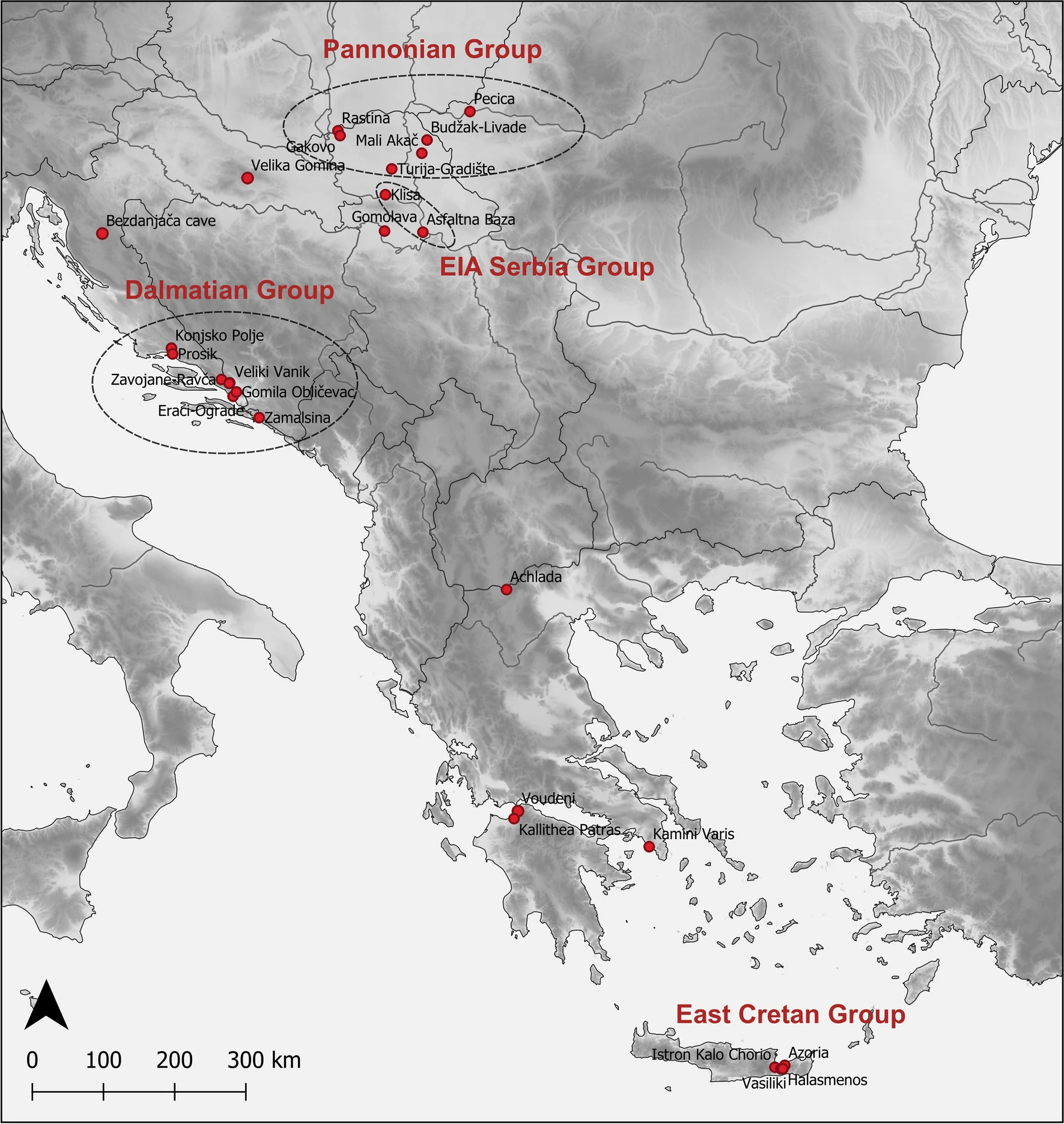
Samples from the 1,200 BC project will include at least these sites, not sure if Croatian ones are recycled from older studies but lots of samples from LBA and EIA northern Serbia and even LBA Romania.

IE4JKw1.png


12520_2023_1862_Fig1_HTML.png
 
Well, no regular burials from the critical groups, but we can hope for a lucky strike, especially in the mass burials from Gomolava. I wonder about the context of the Pecica burials. Later they were surely Gáva-related, but in the early phase not as sure.

Too early and too many outliers:
A Middle Bronze Age system centered on tell sites gave way between 1600 and 1500 BC to a new social order centered on large open settlements that thrived until ca. 1200 BC (Kienlin 2020; Molloy 2023; Nicodemus and O’Shea 2019). Mortuary practices were initially bi-ritual, including both inhumation and cremation, with a bias toward the latter, but this shifted to exclusively cremation in formally organized cemeteries by ca. 1400 BC. Given the rarity of inhumations, we treated this area as a unit with individuals coming from multiple sites (Budžak Livade; Pecica site 14; Gakovo-Vasin Do, Rastina, and Mali Akač cemeteries; and the settlement at Turija) (East Pannonian group; see Fig. 1). There was a return to inhumation as a mortuary rite in various forms (articulated and disarticulated) after 1000 BC, including burials at Gomolava and Klisa considered herein.

That's the main reason I'm more confident about later Basarabi samples, because these appear to be Gáva-related/Belegis II-Gáva related people which shifted to inhumation under Cimmerian-steppe influence. The first shift to cremation might or might not have been caused by migrants from the East Carpathian sphere.

Link to the paper:
 
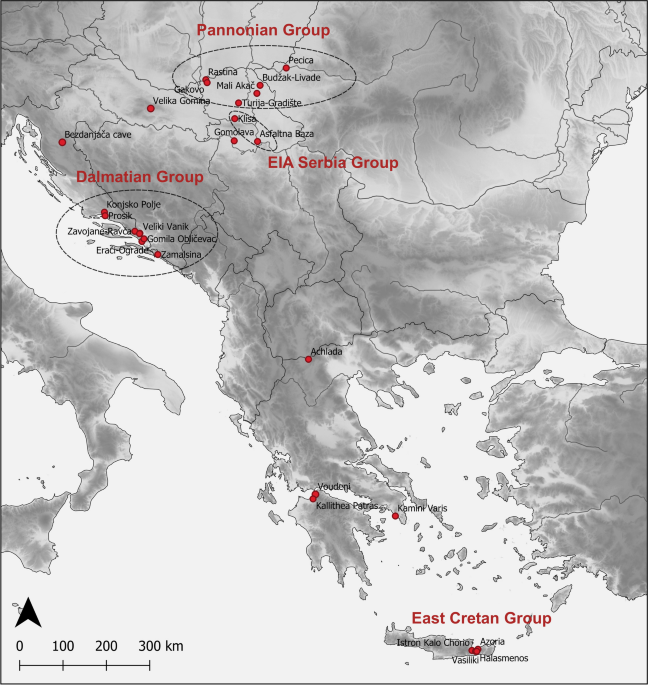
Samples from the 1,200 BC project will include at least these sites, not sure if Croatian ones are recycled from older studies but lots of samples from LBA and EIA northern Serbia and even LBA Romania.

IE4JKw1.png


12520_2023_1862_Fig1_HTML.png
When is it coming out ?
 
I hear you but, I cannot imagine Belegis II as a flash occurrence out of nowhere, they built on a earlier phase of expansion which has to be the Pannonian group. Plus how to account for E-V13 diversification that was happening if they were still restricted further east and north-east. If another haplogroup inhabited the Pannonian group, than this group would surely have left some legacy in Y-DNA as they would have been pushed south. No such mystery Y-DNA exists or is known at the moment. Personally I doubt it. The only question to be seen is, are these inhumation samples legacy of the tell culture-people or E-V13 practicing uncommon burial.
 
Last edited:
When is it coming out ?

No idea, to this day the authors have published lots of archeological related papers relating to this project(The Fall 1,200 BC), and now a skull similarity paper, which for the first time we get an idea which samples they will use for DNA analysis. So far they only have published appetizers/teasers. The earliest we'll see DNA samples is probably second half of 2024, but more realistic they will be published in 2025.

The samples from Greece are lackluster, as they seem to be entirely LBA, how can they measure a migration without having EIA samples as a comparison? What kind of methodology is this?
 
Last edited:
Status
Not open for further replies.
Back
Top