• Don't want to see ads? Install an adblocker like uBlock Origin or use a Europe-based privacy-friendly browser like Vivaldi or Mullvad.

To burn or not to burn: LBA/EIA Balkan case

Status
Not open for further replies.
Are those samples from that 2018 lecture on Youtube (Amvrakia?) perhaps part of this study? Also, is Gomolava now an independent paper or are they holding it back for a "bigger" one?

No that study is separate, from a different team and a later time period. I believe this is the Ambrakia study. There is not much to this study, only one male which we already know the haplogroup of.

What the 1,200 BC team intends to do is unclear. I would assume they intend to release Gomolava first as a teaser, followed by the Greek and other samples in another paper. But I am in the dark as anyone. I only base my assumptions after I looked at their Facebook page, an what they have disclosed so far. Based on the Facebook posts, their sampling work is done since last year.

The good thing about 1,200 BC, it looks like they might have samples from Epirus(museum of Ionnina) during LBA. Which I think would be J2a, but the Phrygians/matt-painted(R-PF7563) culture pressed down and took some major areas(Pogoni-Zagoria) during LBA through EIA. It depends from which sites the samples were excavated from. They will also have samples from western Macedonia which will prove whether the eastern matt-painted folks are any different than the Kamenica ones.
 
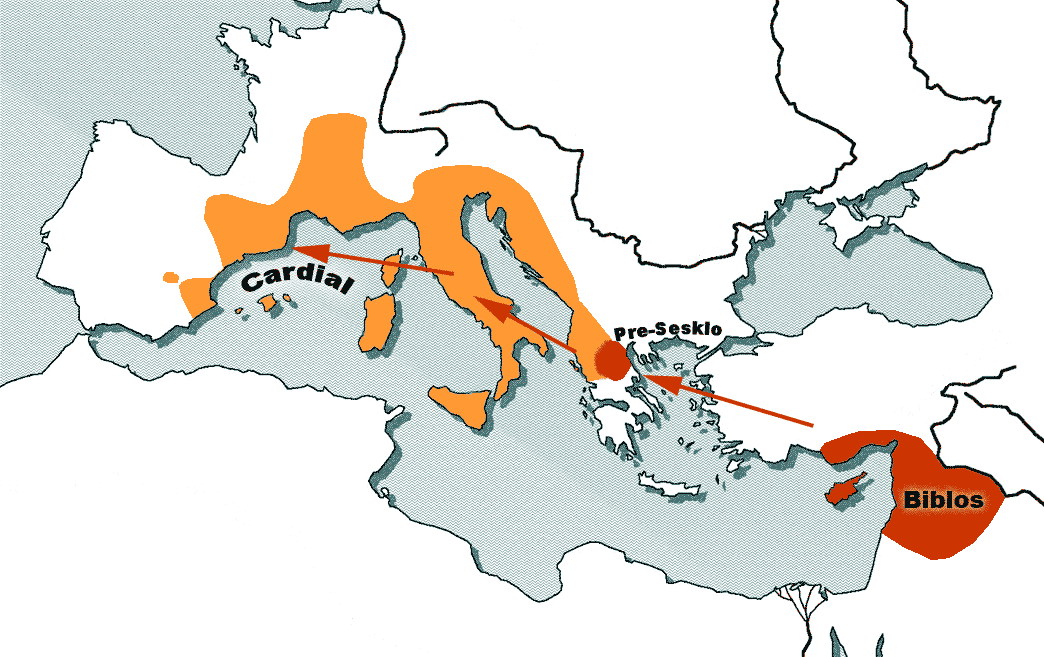
Looking at the leaks from Lalueza-Fox again, it looks like E-L618 was actually a Mesolithic Balkan lineage rather than a Neolithic one. It would make sense considering the absence of E-L618 in Neolithic Anatolia and among Natufians. No matter how the Cardium Pottery having Natufian-Iberomaurusian influences made much sense for E-L618 origin of Cardial-Ware, it just happens that it was actually G2a Anatolians acquiring those influences living nearby Natufians. Confirmation bias on the play maybe.

I wonder from which Mesolithic site the E-L618/E-V13 was found, which modern country borders. Greece, West-Balkans or East-Balkans. I would guess Greece/Epirus South-Albania, somewhere there, where they were assimilated by incoming Cardial Farmers.

D0RC6ri.png


This assumption is based on the scretch of Cardium-Pottery Culture.

Cardial_map.png
 
They were largely from a mixed Neolithic-Mesolithic context, no (safe) original Mesolithic people. Keep in mind that also some H and J appeared in Cardium Pottery. Both being Neolithic in origin too. G2 was dominant in most sites, the others seem to havve been minority lineages, probably even from a second Neolithic wave coming in.
My main interest is where the main E-V13 survived though and how it expanded in the LBA-EIA, that's the big quest for me and I made my bet. ;)
 
That's right, but it's interesting to know about all periods of pre-history.
 
I'm very confident that E-L618 spread from Natufians into Anatolian Farmers and moved into Europe from there, just like the minority lineages of H and J among the EEF. Even some of the C branches are likely to have spread with farmers.
 
We shall see, for that one.
 
Very interesting presentation and it clearly shows that the regions inhabitants had closest relations to people like Gáva and Babadag on the one and Tumulus culture on the other hand. If they would just sample enough people, even if the dead were displayed killed enemies, there should be some E-V13 popping up eventually.
 
I'm happy to know samples from these critical areas are in the works, Transylvania(from a separate study), Tisza-Carpathian basin(from 1200 BC), these regions are speculated to be the core areas of E-V13 by LBA. The lack of data is only a matter of timing at this point. But of course I want to see all doubt to E-V13 story put to rest. The liars and the haters know their days are numbered.
 
Very interesting presentation and it clearly shows that the regions inhabitants had closest relations to people like Gáva and Babadag on the one and Tumulus culture on the other hand. If they would just sample enough people, even if the dead were displayed killed enemies, there should be some E-V13 popping up eventually.

I think you overvalue gava and underestimate the impact of urnfield. Urnfield may have even been responsible for the Greek dark ages
 
It looks like samples from Gradiste Idjos were sent to Hannes Schroeder since 2019. They are part of the 1200 BC project.


KQpGp16.png

I think you overvalue gava and underestimate the impact of urnfield. Urnfield may have even been responsible for the Greek dark ages
There were 3 different Urnfielders which reached Greece:
1. Italians by sea, Proto-Villanovans
2. Small groups of Pannonians, Middle Danubian related and possibly Illyrian admixed
3. Large groups from the Gava-related sphere which moved down the Morava-Vardar valleys.


The 3rd was the only really important genetically for Greece and that's Gava-related. There Gava-Holigrady is in the centre of the Eastern Urnfield expansion.
Even more importantly, its being largely derived from local Tisza people, not Tumulus culture and was instrumental for the formation of the Urnfield phenomenon in the first place.

The Urnfield phenomenon came about when the Carpathian Tumulus culture group had intensive contacts with the local Hatvan, Nyírség and Wietenberg people.
These cremating locals got changed by the Tumulus culture too, which resulted in Suciu de Sus, Berkesz-Demecser and other Pre-Gáva groups.
West of the Danube bent TC derived Urnfielders, mixed in between and East Carpathian Pre-Gáva locals East of the Tisza.

There wouldn't have been an Urnfield culture and Religion without these East Carpathian locals.
 
I think you overvalue gava and underestimate the impact of urnfield. Urnfield may have even been responsible for the Greek dark ages

Gava technically is a sub-set of Urnfield Complex, more specifically Gava is part of Eastern-Urnfield/Carpathian-Urnfield/Earlier-Hallstattian Complex.

The earliest examples of urnfields in the area under consideration can be found in the Carpathian Basin, where this new and complex way of treating and disposing of the dead tends to be juxtaposed with and/or replace the traditional flat inhumations, primary cremations (‘in situ cremations’), or scattered cremations from at least the twenty-fifth century BC. However, it is during the first half of the 2nd millennium BC—and more intensively around the sixteenth–fifteenth centuries BC—that the urnfield custom crosses its original boundaries and starts to be intensively practised in other regions, or isolated sites still surrounded by communities practising other kinds of funerary ritual. To what extent the spread of the urnfield model is the result of cultural transmission rather than (at least partially) a demic diffusion can be debated, but unfortunately not easily verified, since cremation destroys DNA and therefore the identification of any population movement via aDNA analysis. Beside the ideological aspects, the new biomolecular evidence of virulent pathogens, most notably Yersinia pestis, found in individuals dated to the 3rd and 2nd millennia BC, from Central Asia to Central/Northern Europe (Andrades Valtueña et al., 2017; Rasmussen et al., 2015; Spyrou, 2018; Rascovan et al., 2019), suggests that the diffusion of certain epidemics, especially in densely populated and well-interconnected regions, might have triggered practical responses by societies attempting to limit transmission. The burning of corpses may be one of these.

 
The origin of the Carpathian cremation tradition was likely within the Cotofeni cultural complex, which survived Yamnaya:
Within Transylvania and the Carpathian Basin, the
introduction of Yamnaya ideas did not result in the full abandonment of Early Bronze Age traditions or
the replacement of local populations with newcomers. Instead, local communities responded and shifted
some practices, while maintaining a strong connection to their Copper Age ancestry
through the reuse
and repurposing of space.

Cotofeni was already a mixed steppe culture, but with a strong Carpatho-Balkan local tradition surviving. More so than in Corded Ware or Yamnaya-derived groups:

Prior to the arrival of Yamnaya, Transylvania was occupied by people whom archaeologists have called
the Coțofeni culture; part of a broader phenomenon called the Baden-Coțofeni horizon that extended
into the Carpathian Basin and beyond (Fඎඋඁඈඅඍ – Sඓආඒඍ – Zൺඌඍൺඐඇ ඒ 2008). We consider the Coțofeni
culture as belonging to the Late Copper Age (also known as the Late Eneolithic Age) and its end marks
the begining of the Early Bronze Age (EBA) in the Transylvanian region (Cංඎ඀ඎൽൾൺඇ 1996, 15–20,
139–148; 2021; Gඈ඀ඝඅඍൺඇ 2015, fig. 23; Bൾർ඄ – Cංඎ඀ඎൽൾൺඇ – Qඎංඇඇ 2020). This view fits with the
current Bronze Age chronology of Hungary (Kඎඅർඌගඋ – Sඓൾඏൾඋඣඇඒං 2013; Kංඌඌ et al. 2019), but it is still
around 500 years older than the current central European chronology (Bൾඋඍൾආൾඌ – Hൾඒൽ 2002; 2015)

ඈඏ 2018). However, there are several strong cultural historical reasons for
assigning the Baden-Coțofeni cultural horizon to the Late Copper Age. First, the subsistence practices
(agro-pastoralism) and funerary practices (cremation under tumuli or flat cemeteries)
are closely
connected to their predecessors from the Middle Copper Age, such as the Funnel Beaker, Scheibenhenkel
or Lažňany cultures (Sൺർඁඌඌൾ 2008). Second, metallurgical tradi tions of the Baden-Coțofeni correspond
with Late Copper or Late Eneolithic Age (Lංർඁൺඋൽඎඌ 1991; Rൺർඓ඄ඒ 2009; Hඈඋඏගඍඁ 2009; Sർඁංൾඋ
2014).

On Laznany culture: http://www.donau-archaeologie.de/doku.php/kulturen/laznany-hunyadihalom_english_version

We have related samples from the West, but none from the Transtisza zone still. E-V13 surely played no big role in this complex, but we can't exclude its presence.


The earliest evidence of Coțofeni (phase Coțofeni I) comes from excavations in the Turdaş site,1
where Coțofeni groups coexisted with Boleráz-Cernavoda III communities. Three samples belonging
to the Coțofeni I horizon (RoAMS: 1466.117; RoAMS: 1468.117; and RoAMS: 1469.117) date to the
second half of the 4th millennium cal BC (Fig. 8) 2. T

The second phase of the Coțofeni culture is defined by shifts in ceramic production (Cංඎ඀ඎൽൾൺඇ
2000; Cංඎ඀ඎൽൾൺඇ et al. 2005, 9–18; Gඈ඀ඝඅඍൺඇ – Mඈඅඇൺඋ 2009), but still covers the whole area of
Transylvania and Banat (Cංඎ඀ඎൽൾൺඇ 2000), with a clear predilection for the lowland

Especially the late phase is important, because that shift to transhumance in higher altitudes seems to be crucial:

While in the west and south, the expansion of Coţofeni groups reached eastern Serbia and north-
western Bulgaria
, the south-eastern corner of Transylvania seems to be somehow “abandoned” by the
end of phase II, most probably before 3100 BC, according to the result of our Bayesian analysis (Fig. 8).
The change that took place in the evolution of the Coțofeni culture by the end of its second phase is
quite spectacular, and is not restricted to the appearance of the Fürchenstichkeramik style. One major
shift is the rapid expansion of the Coțofeni III settlements in the highlands of both western Transylvania
and the Banat
(Cංඎ඀ඎൽൾൺඇ 2000). We consider this change as likely indicative of the increase in seasonal
transhumance, accompanied by additional modifications in the subsistence strategies (Bൾർ඄ൾඋ 1999;
Cංඎ඀ඎൽൾൺඇ 2000, 19–21; Bංඇൽൾൺ 2005)

Both Cotofeni and Livezile samples should be available in the Transylvanian paper, which needs forever unfortunately:

The transition from the late Coţofeni (Coţofeni III) to the EBA is a critical context in which the social
consequences of the Yamnaya migration and the responses by local communities can be investigated.
Two relevant and recently excavated sites, Hăpria and Râmeţ (Fig. 1 and Fig. 2), are highly important
for understanding the shift from the Coţofeni to the EBA and the role played by the Copper Age ancestry
in this complex process. These sites support existing arguments for the persistence of a strong Coțofeni
ancestry in the first EBA horizon (the Livezile group) of western Transylvania
(Cංඎ඀ඎൽൾൺඇ 1986; 1996).
The post-Cotofeni core is most notable, together with its successors and up to the LBA, for its control of mining and metallurgy. I would focus in the Apuseni mountains. Note that E-V13 has a bottleneck around the time frame of the Yamnaya incursions:
They might well indicate the survival of the late Coţofeni communities
in the western uplands of Transylvania, in a time when the Yamnaya expansion along the middle Mureş
valley and its tributaries has already put an end to large Coţofeni hilltop settlements like Boarta, Măgura
Căpudului or Şincai
.
As to how old the cremation tradition was in Cotofeni:

The recent excavation of the Silvaşu de Jos cemetery offered new evidence not only for other
Yamnaya-type burials in the south-west of Transylvania, but also for the existence of an older tumular
horizon with Coţofeni cremation graves, which has been dated towards the very end of the 4th millennium
cal BC
(Dංൺർඈඇൾඌർ

Interesting that in most instances, if this cremating Carpatho-Balkan groups did use inhumation, after contacts with dominant cultures which did prefer inhumation, they started to use rather untypical forms and oftentimes buried disarticulated bones - not just in Babadag thousand years later, but also in Livezile:

; 1996). Indeed, one of the major tracks characterising the eponymous
Livezile culture incorporates “disarticulated skeletons, the bones being deposited, in whole or in part, in
the form of a ‘package’” (Cංඎ඀ඎൽൾൺඇ 1996, 80). This observation was supported by Motzoi-Chicideanu,
who numbered 24 multiple graves out of a total of 65, and considers bone manipulation as one of the
characteristic rituals in the Livezile burials (Mඈඍඓඈං-Cඁංർංൽൾൺ ඇඎ 2011, 311). The tumulus excavated
at Hăpria delivered a commingled and disarticulated deposit (ID 766-789) of the skeletal remains of at
least five individuals , including one child, one adolescent, and three adults, consisting predominantly of
cranial and appendicular remains (Fig. 3.7).
Such practices extend beyond Transylvania to western Moldavia – at the Bronze Age site of Costișa–
Cetǎ ţuia (Neamţ County), several graves and isolated human skeletal elements were found scattered
throughout the site (Pඈඉൾඌർඎ – Sඈൿංർൺඋඎ – Mබඋ඀බඋංඍ 20

The strong persistence of the Coţofeni ancestry, particularly in the highlands, could be a plausible
explanation for the birth of the new EBA Livezile group,12 which still use some Coţofeni decoration
patterns and pottery shapes (Cංඎ඀ඎൽൾൺඇ 1996; 1997). But it is not enough to explain the presence
of many other new patterns, part of them also present in the Zăbala-type finds from south-eastern
Transylvania, as well as in the Cernavodă II-Folteşti repertory or the Aldesţi-type finds from Moldavia
(Cංඎ඀ඎൽൾൺඇ 1996; 2013; Bඎඋඍබඇൾඌർඎ 2002).
The contacts were always to the South:

The earlier dates of the burials associated with Coțofeni pottery in the mounds at Ariceştii-Rahtivani
(Fඋඨඇർඎඅൾൺඌൺ et al. 2014; Fඋඨඇർඎඅൾൺඌൺ 2020) point towards a late 4th millennium BC beginning of a
close relationship between western Transylvania and the sub-Carpathian area of Prahova. Coțofeni III
communities came into contact with groups beyond the bounds of the Carpathian Mountains, including
communities in northern Oltenia
(Ţඎ෤ඎඅൾඌർඎ 2016a, 140; Ţඎ෤ඎඅൾඌർඎ 2016b) and the Cernavodă II–
Folteşti II people living between the Danube and southern Carpathians (
Fඋඨඇർඎඅൾൺඌൺ 2020

The bottleneck for E-V13 and related Copper Age lineages in the region coincides with the Yamnaya raids and destruction:

2011). The la rge hilltop Coţofeni settlements,
such as Boarta, Șincai, Măgura Căpudului (Cංඎ඀ඎൽൾൺඇ 2000), seem all to cease their evolution by the
end of phase IIIb, at ca. 2900 cal BC, when the first Yamnaya groups crossed from Banat to Transylvania
through the Iron Gates of Transylvania,13 and the Mureş valley (Fig. 1).

That's exactly when we might deal with a single surviving male for the main E-V13 branch. The survivors:

The displaced late Coțofeni population of central and south-western Transylvania, mixed with the Cernavodă II–Folteşti II groups,
that were already a local presence in the south-east of the region, have given birth to the Livezile group,
mainly distributed over the upland regions of the Apuseni Mountains (Cංඎ඀ඎൽൾൺඇ 2013, 20; 2021,
57–59).


There is a paper on ancient DNA from Romania, which results are not that conclusive, but the comments made are highly interesting, because they prove that ancient DNA has been taken and there are some basic conclusions to draw from this:

The point mutations found in the mtDNA sequences presented above were also found in various
patterns, in corresponding mtDNA sequences of other old individuals from different archaeological sites
from Romania, dating from the Bronze Age (Sultana-Malu Roşu) and Iron Age (Satu Nou-Valea lui
Voicu, Jurilovca, Babadag and Enisala-Palanca).
That showed the closed genetic kinship along the
maternal lineage between the three old individuals from Costişa and some individuals found in other
archeological sites dated from the Bronze and Iron Age. We also should note that the point mutations
analyzed above are also found in Romanian modern population (our unpublished data), suggesting that
some old individuals from the human populations living on the Romanian land in the Bronze and Iron
Age, could participate to a certain extent in the foundation of the Romanian genetic pool.

Since these are other sites than those for the Transylvanian paper, we can assume that a couple of ancient DNA samples has been taken. Unfortunately they are rather backward, concentrate on mtDNA still, but the connections and conclusions they make are neverthless worth to be stressed.


Compare also:

The best thing they can do is sending the data to capable labs which make more out of the samples.
 
I did sort the most relevant samples we got up to now by EEF percentage and group - note that we can be pretty sure that Mezocsat-Gáva had E-V13, especially since the succesor group of Sanislau-Eastern Vekerzug being highly likely represented by the individual samples in Chotin, Slovakia - since both Gáva and the Sanislau group did cremate their dead, this find is exceptional. The Mezocsat-Gáva locals are all females, otherwise, with a larger sample, I'm highly confident some E-V13 would have popped up.

Therefore we see a tripartition of the Carpatho-Balkan E-V13 sphere, which are extremely likely to represent Daco-Thracians ethnically:
- Northern Late Gáva group, which transformed into first Mezocsat ("Prescythians" = Thraco-Cimmerians), then with the Scythian influence into Vekerzug (primarily Eastern Vekerzug, Sanislau group being full scale in the Gáva tradition, cremated their dead, produced similar pottery still etc.)
- Central group, most likely representing Basarabi - we see a decrease of WHG by about half, while the steppe percentage stays largely the same. The most likely explanation is a heavy mixture with local North-Central Balkan people (like Belegis I, Brnjica etc.) at the exclusion of the Danubian block (Encrusted Pottery, Monteoru). Such selective mixtures took place multiple times, e.g. Corded Ware did mix way more with GAC people than with other Copper Age communities they encountered. A primary reason for this might have been the cultural affinity of groups like Belegis and other cremating Central Balkan groups to Gáva.
- Southern group, with a decrease of both WHG and steppe, presumably do to heavy admixture with Mycenaean Greek-like and Anatolian people, including Anatolian backflow from the Thracian colonies in West Asia (note especially the spread of Anatolian Grey ware in the late phase of Psenichevo/post-Psenichevo)

There are samples in between, like the Eastern La Tene outlier and the Moldovan. The later from the Scythian period likely represents an individual half-way between post-Psenichevo and Basarabi, which would make sense insofar, since both strains encountered and mixed with each other in Moldova.

The Pannonian LBA samples we got so far look like being closer to Kyjatice and not representing the core of Gáva, which appears way more clearly with the Mezocsat and Eastern Vekerzug samples.

Here is the G25 of these most important samples up to now:
Daco-Thracian-E-V13-Sorted.jpg


I would work only with known E-V13 samples. Mezoscat, whoever they were, are not the ancestors of the Thracians. It is impossible to explain how EEF rich known E-V13 samples derive from WHG heavy population. The current known E-V13 cline matches the Danubian frontier paper.

lvnjf9X.png


awaYLzI.png


In general E-V13 Iron Age groups have a Baltic shift, some Iran N, and elevated CHG. Illyrians lack these except exceptional individuals. Illyrian WHG is Beaker related and is western(Italian), this the Alb rrenjet team ignores like the plague and restrict models to Iron Gates WHG (lol).

The Himera's represent the northern end of E-V13 cline, which strongly suggests they are Dacians. I'm sure Dacians themselves can vary a little further towards Celts and Slavs further like Vekerzug E-V13, but these would be the minority.
 
The Vekerzug sample from Chotin is crucial ans represents the Northern range.

Too bad we have no more samples from Mezocsat and Eastern Vekerzug.
 
I would work only with known E-V13 samples. Mezoscat, whoever they were, are not the ancestors of the Thracians. It is impossible to explain how EEF rich known E-V13 samples derive from WHG heavy population. The current known E-V13 cline matches the Danubian frontier paper.

lvnjf9X.png


awaYLzI.png


In general E-V13 Iron Age groups have a Baltic shift, some Iran N, and elevated CHG. Illyrians lack these except exceptional individuals. Illyrian WHG is Beaker related and is western(Italian), this the Alb rrenjet team ignores like the plague and restrict models to Iron Gates WHG (lol).

The Himera's represent the northern end of E-V13 cline, which strongly suggests they are Dacians. I'm sure Dacians themselves can vary a little further towards Celts and Slavs further like Vekerzug E-V13, but these would be the minority.

The himera samples have zero Iran input, it is possible the other v13 in Bulgaria are mixed with Greeks or Anatolians which gave them the Iran input
 
The himera samples have zero Iran input, it is possible the other v13 in Bulgaria are mixed with Greeks or Anatolians which gave them the Iran input

Which is a good argument that these are north of Danube E-V13s. Let me point out that the LBA(1,350 BCE) sample from Macedonia, has strong Iran admixture. The reason for is, the Vardar valley was one of the main arteries of Bronze Age trade routes that connected central Europe with Mycenaean markets.

QkaEjxx.png


If Iran ancestry had penetrated that far into Northern Macedonia, it must have been even stronger in southern Bulgaria. When E-V13 expanded toward Morava-Vardar axis and southern Bulgaria, it picked up Iran(Aegean-BA Anatolian) admixture by the taking/seizing of local females.

From various models, I strongly believe the ancestral E-V13 population was a little WHG shifted and plotted like Cinamak Illyrians. They shifted to the cline I posted after LBA expansion.
 
Danubian Paper PCA clusters.
lvnjf9X.png


The Bassarabi cluster visualized in G25 PCA, blue trapezoid covers the proposed Bassarabi cluster.

L16Oh9z.png
 
Status
Not open for further replies.
Back
Top