
• Don't want to see ads? Install an adblocker like uBlock Origin or use a Europe-based privacy-friendly browser like Vivaldi or Mullvad.

To burn or not to burn: LBA/EIA Balkan case

Status
Not open for further replies.

He is average/above average steppe for the Chania sample, but has also average Iranian ancestry:
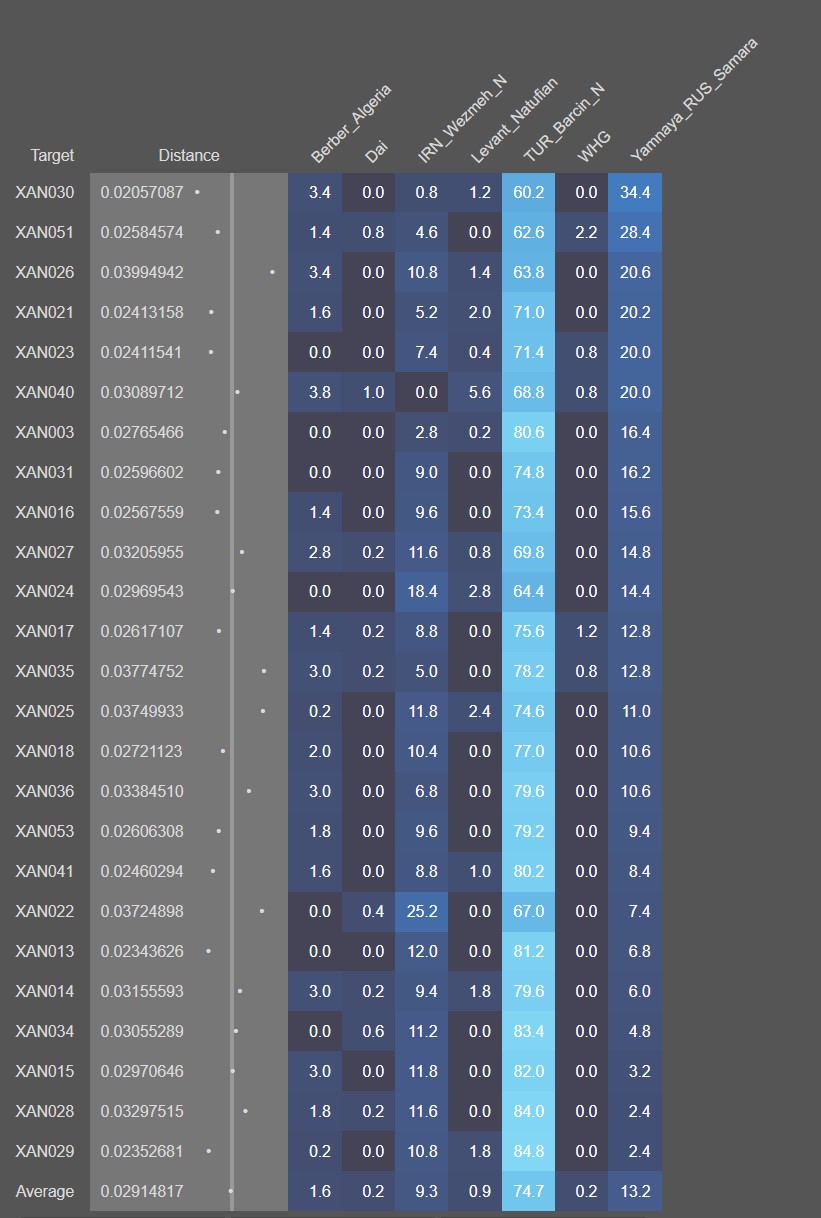
Chania-sample.jpg


On theytree he forms his own branch E-BY6578, which they gave a TMRCA which is practically the same as for E-V13, 4.900 BP.

That kind of makes it a much less successful brother clade of E-V13.
 
He is derived from parellel branch to e-v13
E-CTS10912
https://www.theytree.com/tree/E-CTS10912

That also include BAS025
Bas025 is la- bastida bronze age southeast iberia

This branch is cool :cool-v:
So now do you think XAN016 was a minoan ?
 
He is derived from parellel branch to e-v13
E-CTS10912
https://www.theytree.com/tree/E-CTS10912

That also include BAS025
Bas025 is la- bastida bronze age southeast iberia

This branch is cool :cool-v:
So now do you think XAN016 was a minoan ?

While its possible, I rather think it came down with Mycenaean Greeks/Carpatho-Balkan people from around Romania-Moldova-Ukraine-Bulgaria. Basically the area of Tripolye-Cucuteni/Carpatho-Danubian sphere. There are indeed a couple of C carriers as well which might represent some local elements from around that, which came with the R1b core for Proto-Greeks, from the steppe-Neolithic transitional zone. Would be my guess at the moment.
 
@Riverman @PaleoRevenge

Very correct.

Yamnaya - Balkan Yamnaya - EBA Theopetra like (Balkan Yamnaya derived) - Helladic MBA Logkas like - Mycenaean Era

The pathway of Proto-Greek R1b-PF7562 and I-L701 in Greece can be attributed to the aforementioned cultural complexes and their respective time frames and, as I said before, refusing scientific data is another issue in itself. There is some other "R1b" to be analyzed in this recent paper that is highly likely to be PF7562 too!

[TABLE="class: t1"]
[TR]
[TD="class: td1"]ID I14689[/TD]
[TD="class: td1"]2663-2472 BCE [/TD]
[TD="class: td1"]Balkan Yamnaya_EBA, Çinamak, Albania[/TD]
[TD="class: td1"]R1b-PF7562?[/TD]
[TD="class: td1"]L23-[/TD]
[/TR]
[TR]
[TD="class: td1"]ID G23 [/TD]
[TD="class: td1"]2335–2140 BCE[/TD]
[TD="class: td1"]EBA_Theopetra, North West Thessaly Greece[/TD]
[TD="class: td1"]I-L701[/TD]
[TD="class: td1"]
[/TD]
[/TR]
[TR]
[TD="class: td1"]ID I13518[/TD]
[TD="class: td1"]1200-1070 BCE[/TD]
[TD="class: td1"]GRC_Mycenaean_Palace_of_Nestor_BA, Pylos, Greece[/TD]
[TD="class: td1"]R1b-PF7562>PF7563[/TD]
[TD="class: td1"]
[/TD]
[/TR]
[TR]
[TD="class: td1"]ID I13506[/TD]
[TD="class: td1"]1200-1070 BCE[/TD]
[TD="class: td1"]GRC_Mycenaean_Palace_of_Nestor_BA, Pylos, Greece[/TD]
[TD="class: td1"]R1b-PF7562>PF7563[/TD]
[TD="class: td1"][/TD]
[/TR]
[TR]
[TD="class: td1"]ID I19364[/TD]
[TD="class: td1"]1200-1070 BCE[/TD]
[TD="class: td1"]GRC_Mycenaean_Palace_of_Nestor_BA, Pylos, Greece[/TD]
[TD="class: td1"]R1b-PF7562?[/TD]
[TD="class: td1"]L23-[/TD]
[/TR]
[TR]
[TD="class: td1"]ID I10377[/TD]
[TD="class: td1"]700-500 BCE[/TD]
[TD="class: td1"]MKD_Anc, Post Brnjica, Bucinci-Skopje, North Macedonia[/TD]
[TD="class: td1"]R1b-PF7562?[/TD]
[TD="class: td1"]L23-[/TD]
[/TR]
[TR]
[TD="class: td1"]ID I14688[/TD]
[TD="class: td1"]450 BCE[/TD]
[TD="class: td1"]ALB_Çinamak_Anc, Post Brnjica, Çinamak, Albania[/TD]
[TD="class: td1"]R1b-PF7562>PF7563[/TD]
[TD="class: td1"]
[/TD]
[/TR]
[/TABLE]

Disclaimer: not 100% sure on the L23- read for the Bucinci sample.

This is a false statement as the Mycenaean R1b-PF7562 samples from Pylos have a very classic Mycenaean auDNA profile and there is absolutely nothing foreign about it. Just as there is nothing „foreign“ or unusual about XAN030 being derived from EBA Theopetra like Proto-Greeks. He plots east of the Mygdalia samples and South East of North Western positioned EBA Cetina.

[TABLE="class: t1"]
[TR]
[TD="class: td1"]
Distance to:
[/TD]
[TD="class: td1"]XAN030[/TD]
[/TR]
[TR]
[TD="class: td1"]
3.22450734
[/TD]
[TD="class: td1"]74.00% G23_Theopetra_Aegean_2335–2140_calBCE + 26.00%GRC_Mycenaean_Kastrouli_BA:I13531 [/TD]
[/TR]
[TR]
[TD="class: td1"]
3.39644892
[/TD]
[TD="class: td1"]68.40% Helladic_Logkas_MBA:Log04:Clemente_2021 + 31.60% GRC_Mycenaean_Kastrouli_BA:I13531 [/TD]
[/TR]
[TR]
[TD="class: td1"]
3.61728891
[/TD]
[TD="class: td1"]67.60% Helladic_Logkas_MBA:Log04:Clemente_2021 + 32.40% GRC_Anc_lc:I17960 [/TD]
[/TR]
[TR]
[TD="class: td1"]
3.69196122
[/TD]
[TD="class: td1"]72.60% Helladic_Logkas_MBA:Log04:Clemente_2021 + 27.40% APO043[/TD]
[/TR]
[TR]
[TD="class: td1"]
3.73885255
[/TD]
[TD="class: td1"]72.60% Helladic_Logkas_MBA:Log04:Clemente_2021 + 27.40% APO037[/TD]
[/TR]
[/TABLE]


It's becoming clear that much of Albania was initially populated by northern Greek groups and Phrygians. I can't imagine Epirot samples to be much different from MKD Ohrid and the alleged mdv sample from Albania.

Cp3Lzr4.png


Same model, but without MENA proxies in the model, the Xan sample is half northerner and half Mycenean derived. Xan051, looks 1/3 Illyrian.

dGwHnkd.png


And, there is also R1b-Z2103 with it's own profile, and represents it's own group(Kosovo through Belgrade), which I think it is best represented by Cimmerian MJ12 (the most neutral profile of it's kind we have for now). Notice that the Shkreli sample is largely in aDNA of this profile. Later Illyrians never show such high admixture, even BA Illyrians are not prone to having this mixture, but individuals in BA that do have it, have it in a higher ratio than the IA samples. BA relations were more relaxed in LBA than in IA which seem more hostile.

OdjrwAc.png


Two very interesting samples that don't look it right away is Viminacium R3931, he is actually two thirds Germanic-east Euro mix, notice his Balkan IA portion is entirely Cimmerian MJ 12.
The other fellow is Naisius R6769, he is actually half Middle Eastern and half local. Again pay attention to his Balkan half. Yes E-V13 seems most represented in this profile, but I still think it is the aDNA of the central Balkan group. Otherwise, how else do you explain the Alb MBA fellow and some of the Daunians varrying a portion of this ancestery.
 
You are putting too much definite trust in overfitting percentages. MBA_Shkrel plots to the North West of aforementioned non-Illyrian sample. Though "picking up" or "aquiring" auDNA from before present or/and neighbouring pops, generally mobility leading to more diversity in e.g. BA-IA transition and further is something not off the charts of course.

As for ancient "Epirotes" probably being very similar to Paeonians/Phrygians and G23_Theopetra/MiddleHelladic-like Proto-Greeks, I agree. Such results in aDNA records would not surprise me and seem rather likely.


Over fitting it would be if it was picking all sorts of combinations. I am overfeeding its ME options(though respecting the timeline).

This pattern is also detectable using the Neolithic model. This Dardanii mixture was around in LBA, and if Matzinger is correct, they had intruded in the area south of Shkodra (he argues Buna river is Messapii origin). The Shkreli sample is the only Illyrian that scores so high in MJ 12, and it points to this group living near it, at the time. We know that overtime, Cetina derived groups bullied this group away, a fate shared by the nearby R-PF7562 Greeks.

UHtQYZw.png
 
PaleoRevenge said:
Besides the Mygdalia series, there are 3 other individuals that are autosomally Illyrian derived, though pretty much all have admixed with the locals.

Vu3UAna.png
I moved your post to this more appropriate thread. I stand by what I have written before. XAN051 for instance doesn’t seem like differing too much from autosomally close XAN030. These plot east of the mixed heritage Mygdalia samples. A G23_Theopetra/MBA_Helladic source is the more plausible scenario. MYG004 at best has some minor admix and this can be also seen by his mostly "local" auDNA and parental markers.

[TABLE="class: t1"]
[TR]
[TD="class: td1"]
Distance to:
[/TD]
[TD="class: td1"]XAN051_K12b_33.58%coverage[/TD]
[/TR]
[TR]
[TD="class: td1"]
3.49477328
[/TD]
[TD="class: td1"]65.40% Helladic_Logkas_MBA:Log04:Clemente_2021 + 34.60% Helladic_Manika_EBA:Mik15:Clemente_2021[/TD]
[/TR]
[TR]
[TD="class: td1"]
3.74279307
[/TD]
[TD="class: td1"]50.00% GRC_Mycenaean_Palace_of_Nestor_BA + 50.00% Helladic_Logkas_MBA:Log04:Clemente_2021[/TD]
[/TR]
[TR]
[TD="class: td1"]
4.00919140
[/TD]
[TD="class: td1"]40.80% Mycenaean:I9010:Lazaridis_2017 + 59.20% Helladic_Logkas_MBA:Log04:Clemente_2021[/TD]
[/TR]
[/TABLE]
[TABLE="class: t1"]
[TR]
[TD="class: td1"]
Distance to:
[/TD]
[TD="class: td1"]XAN030_K12b[/TD]
[/TR]
[TR]
[TD="class: td1"]
3.22450734
[/TD]
[TD="class: td1"]74.00% G23_Theopetra_Aegean_2335–2140_calBCE + 26.00% GRC_Mycenaean_Kastrouli_BA:I13531[/TD]
[/TR]
[TR]
[TD="class: td1"]
3.39644892
[/TD]
[TD="class: td1"]68.40% Helladic_Logkas_MBA:Log04:Clemente_2021 + 31.60% GRC_Mycenaean_Kastrouli_BA:I13531[/TD]
[/TR]
[TR]
[TD="class: td1"]
3.61728891
[/TD]
[TD="class: td1"]67.60% Helladic_Logkas_MBA:Log04:Clemente_2021 + 32.40% GRC_Anc_lc:I17960[/TD]
[/TR]
[TR]
[TD="class: td1"]
3.69196122
[/TD]
[TD="class: td1"]72.60% Helladic_Logkas_MBA:Log04:Clemente_2021 + 27.40% APO043_17.92%cov[/TD]
[/TR]
[TR]
[TD="class: td1"]
3.73885255
[/TD]
[TD="class: td1"]72.60% Helladic_Logkas_MBA:Log04:Clemente_2021 + 27.40% APO037_16.02%cov[/TD]
[/TR]
[/TABLE]

Could of course also be something like BA MKD Paeonian/Phrygian derived groups.
 
I still don't get it how R1b-PF7562 keeps showing up more frequently than R1b-Z2103 in ancient Greece.
 
I still don't get it how R1b-PF7562 keeps showing up more frequently than R1b-Z2103 in ancient Greece.

They discuss the exact position of the sample, but yeah, still. It will make more sense, most likely, once we see the actual Proto-Greek population somewhere around Macedonia, Bulgaria, Romania, Moldova most likely. I guess the Proto-Greeks were pretty much in the same position as the later Southern Thracians and autosomally both received from the MBA-LBA locals a strong input, which pulled them South.
 
I still don't get it how R1b-PF7562 keeps showing up more frequently than R1b-Z2103 in ancient Greece.

In LBA it probably had a more northern and central Balkan position/concentration than PF7562. R1b-PF7562/3 is showing connection with Albania as their base camp. The miss-dated mdv sample from Korca, the EBA sample, the lone Cinamak and the Chania sample showing origins from lake Ohrid area.

And this inscription from Pylos where R1b-PF7562/3 has been found with Myceneans.


http://www.peiraeuspubliclibrary.com...mycenaean.html
Enkhelyawon -- Possibly the name of wanax or king of Pylos

That could point to either
1) an Illyrian related element among the (or some) Mycenaeans
2) a Mycenean related origin of at least some Illyrians or just the Enchelei in particular

https://www.eupedia.com/forum/threads/41957-Who-were-the-people-of-Trebeniste-Culture?p=633839&viewfull=1#post633839


The Trebeniste pyre custom. It's all pointing to R1b-PF7562/3 being part of ancient Greeks and Phrygians. It is a pre-Illyrian layer.
 
I moved your post to this more appropriate thread. I stand by what I have written before. XAN051 for instance doesn’t seem like differing too much from autosomally close XAN030. These plot east of the mixed heritage Mygdalia samples. A G23_Theopetra/MBA_Helladic source is the more plausible scenario. MYG004 at best has some minor admix and this can be also seen by his mostly "local" auDNA and parental markers.

[TABLE="class: t1"]
[TR]
[TD="class: td1"]
Distance to:
[/TD]
[TD="class: td1"]XAN051_K12b_33.58%coverage[/TD]
[/TR]
[TR]
[TD="class: td1"]
3.49477328
[/TD]
[TD="class: td1"]65.40% Helladic_Logkas_MBA:Log04:Clemente_2021 + 34.60% Helladic_Manika_EBA:Mik15:Clemente_2021[/TD]
[/TR]
[TR]
[TD="class: td1"]
3.74279307
[/TD]
[TD="class: td1"]50.00% GRC_Mycenaean_Palace_of_Nestor_BA + 50.00% Helladic_Logkas_MBA:Log04:Clemente_2021[/TD]
[/TR]
[TR]
[TD="class: td1"]
4.00919140
[/TD]
[TD="class: td1"]40.80% Mycenaean:I9010:Lazaridis_2017 + 59.20% Helladic_Logkas_MBA:Log04:Clemente_2021[/TD]
[/TR]
[/TABLE]
[TABLE="class: t1"]
[TR]
[TD="class: td1"]
Distance to:
[/TD]
[TD="class: td1"]XAN030_K12b[/TD]
[/TR]
[TR]
[TD="class: td1"]
3.22450734
[/TD]
[TD="class: td1"]74.00% G23_Theopetra_Aegean_2335–2140_calBCE + 26.00% GRC_Mycenaean_Kastrouli_BA:I13531[/TD]
[/TR]
[TR]
[TD="class: td1"]
3.39644892
[/TD]
[TD="class: td1"]68.40% Helladic_Logkas_MBA:Log04:Clemente_2021 + 31.60% GRC_Mycenaean_Kastrouli_BA:I13531[/TD]
[/TR]
[TR]
[TD="class: td1"]
3.61728891
[/TD]
[TD="class: td1"]67.60% Helladic_Logkas_MBA:Log04:Clemente_2021 + 32.40% GRC_Anc_lc:I17960[/TD]
[/TR]
[TR]
[TD="class: td1"]
3.69196122
[/TD]
[TD="class: td1"]72.60% Helladic_Logkas_MBA:Log04:Clemente_2021 + 27.40% APO043_17.92%cov[/TD]
[/TR]
[TR]
[TD="class: td1"]
3.73885255
[/TD]
[TD="class: td1"]72.60% Helladic_Logkas_MBA:Log04:Clemente_2021 + 27.40% APO037_16.02%cov[/TD]
[/TR]
[/TABLE]

Could of course also be something like BA MKD Paeonian/Phrygian derived groups.

The model is consistent in picking up a Illyrian component for XAN051. Here is the IA version. I think he is half Illyrian, half local. His Illyrian side might be through his maternal aDNA, if that' the case he should be LBA, if he is BA collapse, than he is a invader.

I kept Cetina and MNE LBA to make a point. Because normally samples prefer newer averages vs older. The fact that BA averages work so well for I13834 and XAN051 is because they are older than IA and their northern admixture is first generational, not 2nd or 3rd, 4th.... etc...

LXfwM1D.png

 
I disagree with the opinion that E-V13 and Thracians were local Chalcolithic/Neolithic survivors from Bulgaria. I am not completely taking off this option, it might be right but i just don't see it how E-V13 was there down and just popping out among Thracians out of nowhere.

Archaeological records are very clear, Bulgarian archaeological chronology is a bit too confusing, but Hungarian and Romanian ones are a bit more coincise and bold on their statements. Svilengrad samples were Balkan-Carpathian/Balkan-Danubian migrants. From where exactly it's up to debate. If these specific people as we believe the material culture of subsequent Iron Age cultures indicate, unfortunately practiced cremation to a high degree and skews our certainty.

I don't know if Gava and Gava-related cousin cultures from Southern Carpathians (Psenicevo, Babadag, Insula Banului), their rise in prominence during LBA and LBA rise of E-V13 is too good to be true, but it does have a correlation at this point.
 
I disagree with the opinion that E-V13 and Thracians were local Chalcolithic/Neolithic survivors from Bulgaria. I am not completely taking off this option, it might be right but i just don't see it how E-V13 was there down and just popping out among Thracians out of nowhere.

Archaeological records are very clear, Bulgarian archaeological chronology is a bit too confusing, but Hungarian and Romanian ones are a bit more coincise and bold on their statements. Svilengrad samples were Balkan-Carpathian/Balkan-Danubian migrants. From where exactly it's up to debate. If these specific people as we believe the material culture of subsequent Iron Age cultures indicate, unfortunately practiced cremation to a high degree and skews our certainty.

I don't know if Gava and Gava-related cousin cultures from Southern Carpathians (Psenicevo, Babadag, Insula Banului), their rise in prominence during LBA and LBA rise of E-V13 is too good to be true, but it does have a correlation at this point.

Yes. And the main contender is Noua-Coslogeni, which fused with Wietenberg, Monteoru and related groups, giving the second part, after G?va-related Channelled Ware, to early Babadag and Psenichevo. So the contender is the direct Western neighbour of Suciu de Sus into G?va, and still not a group to the South in very South Eastern Bulgaria. And lineages barely surviving, and more can't be expected from that part of the world in that turbulent times, can't expand and multiply that radically in the MBA-LBA. Like J-L283 was likely significantly smaller in that time frame, yet look how much territory they covered. As did other major Bronze Age European haplogroups. But E-V13 should be squeezed into some small area of the Central or very South Eastern Balkans, which got hit again and again by foreign invasions? That just doesn't work out. You would have to stockpile them in some valleys for making that happen...
 
I kept Cetina and MNE LBA to make a point. Because normally samples prefer newer averages vs older. The fact that BA averages work so well for I13834 and XAN051 is because they are older than IA and their northern admixture is first generational, not 2nd or 3rd, 4th.... etc...
As I said, I disagree as he plots way to the east. As for the (Proto-)Illyrians MNE_LBA and ALB_MBA_Shkrel having very likely acquired autosomal admixture from a BA-IA non-Illyrian, probably Catacomb and later Paeonian_IA/MKD_Anc_Ulanci(Paracin, Brnjica) derived groups, I surely agree.

What is rather interesting to note is that the archeological time frame of Montenegro Late Bronze Age can be both considered Dinaric (in itself late phase Cetina) and very late Dinaric but also very importantly early Glasinac-Mati.

I am seeing a lot of misinformation spam like posts on the other forum made by that Wikipedia Maleschreiber hence I wanted to add this to my post. Imagine the effort it takes writing such long misinformation mishmash, must have a lot of free time on his hands.
 
I disagree with the opinion that E-V13 and Thracians were local Chalcolithic/Neolithic survivors from Bulgaria. I am not completely taking off this option, it might be right but i just don't see it how E-V13 was there down and just popping out among Thracians out of nowhere.

Archaeological records are very clear, Bulgarian archaeological chronology is a bit too confusing, but Hungarian and Romanian ones are a bit more coincise and bold on their statements. Svilengrad samples were Balkan-Carpathian/Balkan-Danubian migrants. From where exactly it's up to debate. If these specific people as we believe the material culture of subsequent Iron Age cultures indicate, unfortunately practiced cremation to a high degree and skews our certainty.

I don't know if Gava and Gava-related cousin cultures from Southern Carpathians (Psenicevo, Babadag, Insula Banului), their rise in prominence during LBA and LBA rise of E-V13 is too good to be true, but it does have a correlation at this point.
Agreed. Are there enough origin location proposals that would make a consensus or forming a likelihood possible or is it still some sort of "enigma" similar to the (pre-)EBA Cetina situation?
 
Agreed. Are there enough origin location proposals that would make a consensus or forming a likelihood possible or is it still some sort of "enigma" similar to the (pre-)EBA Cetina situation?

From MBA-LBA it's that horizon in between Balkan and Carpathians and Lower Danube/Danubian Delta, prior to that, completely unknown. Perhaps always around there. I might take a guess Vinca-Turdas, Lengyel-Sopot or Starcevo. or even the so called Karanovo Culture.

Before, EBA, in archaeological context it gets harder to pinpoint origins for any culture. More unknown variables involved.
 
From MBA-LBA it's that horizon in between Balkan and Carpathians and Lower Danube/Danubian Delta, prior to that, completely unknown. Perhaps always around there. I might take a guess Vinca-Turdas, Lengyel-Sopot or Starcevo. or even the so called Karanovo Culture.

Before, EBA, in archaeological context it gets harder to pinpoint origins for any culture. More unknown variables involved.

Crucial for many of these groups, from Suciu de Sus down to Verbicoara-Tei is the EBA Cotofeni horizon, which then evolved into Mak? and Nyirseg, as well as other related groups of the Carpathian basin. E-V13 starts basically around the time of Cotofeni, before that we have the gap from the first E-V13 to the modern main clade and all its subclades. At the time of Cotofeni we're really talking about one lineage, possibly even just one individual. So even if E-L618, early E-V13 was just a tiny, tiny minority, one individual could have been enough.
After that we see a steady growth and sudden increase around the MBA, with an enormous peak in the LBA-EIA transition (1.300-800 BC/especially 1.200-1.100 BC). That's the G?va/Channelled Ware timing.
 
Last edited:
Crucial for many of these groups, from Suciu de Sus down to Verbicoara-Tei is the EBA Cotofeni horizon, which then evolved into Mak� and Nyirseg, as well as other related groups of the Carpathian basin. E-V13 starts basically around the time of Cotofeni, before that we have the gap from the first E-V13 to the modern main clade and all its subclades. At the time of Cotofeni we're really talking about one lineage, possibly even just one individual. So even if E-L618, early E-V13 was just a tiny, tiny minority, one individual could have been enough.
After that we see a steady growth and sudden increase around the MBA, with an enormous peak in the LBA-EIA transition (1.300-800 BC/especially 1.200-1.100 BC). That's the G�va/Channelled Ware timing.

Happy New 2023 to you and others in the thread.

The problem with you Riverman is that you are focused with Gava solely. Gava is very likely to show E-V13, but that wasn't the vector of all E-V13. As Gabor Vekony states the trio (Psenicevo, Babadag, Insula Banului) are the Southern Carpathian cousin cultures of Gava not descended from them. I cannot pinpoint what was involved on the creation of these cultures, but i am assuming Tei and Verbicoara(?) and subsequently Grla-Mara/Dubovac Zuto Brdo and Vatin-like minus Encrusted Pottery people who likely left little to none mark on them genetically.
 
Happy New 2023 to you and others in the thread.

The problem with you Riverman is that you are focused with Gava solely. Gava is very likely to show E-V13, but that wasn't the vector of all E-V13. As Gabor Vekony states the trio (Psenicevo, Babadag, Insula Banului) are the Southern Carpathian cousin cultures of Gava not descended from them. I cannot pinpoint what was involved on the creation of these cultures, but i am assuming Tei and Verbicoara(?) and subsequently Grla-Mara/Dubovac Zuto Brdo and Vatin-like minus Encrusted Pottery people who likely left little to none mark on them genetically.

Happy New Year!

Verbicoara is possible, a lot is possible, but some rhings are impossible, because of the phylogeny we can deduce from moderns.
Like the vast majority, the more important clades lived together up to the LBA-EIA transition and were therefore united in one population and culture.
So I can't say it for all of E-V13, but the bulk must be sought in one particular group for which Suciu de Sus-Lapus into G?va is just the prime candidate.
Only a direct neighbour which fused early with the prime group can be considered and earlier branching events which make up a minority of the modern survivors.

Therefore if Gava wouldn't be it, another in the MBA-LBA radically expanding group must be identified in correct position which was the source of Channelled Ware into Stamped pottery.
 
Status
Not open for further replies.
Back
Top