The reason I am speculating about the Greek part is this result from a Genebase population study study comparison to my markers:
The
Y-DNA of Curtis Pigman was compared to a dataset of
2 populations in
1 journal using
8 Y-DNA STR markers. The closest matches in a set of
2 populations are listed in the table below:
[TABLE="class: tblBarGraph"]
[TR]
[TD="class: left"]
 Smyma, Greece
[/TD]
[TD="class: right"]
RMI: 294.05[/TD]
[/TR]
[TR]
[TD="class: left"]
Phocaea, Greece[/TD]
[TD="class: right"]
RMI: 205.95[/TD]
[/TR]
[/TABLE]
Curtis Pigman's Y-DNA STR markers were compared to the following
2 populations:
[TABLE="class: tblOrder02 br25"]
[TR]
[TH]Population[/TH]
[TH]Continent[/TH]
[TH]Category[/TH]
[TH]Size (N)[/TH]
[/TR]
[TR]
[TD]Smyma, Greece[/TD]
[TD]Europe[/TD]
[TD]Indigenous[/TD]
[TD]45[/TD]
[/TR]
[TR]
[TD]Phocaea, Greece[/TD]
[TD]Europe[/TD]
[TD]Indigenous[/TD]
[TD]26[/TD]
[/TR]
[/TABLE]
Appendix 4: Raw Comparison Results
The results of this comparison are based on the following raw analysis data:
Matches at a Genetic Distance of 0:
[TABLE="class: tblOrder02"]
[TR]
[TH]Population Set[/TH]
[TH]# Matches[/TH]
[TH]Population Size[/TH]
[TH]Match %[/TH]
[/TR]
[TR]
[TD]Phocaea, Greece[/TD]
[TD]1[/TD]
[TD]26[/TD]
[TD]3.85%[/TD]
[/TR]
[/TABLE]
Matches at a Genetic Distance of 1:
[TABLE="class: tblOrder02"]
[TR]
[TH]Population Set[/TH]
[TH]# Matches[/TH]
[TH]Population Size[/TH]
[TH]Match %[/TH]
[/TR]
[TR]
[TD]Smyma, Greece[/TD]
[TD]1[/TD]
[TD]45[/TD]
[TD]2.22%[/TD]
[/TR]
[/TABLE]
Matches at a Genetic Distance of 2:
[TABLE="class: tblOrder02"]
[TR]
[TH]Population Set[/TH]
[TH]# Matches[/TH]
[TH]Population Size[/TH]
[TH]Match %[/TH]
[/TR]
[TR]
[TD]Smyma, Greece[/TD]
[TD]5[/TD]
[TD]45[/TD]
[TD]11.11%[/TD]
[/TR]
[/TABLE]
Matches at a Genetic Distance of 3:
[TABLE="class: tblOrder02"]
[TR]
[TH]Population Set[/TH]
[TH]# Matches[/TH]
[TH]Population Size[/TH]
[TH]Match %[/TH]
[/TR]
[TR]
[TD]Smyma, Greece[/TD]
[TD]7[/TD]
[TD]45[/TD]
[TD]15.56%[/TD]
[/TR]
[TR]
[TD]Phocaea, Greece[/TD]
[TD]3[/TD]
[TD]26[/TD]
[TD]11.54%[/TD]
[/TR]
[/TABLE]
Matches at a Genetic Distance of 4:
[TABLE="class: tblOrder02"]
[TR]
[TH]Population Set[/TH]
[TH]# Matches[/TH]
[TH]Population Size[/TH]
[TH]Match %[/TH]
[/TR]
[TR]
[TD]Phocaea, Greece[/TD]
[TD]4[/TD]
[TD]26[/TD]
[TD]15.38%[/TD]
[/TR]
[TR]
[TD]Smyma, Greece
[/TD]
[TD]4[/TD]
[TD]45[/TD]
[TD]8.89%[/TD]
[/TR]
[/TABLE]
Although not ideal because they did not compare SNPs, the people in these studies were selected because they could prove (to the period before 1920) they were in fact from Greek ancestry.
The population study is from:
The coming of the Greeks to Provence and Corsica: Y-chromosome models of archaic Greek colonization of the western Mediterranean
http://www.ncbi.nlm.nih.gov/pmc/articles/PMC3068964/?tool=pubmed
Ionian Greek were previously in Crete.
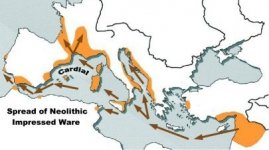
These two Greece cities in Greek Asia Minor are said to have been founded by Ionian Greeks from the Peloponnese and after a time became allies of the Romans. Smyrna and Phocean Nobles were also encouraged (because of overpopulation?) to relocate to Marseilles, France and start new cities.
What are your thoughts?
Regards,
Curtis Pigman(French - Pigmon / Greek - Pygmon)