• Don't want to see ads? Install an adblocker like uBlock Origin or use a Europe-based privacy-friendly browser like Vivaldi or Mullvad.

Genetic study Population discontinuity in the Paris Basin linked to evidence of the Neolithic decline

Tautalus

Regular Member
Messages
545
Reaction score
1,380
Points
93
Ethnic group
Portuguese
Y-DNA haplogroup
I2-M223 / I-FTB15368
mtDNA haplogroup
H6a1b2y
Abstract
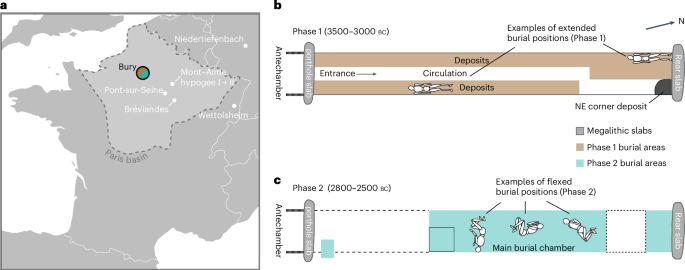
At the transition between the third and the fourth millennium BC, there is evidence for a population decline concurrent with the end of megalith building across continental northwestern Europe. In Scandinavia this ‘Neolithic decline’ is followed by a massive population turnover, as farming communities disappeared and were replaced by people with steppe ancestry. In western Europe, however, ancestry associated with Neolithic farmers persisted beyond the Neolithic decline, and it remains unclear whether a similar demographic replacement occurred. To investigate the population dynamics around the Neolithic decline in present-day France, we sequenced 132 ancient genomes from the allée sépulcrale at Bury. Located in the Paris area, Bury spans two burial phases separated by a hiatus with no burial activity: one phase directly preceding the Neolithic decline in the late fourth millennium BC, ending around 3000 BC, and a later phase some time after the Neolithic decline in the early- to mid-third millennium BC. Our analysis revealed that the two burial phases at Bury represented largely discontinuous genetic groups of a markedly different social organization as inferred from three large pedigrees. We show that the difference between the two burial phases can be linked to a northwards movement of Neolithic ancestry from the south, which only spread into the Paris Basin after the Neolithic decline, at around 2900 BC. Together with genetic evidence of various infectious diseases in the dataset, such as Yersinia pestis and Borrelia recurrentis, as well as evidence for forest regrowth between the two phases, these findings detail a population turnover at the end of the fourth millennium BC, offering a possible explanation for the cessation of megalith building.

Map of genomes from western Europe coloured by the major modelled ancestry group in each individual, split by time period. Grey (‘no major ancestry’) represents individuals where no ancestry group makes up over 60% of the total ancestry.

2fwYuwi.png


a) Proportions of modelled ancestries per individual stratified by time period and region
b) Pie charts of ancestry proportions per individual

dTFIrUJ.png


a) Distribution of chromosome Y haplogroups
b) Map of Y chromosome haplogroups distribution in Neolithic Western Europe. Only individuals with chromosome Y haplogroups within H, I and R are shown.

rRTz5E3.png
 
Last edited:
It would generally appear that steppe and corded ware populations brought with them a plethora of diseases from Eurasia to the rest of europe, including the predecessor of the bubonic plague. This could explain the rapid depopulation of western Europe's neolithic farming populations which allowed steppe/corded ware influence (which was already in the selection process to survive such pandemics) to impact the area so severely, similar to the scenario of European colonial influence in the Americas.

I think this is a lot more of a likely explanation than the idea that steppe herders waged some sort of broad spectrum war against the entire continent and killed off huge swaths of the population through means of violence, though I'm sure that likely did sometimes happen in smaller, more localized tribal conflicts at various points.
 
Last edited:
It would generally appear that steppe and corded ware populations brought with them a plethora of diseases from Eurasia to the rest of europe, including the predecessor of the bubonic plague. This could explain the rapid depopulation of western Europe's neolithic farming populations which allowed steppe/corded ware influence (which was already in the selection process to survive such pandemics) to impact the area so severely, similar to the scenario of European colonial influence in the Americas.

I think this is a lot more of a likely explanation than the idea that steppe herders waged some sort of broad spectrum war against the entire continent and killed off huge swaths of the population through means of violence, though I'm sure that likely did sometimes happen in smaller, more localized tribal conflicts at various points.

The article does not state that diseases arrived with carriers of the “Steppe-related” ancestry.

Evidence of diseases is found in four individuals between Phase 1 (3) and Phase 2 (1), which would correspond to roughly 3400–2500 BC.
 
EHU002 is the sacred cow of Iberian archaeogenetics, and it is not properly represented—assigning it 60% “Steppe-related” is a distortion of an autosomal mixture created to keep the steppe migration narrative alive. However, after 20,000 published ancient DNA samples, a total of zero (0) samples carrying the P312 mutation have been found in the steppes.

In the 2019 paper by my Basque nationalist friend, they performed two different models to “explain” the autosomal shift between Chalcolithic and Bronze Age populations in Iberia between 2600–2000 BC.

For a qpAdm model to be considered good, the SE (standard error) must not exceed 0.050.

IMG_6844.jpeg

IMG_6846.jpeg


The model of 70% CA_Iberia + 30% EBA_Steppe yielded an SE of 0.011.


The model of 40% CA_Iberia + 60% Bell Beaker Germany for EHU002 gives an SE of 0.049, right at the limit of acceptability.

The vast majority of the Iberian “steppe” C samples (11 out of 18) had SE values above 0.050, which would be considered poor for more than 50% of the samples and borderline for the rest.

IMG_6845.jpeg


Strontium isotope analysis of the EHU002 individual indicates that it came from the Duero Valley, about 100 km west of Burgos (Spain). It was not a recent arrival from either the steppes or Central Europe.

For those unfamiliar with what “EBA_Steppe” means, it is basically 60–70% CHG + 30–40% WHG. Some models include around 10% ANE, which is the component that also characterized EHG.

In the Burin paper, they used the Iberian_N (not Iberia_C) mixture for the I2 individuals from phase 2 of Burin.

The data after 2500 BC all come from previous papers and have nothing to do with Burin; they simply add the samples that suit their narrative (they do not include all documented Bell Beaker samples) to continue the steppe migration story. What was first called “Yamnaya,” then “Bell Beaker Germany,” then “Corded Ware related,” is now labeled “Steppe-related” (HG_Ukraine). But to avoid confusion, remember that all of these are essentially synonymous with (40% WHG-EHG + 60% CHG).

There is no population with more than 30% EHG after 4000–3000 BC.

These are forced mixtures designed to separate North and South because they overlap too much, but they only produce patchwork solutions using more narrative and visuals rather than solid data.

This is where EHU002 would appear in a broad PCA:
IMG_6852.jpeg


EHU002 (Burgos, Spain), dated to 2560–2400 BC (Bell Beaker Culture)

R1B-M269 > L51 > P310 > L151 > P312 > DF27 > ZZ11 > ZZ12
K1a4a1

70% C_Iberia
(40% ANF + 25% WHG + 5% EHG)

30% Steppe_EBA
(15% CHG + 10% WHG + 5% EHG)

SE 0.011

Its most accurate model, with an SE of 0.005, would be:

35% WHG + 40% ANF + 10% EHG + 15% CHG

Modeling it as 85% Iberia CA + 15% CHG would also yield an SE below 0.050.

The component that arrived in Iberia between 3000–2000 BC—and was not present before—was roughly ~20% CHG. EHG was already present in the Chalcolithic among I2 individuals at around 10–15%.

Therefore, there is no solid evidence that any kind of steppe population reached Iberia.

Bell Beaker groups around 2700 BC:
~70% R1B-P312

Corded Ware groups around 2700 BC:
~70% R1a-M417

Yamnaya groups around 3300 BC:
~70% R1B-Z2103

Between 3000–2000 BC:

No R1a group moved west or southwest beyond the Rhine.

No R1b-Z2103 group moved beyond Hungary.

M269 > PF7562* appears to originate in the Balkans/Aegean.

M269 > L23 > L51 > PF7589* appears to originate in Italy/Balkans/Aegean.

These latter M269* branches have also not been found in the steppes.

IMG_6861.jpeg


P312 is a Western founder effect. It did not replace I2 or G2 through massacres; rather, it reproduced disproportionately compared to other lineages. Between 2800–2000 BC they were not 80% of the population—they are 80% of the analyzed samples.

There seems to be a strong academic inertia toward an increasingly outdated narrative that does not fit, fails to clarify anything, and is largely rooted in a 2019 paper that some in Genarchivist treat almost evangelically, quoting it like scripture.
 
Back
Top