

Angela
Veteran member
- Messages
- 21,783
- Reaction score
- 12,343
- Points
- 113
- Ethnic group
- Italian
Archaeology News posted this yesterday:
See:
http://www.archaeology.org/news/4388-160418-england-roman-villa
I didn't realize some of them were so large. The heating pipes indicate there's a bath there, of course.
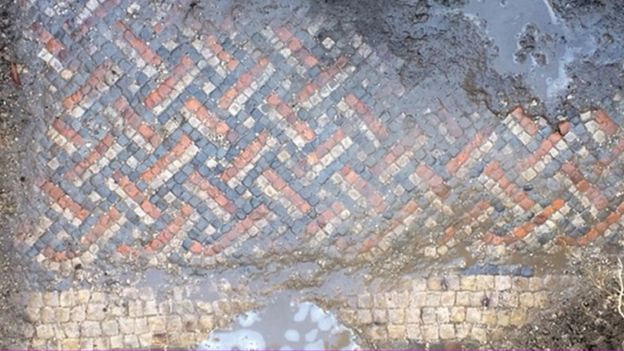
"LONDON, ENGLAND—A Roman villa said to be one of the largest in England has been discovered in a private yard in Wiltshire. Workmen were digging a trench for electric cables when they found a red, white, and blue mosaic floor, so the landowner called the local government office. The New York Timesreports that experts from the Salisbury Museum and Historic England uncovered coins, jewelry, pottery, a well, heating pipes, and the shells of hundreds of oysters and whelks. The shellfish were probably imported in barrels of salt water from the coast. The main structure is thought to have been a three-story tall building with as many as 25 rooms on its ground floor. The villa’s outbuildings are also expected to be found at the site. “The site has not been touched since its collapse 1,400 years ago, and so it’s of extreme importance,” said archaeologist David Roberts of Historic England. "
This is a picture of a piece of the mosaic floor right after it was found.
I'm always impressed by how carefully and respectfully Britain treats the remains of its past.
A video featuring the home owner and one of the scientists:
http://www.independent.co.uk/news/u...ved-roman-villa-in-his-backyard-a6987901.html
This Guardian article includes an artist's reconstruction of the villa.
http://www.theguardian.com/uk-news/2016/apr/17/amazing-find-roman-villa
"The electricians started drilling and hit a hard layer 18 inches below the surface. It was found to consist of pieces of mosaic. “We knew the significance of that straight away,” added Irwin. “No one since the Romans has laid mosaics as house floors in Britain. Fortunately we were able to stop the workmen just before they began to wield pickaxes to break up the mosaic layer.”Irwin called in Historic England (formerly English Heritage), whose archaeologists confirmed that the mosaic had formed part the floor of a grand villa built between AD175 and 220, and had been remodelled several times before the fifth century.
The Irwins’ house, created out of two labourers’ cottages, was built in the centre of the old villa and rests on a large slab of Purbeck marble, which is probably of Roman origin. According to the experts, the discovery is of “national significance”."
See:
http://www.archaeology.org/news/4388-160418-england-roman-villa
I didn't realize some of them were so large. The heating pipes indicate there's a bath there, of course.
"LONDON, ENGLAND—A Roman villa said to be one of the largest in England has been discovered in a private yard in Wiltshire. Workmen were digging a trench for electric cables when they found a red, white, and blue mosaic floor, so the landowner called the local government office. The New York Timesreports that experts from the Salisbury Museum and Historic England uncovered coins, jewelry, pottery, a well, heating pipes, and the shells of hundreds of oysters and whelks. The shellfish were probably imported in barrels of salt water from the coast. The main structure is thought to have been a three-story tall building with as many as 25 rooms on its ground floor. The villa’s outbuildings are also expected to be found at the site. “The site has not been touched since its collapse 1,400 years ago, and so it’s of extreme importance,” said archaeologist David Roberts of Historic England. "
This is a picture of a piece of the mosaic floor right after it was found.
I'm always impressed by how carefully and respectfully Britain treats the remains of its past.
A video featuring the home owner and one of the scientists:
http://www.independent.co.uk/news/u...ved-roman-villa-in-his-backyard-a6987901.html
This Guardian article includes an artist's reconstruction of the villa.
http://www.theguardian.com/uk-news/2016/apr/17/amazing-find-roman-villa
"The electricians started drilling and hit a hard layer 18 inches below the surface. It was found to consist of pieces of mosaic. “We knew the significance of that straight away,” added Irwin. “No one since the Romans has laid mosaics as house floors in Britain. Fortunately we were able to stop the workmen just before they began to wield pickaxes to break up the mosaic layer.”Irwin called in Historic England (formerly English Heritage), whose archaeologists confirmed that the mosaic had formed part the floor of a grand villa built between AD175 and 220, and had been remodelled several times before the fifth century.
The Irwins’ house, created out of two labourers’ cottages, was built in the centre of the old villa and rests on a large slab of Purbeck marble, which is probably of Roman origin. According to the experts, the discovery is of “national significance”."