
I was reading through a Serbian forum after scouring google for any information regarding haplogroup J2a-L70 and came across an interesting discussion. (Credit to the user Ivica Jovanovic on that forum).
I was curious of any J2a-L70s on Eupedia or anyone knowledge about J2a-L70 regarding their thoughts on the information from the Serbian forum.
Please see below the comments made by the user throughout the years regarding his observations of J2a-L70.
What do you think? Does it all make sense or does anyone know any additional info that counters the narrative presented above?
I was curious of any J2a-L70s on Eupedia or anyone knowledge about J2a-L70 regarding their thoughts on the information from the Serbian forum.
Please see below the comments made by the user throughout the years regarding his observations of J2a-L70.
About J-L70 (Theories of Origin)
J-L70, although young (formed 6700 ybp, TMRCA 3900 ybp), is a very widespread branch of haplogroup J2a. J-L70 is found throughout Western Eurasia, from the Levant through Anatolia and Greece to all areas of the former Roman Empire (and beyond). This has led to some controversy over where it originated and where it spread. The L70 haplogroup was present in the Levant, Anatolia and Mesopotamia before the Romans. Although a large number of branches are present among Jews, it must be pointed out that L70 is older than Israelis, but also Italians and Greeks, and that its significant presence among them can only be explained by a larger volume of testing within that population. It is considered that at this moment it is not provable that L70 originated and spread from Anatolia (which was the ruling paradigm until recently). We do not have a situation where there is a set of Anatolian (or Greek) sub-branches with one set of branches that went to the Levant. Phylogeny simply tells a different story. It's not like we see a clear Greek cluster and then a clear Levantine cluster - all the branches of J-L70 are mixed up. This suggests that J-L70 diversified among a particular culture or in a particular region before it spread. Additionally, we find Jewish branches all over J-L70 (15 found so far), while for the Anatolian expansion we should only have Jewish branches in one place (or in one sub-branch as among the Djerba population in North Africa). The presence of those Jewish branches throughout the phylogeny strongly supports the expansion of L70 from the Levant. Of course, this does not exclude the possibility that a large number of branches spread from Anatolia.
J-L70 is most common in the central and eastern Mediterranean and the Middle East. These are the regions with the highest frequencies. As we move away from these regions, the frequency drops drastically. The two regions with the greatest diversity are the Levant and Italy. L70 is a rare haplogroup of groups in the Caucasus, except among Mizrahi-Juhur and Armenians, however Herrera et al (2011) concluded that most L70 paternal lineages are among Levantine Armenians. So, the current prevailing theory is that L70 originated somewhere in the Levant and then spread to Anatolia and beyond, starting in the late Neolithic and in the Bronze Age in particular. Although we have a wide distribution of L70 today, with a TMRCA of 3800 years it is really young to reach that extent of distribution. The only logical explanation is that the expansion occurred first with the formation of Greek colonies and later with dispersion during the Roman Empire. In Italy itself we notice a trend that today J-L70 is more common in central Italy, Sicily and southern Italy than in the north. With a small note that Z2177 in Italy is more branched than CTS3601 (for now).
The branches that we will cover below, and which we should be interested in, are precisely J-Z2177 (TMRCA 3800 ybp) and J-CTS3601 (TMRCA 3300 ybp).
J-L70 in the Balkans, sources and stages of spread
If we consider the origin of J-L70 in the Balkans, it would be incorrect to claim that all individuals tested so far are of the same origin. Although currently the situation is such that about 70% of tested persons (from Serbia, Bosnia and Herzegovina, Montenegro, Croatia, Albania, Greece...) belong to the CTS3601 branch, it is more correct to assume that the L70 branch spread in the Balkans in different periods, following the spread of different cultures. Some of those cultures were probably Mycenaean and Minoan (although we still don't have archaeogenetic evidence). In addition, the living connections between Anatolia and the Greek world during the Bronze and Iron Ages should not be overlooked. Therefore, we can assume that some of the subbranches of L70 arrived that way as well. Also, specifically with J-PF5456, there is an opinion that it originated among the Italic tribes, in a complex interaction of R1b immigrants from the north and the local population of the Apennine Peninsula. Thus, L70 in the Balkans could have arrived from the south with the Greeks (from the islands and from Anatolia) or from the west with the Romans during the expansion of their empire. We should not reject the theory that the presence of L70 in the Balkans was reinforced by the arrival of auxiliary troops from Syria whose task was to guard the Danube Limes. In essence, we can assume that the Romans found a local presence of L70 in the wider area of the Balkans (most likely among the Greeks), but that some branches came with the Romans from Italy, while part of the carriers of that line came from the east (during the existence of the Roman Empire and Byzantium in these areas). That is why in the following text I will use the adjective "Greek-Roman" for the Balkan L70 (especially among the Serbs).
*** Before continuing, we must emphasize that apart from "Greco-Roman", there are several other theories about the origin of L70 in the Balkans. We will mention three: Celtic, Jewish and as a third theory that L70 appeared in the Balkans in the second wave of Indo-European migrations from the steppes. Although, where there is no archaeogenetic evidence, we must not use the epithet impossible. We will only say that these three theories are currently more difficult to prove.
Phase One: Greek Colonies and Their Influence on the Spread of J-Z387
The argument that the initial spread of L70 in the Balkans (and beyond) occurred during the establishment of Greek colonies in the Mediterranean (Magna Graecia, beginning in the 9th century BC) is that J-Z387 (DYS391-9) is present even in Provence. Greek colonies in Provence were founded by Greeks from Phocaea, which was located, miraculously, in western Anatolia. It should also be added that J2a-L397, which is associated with the Greek colonization of the Mediterranean, is also characterized by DYS445-6 (which was confirmed by my in-depth test). All tested so far on the SDNK project share a common value of DYS391, i.e. 9. In short, it is considered that L70 was present in the Balkans (including the islands) before the arrival of the Romans.
Second phase: Roman expansion in the Balkans
Starting from the 2nd century BC, the Romans gradually included our areas in their state. As we have already mentioned, there is a paradigm among experts dealing with haplogroup J-L70 that the further spread of L70 in the Balkans (and throughout the Mediterranean) occurred during the Roman Empire. It is assumed that some subgroups came to the Balkans from the Apennine Peninsula. We would not be wrong if we consider that there is a possibility that some Roman colonist, legionary, representative of the administration or trader came and brought that haplogroup. This would not be an isolated case as we find L70 from Hadrian's Wall (literally) all the way to western Armenia, the Levant and Egypt.
Phase Three: Migrations within the Roman Empire and Byzantium
In the era when the Roman Empire was at its peak, travel from one end of the empire to the other was easy. Whether they were merchants, colonists, representatives of the administration or legionnaires, using the extensive network of roads, they could travel in a short time, for example, from Syria to the Balkans or from the Balkans to Britain. There is much evidence for this, such as the tombstones of Romans with typically Dacian names in the necropolises around ancient Londinium (present-day London). We would not be wrong if we assume that those micromigrations did not bypass the carriers of haplogroup L70. In a sea of hard-to-proven claims, the claim that there was a large dispersion of subgroups of L70 precisely at that time, when Rome was at its peak, absolutely stands. The logical continuation was expansion within Byzantium. It is believed that in those periods J-L70 was already widespread in the Balkans. One of the pieces of evidence is an archaeogenetic sample from the Pirivoi necropolis near Viminacium, which belongs to haplogroup L70 (placed in the Anatolian cluster, if I'm not mistaken). Evidence that the additional influence of J-L70 came from the east is shown by the R:136 sample from Rome, which is partly autosomally leaning to the eastern Mediterranean.
Fourth phase: Migrations from the interior of the peninsula towards coastal and mountainous areas
Perhaps the most interesting phase for us is the phase during and after the arrival of the Slavs. It is generally known that after the arrival of the Slavs, part of the then population migrated to the peripheral parts of the peninsula, i.e. to the coasts (Adriatic, Aegean) as well as to hard-to-reach mountains (of which there is no shortage in the Balkans). Over the centuries, this heterogeneous population assimilated among various peoples - Serbs, Croats, Albanians, etc. Among them there are certainly individuals who carried the J-L70 haplogroup. Therefore, the appearance of Greco-Roman L70 among Serbs (but also other Slavs in the Balkans) is the result of the incorporation of the found population into the majority Slavic corpus.
End of Part I.
*** In part II, we will deal with archaeogenetic samples, distribution and autosomal results. We will also look at the current state of affairs among Serbs (and beyond).
In the third installment of this mini-project, we will talk about one of the most significant discoveries in recent times related to the J-L70 haplogroup in the Balkans. Namely, we will talk about an epochal archaeogenetic discovery from the vicinity of Travnik, from the Klisa-Guča Gora site.
Although the site has long been known to the scientific community (archaeologists and historians) as well as the fact that the remains of a nobleman named Petar Kušetić rest at that site, it was not known which haplogroup Patar Kušetić belonged to or whether the remains found in the vicinity were related to the aforementioned nobleman of medieval Bosnia.
The paper, published on January 16, 2023, and published by a team consisting of Mirela Džehverović, Belma Jusić, Amela Pilav, Tamara Lukić and Jasmina Cakar, reveals that the people buried at that site belonged to haplogroup J2a and that a large number of these individuals are closely related to each other. We will not be far wrong if we say that these are people who belonged to the same clan.
Comparing the publicly published markers with the, not so small, database of our project, it was determined that the Kušetić clan definitely belongs to haplogroup J-L70. To the surprise of both our and Bosnian researchers, given that the aforementioned haplogroup was found in the territory with the highest frequency of Slavic haplogroups in the Balkans today (excluding the area of Croatia). So, we have irrefutable evidence that the pre-Slavic J2a was also present in the landed gentry. This raises many questions about the relationship between the Slavs and the existing population and challenges many of the narratives that have existed so far.
Who were the Kušetićs, the only archaeogenetically examined J-L70 samples in the world whose names we have. Namely, it is a very significant and reported landed gentry family that, based on several valid testimonies, played a significant role in a wider area of that part of the Western Balkans. What remains to be proven is whether the Kušetićs are a branch of the even more significant Družićs, who ruled in that area somewhat earlier. Let us recall that the Družićs are mentioned as witnesses in two charters of the Kotromanjićs. The argument that the Kushetićs may have descended from the Druzićs is that on the tombstone of Petar Kushetić there is, unfortunately damaged, an inscription that says: Here lie Petar Kushetić and his brother Matia, in antiquity P/D. I deliberately put /D precisely because that is the missing part. It is possible that D was actually original, but due to damage it was identified as P.
The results of two samples from the Klis-Guča Gora site have been inserted into the Project table and there is an indication that they are close to the J-L70 clan that celebrates St. John's Day. Let us remind you that one of them (Maslarić) did a whole genome test and it was determined that he belongs to the haplogroup J-Z435* (more precisely J-FTC15577 on ftDNA). A small curiosity, the same sub-branch on ftDNA also belongs to a sample from Renaissance Italy - Tivoli 970, dated to the 17th or 18th century. Given this, it would be really useful if Maslarić or someone else from that branched clan did a ftDNA test at some point.
In the last paragraph I will try to give a bold theory about the origin of the branch to which the Kušetić nobles belong, but I believe also a good part of the other J-L70s in the Western Balkans. I believe, and the future will show whether I was right, that all of them are descendants of the population that was pushed towards the Adriatic coast at the time of the fall of the Limes and the arrival of the Slavs (and other peoples before them, the Goths for example). Over time, and thanks to the complex relationships that led to integration into the majority Slavic population, these people continue their existence within other current communities. I believe that neither the Kušetići/Družići nor their predecessors had the idea that they belonged to any other community until the current one. As an argument, I would also state that today among people from Dalmatia J-L70 is definitely present, as evidenced by the results on 23andme. That would be it regarding the Kušetići, next time we go to Viminacium on the Danube. After that, we will talk about possible patterns of such a widening of J-L70 in the Balkans. A diversity that many would envy, given the number of haplogroups tested today.
Quote: Ivica Jovanović December 09, 2023, 06:18:00 PM
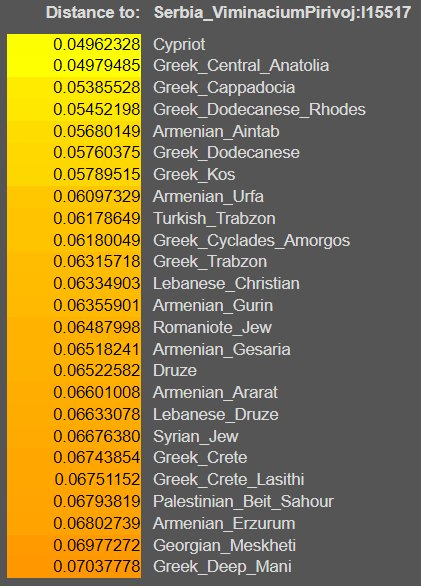
The long-awaitedautosomal results of the L70 sample from Viminacium.
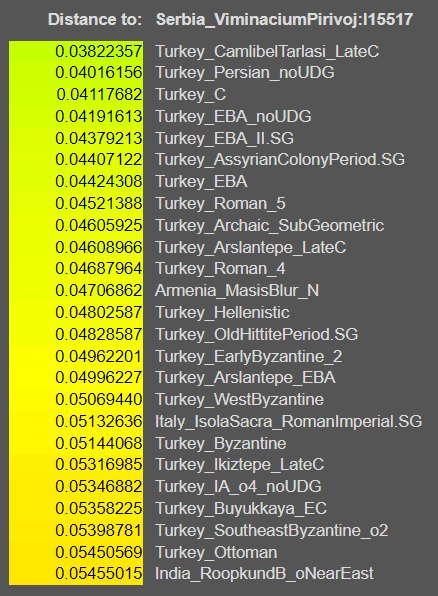
So this is definitely a representative of the Eastern Mediterranean immigration that was present in the Balkans in the first centuries of Roman rule.
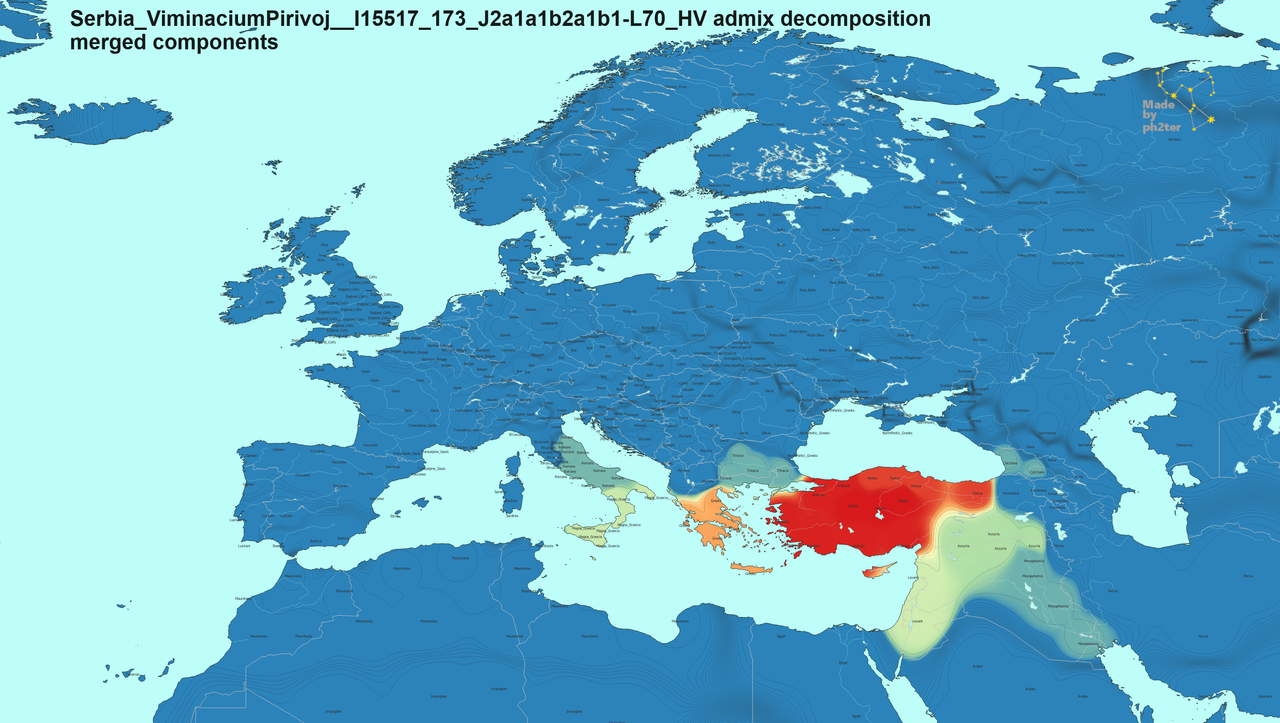
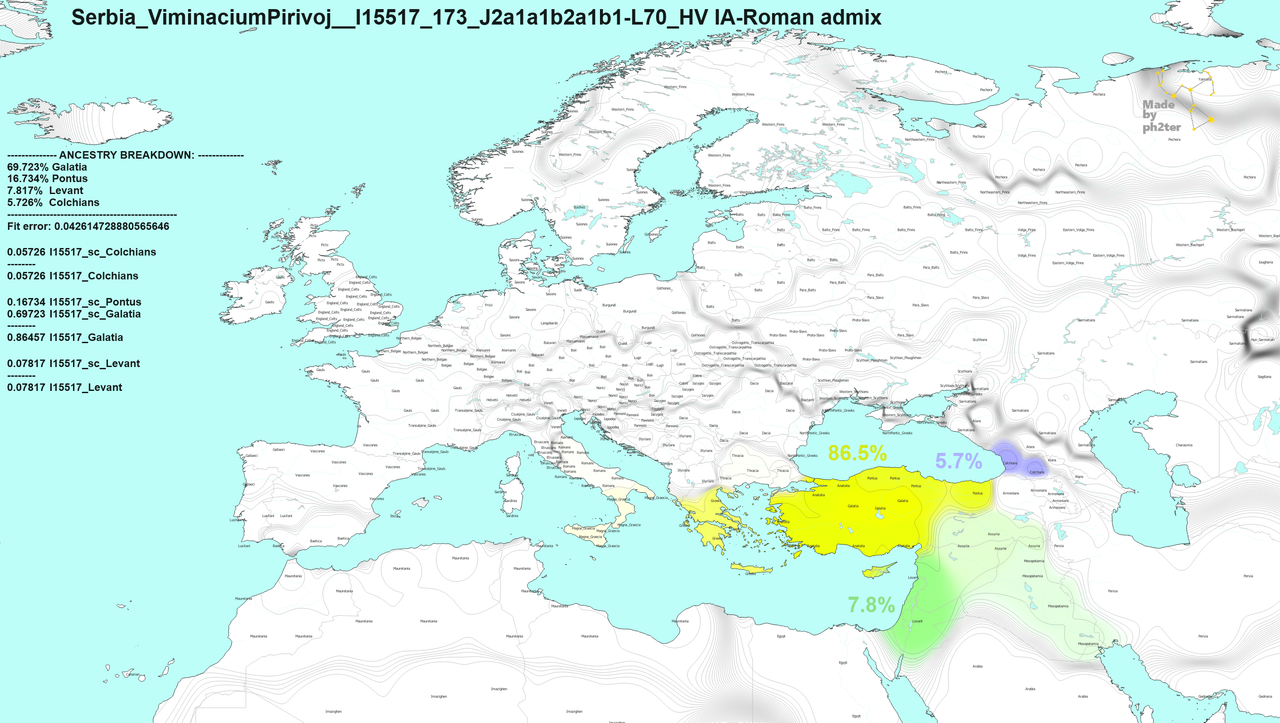
Maps of the same pattern from Viminacium.
PART 3:
HAPLOGROUP J-L70 IN THE BALKANS
What we know so far and what we can expect
Based on the tests conducted so far, we can conclude the following:
- Haplogroup J-L70 is present in the Balkans in a huge number of sub-branches.
- Although it was thought that only branches below J-Z435 were involved, Balkans were also found in other branches (Bulgarians/Greeks).
- In the former Yugoslavia, among the individuals tested so far, we have confirmed the following branches: FTC15577, Z40772, Z2177 and FTA63696. The number of confirmed branches is expected to increase.
- As for archaeogenetic samples, we have confirmation that J-L70 was present in the Balkans during the Roman Empire (Sample L15517). The Ph2ter map of this sample clearly indicates that it is a first generation of immigrants from Anatolia. Published work and the results of archaeogenetic testing of the skeletons from Viminacium indicate a significant presence of individuals who came from the east, and sample L15517 should be viewed in this context.
- Although we do not have a subgroup for the above-mentioned sample (it is only designated as J-L70), it is considered that it is most likely below J-Z435.
- Below J-CTS3601 we have two samples from the early Middle Ages found on the territory of Hungary. These are individuals buried in Avar graves, and according to their autosomal results they are probably descendants of Balkan Romans who joined the Avars or Slavs in a way that is still not completely clear. The Strategikon of Maurice also speaks of Romans who defected to the Slavs/Avars. In addition, it speaks of prisoners of war who, after being released, decided to continue their lives north of the Danube, and these two samples from Hungary could easily fit into that picture.
- The presence of a huge number of different sub-branches indicates an extremely long presence of L70 in these areas. Although the oldest sample found is from the Roman period, it is expected, especially in the southern Balkans, to find older samples.
- Haplogroup L70, which we also find among Serbs, could have come from several directions, but it is undoubtedly the most logical to assume that they are descendants of the pre-Slavic population that assimilated into the majority and dominant Slavic corpus. In this sense, L70 is no exception, and there are many similar cases. In addition, the possibility that some branches came with the Slavs, after their ancestors spent some time in these populations north of the Danube, cannot be ruled out.
- The not so small number of Croats, tested through 23andMe, and confirmed as L70, suggests that they are probably descendants of those Romans who retreated to the Adriatic cities and over the centuries became Slavicized. In our project, we have a Catholic Croat from the island of Krk who belongs to this haplogroup.
- We have a considerable number of confirmed carriers of this haplogroup among Macedonians, who are not tested much globally. To date, we have not had a single L70 Macedonian tested in depth.
- Among Albanians, it is mainly present in the southern and eastern parts of Albania.
- In Greece, the highest concentration is in the west.
- In Bulgaria, the concentration is in central Bulgaria, with a relatively small number of people tested.
- In Romania and Moldova, we have a specific case. Only two individuals have been tested in depth, and both are of Ashkenazi origin.
- Based on the above, it can be said that today the epicenter of this haplogroup in the Balkans is in the Ohrid-Ioannina-Valona triangle and that it can definitely be linked to the Romanophone population.
- Several clusters are observed among Serbs. The easiest to spot are two, the western (Jovanjštaci) from the north of Republika Srpska (BiH) and the eastern (Nikoljštaci) from southeastern Serbia. In addition, based on the limited number of markers, we can say that there are several more. I am primarily referring to the group in Šumadija, which may be linked to the group in Macedonia. There are strong indications that the group from the western regions, the aforementioned Jovanjštaci (FTC15577), is closely related to the recently found medieval samples from the Travnik area.
What can we expect in the coming period:Thanks to the announcements of extensive archaeogenetic research that will include numerous centers, such as Sirmium for example, we can expect the appearance of more L70 samples from the period of late antiquity. Also, as research in Turkey becomes more intensive, and with an emphasis on the Hittite period, the discovery of older L70 samples is expected. All indications point to the origin of this haplogroup being located in the triangle Turkey - Jordan - northern Iraq. One branch (J-Z435) spreads westward in the Bronze Age. Whether it was part of the Bronze Age migration of haplogroup J2 that left its mark on the western Balkans remains to be seen, because the only certain fact is that the Romans contributed to its large dispersion.
We hope that everything published so far will help people who have been tested, or are about to be tested, and have been assigned the J-L70 haplogroup. To help in terms of easier understanding of their own ancestry along the uninterrupted male line, but also to contribute to an easier decision to undergo tests on a larger number of markers.
One new result caught our attention. Namely, another Albanian appeared in the J-Y126749 branch, and the TMRCA was determined to be 3000 years old. Although it has previously been speculated that there is a possibility that some of the L70 branches have been in the Balkans for a long time, and that the entire J-Z435 started to spread from the Balkans, as incredible as it sounds at this moment, we must admit that there is a chance that some branches have indeed been there since the Bronze Age. So much earlier than previously thought, that is, it was believed that the first carriers could only have arrived with the Hellenized Anatolians who participated in the Greek colonization of the Mediterranean. An additional mystery is that there is also one Chinese in the same branch, out of two in J-Z423. Maybe, but just maybe, it is part of the population that colonized the Balkans, the Apennines and the Tyrrhenian Islands in the Bronze Age, which is the case with some other J2 branches. There is also the possibility that they came from present-day northern Iran or Armenia, territories that were involved in trade between the Mediterranean and the East even before the establishment of the Silk Road. In any case, it seems that J-Z423 was in the Balkans and the Apennines for a long time and that it could have spread from there to Western Europe, as there are branches in Western Europe with a TMRCA of about 3500 years.
What do you think? Does it all make sense or does anyone know any additional info that counters the narrative presented above?
