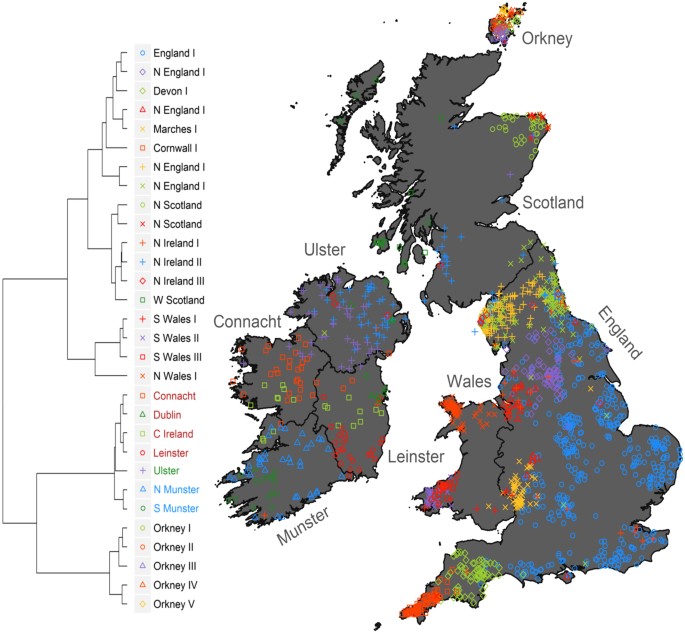
Yes and there it's were it fails, there is no such thing as "purity" on the European level, see Angela: "Given how similar all human beings are, "races" have to correspond to source areas separated from one another for a long enough time that enough differences attributed to selection based on environment as well as happenstance can accumulate. That leaves you with, as Reich put it, continental breeding populations."
@Riverman, that would be the method we draw a fence about "La Tene" and "Jastorf" in a given time and we call this population "pure"?
Ok suppose we are able to have enough samples. First of all the question is, if this "delivers" a coherent auDNA position.
Take for example the Westfrisian case. This is a very, very small restricted area. But already in IA there it was autosomal differentiated, not restricted to one specific close core area on the PCA's etc.
But even if we could restrict is to a certain area with close autosomal results (could you in the case of La Tene or Jastorf??? I see no signs).
Then I still can't see that the "Germanic world" the folks from Leeuwarden in Frisia to Bergen in Norway, Stralsund in Germany can be drawn back to the Jastorf auDNA. The same with the "Celtic world"....and La Tene.
You gave the answer yourself. I think of Germanic and Celtic being on all the mentioned levels part of a related continuum.
What separates their respective cores was much less a fundamental, essential difference, but rather other groups of people of their own in between them. Like Proto-Celtic A, unknown B, unknown C, Proto-Germanic D.
They were no direct neighbours initially, in their proto-stage.
The same was or even still is true for many races and subraces or populations, which, just like this case, didn't have to be fundamentally different, but simply had no direct contact and overlap.
Like in Europe, with the usual PCAs, its the same with populations and types. Some do overlap, others do not or at least much less so. Like Germans and English do overlap, for many obvious reasons, so do Greek and Albanians. But Finns and Greeks usually don't overlap on a PCA.
That principle of affinity, neighbourhood, overlap or simply biological relatedness is key in all these matters which concern "race" and biological differences.
The more you go into detail, the more blurred it gets, while if you zoom out, the pattern is clear.
That's also why post-1968, Marxist inspired "New Archaeology" focused on as detailled as possible small scale research, while abandoning the bigger picture in large parts of the publications ("end of great explanations"). Its a way to blurr the bigger picture for the recipients, by deliberately ignoring the general patterns and observable principles, while at the same time refusing accountability: They could declare and claim all kind of things by just focusing on a small scale regional pattern, while ignoring context.
That way, instead of "Beaker folk", they spoke about a "Beaker cultural phenomenon" of prestige goods and social habits. Fortresses became "central social places" and weapons "social signals" (only).
And that was also the reason why the archaeologists following that kind of arbitrary reasoning opposed ancient DNA research, because they knew the truth but just wanted to hide it. It made their nonsense theories accountable again! Now they couldn't just claim crap like "same people just different pots" and hide behind miserable theoretical constructs (that are real "social constructs" or better scientific misconduct), but had to face hard data from the natural scientific approach (again).
Leaves in both cases the social construct.....
Everything is a social construct and nothing for our species. The concept of a "human race" is as much a construct as that of race XY or a species of butterflies, which only exists in the head of an entomologist.
There is biological reality and then there is our human ability to grasp and describe it.
For any sort of biological categorisation, the number one quality proof is that the method being as simple as possible and its replicability.
Replicability means in this context that a properly educated person would be always able to come to similar conclusions and classifications.
Like if an entomologist concentrated on a small variation of color in the wing of a butterfly which is barely visible and not generally common in the regional subpopulation, it would be at best a regional frequency trait, but constitute no distinct species, race or type of its own.
The same applies to all living organisms, including human. And its equally true for the phenotypical or genetic categorisations.
In the case of Germanics and Celts, the first and foremost difference is quite obviously the language and everything else follows at a distance...
 so we can't pinpoint how they spoke. High danger of projection (afterwards).