

ZZZZ1111
Regular Member
- Messages
- 106
- Reaction score
- 29
- Points
- 28
Most of the mitochondria in East Asia belong to Mt-D4 and D5, and most of them came from Siberia. They rapidly diversified 18,000 years ago and spread to the south, bringing EDAR-370A from Siberia.
During the ice age, there were Tianyuan people (mainly Y-Q at that time). Later, Y-N arrived in Siberia and was absorbed. Y-C may be more widely related to Mt-C and Z.
The original maternal line of Y-O is (B5, M7, N9a) and the original maternal line of Y-D is (M7, N9b), which is likely not involved while lived in the south and isolated island.
The paternal lineage O1b may have been associated with N 20,000 years ago. Both O1b* and N1b* were observed at the early Yangshao site, and were quickly replaced by O2-m117 from the south.After the failure of O1b, went south 12,000 years ago and participated in the formation of the Austroasiatic language family.
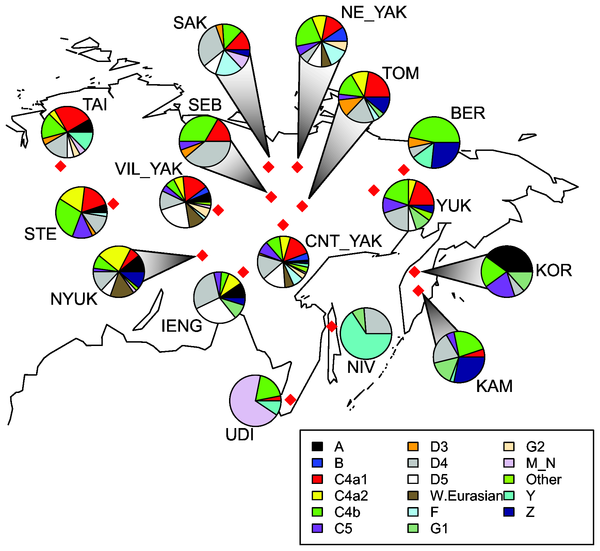
During the ice age, there were Tianyuan people (mainly Y-Q at that time). Later, Y-N arrived in Siberia and was absorbed. Y-C may be more widely related to Mt-C and Z.
The original maternal line of Y-O is (B5, M7, N9a) and the original maternal line of Y-D is (M7, N9b), which is likely not involved while lived in the south and isolated island.
The paternal lineage O1b may have been associated with N 20,000 years ago. Both O1b* and N1b* were observed at the early Yangshao site, and were quickly replaced by O2-m117 from the south.After the failure of O1b, went south 12,000 years ago and participated in the formation of the Austroasiatic language family.
Last edited: