The Bell Beaker phenomenon is one of the most debated subjects in European prehistory because it combines an extraordinary geographical and cultural expansion with great genetic diversity.
Jean Manco's theory about the Stelae People (Proto-Italo-Celtic speakers), that they travelled from the Carpathian Basin to Portugal and developed there the Bell Beaker Culture, is very interesting: “
It seems possible that a group of Pre-Proto-Italo-Celtic speakers left the Danube corridor to travel through the Vučedol culture (Croatia), which would give them a relatively easy route to the Adriatic Sea and from there to northern Italy, along the River Po to Liguria and on to Iberia by sea.” “We can also picture the mother group of Proto-Italo-Celtic speakers gradually moving further up the Danube from the Carpathian Basin and developing Proto-Celtic. If the Stelae People had created trade routes across Europe from the Carpathian Basin as far as Portugal, we can see how Bell Beaker ware could have been developed in Portugal and yet crop up in Hungary.”
But archaeological and genetic evidence is lacking to confirm this.
There are several models to explain their origin and expansion, the Iberian model, the Dutch Model, but there are difficulties establishing an absolute chronology, there is a lack of chronological resolution because radiocarbon ranges overlap, making precise dating unclear, so there are still many unanswered questions. But the consensus between scholars is their origin in Western Iberia and expansion from there.
Between approximately 2800 and 1800 BCE, Bell Beaker pottery, individual burial customs, archery equipment, copper metallurgy, and a range of prestige objects appeared across a vast territory stretching from Portugal to Hungary and from Sicily to Scotland. For more than a century, archaeologists attempted to explain this phenomenon through a single narrative, but recent archaeological and genetic evidence suggests that no single explanation is sufficient.
I agree with Maciamo that the Bell Beaker culture was a cultural phenomenon and not an ethnic culture. All the evidence, archaeological, genetic, points in that direction. The earliest interpretations viewed Bell Beaker as the expansion of a distinct people, often referred to as the "Beaker Folk." In this model, a coherent population migrated across Europe carrying its characteristic pottery, technologies, and social practices. As archaeological evidence accumulated, however, this explanation became increasingly difficult to sustain because Bell Beaker assemblages displayed substantial regional variation. The pottery styles, burial practices, settlement patterns, and economic systems associated with Bell Beaker communities differed from one region to another, suggesting a more complex process than the movement of a single ethnic group.
One of the most influential attempts to explain this complexity was the
Reflux Theory proposed by Edward Sangmeister during the mid-twentieth century. Sangmeister accepted that the earliest Bell Beaker pottery, particularly the Maritime Beaker style, appeared in Atlantic Iberia, especially around the Tagus estuary in Portugal. He proposed that Bell Beaker first spread eastward and northward from Portugal into western and central Europe. This initial movement, the "flux," carried Bell Beaker styles across the continent. Once these traditions reached Central Europe, they interacted with local Chalcolithic and Corded Ware populations. According to Sangmeister, this interaction transformed the Bell Beaker package, introducing new features such as corded decoration, and other characteristic elements (All-Over-Corded (AOC)). These innovations then spread back westward and south-westward in a second movement, the "reflux" or backflow. In Sangmeister's view, Bell Beaker culture therefore originated in Iberia but achieved its mature form in Central Europe before returning to influence the west.
The attractiveness of Sangmeister's theory lies in its ability to explain why some Bell Beaker features appear earlier in Iberia while other characteristic elements seem to emerge later in Central Europe. However, the theory was developed before the advent of radiocarbon dating, isotopic studies, and ancient DNA, and therefore relied entirely on artifact distributions and typological sequences.
A related question concerns how Bell Beaker traditions could have travelled from Atlantic Portugal to Central Europe in the first place. One possible answer lies in the earlier megalithic world of Atlantic Europe. Long before Bell Beaker appeared, extensive networks linked Portugal, western France, Britain, Ireland, the Low Countries, Denmark, and parts of Scandinavia through the construction of megalithic monuments and the exchange of ideas, symbols, and materials. Rather than seeing Bell Beaker as a sudden innovation spreading through previously isolated regions, it may be more accurate to view it as emerging within an already interconnected Atlantic interaction sphere. The Bell Beaker phenomenon may therefore have followed communication routes established centuries earlier by megalithic societies. In this interpretation, Bell Beaker was not the creator of long distance European connectivity but rather a transformation of networks that already existed.
Ancient DNA has dramatically reshaped the debate. The
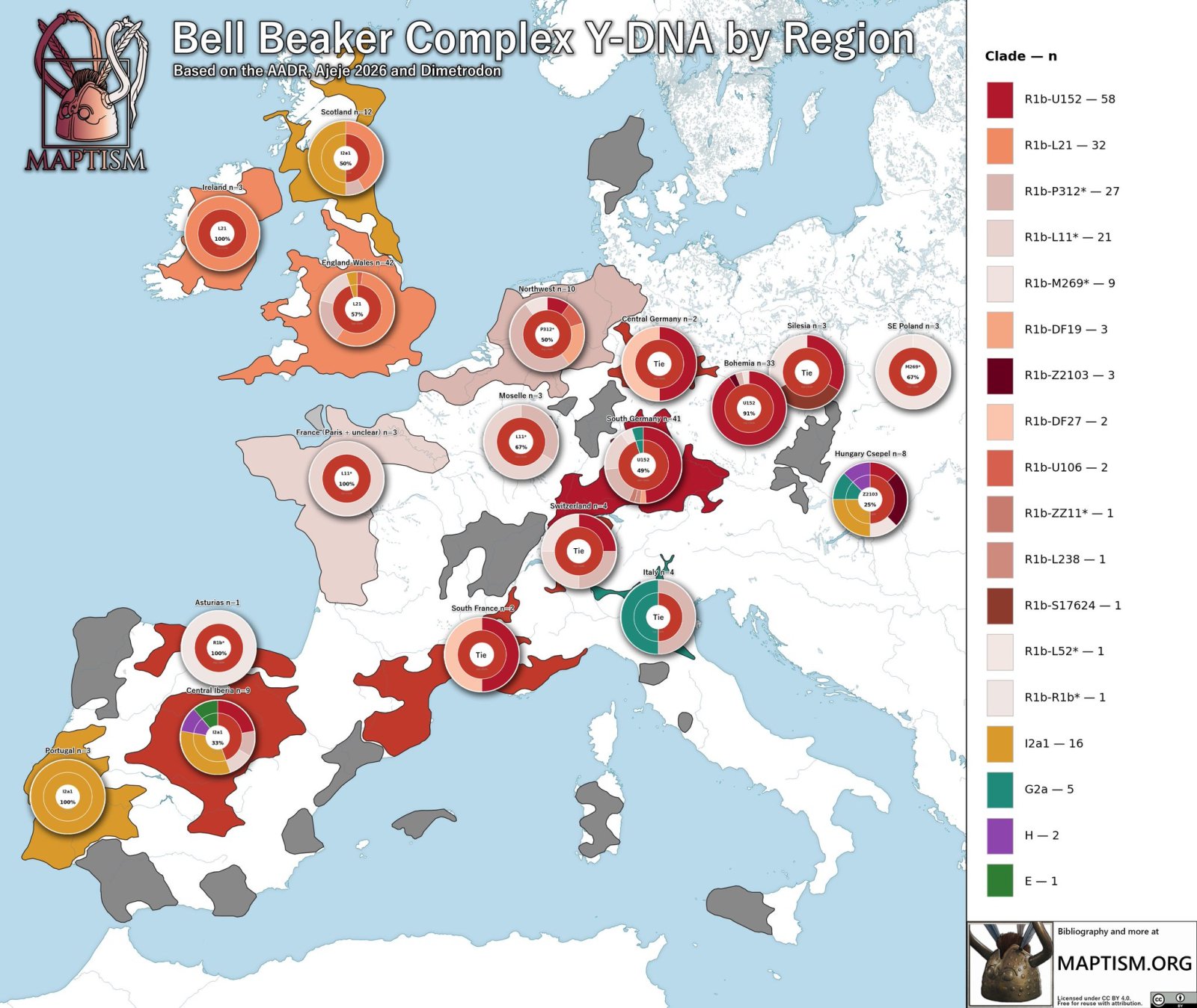
2018 study led by researchers associated with David Reich analysed hundreds of ancient genomes from across Europe and demonstrated that Bell Beaker populations were not genetically homogeneous. Individuals associated with Bell Beaker artifacts in Iberia possessed ancestry profiles very different from those of Bell Beaker populations in Central Europe. Most Iberian Bell Beaker individuals showed strong continuity with earlier local populations and little steppe ancestry, whereas Central European Bell Beaker populations carried substantial steppe derived ancestry. This finding effectively ruled out the idea that a single Iberian Bell Beaker population migrated across Europe carrying the culture everywhere it went.
At the same time, the genetic evidence revealed one of the most dramatic demographic events in European prehistory. In Britain, the arrival of Bell Beaker associated populations around 2450 BCE coincided with the replacement of roughly ninety percent of the ancestry of the preceding Neolithic population within a few centuries. The incoming populations were genetically closest not to Iberians but to Bell Beaker groups from the Lower Rhine and adjacent regions of northwestern Europe. This demonstrated that Bell Beaker expansion involved very different processes in different regions. In Iberia, Bell Beaker often spread primarily as a cultural phenomenon with limited demographic impact. In Britain, Bell Beaker was associated with massive migration and population turnover.
Ironically, the genetic evidence has revived part of Sangmeister's intuition while rejecting his original mechanism. The data do not support a migration of Iberian Bell Beaker people into Central Europe and back again. However, they do suggest a sequence in which Bell Beaker ideas may have originated or crystallised in Atlantic Iberia, spread eastward through cultural networks, became associated with steppe-derived populations in Central Europe, and then moved westward again through migration into Britain and other regions. In this sense, there may indeed have been a reflux of a transformed Bell Beaker phenomenon.
Recent archaeological interpretations have moved beyond the search for a single homeland. Marc Vander Linden's work (
The Bell Beaker Phenomenon in Europe - 2024) represents an influential contemporary synthesis. Rather than viewing Bell Beaker as a culture, ethnicity, or migrating people, he interprets it as a metapopulation. In this model, Bell Beaker consisted of numerous regional communities connected through networks of exchange, mobility, marriage, metallurgy, ritual practices, and shared symbols. These communities maintained their local identities while participating in a broader system of interaction that stretched across much of Europe. Bell Beaker unity therefore arose not from common ancestry or political organisation but from connectivity itself.
This metapopulation model accommodates both the archaeological diversity and the genetic variability revealed by recent studies. It explains why Bell Beaker pottery and practices could appear across enormous distances while populations remained biologically distinct. It also explains why migration was significant in some regions and limited in others. Rather than forcing all evidence into a single narrative, the model recognises that different local trajectories coexisted within the same broad phenomenon.
When all these perspectives are combined, a coherent picture emerges. The Bell Beaker phenomenon likely originated within the Atlantic networks of Late Neolithic Europe, perhaps in the Tagus estuary region of Portugal, where the earliest Maritime Beakers are found. The existence of long established megalithic interaction networks may have facilitated its initial spread across western Europe. As Bell Beaker traditions moved eastward, they encountered the societies of Central Europe, including populations carrying substantial steppe ancestry. There, new social, technological, and ideological forms emerged, transforming the phenomenon. Some of these transformed Bell Beaker groups subsequently expanded westward, particularly into Britain, where they produced profound demographic change. Throughout this process, Bell Beaker was never a single people or civilisation. It was a dynamic and evolving network of interconnected communities whose members exchanged objects, ideas, technologies, and, in some regions, people.
From this perspective, Sangmeister, Reich, and Vander Linden are offering complementary explanations. Sangmeister helps explain the directional flow of cultural developments, Reich demonstrates that migration played a major but regionally variable role, and Vander Linden provides the overarching framework that integrates both cultural transmission and human mobility. Together, their work suggests that the Bell Beaker phenomenon was neither merely a culture nor merely a migration. It was a continent-wide system of interaction that transformed older Atlantic networks, absorbed Central European influences, and reshaped the demographic and cultural landscape of prehistoric Europe.
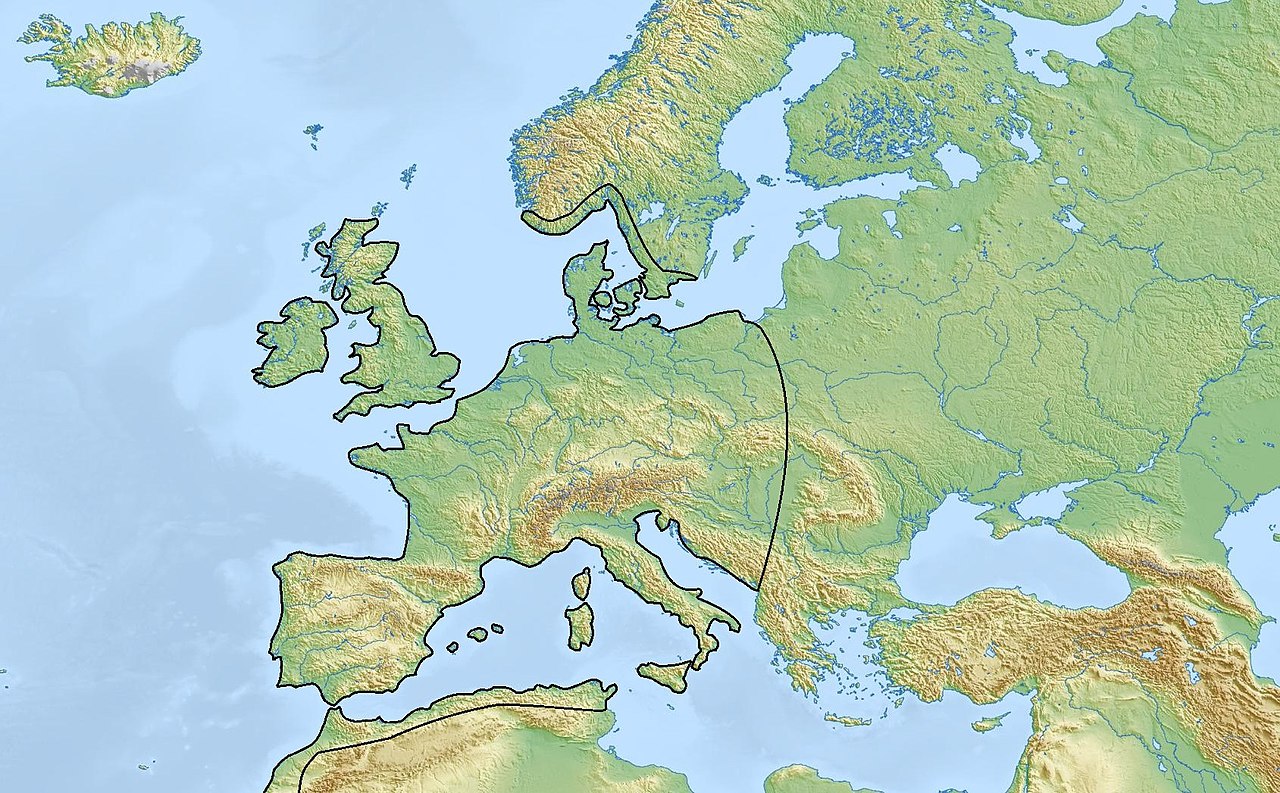
The maps aren't great, but you can get the idea.