

Tautalus
Regular Member
- Messages
- 580
- Reaction score
- 1,482
- Points
- 93
- Ethnic group
- Portuguese
- Y-DNA haplogroup
- I2-M223 / I-FTB15368
- mtDNA haplogroup
- H6a1b2y
This paper investigates how natural selection has shaped human genetic variation over the last ~18,000 years by analysing a very large dataset of ancient genomes. The authors compile and analyse genetic data from 15,836 individuals, including more than 10,000 newly sequenced ancient samples, alongside modern genomes, making this one of the most comprehensive temporal datasets ever assembled for studying human evolution. The central goal is to directly detect directional selection, meaning consistent increases or decreases in allele frequencies over time, rather than inferring selection indirectly from present day genetic patterns.
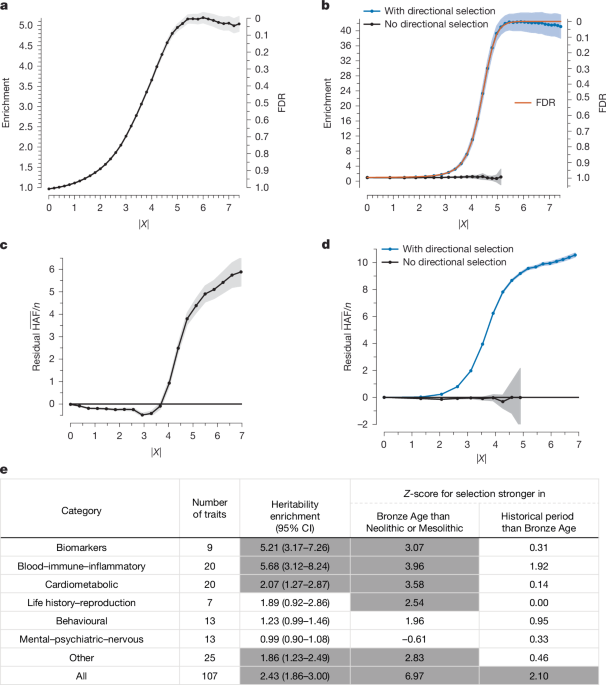
To achieve this, the authors introduce a new statistical method designed to identify directional selection in time series genetic data. Instead of relying on comparisons between populations that can be confounded by migration or population structure, their method tests whether allele frequencies change consistently with time after accounting for genetic similarity between individuals. This allows them to distinguish true selection from changes caused by admixture, drift, or demographic history. They further increase power by imputing missing genetic data, applying extensive quality control, and analyzing millions of variants across the genome. Because standard statistical assumptions do not hold in this context, they calibrate their test using enrichment of genome wide association study (GWAS) signals and simulations, ensuring that detected signals are likely to reflect genuine selection rather than artefacts.
Using this framework, the study finds that directional selection has been widespread and strong in West Eurasia over the last 10,000 years, identifying 479 independent loci with very high confidence and thousands more with weaker evidence. This is a striking contrast to earlier views that strong selection was rare in recent human history. The estimated selection coefficients are often on the order of 0.5% or higher, which is substantial in evolutionary terms. The authors show that these signals are robust through multiple lines of evidence, including enrichment for GWAS associated variants and characteristic patterns in surrounding haplotypes.
The traits most strongly affected by selection are those related to immune function, metabolism, and environmental adaptation. Immune related genes show particularly strong and consistent signals, likely reflecting adaptation to changing pathogen environments as human populations grew, adopted agriculture, and lived in closer proximity to domesticated animals. The study also finds strong selection on genes affecting skin pigmentation, with multiple loci contributing to the evolution of lighter skin in West Eurasia. These changes occurred largely after the adoption of farming and are plausibly linked to reduced sunlight exposure and dietary shifts affecting vitamin D synthesis.
In addition to single gene effects, the authors examine polygenic adaptation, where many genes with small effects collectively influence complex traits. By combining their selection estimates with GWAS data for hundreds of traits, they test whether groups of alleles associated with particular phenotypes have shifted in a coordinated way over time. They find evidence that genetic predictors of traits such as body fat, cardio-metabolic risk, smoking behavior, and some psychiatric conditions have changed directionally, often in ways consistent with improved health outcomes in modern environments. They also detect signals suggesting increases in genetic predictors of traits related to cognitive performance, education, and socioeconomic outcomes, although they emphasize that these modern phenotypes may not correspond directly to traits under selection in ancient populations.
A key insight of the study is that human evolution has been highly dynamic and context-dependent, with selection pressures changing over time and sometimes reversing direction. Several specific genetic examples illustrate this complexity. For instance, alleles in immune genes that today increase risk for autoimmune diseases were positively selected in the past, likely because they conferred protection against infections. Other loci show clear reversals, where an allele was initially favored and later selected against as environments changed. The study also revisits well known hypotheses about particular genes, confirming some (such as selection on pigmentation genes) while rejecting others (such as strong directional selection on the cystic fibrosis allele).
Despite its strengths, the study acknowledges important limitations. Interpretation of polygenic signals is particularly challenging because GWAS effect sizes are derived from modern populations and environments, which may differ greatly from ancient conditions. Additionally, although the method attempts to control for population structure, residual confounding cannot be entirely ruled out. The assumption of constant selection coefficients over time is also a simplification, given evidence that selection pressures often fluctuate.
Overall, the study provides strong evidence that recent human evolution in West Eurasia involved widespread, ongoing directional selection affecting hundreds of genetic variants and many biological systems. It shifts the perspective from rare, dramatic selective sweeps to a more complex picture in which adaptation is often polygenic, temporally variable, and closely tied to cultural and environmental changes such as agriculture, diet, and disease exposure.
AbstractTo achieve this, the authors introduce a new statistical method designed to identify directional selection in time series genetic data. Instead of relying on comparisons between populations that can be confounded by migration or population structure, their method tests whether allele frequencies change consistently with time after accounting for genetic similarity between individuals. This allows them to distinguish true selection from changes caused by admixture, drift, or demographic history. They further increase power by imputing missing genetic data, applying extensive quality control, and analyzing millions of variants across the genome. Because standard statistical assumptions do not hold in this context, they calibrate their test using enrichment of genome wide association study (GWAS) signals and simulations, ensuring that detected signals are likely to reflect genuine selection rather than artefacts.
Using this framework, the study finds that directional selection has been widespread and strong in West Eurasia over the last 10,000 years, identifying 479 independent loci with very high confidence and thousands more with weaker evidence. This is a striking contrast to earlier views that strong selection was rare in recent human history. The estimated selection coefficients are often on the order of 0.5% or higher, which is substantial in evolutionary terms. The authors show that these signals are robust through multiple lines of evidence, including enrichment for GWAS associated variants and characteristic patterns in surrounding haplotypes.
The traits most strongly affected by selection are those related to immune function, metabolism, and environmental adaptation. Immune related genes show particularly strong and consistent signals, likely reflecting adaptation to changing pathogen environments as human populations grew, adopted agriculture, and lived in closer proximity to domesticated animals. The study also finds strong selection on genes affecting skin pigmentation, with multiple loci contributing to the evolution of lighter skin in West Eurasia. These changes occurred largely after the adoption of farming and are plausibly linked to reduced sunlight exposure and dietary shifts affecting vitamin D synthesis.
In addition to single gene effects, the authors examine polygenic adaptation, where many genes with small effects collectively influence complex traits. By combining their selection estimates with GWAS data for hundreds of traits, they test whether groups of alleles associated with particular phenotypes have shifted in a coordinated way over time. They find evidence that genetic predictors of traits such as body fat, cardio-metabolic risk, smoking behavior, and some psychiatric conditions have changed directionally, often in ways consistent with improved health outcomes in modern environments. They also detect signals suggesting increases in genetic predictors of traits related to cognitive performance, education, and socioeconomic outcomes, although they emphasize that these modern phenotypes may not correspond directly to traits under selection in ancient populations.
A key insight of the study is that human evolution has been highly dynamic and context-dependent, with selection pressures changing over time and sometimes reversing direction. Several specific genetic examples illustrate this complexity. For instance, alleles in immune genes that today increase risk for autoimmune diseases were positively selected in the past, likely because they conferred protection against infections. Other loci show clear reversals, where an allele was initially favored and later selected against as environments changed. The study also revisits well known hypotheses about particular genes, confirming some (such as selection on pigmentation genes) while rejecting others (such as strong directional selection on the cystic fibrosis allele).
Despite its strengths, the study acknowledges important limitations. Interpretation of polygenic signals is particularly challenging because GWAS effect sizes are derived from modern populations and environments, which may differ greatly from ancient conditions. Additionally, although the method attempts to control for population structure, residual confounding cannot be entirely ruled out. The assumption of constant selection coefficients over time is also a simplification, given evidence that selection pressures often fluctuate.
Overall, the study provides strong evidence that recent human evolution in West Eurasia involved widespread, ongoing directional selection affecting hundreds of genetic variants and many biological systems. It shifts the perspective from rare, dramatic selective sweeps to a more complex picture in which adaptation is often polygenic, temporally variable, and closely tied to cultural and environmental changes such as agriculture, diet, and disease exposure.
Ancient DNA has transformed our understanding of population history, but its potential to reveal as much about human evolutionary biology has not been realized because of limited sample sizes and the difficulty of distinguishing sustained rises in allele frequency increasing fitness—directional selection—from shifts due to migrations, population structure, or non-adaptive purifying or stabilizing selection. Here we present a method for detecting directional selection in ancient DNA time-series data that tests for consistent trends in allele frequency change over time, and apply it to 15,836 West Eurasians (10,016 with new data). Previous work has shown that classic hard sweeps driving advantageous mutations to fixation have been rare over the broad span of human evolution. By contrast, in the past ten millennia, we find that many hundreds of alleles have been affected by strong directional selection. We also document one-standard-deviation changes on the scale of modern variation in combinations of alleles that today predict complex traits. This includes decreases in predicted body fat and schizophrenia, and increases in measures of cognitive performance. These effects were measured in industrialized societies, and it remains unclear how these relate to phenotypes that were adaptive in the past. We estimate selection coefficients at 9.7 million variants, enabling study of how Darwinian forces couple to allelic effects and shape the genetic architecture of complex traits.
Behind a paywall
Behind a paywall
Ancient DNA reveals pervasive directional selection across West Eurasia - Nature
Analysis of 15,836 ancient West Eurasian genomes reveals hundreds of instances of directional selection, showing that sustained changes in allele frequency were widespread, rather than being rare over this period as previously assumed.www.nature.com
Pdf from David Reich Lab
Article in Science Magazine
Gallery of single-variant allele frequency trajectories

Signals of directional polygenic selection.

Last edited: