

I was wondering where and when exactly did lions start being adopted on coat of arms in Medieval Europe. I did my research and here is what I found.
The earliest known coat of arms featuring a lion is that of Geoffrey Plantagenet, Count of Anjou. An enamel plaque for his tomb (made c. 1155–1160) shows Geoffrey with a blue shield strewn with six golden lions rampant, and a helm crested with another lion. A chronicle written around 1175 reports that Geoffrey received that same lion-decorated shield when he was knighted by Henry I of England in 1128, which, if taken at face value, would be the earliest recorded grant of a lion coat of arms.

The first instance of the lion as symbol of León is found on minted coins of Alfonso VII "the Emperor" (1126–1157), from around 1134 onwards. His son Ferdinand II of León (1157–1188) then used the lion on royal charters. Ironically the name León does not come from the Spanish for lion but from a corruption of the Latin name of the city, Legio, as it was founded in the 1st century BCE by the Roman legion Legio VII Gemina.

The Flemish lion first appears clearly on a seal of Count Philip of Alsace in 1163, and his cousin William of Ypres used a lion passant on a seal of 1158.
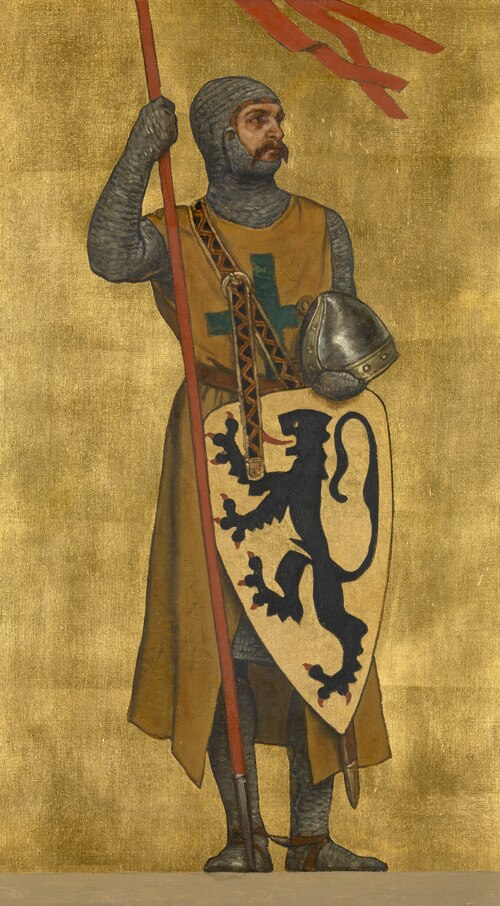
The Count of Holland, Floris III (r. 1157–1190), adopted the Holland lion (or, a lion rampant gules) around 1160 on his coins and 1162 on his shield, probably inspired by Flanders. The lion's rapid spread around the Low Countries (Hainaut, Namur, Brabant, Limburg, Luxembourg) between the 1190s and the 1220s, reflecting a regional fashion, which also spread to West Germany (Saarbrücken, Palatinate, Nassau) and beyond (Thuringia).
In contrast the lion coat of arms of Swabia is stylistically quite different from the standing lion of the Low Countries. Frederick VI of Swabia's seal (c. 1181) shows a single lion rampant on his shield — the earliest known Hohenstaufen lion arms. His brother and heir Philip of Swabia used three lions passant sable on or (1197 seal) — the fully developed version that becomes the standard Hohenstaufen/Swabian arms.
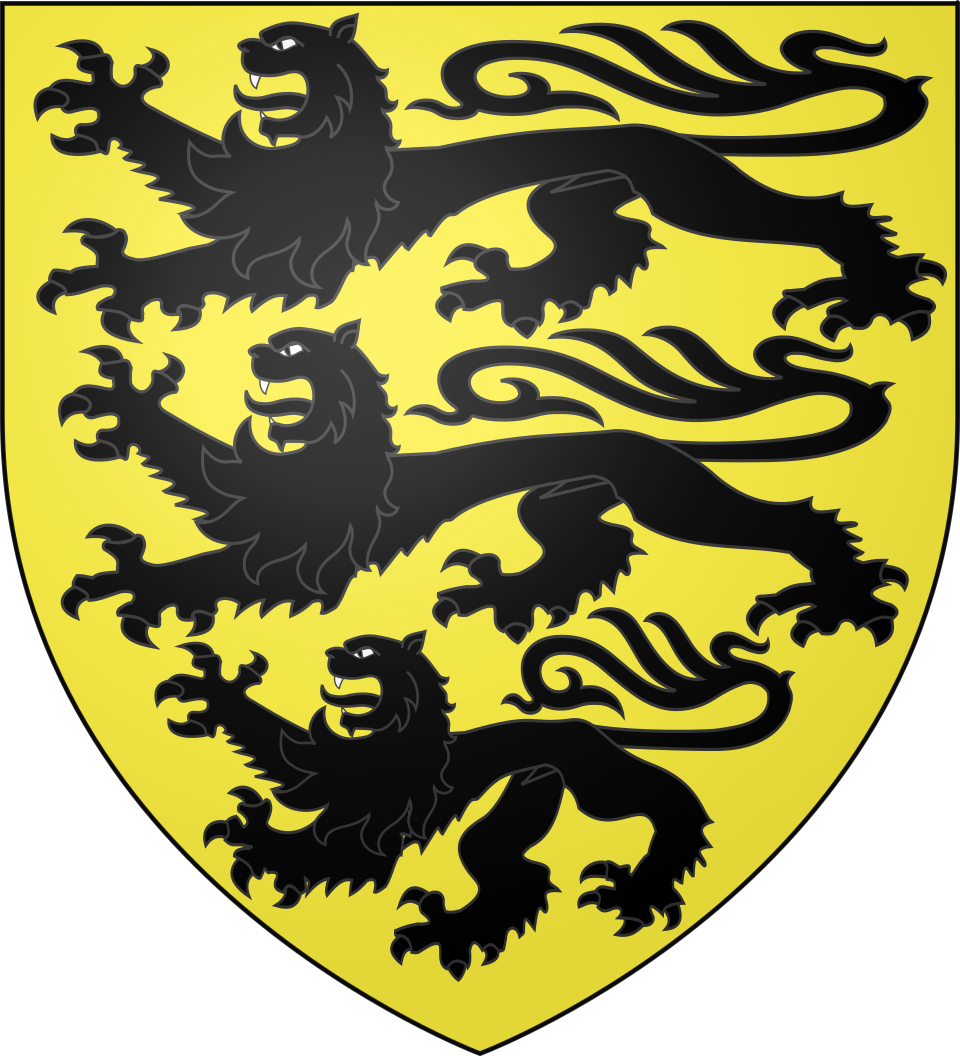
It seems that Richard the Lionheart, King of England and Duke of Normandy, got his inspiration directly from the House of Hohenstaufen. Richard's first Great Seal (1189) was a single lion rampant (like Frederick VI's and only 8 years later). His second Great Seal (1198) was three lions passant guardant or on gules, adopted just one year after Philip of Swabia!

The origins of the arms of Bohemia are shrouded in legend. A medieval chronicle by Dalimil (early 14th century) claims that Holy Roman Emperor Frederick Barbarossa granted the silver lion on red to Vladislaus II (r. 1158–1172) as a reward for military aid against Milan. This tale symbolises Vladislaus's elevation to kingly status, but Dalimil wrote a century later and is considered unreliable for precise historical facts. The first secure attestation of the Bohemian lion is on the equestrian seal of Vladislaus Henry, Margrave of Moravia (brother of Přemysl Otakar I), dated 1213.
- Anjou (1128 / Geoffrey Plantagenet)
- León (1134 / Alfonso VII)
- Flanders (1158–63 / Philip of Alsace)
- Holland (1160–62 / Floris III)
- Swabia (1181)
- Normandy/England (1189 / "Richard the Lionheart")
- Namur (1192)
- Hainaut (1193)
- Denmark (1194)
- Palatinate (1196)
- Brabant (c.1200)
- Roucy (c.1200)
- Limbourg (1208)
- Bohemia (1213)
- Bigorre (1216–1220)
- Saarbrücken (1220)
- Scotland (1222)
- Nassau (1220–1276)
- Thuringia (1230)
- Guelders (1236)
- Luxembourg (1242)
- Norway (1250)
- Sweden (1250)
The earliest known coat of arms featuring a lion is that of Geoffrey Plantagenet, Count of Anjou. An enamel plaque for his tomb (made c. 1155–1160) shows Geoffrey with a blue shield strewn with six golden lions rampant, and a helm crested with another lion. A chronicle written around 1175 reports that Geoffrey received that same lion-decorated shield when he was knighted by Henry I of England in 1128, which, if taken at face value, would be the earliest recorded grant of a lion coat of arms.
The first instance of the lion as symbol of León is found on minted coins of Alfonso VII "the Emperor" (1126–1157), from around 1134 onwards. His son Ferdinand II of León (1157–1188) then used the lion on royal charters. Ironically the name León does not come from the Spanish for lion but from a corruption of the Latin name of the city, Legio, as it was founded in the 1st century BCE by the Roman legion Legio VII Gemina.
The Flemish lion first appears clearly on a seal of Count Philip of Alsace in 1163, and his cousin William of Ypres used a lion passant on a seal of 1158.
The Count of Holland, Floris III (r. 1157–1190), adopted the Holland lion (or, a lion rampant gules) around 1160 on his coins and 1162 on his shield, probably inspired by Flanders. The lion's rapid spread around the Low Countries (Hainaut, Namur, Brabant, Limburg, Luxembourg) between the 1190s and the 1220s, reflecting a regional fashion, which also spread to West Germany (Saarbrücken, Palatinate, Nassau) and beyond (Thuringia).
In contrast the lion coat of arms of Swabia is stylistically quite different from the standing lion of the Low Countries. Frederick VI of Swabia's seal (c. 1181) shows a single lion rampant on his shield — the earliest known Hohenstaufen lion arms. His brother and heir Philip of Swabia used three lions passant sable on or (1197 seal) — the fully developed version that becomes the standard Hohenstaufen/Swabian arms.
It seems that Richard the Lionheart, King of England and Duke of Normandy, got his inspiration directly from the House of Hohenstaufen. Richard's first Great Seal (1189) was a single lion rampant (like Frederick VI's and only 8 years later). His second Great Seal (1198) was three lions passant guardant or on gules, adopted just one year after Philip of Swabia!
The origins of the arms of Bohemia are shrouded in legend. A medieval chronicle by Dalimil (early 14th century) claims that Holy Roman Emperor Frederick Barbarossa granted the silver lion on red to Vladislaus II (r. 1158–1172) as a reward for military aid against Milan. This tale symbolises Vladislaus's elevation to kingly status, but Dalimil wrote a century later and is considered unreliable for precise historical facts. The first secure attestation of the Bohemian lion is on the equestrian seal of Vladislaus Henry, Margrave of Moravia (brother of Přemysl Otakar I), dated 1213.
Last edited:

 ; they always included King Arthur in their invented stories to justify anything. Someone writing that the shield with lions was granted at his wedding, 50 years after the supposed event, is meaningless on paper. In any case, the empirical evidence lies in his tomb, but it does not necessarily have to correspond strictly to the year of his death; someone could have commissioned it to be decorated that way later on.