

Blood types do not exist just to create conversation between people ("What's your blood type ? Really ? Me too !") or for the Japanese to try to predict your personality. They actually have a vital immunological function. They help us fight diseases.
Their distribution can tell us what major disease epidemics a given population suffered in its recent history (e.g. in the last thousand years). For example, most native Americans belong to group O. It is believed that this is due to a syphilis epidemics and that the O type were better are fighting off the disease.
There is no ideal blood type though. Each type has its pros and cons.
Group A and B make people more resistant to cholera, while AB confers the most resistance. O offers virtually no immunity against cholera.
B confers weaker protection against plague. This is probably why B is more common in North-East Europe, which was virtually unaffected by the Black Death during the Middle Ages.
A-type carriers are the most likely to survive plague, but suffer from a higher rate of heart disease, because their blood is more likely to clot. They are also at increased risk of contracting smallpox and developing cancer of the esophagus, pancreas, and stomach.
Type O, contrarily to A, is slightly protective against cardiovascular problems. It also boosts resistance against tuberculosis (TB), but increases the risk of venous thromboembolism and developing duodenal and peptic ulcers. It also attracts more mosquitoes (through which malaria is transmitted).
A recent study revealed that people with type O blood are less likely to get pancreatic cancer, but also stomach, breast, ovarian and cervical cancer.
Humans are not the only ones to have an ABO system. Apes have the same antigens on their red blood cells. Gorillas are almost always B, exceptionally O, but never A or AB. Chimpanzees most usually belong to A, occasionally to O, but never to B or AB. Orang-utans seem to lack the O type altogether.
Other antigen systems
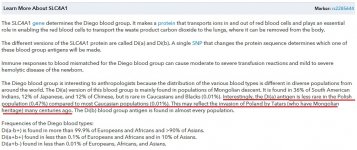
The ABO blood group system isn't the only antigen system found in humans. There are about 30 human blood type systems: Rhesus, Kell, Diego, Duffy, Kidd, and so on. Each have a role in immunity. Some are found only in some specific populations and completely absent elsewhere. This is the case of Diego antigens, found only (at low frequency) among Mongolic people and Amerindians.
Having a lot of antigens isn't always better for your health. Just as A antigens can make your blood clot, being positive for Lewis antigens makes people at extremely high risk for stomach ulcers.
Likewise, the absence of Duffy antigen is protective against malaria. Once again, humans have been shown to be close to other primates, as baboons have evolved the same Duffy antigen immunity as the one found in humans.
Their distribution can tell us what major disease epidemics a given population suffered in its recent history (e.g. in the last thousand years). For example, most native Americans belong to group O. It is believed that this is due to a syphilis epidemics and that the O type were better are fighting off the disease.
There is no ideal blood type though. Each type has its pros and cons.
Group A and B make people more resistant to cholera, while AB confers the most resistance. O offers virtually no immunity against cholera.
B confers weaker protection against plague. This is probably why B is more common in North-East Europe, which was virtually unaffected by the Black Death during the Middle Ages.
A-type carriers are the most likely to survive plague, but suffer from a higher rate of heart disease, because their blood is more likely to clot. They are also at increased risk of contracting smallpox and developing cancer of the esophagus, pancreas, and stomach.
Type O, contrarily to A, is slightly protective against cardiovascular problems. It also boosts resistance against tuberculosis (TB), but increases the risk of venous thromboembolism and developing duodenal and peptic ulcers. It also attracts more mosquitoes (through which malaria is transmitted).
A recent study revealed that people with type O blood are less likely to get pancreatic cancer, but also stomach, breast, ovarian and cervical cancer.
Humans are not the only ones to have an ABO system. Apes have the same antigens on their red blood cells. Gorillas are almost always B, exceptionally O, but never A or AB. Chimpanzees most usually belong to A, occasionally to O, but never to B or AB. Orang-utans seem to lack the O type altogether.
Other antigen systems
The ABO blood group system isn't the only antigen system found in humans. There are about 30 human blood type systems: Rhesus, Kell, Diego, Duffy, Kidd, and so on. Each have a role in immunity. Some are found only in some specific populations and completely absent elsewhere. This is the case of Diego antigens, found only (at low frequency) among Mongolic people and Amerindians.
Having a lot of antigens isn't always better for your health. Just as A antigens can make your blood clot, being positive for Lewis antigens makes people at extremely high risk for stomach ulcers.
Likewise, the absence of Duffy antigen is protective against malaria. Once again, humans have been shown to be close to other primates, as baboons have evolved the same Duffy antigen immunity as the one found in humans.
Last edited: